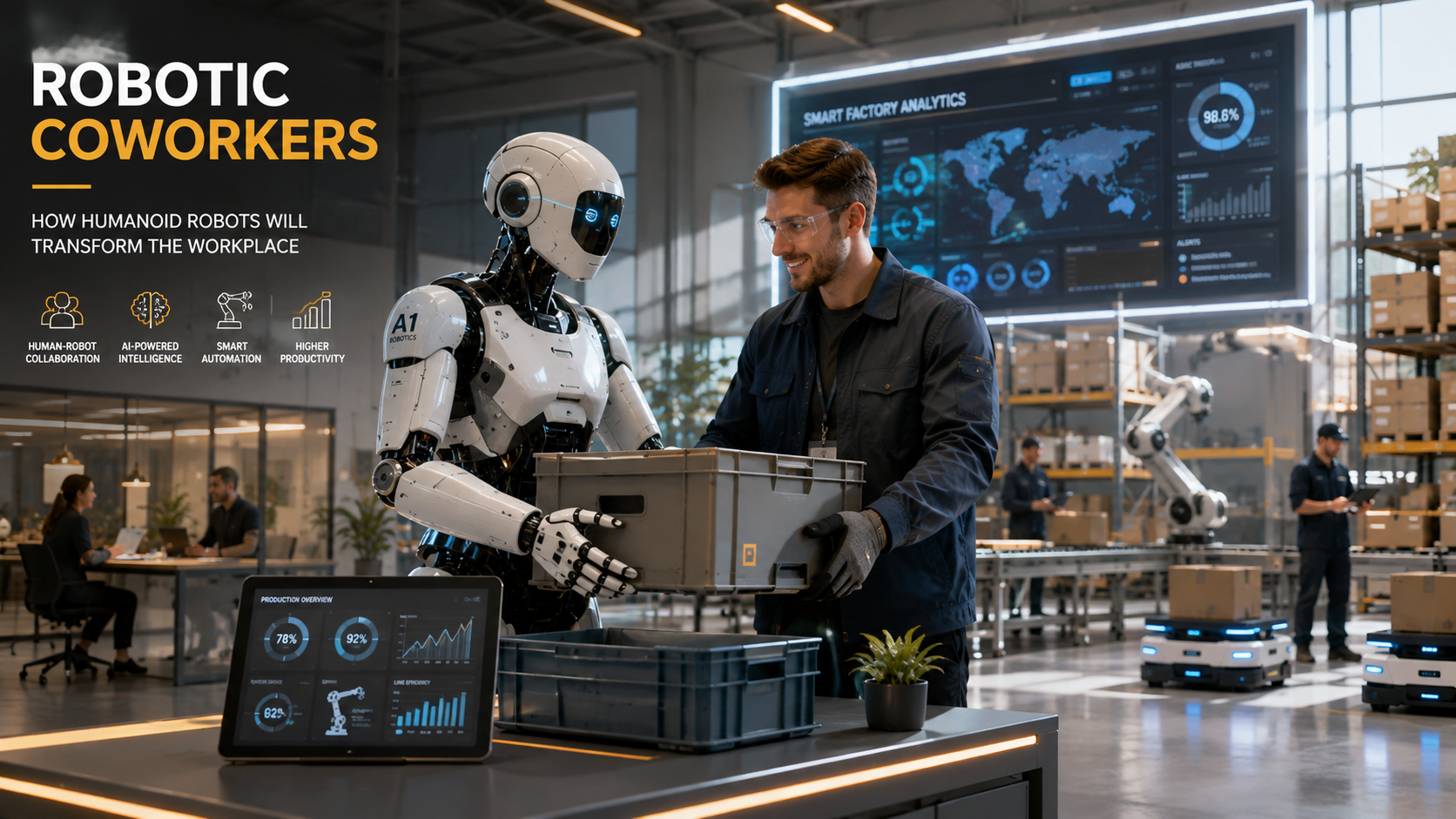
Humanoid robots are no longer just something we see in science-fiction movies. Advances in artificial intelligence, computer vision, sensors, and robotics are making it possible for robots to perform more useful tasks in real-world environments.
This is leading to an interesting idea: robotic coworkers.
Instead of robots working completely separately from people, future workplaces could have humans and robots working side by side. Robots could handle repetitive or physically demanding jobs while people focus on tasks that require creativity, communication, decision-making, and experience.
But how will humanoid robots actually change the workplace? And will they replace human workers? Let’s take a simple look.
What Are Robotic Coworkers?
Robotic coworkers are robots designed to help people with their daily work.
Traditional industrial robots are usually built for a specific task. For example, a robotic arm in a factory may repeatedly pick up a part and place it in exactly the same position.
Humanoid robots are different. They are designed to move and interact more like people. They may have two arms, two legs, cameras, sensors, and AI systems that help them understand their surroundings.
The goal is not simply to create a robot that looks like a human. The bigger goal is to build machines that can work in environments already designed for people.
Why Are Humanoid Robots Getting So Much Attention?
Artificial intelligence is making robots much more capable than before.
Modern AI can help a robot understand what it sees, recognize objects, follow instructions, plan movements, and respond to changes around it.
For example, instead of programming a robot for every single movement, a future worker might simply give it an instruction such as, “Move these boxes to the loading area.”
The robot could then identify the boxes, find a safe route, pick them up, and move them.
This combination of AI and robotics is often connected with terms such as physical AI and embodied AI.
Humanoid Robots in Manufacturing
Manufacturing is one of the areas where robotic coworkers could have a major impact.
Factories often contain repetitive tasks such as moving materials, packaging products, inspecting parts, and loading machines.
Humanoid robots could help with some of these jobs. They could move objects from one location to another, assist workers on production lines, or perform tasks that are tiring or uncomfortable for people.
One major advantage is flexibility. A traditional machine may be designed for one specific process, while a more advanced humanoid robot could potentially be trained to perform several different tasks.
Robots in Warehouses and Logistics
Warehouses are another natural environment for automation.
Workers may spend many hours moving boxes, sorting products, picking items, and preparing orders. These tasks can be repetitive and physically demanding.
AI-powered robots could help with some of this work by moving products, carrying packages, scanning shelves, or delivering items to different areas of a warehouse.
This does not necessarily mean that humans disappear from warehouses. Instead, robots could take care of physically repetitive tasks while workers focus on managing operations, solving problems, and handling situations that require human judgment.
Humanoid Robots in Healthcare
Healthcare could also benefit from robotic assistance, although safety requirements would be much higher.
Humanoid robots could potentially help with tasks such as moving supplies, transporting equipment, delivering items, or supporting hospital logistics.
In elderly-care environments, robots may also assist with simple everyday tasks.
However, robots would not replace doctors, nurses, or other healthcare professionals. Healthcare involves communication, empathy, complex decisions, and human care—areas where people remain extremely important.
Robots in Retail and Hospitality
Robotic coworkers could also become useful in shops, hotels, and restaurants.
In a store, a robot could help check inventory or move products. In a hotel, it could deliver items or help move luggage. In a restaurant, robots could assist with moving ingredients, dishes, or supplies.
The interesting part is that humanoid robots could potentially work in spaces that were already designed for humans.
A store does not necessarily need to be completely redesigned for a humanoid robot to move around shelves, doors, counters, and storage areas.
How AI Helps Robots Understand the Workplace
The biggest change in modern robotics is not just the robot’s physical design. It is the intelligence behind it.
Older robots generally followed fixed instructions. If something unexpected happened, they often needed human assistance.
AI-powered robots are moving toward a more flexible approach.
They can use cameras and sensors to understand their surroundings, AI models to interpret information, and motion systems to decide how to complete a task.
Think of it like this:
See → Understand → Decide → Act
A robot could see a box, understand what it is, decide how to pick it up, and then move it to the correct location.
This is one reason AI is becoming such an important part of robotics.
Will Humanoid Robots Replace Human Workers?
This is probably the biggest question surrounding workplace robotics.
The simple answer is: not all human jobs will be replaced by robots.
Robots are especially useful for repetitive, physically demanding, dangerous, or highly predictable work.
People are still much better suited to many tasks involving creativity, leadership, communication, empathy, problem-solving, and complex judgment.
Because of this, the future may be less about humans versus robots and more about humans working with robots.
A factory worker, for example, could use a robot to handle heavy materials while focusing on quality control and production decisions.
The Benefits of Robotic Coworkers
Robotic coworkers could provide several benefits to businesses and employees.
They can perform repetitive tasks without getting tired. They can also work in environments that may be uncomfortable or dangerous for people.
Businesses could use robots to improve productivity, reduce workplace injuries, and support workers with physically demanding jobs.
Another benefit is flexibility. If humanoid robots become capable of learning different tasks, companies may be able to use the same robot for multiple jobs instead of purchasing a separate machine for every process.
The Challenges of Humanoid Robots
Humanoid robots still have a long way to go.
The technology is expensive and complicated. Building a robot that can safely walk, balance, see objects, understand instructions, and manipulate different items is extremely difficult.
Safety is another major concern. A large machine working around people must be highly reliable.
Battery life, maintenance, software updates, AI limitations, and the cost of deployment are also important challenges.
Most importantly, businesses need to see a real financial benefit. It is not enough for a robot to perform a task. It needs to perform that task safely, reliably, and at a reasonable cost.
The Future of Human and Robot Collaboration
The future workplace may not look like a place where robots simply replace people.
Instead, we may see a combination of people, AI systems, and robotic coworkers.
Humans could make important decisions, communicate with customers, manage teams, and solve complex problems.
AI could analyze information and help optimize operations.
Robots could handle physical tasks such as carrying, moving, sorting, inspecting, and assembling products.
This combination could create a workplace where technology takes care of some of the difficult physical work while people focus on the parts of work where human skills matter most.
What Could the Workplace Look Like in the Future?
Imagine walking into a factory where humans and humanoid robots work on the same production floor.
A worker asks a robot to bring materials. The robot identifies the correct items and delivers them. Another robot moves finished products to the warehouse. AI software monitors the entire process and alerts workers when something needs attention.
The people are still in control, but robots handle many of the physical tasks.
This is the idea behind the robotic coworker: a machine that works with people rather than simply working instead of people.
Final Thoughts
Humanoid robots could become an important part of workplace automation as AI and robotics continue to improve.
They may help factories, warehouses, hospitals, stores, hotels, and other businesses handle repetitive and physically demanding work.
However, the transition will not happen overnight. Cost, safety, reliability, battery life, AI capabilities, and real-world performance will determine how quickly businesses adopt humanoid robots.
The most realistic future is likely to be a human-and-robot workplace, where each side does what it does best.
Humans bring creativity, judgment, communication, and empathy. Robots bring speed, consistency, physical strength, and the ability to perform repetitive tasks.
If humanoid robotics continues to improve, the question may eventually change from “Will robots take our jobs?” to “How can humans and robots work better together?”
