For years, smartphones have been at the center of our digital lives. We use them to send messages, search the internet, take photos, navigate, work, shop, watch videos, and interact with AI.
But technology is starting to move in a different direction.
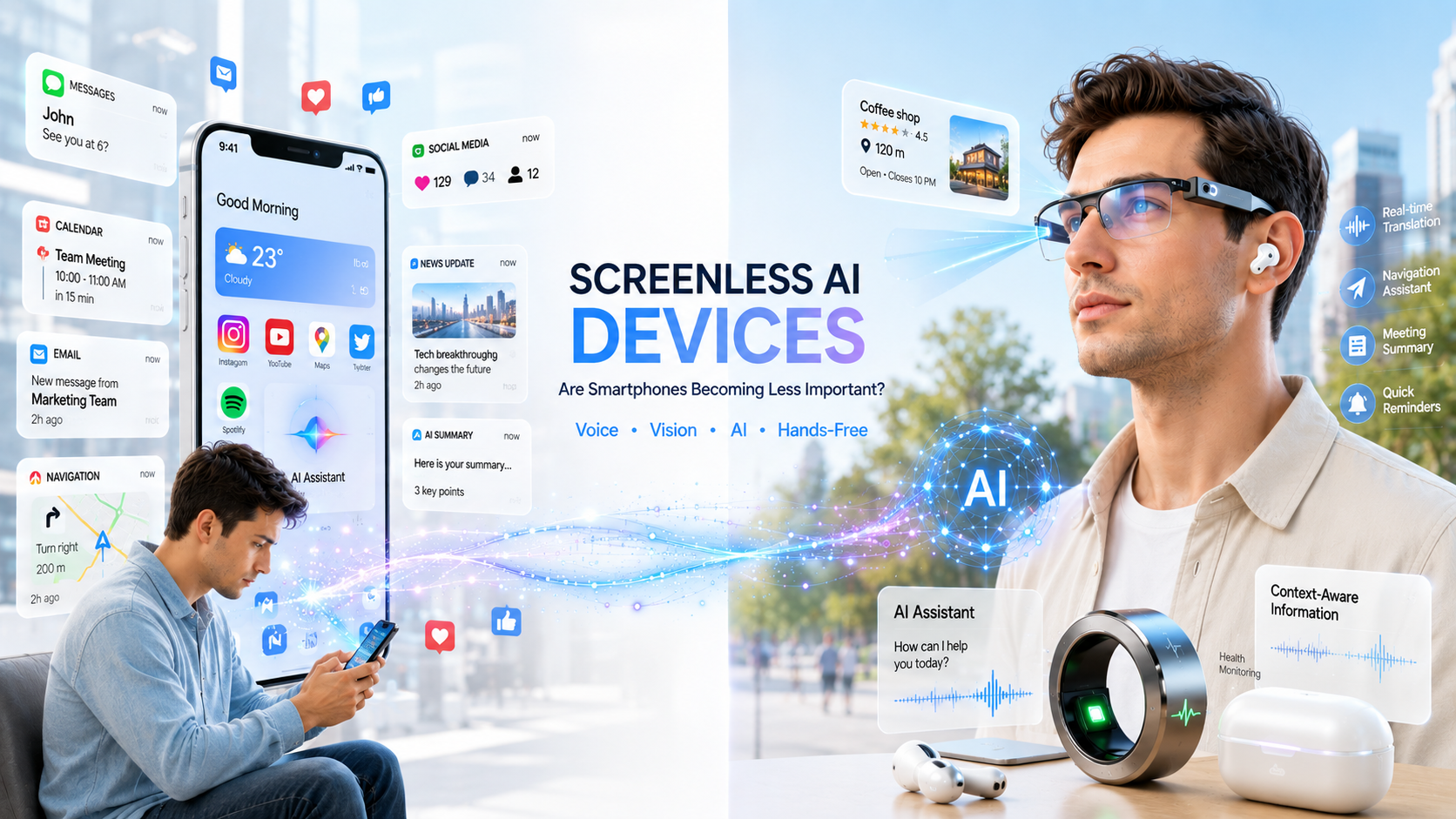
A new generation of screenless AI devices is making it possible to interact with technology without constantly looking at a smartphone. AI glasses, smart rings, AI earbuds, and other wearable devices are creating new ways to communicate with computers using voice, cameras, sensors, and artificial intelligence.
This raises an interesting question: Are smartphones becoming less important?
The answer is not as simple as smartphones disappearing. Instead, AI may change the way we use them.
What Are Screenless AI Devices?
Screenless AI devices are gadgets that can provide useful digital features without depending on a traditional screen.
Instead of opening an app and tapping buttons, users can interact with the device using their voice, gestures, cameras, sensors, or other natural methods.
For example, imagine seeing a restaurant menu written in another language. Instead of taking out your phone, opening a translation app, taking a picture, and reading the result, an AI wearable could recognize the text and tell you the translation through audio.
The basic idea is simple:
Less screen interaction, more natural interaction.
Why Is Screenless Technology Becoming Popular?
The biggest reason is the rapid improvement of artificial intelligence.
Older digital devices usually required users to tell the device exactly what to do. You had to open an application, find the right option, and enter information.
AI is changing that experience.
Modern AI can understand natural language, recognize images, process audio, summarize information, and understand different types of context.
Instead of navigating through several menus, you can simply ask:
“What am I looking at?”
or
“Translate this for me.”
The AI can then understand the request and provide an answer.
This makes voice, vision, and other screen-free interactions much more useful.
AI Smart Glasses Are Leading the Change
Smart glasses are one of the most interesting examples of screenless AI technology.
Modern AI glasses can combine cameras, microphones, speakers, wireless connectivity, and AI assistants into a small wearable device.
The glasses can potentially understand what the wearer is seeing and provide information without requiring the user to constantly check a phone.
Imagine walking through a new city and asking:
“Where is the nearest train station?”
Instead of looking down at a map, an AI assistant could provide directions through audio.
Other possible uses include:
- Translation
- Navigation
- Object recognition
- Hands-free communication
- Accessibility
- Information lookup
- Real-time assistance
The important change is that the world around you can become part of the user interface.
AI Earbuds Are Becoming More Than Headphones
Wireless earbuds were originally designed mainly for music and phone calls.
AI could give them a much bigger role.
Future AI earbuds could potentially act as personal assistants that understand conversations, translate languages, recognize sounds, provide reminders, and answer questions.
Some emerging research is also exploring earbuds with cameras and AI vision capabilities.
This could allow earbuds to understand both what you hear and what you see.
Imagine walking through a museum and asking your earbuds:
“Tell me about this painting.”
The device could potentially use its camera and AI system to identify the artwork and provide information through audio.
In this way, earbuds could become another interface for AI rather than simply an audio accessory.
Smart Rings Show Another Side of Screenless Technology
Smart rings take a different approach.
They are not designed to replace smartphones or provide a large collection of apps. Instead, they quietly collect information using built-in sensors.
Depending on the device, smart rings can track things such as:
- Sleep
- Activity
- Movement
- Temperature trends
- Heart-related measurements
The information can then be analyzed and displayed through another device.
This means a smart ring does not necessarily need a screen to be useful.
It can work quietly in the background while your smartphone or another device shows the important information when needed.
Screenless Does Not Mean Smartphone-Free
This is one of the most important things to understand.
Screenless AI devices are not necessarily designed to completely replace smartphones.
Smartphones still have many advantages.
They provide large displays, powerful applications, cameras, keyboards, gaming, detailed maps, file management, video editing, and many other features.
Instead of replacing smartphones completely, screenless devices may change their role.
Today, the smartphone is often the main device we use for almost everything.
In the future, it could become part of a larger ecosystem:
Smart Glasses + AI Earbuds + Smart Ring + Smartphone + Cloud AI
Each device could handle a different type of task.
AI Is Changing How We Interact With Technology
The biggest change may not actually be the gadgets themselves.
It may be the way we interact with them.
For many years, people have learned how to use computers through buttons, menus, apps, keyboards, and touchscreens.
AI allows technology to understand more natural communication.
You can simply speak to an AI assistant instead of searching through an application.
For example:
Traditional interaction:
Open app → Find feature → Enter information → Get result
AI interaction:
Ask → AI understands → AI responds or performs the task
This could make everyday technology feel more natural and less complicated.
Wearable AI Could Become More Context-Aware
The next generation of wearable AI may not simply wait for commands.
It could understand more about the user’s situation.
For example, imagine wearing AI glasses while traveling.
The device could understand that you are at an airport, recognize signs around you, and provide useful information when needed.
The experience could become:
See → Understand → Decide → Assist
This is where AI agents could become especially interesting for wearable technology.
Instead of being just a chatbot, AI could become an assistant that understands the user’s environment and helps with real-world tasks.
Why Screenless AI Devices Could Be Useful
Screenless devices can offer several practical benefits.
Hands-Free Interaction
You do not need to take your phone out of your pocket every time you need information.
This can be useful while walking, cooking, exercising, working, or traveling.
Less Dependence on Screens
People spend a significant amount of time looking at screens.
Screenless devices could provide information through audio or other interactions without requiring users to constantly look at a display.
Faster Access to Information
Asking an AI assistant can sometimes be faster than opening an app, searching for information, and reading through results.
More Natural Interaction
Talking to a device can feel more natural than navigating through multiple menus.
Better Accessibility
Voice and audio-based interfaces can also make technology easier to use for people who have difficulty interacting with traditional screens.
Privacy Could Become a Major Challenge
Screenless AI devices also create important privacy questions.
Consider AI glasses that contain cameras and microphones.
The device may be able to see and hear the environment around the user.
This creates questions such as:
What is being recorded?
Where is the information processed?
Is the data stored?
Is it sent to the cloud?
Can people nearby be recorded without knowing?
These concerns could become more important as AI devices become smarter.
For screenless AI to become widely accepted, companies will need to make privacy controls clear and easy to understand.
Battery Life Is Still a Problem
AI features can require a lot of processing power.
Small wearable devices have much smaller batteries than smartphones.
This creates a difficult challenge:
More AI features → More processing → More power consumption
Manufacturers therefore need better chips, more efficient AI models, improved batteries, and smarter power management.
Future devices may solve some of this problem by combining local processing with cloud AI.
Edge AI Could Make Wearables Smarter
Edge AI means processing some AI tasks directly on the device instead of sending everything to a remote server.
For example:
Camera → On-device AI → Result
Instead of:
Camera → Internet → Cloud AI → Internet → Device
Processing information locally can potentially reduce delays and improve privacy.
It can also reduce the amount of information that needs to travel over the internet.
This could become especially important for AI glasses, earbuds, and other small wearable devices.
Could Screenless AI Devices Replace Smartphones?
Probably not completely, at least not in the near future.
Smartphones are still extremely useful for complex tasks.
You may not need a phone to ask a quick question or get directions, but you will probably still want a larger screen for activities such as editing documents, watching movies, managing files, playing games, or working on complex projects.
The more likely future is that smartphones become less necessary for small everyday tasks.
For example:
Today:
Take out phone → Unlock → Open app → Search → Read
Future:
Ask wearable → AI understands → Receive answer
The phone is still there, but you do not need to use it for everything.
The Smartphone Could Become a Hub
Instead of being the only important computing device, the smartphone could become a central hub connecting several AI-powered devices.
For example:
Smart Ring collects health information.
AI Glasses understand the user’s surroundings.
AI Earbuds provide audio responses.
Smartphone handles complex tasks and provides a larger screen.
Cloud AI provides additional processing power.
Together, these devices could create a connected personal computing system.
What Could the Future Look Like?
Imagine starting your day with an AI-powered wearable ecosystem.
Your smart ring has already collected information about your sleep and activity.
Your AI glasses can provide your schedule through audio.
Your earbuds can summarize important messages.
When you leave home, your glasses can help with navigation.
While shopping, you can ask your AI assistant questions without taking out your phone.
When you need to perform a complicated task, you use your smartphone as a larger interface.
This is not necessarily a smartphone-free future.
It is a future where the smartphone is only one part of your personal technology ecosystem.
Are Smartphones Becoming Less Important?
In some ways, yes.
But it is more accurate to say that smartphones may become less central rather than completely irrelevant.
The future of computing could be more distributed.
Instead of depending on one device for everything, people could use several devices that work together.
The smartphone might handle complex tasks, while wearables handle quick, contextual, and hands-free interactions.
AI could become the software layer connecting all of these devices.
The Future of Screenless Computing
Screenless AI technology is still developing.
There are still major challenges around privacy, battery life, AI accuracy, connectivity, cost, reliability, and social acceptance.
But the direction is interesting.
Technology is gradually moving from devices that require people to constantly look at a screen toward devices that can understand voice, vision, context, and the environment around us.
The smartphone probably will not disappear overnight.
Instead, we may slowly use it less for simple tasks while relying more on AI-powered wearables.
The bigger question is not:
“What will replace the smartphone?”
It may be:
“What happens when we no longer need a screen for every digital interaction?”
That is the real promise of screenless AI devices.
