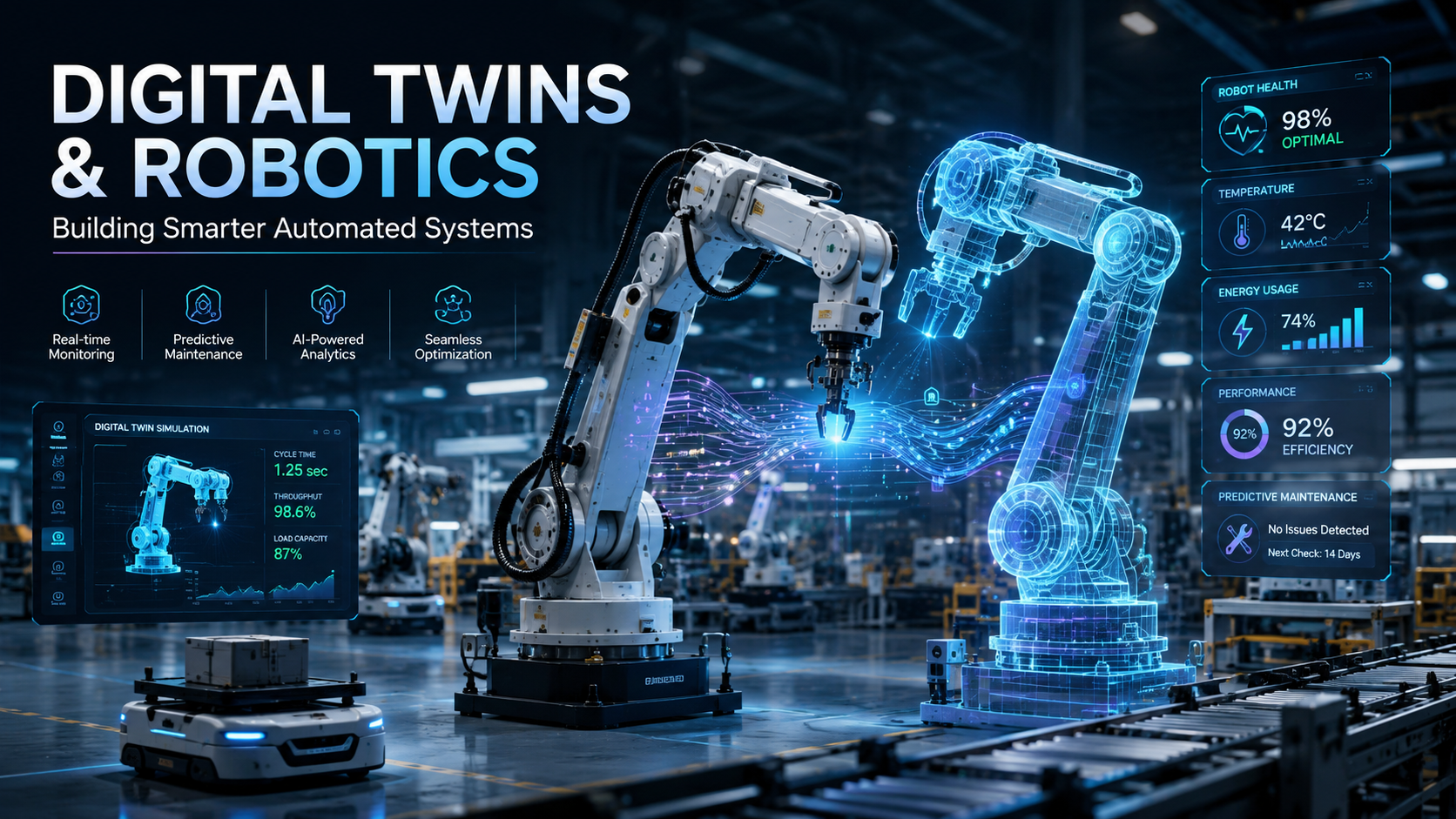
Digital twins and robotics are transforming the way modern industries design, operate, and maintain automated systems. As factories, warehouses, healthcare facilities, and other industries adopt smarter automation, digital twin technology is becoming an important tool for improving robot performance, reducing downtime, and making better decisions.
A digital twin is a virtual representation of a physical object, machine, robot, production line, or even an entire factory. It receives data from the real-world system through sensors, IoT devices, and connected software. This allows businesses to monitor equipment, test different scenarios, predict problems, and optimize performance in a virtual environment.
How Digital Twins Work With Robotics
In robotics, a digital twin creates a virtual model of a real robot and its working environment. Data such as movement, speed, temperature, energy consumption, vibration, workload, and component condition can be collected from the physical robot and reflected in its digital model.
Engineers can use this virtual environment to understand how a robot is performing without interrupting real operations. They can also simulate new movements, workflows, and configurations before applying them to the physical system.
For example, before changing the movement path of an industrial robotic arm, engineers can test the new path using its digital twin. This helps identify possible collisions, unnecessary movements, safety risks, and performance problems before the changes are deployed.
Smarter Robot Simulation and Testing
Traditional robot testing often requires physical equipment, production space, and significant time. Digital twins allow many testing activities to happen virtually.
Developers can simulate different workloads, environmental conditions, robot speeds, and production scenarios. They can study how a robot responds to changes and improve its behavior before making changes to the real machine.
This approach can reduce development time and help businesses introduce new automation systems with fewer disruptions.
Predictive Maintenance for Robotic Systems
Unexpected robot failure can stop production and create expensive delays. Digital twins can support predictive maintenance by continuously analyzing operational data from robotic equipment.
Instead of waiting for a component to fail, the system can identify unusual patterns such as increasing vibration, higher temperatures, declining accuracy, or abnormal energy consumption. Maintenance teams can inspect or replace components before a serious failure occurs.
This changes maintenance from a reactive process into a more proactive and data-driven strategy.
Improving Robot Performance
Digital twins provide detailed information about how robots operate over time. Businesses can use this information to identify slow processes, unnecessary movements, energy waste, and workflow bottlenecks.
Engineers can experiment with different configurations inside the virtual model and compare the results. Once an improved configuration is validated, it can be applied to the physical robotic system.
This continuous connection between virtual simulation and real-world operation helps automated systems become more efficient and adaptable.
Digital Twins in Smart Manufacturing
Smart factories are one of the biggest areas where digital twins and robotics work together. A manufacturer can create digital models of individual robots, production machines, assembly lines, and complete factory operations.
These connected models provide a broader view of the production process. Factory teams can analyze how a change in one robotic station may affect other machines, production speed, product quality, or energy usage.
Digital twins can also support production planning by allowing manufacturers to test new product designs or manufacturing workflows virtually before changing the physical production line.
Digital Twins and Autonomous Robots
Autonomous robots must understand changing environments and make decisions using real-time information. Digital twins can provide realistic virtual environments where these robots can be tested and improved.
Warehouse robots, delivery robots, drones, and other autonomous systems can be trained in simulated environments that represent real operational conditions. Developers can test unusual or dangerous situations without risking physical equipment or people.
The knowledge gained from these simulations can help improve navigation, obstacle avoidance, route planning, and decision-making.
The Role of AI and IoT
Artificial intelligence and the Internet of Things are important parts of modern digital twin systems.
IoT sensors collect information from physical robots and machines, while AI systems analyze the data to identify patterns, detect anomalies, and recommend improvements. The digital twin provides the virtual environment where this information can be visualized, simulated, and tested.
Together, AI, IoT, robotics, and digital twins create connected automation systems that can continuously learn from operational data and improve over time.
Benefits of Digital Twins in Robotics
The combination of digital twins and robotics offers several important advantages:
- Reduced equipment downtime through predictive maintenance
- Faster robot development and testing
- Improved operational efficiency
- Safer testing of complex or dangerous scenarios
- Better production planning and workflow optimization
- Reduced maintenance and operational costs
- Real-time visibility into robot performance
- Easier testing of system upgrades and configuration changes
- Better decision-making using real operational data
Challenges of Digital Twin Technology
Despite its benefits, implementing digital twins can be complex. Businesses need reliable sensors, connected infrastructure, accurate simulation models, secure data management, and skilled technical teams.
The virtual model must also remain synchronized with the physical system. If sensor data is incomplete or the digital model does not accurately represent the real robot, simulation results may become less useful.
Cybersecurity is another important consideration because connected robots and digital twin platforms exchange large amounts of operational data.
The Future of Digital Twins and Robotics
The future of automation is moving toward systems that are more connected, intelligent, and adaptable. Digital twins will play an important role in this development by connecting virtual simulation with real-world robotic operations.
As artificial intelligence, sensor technology, edge computing, and simulation platforms continue to improve, digital twins are likely to become more accurate and capable. Future robotic systems may use digital twins continuously to test decisions, predict problems, optimize movements, and adapt to changing environments.
Conclusion
Digital twins and robotics are creating new possibilities for smarter automated systems. By connecting physical robots with accurate virtual models, businesses can monitor performance, test improvements, predict maintenance needs, and optimize operations without unnecessary disruption.
From smart factories and warehouses to autonomous robots and complex industrial systems, digital twin technology can make automation more efficient, reliable, and flexible. As industries continue adopting intelligent automation, the combination of digital twins, AI, IoT, and robotics will become an increasingly important part of modern digital transformation.
