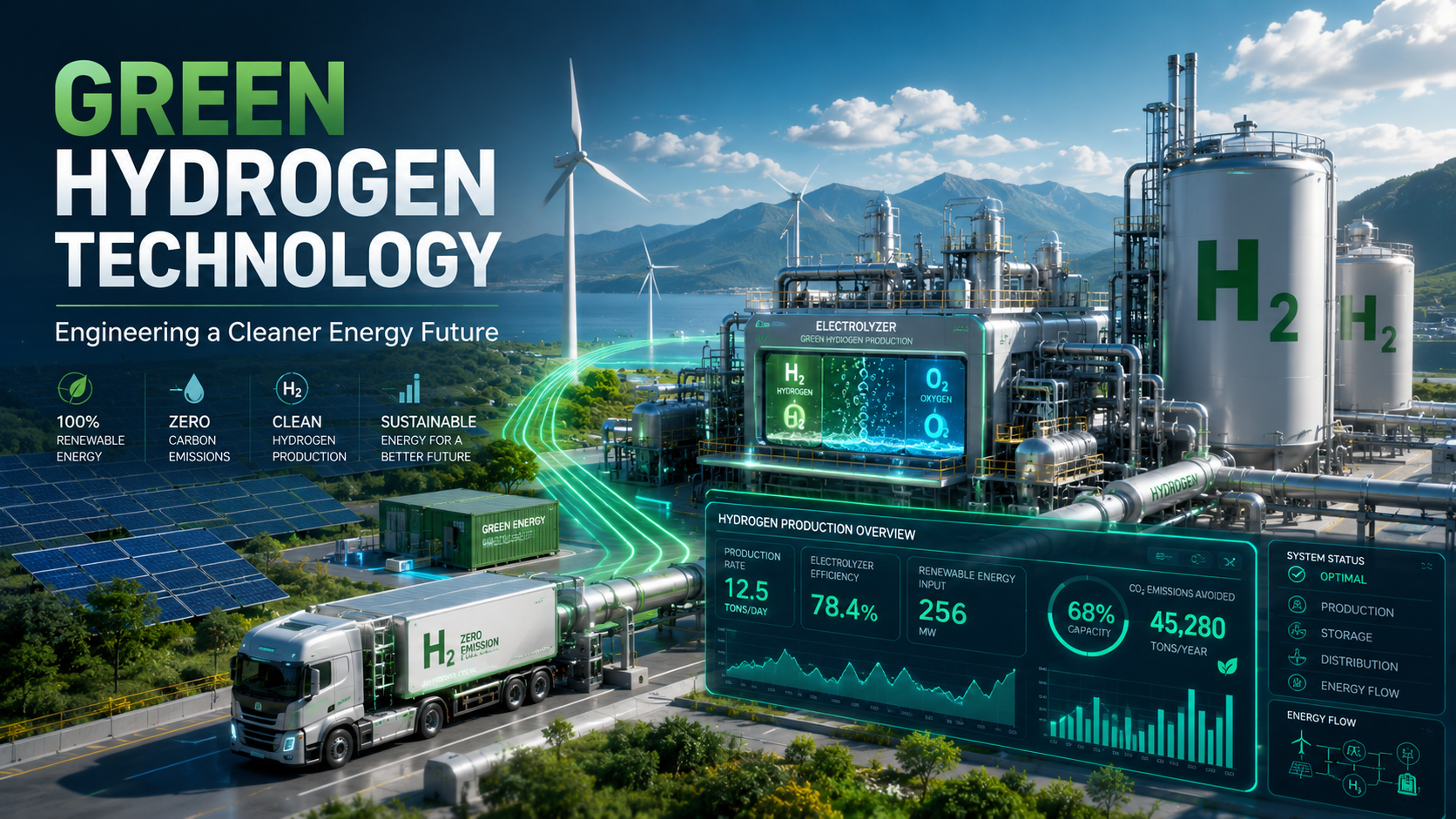
The world is searching for cleaner and more sustainable ways to produce energy. While renewable sources such as solar and wind power are growing rapidly, many industries still depend heavily on fossil fuels. Green hydrogen technology is emerging as a promising solution for reducing carbon emissions in sectors that are difficult to electrify directly.
Green hydrogen is produced using renewable electricity and water. Unlike conventional hydrogen production methods that rely on fossil fuels, green hydrogen can be produced with very low operational carbon emissions when powered by renewable energy. It can be used as an industrial raw material, an energy carrier, a fuel, and a method of storing renewable electricity.
From steel manufacturing and chemical production to heavy transportation, shipping, aviation fuels, and long-duration energy storage, green hydrogen could play an important role in building a cleaner energy future.
What Is Green Hydrogen?
Hydrogen is the most abundant element in the universe, but on Earth it is usually found combined with other elements in substances such as water and hydrocarbons. Energy is required to separate hydrogen and produce it as a usable fuel or industrial feedstock.
Green hydrogen is commonly produced through a process called water electrolysis. An electrolyzer uses electricity to split water into hydrogen and oxygen. When the electricity comes from renewable sources such as solar, wind, or hydropower, the resulting hydrogen is generally referred to as green or renewable hydrogen.
The hydrogen can then be stored, transported, converted into derivatives such as ammonia or methanol, or used directly in industrial and energy applications.
How Does Green Hydrogen Technology Work?
A green hydrogen system begins with renewable electricity generation. Solar panels, wind turbines, or other renewable energy sources supply electricity to an electrolyzer.
The electrolyzer splits water into hydrogen and oxygen. The hydrogen is then purified and, depending on its final application, compressed, liquefied, stored, transported, or converted into another hydrogen-based product.
A typical green hydrogen value chain includes renewable energy generation, water treatment, electrolysis, hydrogen purification, compression, storage, transportation, and end use.
Engineering is essential across this entire process. Engineers work to improve electrolyzer efficiency, reduce energy losses, develop better storage systems, design safer infrastructure, and lower the overall cost of hydrogen production and delivery.
Why Is Green Hydrogen Important?
Many parts of the economy can reduce emissions through direct electrification. Electric cars, heat pumps, and renewable electricity are already helping reduce dependence on fossil fuels.
However, some industries require extremely high temperatures, chemical feedstocks, long operating ranges, or large amounts of stored energy. Direct electrification can be difficult or expensive in these applications.
Green hydrogen may help reduce emissions in areas such as steel production, fertilizer manufacturing, refining, heavy transportation, shipping, synthetic aviation fuels, and long-duration energy storage.
Its greatest value may be in applications where direct use of renewable electricity is technically difficult or impractical.
Green Hydrogen in Industrial Manufacturing
Heavy industries are responsible for a significant share of global energy consumption and emissions. Many industrial processes still depend on coal, oil, and natural gas for heat or as chemical inputs.
Green hydrogen can provide an alternative in selected industrial applications.
In steel manufacturing, hydrogen can be used as a reducing agent in processes designed to reduce dependence on coal. In chemical industries, renewable hydrogen can support the production of lower-emission ammonia, methanol, fertilizers, and other chemical products.
Industrial hydrogen hubs could also allow multiple factories to share production, storage, and transportation infrastructure, helping improve utilization and reduce costs.
Green Hydrogen for Energy Storage
Solar and wind energy are variable because electricity generation depends on weather conditions. Energy storage is therefore an important part of a renewable electricity system.
Green hydrogen can provide one option for storing large amounts of renewable energy over longer periods.
When renewable electricity production is higher than immediate demand, some of that electricity can be used to produce hydrogen. The hydrogen can be stored and later used in fuel cells, industrial processes, gas turbines designed for hydrogen blends or hydrogen use, or converted into other fuels.
However, converting electricity into hydrogen and then back into electricity involves significant energy losses. For this reason, hydrogen storage is generally more attractive for long-duration, seasonal, or specialized applications than for short-term electricity storage.
Green Hydrogen in Transportation
Battery-electric vehicles are becoming increasingly common for passenger cars and many short-distance transport applications. Hydrogen may be more useful in specific transportation areas where high payloads, long operating ranges, rapid refueling, or continuous operation are important.
Potential applications include heavy-duty trucks, buses, trains on selected non-electrified routes, maritime transport, and hydrogen-derived aviation fuels.
Fuel-cell vehicles convert hydrogen into electricity to power an electric motor. Their main operational output is water, although the total environmental benefit depends on how the hydrogen is produced and transported.
For shipping and aviation, hydrogen may also be converted into fuels such as green ammonia, green methanol, or synthetic hydrocarbons.
Engineering Challenges of Green Hydrogen
Although green hydrogen has significant potential, several technical and economic challenges must be addressed.
One major challenge is cost. Producing renewable hydrogen requires large amounts of low-cost clean electricity, electrolyzers, water treatment systems, compression equipment, storage facilities, and transportation infrastructure.
Storage is another engineering challenge. Hydrogen has a low volumetric energy density under normal conditions, so practical storage may require high-pressure tanks, cryogenic liquefaction, underground storage, or conversion into hydrogen carriers.
Hydrogen molecules are also very small and can leak through some materials. Hydrogen can cause embrittlement in certain metals, which makes material selection, pipeline design, valve engineering, sensors, and safety systems extremely important.
The Role of Electrolyzer Technology
The electrolyzer is one of the most important technologies in the green hydrogen production process.
Several types of electrolyzers are being developed and deployed, including alkaline electrolyzers, proton exchange membrane or PEM electrolyzers, solid oxide electrolyzers, and emerging anion exchange membrane technologies.
Each technology has different characteristics related to cost, efficiency, operating temperature, response time, materials, and compatibility with variable renewable electricity.
Engineering improvements in catalysts, membranes, manufacturing methods, system design, and power electronics could help make electrolyzers more efficient, durable, scalable, and affordable.
Green Hydrogen and Renewable Energy
Green hydrogen and renewable energy can complement each other.
Large hydrogen production facilities can be connected to solar and wind farms. Electrolyzers may adjust their operation based on electricity availability, system design, market conditions, and hydrogen demand.
This creates opportunities to connect renewable electricity generation with industrial energy demand.
For example, regions with strong solar or wind resources may produce renewable hydrogen or hydrogen-derived products for domestic industrial use or export. This could create new energy supply chains and industrial opportunities.
Benefits of Green Hydrogen Technology
Green hydrogen offers several potential advantages when used in suitable applications:
- Supports decarbonization of hard-to-electrify industries
- Provides a clean feedstock option for selected industrial processes
- Can support long-duration and seasonal energy storage
- Connects renewable electricity with industrial energy demand
- Can be converted into ammonia, methanol, and synthetic fuels
- Supports development of new clean-energy industries
- May reduce dependence on fossil-based hydrogen production
- Can help balance renewable energy systems in certain applications
- Supports innovation in electrolysis, storage, materials, and infrastructure engineering
Challenges and Limitations
Green hydrogen is not a universal replacement for all fossil fuels.
Its production requires substantial electricity, and energy is lost during electrolysis, compression, transportation, conversion, and final use. In applications where electricity can be used directly, direct electrification is often more energy-efficient.
Large-scale projects also require investment in renewable power generation, water systems, hydrogen storage, pipelines, ports, refueling infrastructure, and industrial equipment.
Water availability must also be carefully considered, particularly in water-stressed regions. Desalination can provide a water source for coastal projects, but it adds infrastructure, energy requirements, and environmental considerations.
The successful growth of green hydrogen will therefore depend on careful engineering, appropriate use cases, infrastructure planning, renewable energy availability, and supportive economic conditions.
The Role of Engineers in the Green Hydrogen Economy
Engineers will play a central role in the development of green hydrogen technology.
Chemical engineers can improve electrolysis and hydrogen conversion processes. Mechanical engineers can design compressors, storage tanks, turbines, and industrial equipment. Electrical engineers can integrate electrolyzers with renewable power systems and smart grids.
Materials engineers can develop catalysts, membranes, coatings, and hydrogen-resistant materials. Civil engineers can help build hydrogen production facilities, pipelines, storage infrastructure, and transportation networks.
Software engineers and AI specialists can also contribute by creating digital twins, predictive maintenance systems, energy optimization platforms, and intelligent control systems for hydrogen facilities.
Green hydrogen is therefore not only an energy technology. It is a multidisciplinary engineering challenge involving energy, materials, chemistry, infrastructure, automation, software, and industrial design.
Future of Green Hydrogen Technology
The future of green hydrogen will depend on reducing production costs, expanding renewable electricity capacity, improving electrolyzer technology, and developing reliable storage and transportation infrastructure.
As engineering technology advances, hydrogen production systems are expected to become more efficient, modular, and scalable. Large industrial projects may increasingly connect renewable energy generation directly with hydrogen production and industrial consumption.
Digital technologies will also play a larger role. AI-powered energy management, digital twins, advanced sensors, predictive maintenance, and automated control systems can help optimize hydrogen plants and improve reliability.
Green hydrogen is likely to develop alongside batteries, direct electrification, bioenergy, carbon management, and other clean technologies rather than replacing all of them.
Conclusion
Green hydrogen technology has the potential to become an important part of the global transition toward cleaner energy systems. By using renewable electricity to produce hydrogen, industries can explore new ways to reduce their dependence on fossil fuels and lower emissions in applications that are difficult to electrify directly.
Its future success depends on engineering innovation. Better electrolyzers, safer storage systems, efficient transportation methods, renewable energy integration, advanced materials, and intelligent control technologies will all be essential.
Green hydrogen will not solve every energy challenge, but in the right applications, it can help connect renewable electricity with industry, transportation, energy storage, and fuel production. As investment and engineering innovation continue, green hydrogen could become an important building block in a cleaner and more sustainable energy future.
