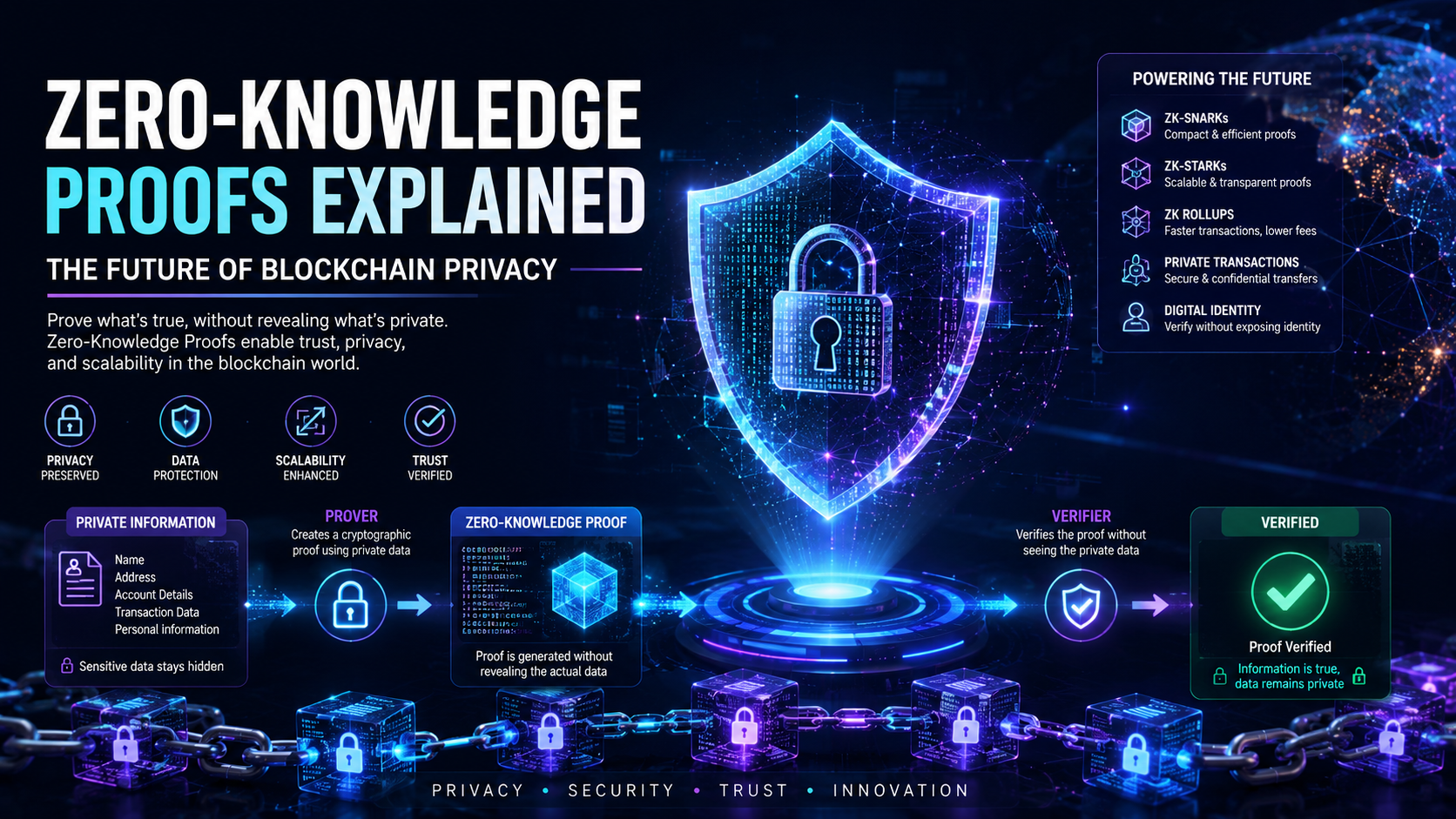
Blockchain technology has changed the way people think about digital trust. It allows transactions and data to be verified without depending completely on one central organization. However, public blockchain networks also create a privacy challenge because transaction information can often be viewed by anyone.
This is where Zero-Knowledge Proofs, also known as ZKPs, can help.
Zero-Knowledge Proofs make it possible to prove that something is true without revealing the private information behind it. This technology is becoming increasingly important for blockchain privacy, secure transactions, digital identity, and blockchain scalability.
What Are Zero-Knowledge Proofs?
A Zero-Knowledge Proof is a cryptographic method that allows someone to prove a fact without sharing the secret information used to prove it.
A simple example is age verification. Imagine a website needs to confirm that you are over 18. Normally, you might need to upload an identity document that contains your full name, date of birth, address, photograph, and other personal details.
With Zero-Knowledge Proof technology, you could prove that you are over 18 without sharing your exact date of birth or other personal information.
The website gets the answer it needs, while your private information stays protected.
A Simple Example of Zero-Knowledge Proof
Imagine that you know the password to enter a private room. Someone wants proof that you know the password, but you do not want to tell them what it is.
Instead of sharing the password, you enter the room and complete an action that only someone with the correct password could perform.
The other person can now confirm that you know the password without ever learning the password itself.
Zero-Knowledge Proofs use advanced mathematics and cryptography instead of rooms and passwords, but the main idea is similar: prove that you know something without revealing the secret.
How Do Zero-Knowledge Proofs Work?
A Zero-Knowledge Proof usually involves two sides: a prover and a verifier.
The prover is the person or system that wants to prove something. The verifier is the person or system that checks whether the proof is valid.
The prover creates a special mathematical proof based on private information. The verifier checks this proof and confirms whether the claim is true.
The verifier learns only the required result. The original secret information does not need to be shared.
This makes it possible to verify information while keeping sensitive data private.
Why Does Blockchain Need Privacy?
Blockchain networks are known for transparency. On many public blockchains, transactions are recorded on a public ledger that anyone can inspect.
Transparency is useful because it allows people to verify transactions and network activity. However, complete transparency is not suitable for every real-world situation.
Imagine a company using blockchain for payments. The company may not want competitors to see its payment amounts, business relationships, or financial activity.
The same issue applies to individuals. Most people do not want their complete financial history publicly visible.
Zero-Knowledge Proofs can help blockchain systems keep the benefits of verification while protecting sensitive information.
How Zero-Knowledge Proofs Improve Blockchain Privacy
Zero-Knowledge Proofs allow blockchain systems to verify that a transaction follows the required rules without revealing every detail of the transaction.
For example, a system could prove that a user has enough funds to complete a transaction without publicly showing the user’s full balance.
A blockchain application could also verify that a user meets certain requirements without storing all of the user’s personal information on a public network.
This creates a useful balance between transparency and privacy.
What Are ZK-SNARKs?
ZK-SNARKs are one popular type of Zero-Knowledge Proof.
The full name is Zero-Knowledge Succinct Non-Interactive Argument of Knowledge. The name sounds complicated, but the basic idea is simple.
ZK-SNARKs create relatively small cryptographic proofs that can be checked quickly. The prover creates the proof, and the verifier can check it without requiring a long back-and-forth conversation.
This makes ZK-SNARKs useful for blockchain systems where storage space and verification speed are important.
Some ZK-SNARK systems use a trusted setup process. This setup must be performed carefully because weaknesses in the setup could create security risks.
What Are ZK-STARKs?
ZK-STARKs are another type of Zero-Knowledge Proof technology.
The full name is Zero-Knowledge Scalable Transparent Argument of Knowledge.
One important difference is that ZK-STARK systems do not require the same kind of trusted setup used by some ZK-SNARK systems. This is why they are described as transparent.
ZK-STARK proofs can be larger, but they can offer useful advantages for scalability and transparency.
ZK-SNARKs and ZK-STARKs both have benefits. The best option depends on the needs of the blockchain application.
What Are ZK Rollups?
Zero-Knowledge Proof technology is not only used for privacy. It is also helping blockchain networks process more transactions.
A popular example is the ZK rollup.
A ZK rollup processes many transactions outside the main blockchain layer. It then creates a cryptographic proof showing that the batch of transactions was processed correctly.
The main blockchain checks this proof instead of processing every transaction separately.
In simple words, imagine a teacher checking every calculation made by every student. That could take a long time. Now imagine receiving a trusted proof that confirms a large group of calculations was completed correctly. Checking the proof can be much faster.
ZK rollups use a similar idea to improve blockchain scalability and reduce transaction costs.
Zero-Knowledge Proofs for Digital Identity
Digital identity is one of the most promising areas for Zero-Knowledge Proof technology.
Today, people often share more personal information than necessary.
For example, you may only need to prove that you are old enough to use a service. However, your identity document may also reveal your exact birth date, home address, full legal name, and other information.
With a privacy-focused digital identity system, a user could prove only the required fact.
A person might prove that they meet an age requirement, hold a valid qualification, belong to an approved organization, or meet a location requirement without revealing unnecessary personal data.
This idea is sometimes called selective disclosure.
Zero-Knowledge Proofs in Financial Services
Banks and financial companies work with highly sensitive information.
Zero-Knowledge Proofs could allow financial systems to verify certain requirements without exposing complete customer or business records.
For example, a company might prove that it meets a financial requirement without publicly sharing all of its financial data.
ZK technology may also support privacy-focused payment systems and compliance processes where verification is required but unnecessary data sharing should be avoided.
Zero-Knowledge Proofs in Healthcare
Healthcare organizations manage sensitive personal data. Sharing this information between systems can create privacy and security challenges.
Zero-Knowledge Proofs could help verify certain medical or insurance-related facts without exposing complete records.
For example, a system could confirm that a person meets a specific requirement without revealing their entire medical history.
Healthcare applications require strong privacy controls, careful testing, legal compliance, and professional oversight. ZK technology could become one useful tool within these larger privacy systems.
Zero-Knowledge Proofs in Supply Chains
Modern supply chains involve manufacturers, suppliers, logistics companies, distributors, and retailers.
Businesses may need to verify information without sharing all of their confidential data.
For example, a supplier could prove that a product meets a required standard without revealing every detail of its internal production process.
Zero-Knowledge Proofs could help improve trust between businesses while protecting commercially sensitive information.
Benefits of Zero-Knowledge Proofs
One of the biggest benefits of Zero-Knowledge Proofs is privacy. Users and businesses can prove facts without exposing unnecessary private information.
Another benefit is better data control. Instead of giving an application a complete document, users may be able to share proof of only the information that is required.
ZK technology can also support blockchain scalability through solutions such as ZK rollups.
For businesses, Zero-Knowledge Proofs may make blockchain technology more useful in industries where privacy and confidentiality are essential.
Challenges of Zero-Knowledge Proof Technology
Zero-Knowledge Proofs have strong potential, but the technology is still complex.
Creating and verifying some types of proofs can require significant computing resources. Developing secure ZK applications also requires specialized technical knowledge.
Another challenge is implementation security. Even strong cryptography can be part of an unsafe system if developers make mistakes in application logic, smart contracts, key management, or access controls.
User experience is another important challenge. Most users do not want to understand complicated cryptography before using an application. ZK-powered systems need to make privacy simple and easy to use.
Zero-Knowledge Proofs Beyond Cryptocurrency
Zero-Knowledge Proofs are often discussed in connection with cryptocurrency, but their potential uses are much wider.
They could support private digital identity, secure authentication, financial verification, healthcare data sharing, supply chain compliance, online voting systems, and business-to-business verification.
The common idea across these applications is simple: verify what is necessary without revealing more information than needed.
This approach could help create digital systems that collect and expose less personal information.
The Future of Blockchain Privacy
Privacy will become increasingly important as blockchain technology moves into more business and consumer applications.
Public transparency is useful for verification, but businesses and individuals also need confidentiality.
Zero-Knowledge Proofs offer a way to combine these two needs. They can help systems verify information while protecting the private data behind it.
As ZK technology becomes faster, easier for developers to use, and more affordable, it could become a common part of blockchain networks, digital identity systems, financial applications, and privacy-focused online services.
Final Thoughts
Zero-Knowledge Proofs are an important development in blockchain technology and digital privacy.
The main idea is easy to understand: prove that something is true without revealing the private information behind it.
This technology can improve blockchain privacy, support secure digital identity, help protect sensitive business information, and improve blockchain scalability through solutions such as ZK rollups.
Zero-Knowledge Proof technology still has challenges related to complexity, computing requirements, implementation security, and user experience. However, its ability to combine privacy with verification makes it an important technology to watch.
As more personal, financial, and business activity moves online, technologies that reduce unnecessary data sharing will become more valuable. Zero-Knowledge Proofs could play an important role in building a more private and secure digital future.
