Introduction
Global business is becoming more connected than ever. Companies today work with suppliers, customers, freelancers, and partners across different countries. However, sending money internationally is still often slow, expensive, and complicated.
Traditional cross-border payments usually involve multiple banks, currency conversions, transaction fees, and processing delays. These challenges can affect cash flow and increase operational costs for businesses.
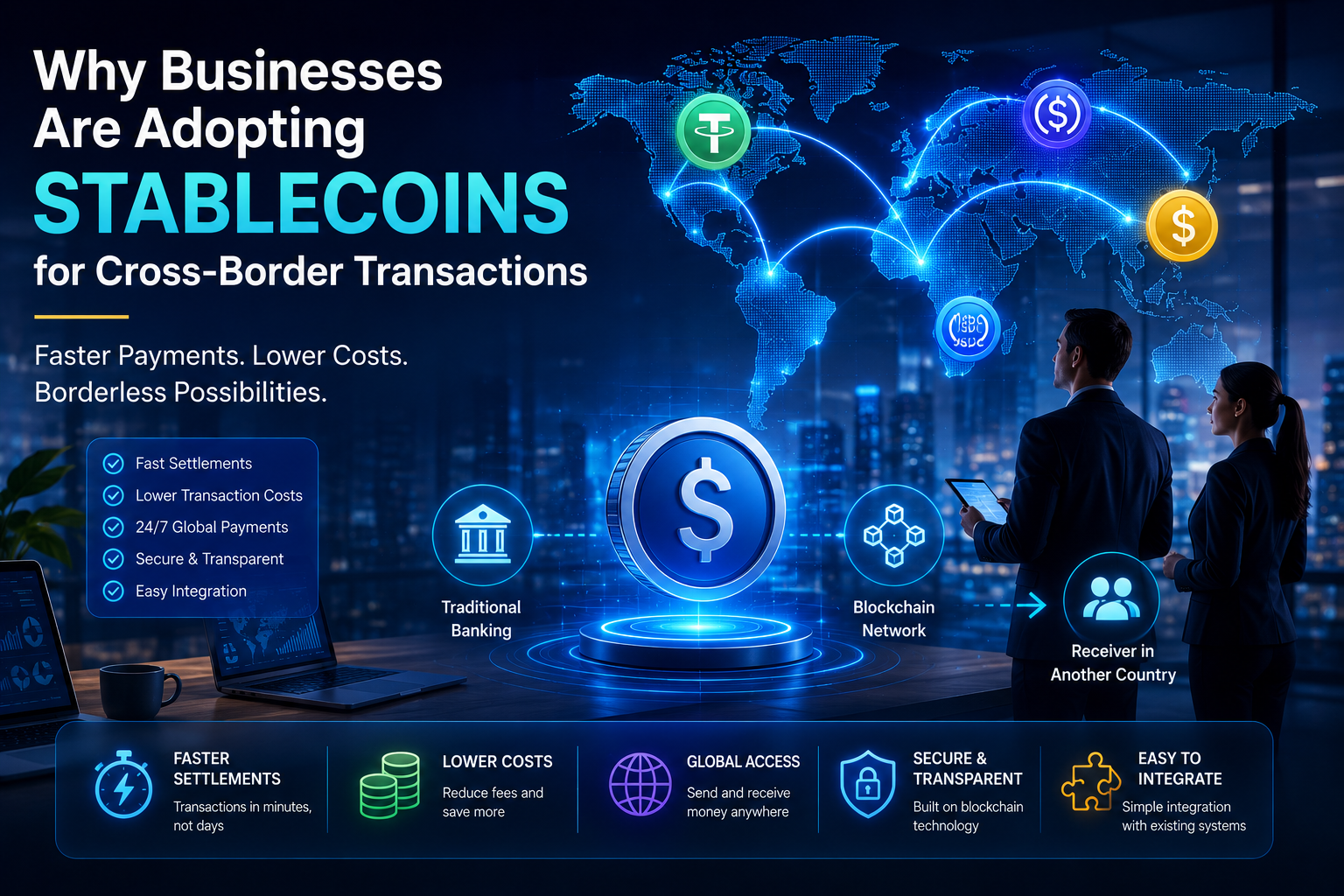
This is where stablecoins are gaining attention. Businesses around the world are starting to use stablecoins as a faster, more efficient, and cost-effective way to send and receive payments across borders.
What Are Stablecoins?
Stablecoins are a type of cryptocurrency designed to maintain a stable value. Unlike many cryptocurrencies that experience large price fluctuations, stablecoins are typically linked to traditional assets such as the US Dollar or Euro.
Because their value remains relatively stable, businesses can use them for payments without worrying about significant price changes.
This combination of blockchain technology and price stability makes stablecoins attractive for commercial transactions.
The Challenges of Traditional Cross-Border Payments
International payments have always been a challenge for businesses.
Sending money through traditional banking systems often involves multiple intermediaries, which can increase both cost and processing time.
Common challenges include:
- High transaction fees
- Slow settlement times
- Currency conversion costs
- Limited banking hours
- Complex payment processes
- Delays caused by multiple financial institutions
For businesses operating globally, these issues can impact efficiency and profitability.
Faster International Payments
One of the biggest reasons businesses are adopting stablecoins is speed.
Traditional international bank transfers can take several days to complete. Stablecoin transactions, however, can often be settled within minutes regardless of where the sender and receiver are located.
This allows businesses to move funds quickly, improve cash flow, and reduce waiting times for payments.
Faster transactions also help businesses respond more efficiently to market opportunities and customer demands.
Lower Transaction Costs
Cross-border payments through banks and payment providers often include multiple fees.
Businesses may need to pay:
- Transfer fees
- Intermediary bank charges
- Currency exchange fees
- Processing fees
Stablecoins can significantly reduce these costs by allowing funds to move directly through blockchain networks.
For companies that handle frequent international transactions, these savings can become substantial over time.
Improved Accessibility
Not every region has access to advanced banking infrastructure.
Stablecoins provide businesses with an alternative payment method that only requires internet access and a digital wallet.
This makes it easier for companies to work with international suppliers, remote employees, and customers in emerging markets.
As global commerce continues to expand, accessibility becomes an increasingly important advantage.
Better Transparency and Security
Blockchain technology records every transaction on a transparent and secure digital ledger.
This allows businesses to track payments more easily and verify transaction histories whenever needed.
The transparency offered by blockchain helps reduce disputes and improves trust between business partners.
Additionally, blockchain networks use advanced security measures that make unauthorized changes extremely difficult.
Supporting Global Business Growth
Many businesses are expanding into international markets.
As operations become more global, companies need payment systems that can keep up with growing transaction volumes and international partnerships.
Stablecoins help businesses overcome geographical barriers by providing a fast and efficient payment solution that works across borders.
This enables organizations to operate more smoothly in a global economy.
Stablecoins and Business Innovation
Businesses are not only using stablecoins for payments but also exploring new financial opportunities.
Companies are beginning to integrate stablecoin payments into:
- E-commerce platforms
- Supply chain networks
- B2B payment systems
- International payroll services
- Digital marketplaces
These innovations are helping businesses create more flexible and modern financial ecosystems.
Challenges Businesses Should Consider
While stablecoins offer many benefits, businesses should also understand the challenges involved.
Regulatory requirements continue to evolve in many countries. Organizations must ensure they comply with local laws and financial regulations.
Businesses should also carefully evaluate the stablecoins they use, considering factors such as transparency, security, and issuer credibility.
Choosing trusted and widely adopted stablecoins can help reduce potential risks.
The Future of Cross-Border Payments
The demand for faster and more efficient international payments continues to grow.
As blockchain technology matures and regulations become clearer, stablecoins are expected to play an increasingly important role in global commerce.
Many financial institutions, fintech companies, and enterprises are already investing in blockchain-based payment solutions.
This growing adoption suggests that stablecoins could become a key component of the future financial system.
Conclusion
Stablecoins are transforming the way businesses handle cross-border transactions. By offering faster settlement times, lower fees, greater accessibility, and enhanced transparency, they provide a compelling alternative to traditional international payment systems.
As global trade continues to expand, businesses are looking for smarter ways to move money across borders. Stablecoins offer a practical solution that helps improve efficiency, reduce costs, and support international growth.
Organizations that understand and embrace this technology today may gain a significant advantage in the increasingly digital global economy.
