Introduction
Artificial Intelligence (AI) has come a long way in recent years. Earlier AI systems could only understand one type of information at a time, such as text or images. Today, AI is becoming much smarter. It can now understand and process different types of information together, including text, images, audio, and video. This technology is known as Multimodal AI.
Multimodal AI is changing the way humans interact with machines. It helps AI understand situations more naturally, making conversations and interactions feel more human-like. As businesses continue adopting AI solutions, multimodal AI is becoming one of the most important technologies shaping the future.
What is Multimodal AI?
Multimodal AI is a type of artificial intelligence that can understand and work with different forms of data at the same time.
For example, imagine you upload a photo of a damaged machine and ask an AI assistant, “What is wrong with this equipment?” The AI can look at the image, understand your question, and provide a useful answer. It is combining visual information with text to understand the complete situation.
Unlike traditional AI systems that work with only one type of input, multimodal AI brings different sources of information together to create a better understanding of what users need.
Why Multimodal AI is Important
People naturally communicate using multiple forms of information. We speak, listen, look at images, watch videos, and understand body language. Traditional AI systems struggle to understand this complete picture.
Multimodal AI helps bridge this gap. It allows machines to process information in a way that is closer to how humans understand the world. As a result, AI can provide more accurate answers, better recommendations, and a smoother user experience.
This is why many technology companies are investing heavily in multimodal AI solutions.
How Multimodal AI Works
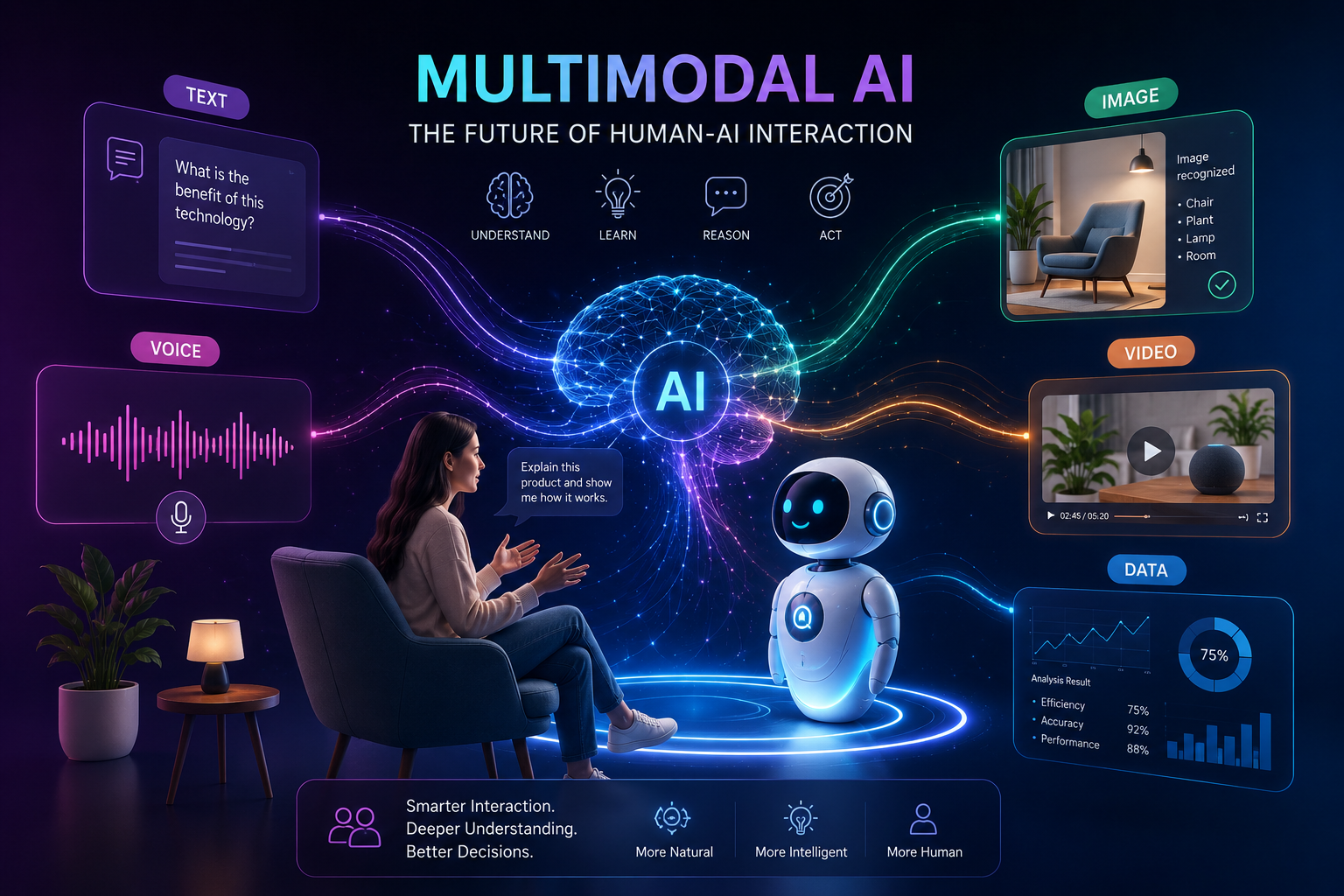
Multimodal AI collects information from different sources and combines them into a single understanding.
For example, an AI system may receive:
- A text message
- An image
- A voice recording
- A video clip
The AI analyzes each type of information separately and then combines everything together. This helps the system understand context more accurately and generate smarter responses.
Because it can see, hear, and read information simultaneously, multimodal AI can make decisions that are far more intelligent than traditional AI systems.
Benefits of Multimodal AI
Better Understanding of Context
One of the biggest advantages of multimodal AI is its ability to understand context.
For example, if a customer sends a support message along with a screenshot of an error, the AI can analyze both the text and image together. This allows it to provide a more accurate solution than a text-only chatbot.
More Natural User Experiences
People prefer interacting naturally rather than following strict commands. Multimodal AI allows users to communicate through voice, images, videos, or text.
This flexibility creates a smoother and more enjoyable experience for users.
Improved Accuracy
When AI has access to multiple sources of information, it can make better decisions and reduce mistakes.
Instead of relying on a single piece of data, it can compare information from different inputs and generate more reliable results.
Faster Automation
Businesses can automate complex tasks more effectively with multimodal AI.
Tasks such as document analysis, image recognition, video monitoring, and customer support can be completed faster and with less human involvement.
Greater Accessibility
Not everyone prefers typing. Some users may find it easier to speak, upload images, or use voice commands.
Multimodal AI makes technology more accessible by supporting different ways of communication.
Real-World Applications of Multimodal AI
Healthcare
Healthcare organizations are using multimodal AI to analyze medical images, patient records, lab reports, and doctor’s notes together.
This helps doctors identify diseases faster and improve patient care.
Customer Service
Modern customer support systems can understand messages, screenshots, voice recordings, and product photos.
As a result, customers receive faster and more personalized assistance.
Manufacturing
Manufacturing companies use multimodal AI to monitor equipment, detect defects, and predict maintenance needs.
By combining camera feeds, sensor data, and machine logs, businesses can reduce downtime and improve productivity.
Education
Educational platforms use multimodal AI to create more personalized learning experiences.
Students can learn through text, videos, voice interactions, and interactive content tailored to their learning style.
Autonomous Vehicles
Self-driving vehicles rely heavily on multimodal AI.
They continuously analyze camera images, sensors, maps, traffic information, and road conditions to make safe driving decisions.
Challenges of Multimodal AI
Although multimodal AI offers many benefits, there are still some challenges.
Processing multiple types of data requires powerful computing resources. Building and training these systems can be expensive.
Privacy and security are also important concerns because multimodal AI often works with sensitive information such as images, videos, and personal data.
Additionally, combining information from different sources accurately can be technically complex.
Despite these challenges, advancements in AI technology continue to make multimodal systems more efficient and affordable.
The Future of Human-AI Interaction
The future of AI will be much more interactive and intelligent than it is today.
Soon, AI assistants will not only understand what we say but also recognize what we see and hear. Smart devices, wearable technology, autonomous robots, and digital assistants will become more capable of understanding human needs in real time.
Businesses will use multimodal AI to create better customer experiences, automate operations, and improve decision-making.
As the technology continues to evolve, human-AI interactions will become more natural, personalized, and effective.
Conclusion
Multimodal AI is transforming the way humans interact with technology. By combining text, images, audio, video, and other forms of data, it enables AI systems to understand context more accurately and respond more intelligently.
From healthcare and education to manufacturing and customer service, multimodal AI is already making a significant impact across industries.
As organizations continue embracing artificial intelligence, multimodal AI will play a key role in creating smarter applications, improving automation, and delivering more human-like digital experiences.
Businesses that adopt this technology today will be better prepared for the future of AI-driven innovation.
