Introduction
Running a warehouse is no longer just about storing products on shelves. Today, businesses need to process orders faster, manage inventory accurately, and deliver products to customers as quickly as possible. As online shopping continues to grow, customer expectations are also increasing. People expect quick deliveries, accurate orders, and real-time tracking.
To meet these expectations, many businesses are turning to warehouse automation. Modern technologies like artificial intelligence (AI), robots, smart sensors, and warehouse management software are making warehouse operations faster, safer, and more efficient.
In this guide, we’ll explain the latest warehouse automation trends in simple words. Whether you own a small business or manage a large warehouse, these trends can help you improve productivity and stay ahead of the competition.
What Is Warehouse Automation?
Warehouse automation means using technology to perform warehouse tasks with little or no manual work. Instead of relying only on employees for every task, businesses use machines, software, and robots to help move products, manage inventory, and process orders.
Automation can handle everyday tasks such as storing products, picking items, packing orders, sorting packages, and preparing shipments. This allows employees to focus on more important work while reducing mistakes and saving time.
Simply put, warehouse automation helps businesses work smarter, not harder.
Why More Businesses Are Choosing Warehouse Automation
The demand for warehouse automation is growing every year. One of the biggest reasons is the rapid growth of eCommerce. Customers now expect same-day or next-day delivery, which is difficult to achieve using only manual processes.
Another challenge is the shortage of skilled warehouse workers. Hiring and training employees has become more expensive, so many businesses are investing in automation to reduce labor costs while improving efficiency.
Automation also helps businesses reduce errors, improve inventory accuracy, and handle larger numbers of orders without increasing their workforce.
Autonomous Mobile Robots Are Making Warehouses Smarter
One of the biggest trends in warehouse automation is the use of Autonomous Mobile Robots (AMRs).
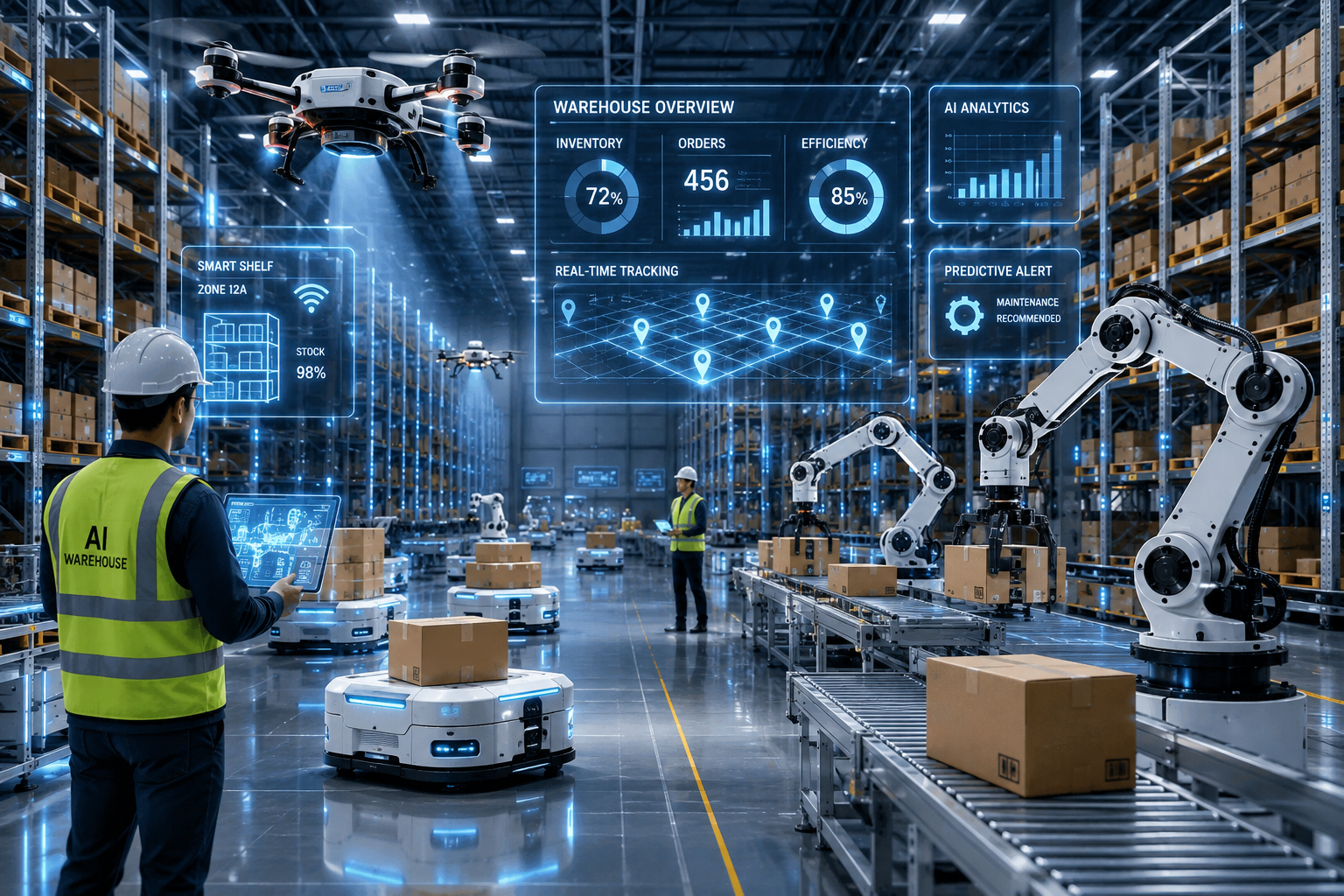
These smart robots move around the warehouse on their own. They use cameras, sensors, and artificial intelligence to find the best route without needing tracks or fixed paths.
Instead of employees walking long distances to move products, AMRs carry inventory between storage areas and packing stations. This saves time, reduces physical effort, and increases productivity.
Many modern warehouses now use these robots to speed up daily operations.
Artificial Intelligence Is Improving Warehouse Management
Artificial Intelligence (AI) is becoming an important part of warehouse operations.
AI helps warehouse managers make better decisions by analyzing large amounts of data. It can predict which products will be in high demand, suggest the best places to store inventory, and create faster picking routes for workers.
Instead of guessing what customers might buy next, AI uses past sales data and current trends to make accurate predictions. This helps businesses avoid running out of stock or ordering more products than they need.
Robots Are Helping With Picking and Packing
Picking products from shelves and packing customer orders are two of the most time-consuming warehouse tasks.
Today, robotic arms can identify products using cameras and sensors before picking them up carefully and placing them into boxes.
These robots work quickly, accurately, and can operate around the clock without getting tired. This allows businesses to process more orders while reducing mistakes.
Human workers still play an important role, but robots help them complete repetitive tasks much faster.
Smart Storage Systems Save Space and Time
Many warehouses are replacing traditional shelving with Automated Storage and Retrieval Systems (AS/RS).
These systems automatically store products and bring them to workers whenever they are needed.
Instead of employees searching through large storage areas, machines retrieve products in just a few seconds.
This not only saves time but also allows businesses to store more products in less space.
AI Makes Inventory Management Easier
Keeping track of inventory is one of the biggest challenges for any warehouse.
AI-powered inventory systems constantly monitor stock levels and predict future demand.
If a product is selling faster than expected, the system alerts managers before the item runs out. If certain products are not selling well, businesses can reduce unnecessary inventory.
This helps companies maintain the right amount of stock while avoiding costly mistakes.
Smart Cameras Improve Quality Control
Modern warehouses use machine vision systems, which are smart cameras powered by AI.
These cameras inspect products automatically and can detect damaged packaging, missing labels, incorrect barcodes, or defective items.
Unlike manual inspections, smart cameras work consistently and can check thousands of products every hour.
This improves product quality while reducing customer complaints and returns.
IoT Devices Keep Warehouses Connected
The Internet of Things (IoT) allows different warehouse devices to communicate with each other.
Small sensors placed throughout the warehouse collect real-time information about inventory, equipment, temperature, humidity, and product locations.
Managers can monitor everything from a single dashboard, making it easier to identify problems before they become serious.
Real-time data also helps businesses make faster decisions and improve overall efficiency.
Predictive Maintenance Prevents Equipment Breakdowns
Warehouse equipment can be expensive to repair if it suddenly stops working.
Predictive maintenance uses AI and sensors to monitor the condition of machines every day.
Instead of waiting for equipment to fail, the system detects early warning signs and recommends maintenance before serious problems occur.
This reduces downtime, lowers repair costs, and keeps warehouse operations running smoothly.
Drones Are Simplifying Inventory Checks
Warehouse drones are becoming more popular for inventory management.
Instead of employees climbing ladders to scan products on high shelves, drones fly through the warehouse and scan barcodes automatically.
This makes inventory counting much faster and much safer.
Large warehouses can complete inventory checks in hours instead of several days.
Digital Twins Help Businesses Plan Better
A Digital Twin is a virtual copy of a real warehouse.
Managers can test different layouts, robot movements, storage arrangements, and workflows on a computer before making changes in the actual warehouse.
This helps businesses find the most efficient way to organize their warehouse while avoiding costly mistakes.
Benefits of Warehouse Automation
Warehouse automation offers many advantages for businesses of every size.
It increases productivity because machines complete repetitive tasks much faster than people.
Automation also improves inventory accuracy, reducing the chances of shipping the wrong products to customers.
Businesses can lower labor costs while processing more orders in less time.
Employees benefit as well because robots handle heavy lifting and repetitive work, creating a safer workplace.
Most importantly, customers receive their orders faster and with fewer mistakes, leading to higher satisfaction and repeat purchases.
Challenges Businesses Should Consider
Although warehouse automation offers many benefits, it also requires careful planning.
The biggest challenge is the initial investment. Purchasing robots, automation software, and smart equipment can be expensive.
Businesses also need to train employees to use the new technology effectively.
Another important consideration is system integration. New automation tools should work smoothly with existing warehouse software and business processes.
Despite these challenges, many businesses find that the long-term savings and productivity improvements make automation a worthwhile investment.
How to Start Warehouse Automation
Businesses don’t need to automate everything at once.
A good starting point is identifying repetitive tasks that take the most time.
Next, choose a reliable Warehouse Management System (WMS) and gradually introduce automation technologies like barcode scanners, AI software, or mobile robots.
As your business grows, you can add more advanced automation solutions based on your needs and budget.
Starting small allows businesses to learn, improve, and expand automation over time.
The Future of Warehouse Automation
Warehouse automation will continue to evolve as AI and robotics become more advanced.
In the coming years, warehouses will become even smarter with intelligent robots, self-learning AI systems, digital twins, and connected devices working together.
Rather than replacing human workers, automation will support them by handling repetitive and physically demanding tasks.
Businesses that adopt these technologies early will be better prepared to meet future customer demands while staying competitive.
Final Thoughts
Warehouse automation is changing the way businesses manage inventory, process orders, and deliver products.
From AI-powered software and mobile robots to smart cameras and connected sensors, automation helps businesses work faster, reduce costs, and improve customer satisfaction.
Whether you operate a small warehouse or a large distribution center, adopting the right automation technology can make your operations more efficient and ready for future growth.
As technology continues to improve, warehouse automation will become an essential part of modern supply chain management.
