Blockchain technology has grown far beyond a single network. Today, there are many blockchain ecosystems, each with its own applications, digital assets, transaction methods, and communities.
However, these blockchain networks do not naturally communicate with each other. An asset or piece of data available on one blockchain cannot always be used directly on another network.
This is where cross-chain bridges become useful. They create connections between separate blockchain networks and help users move or represent digital assets across different ecosystems.
In this blog, we will explain what cross-chain bridges are, how blockchain bridges work, their benefits, common methods, security risks, and why interoperability is important for the future of Web3.
What Are Cross-Chain Bridges?
A cross-chain bridge is a technology that connects two or more blockchain networks. It allows users to transfer or represent digital assets and, in some designs, send information between separate blockchains.
A simple way to understand this is to imagine blockchains as different islands. Each island has its own roads, rules, and economy. Without a bridge, moving directly between the islands is difficult.
A cross-chain bridge acts as a connection between these blockchain islands.
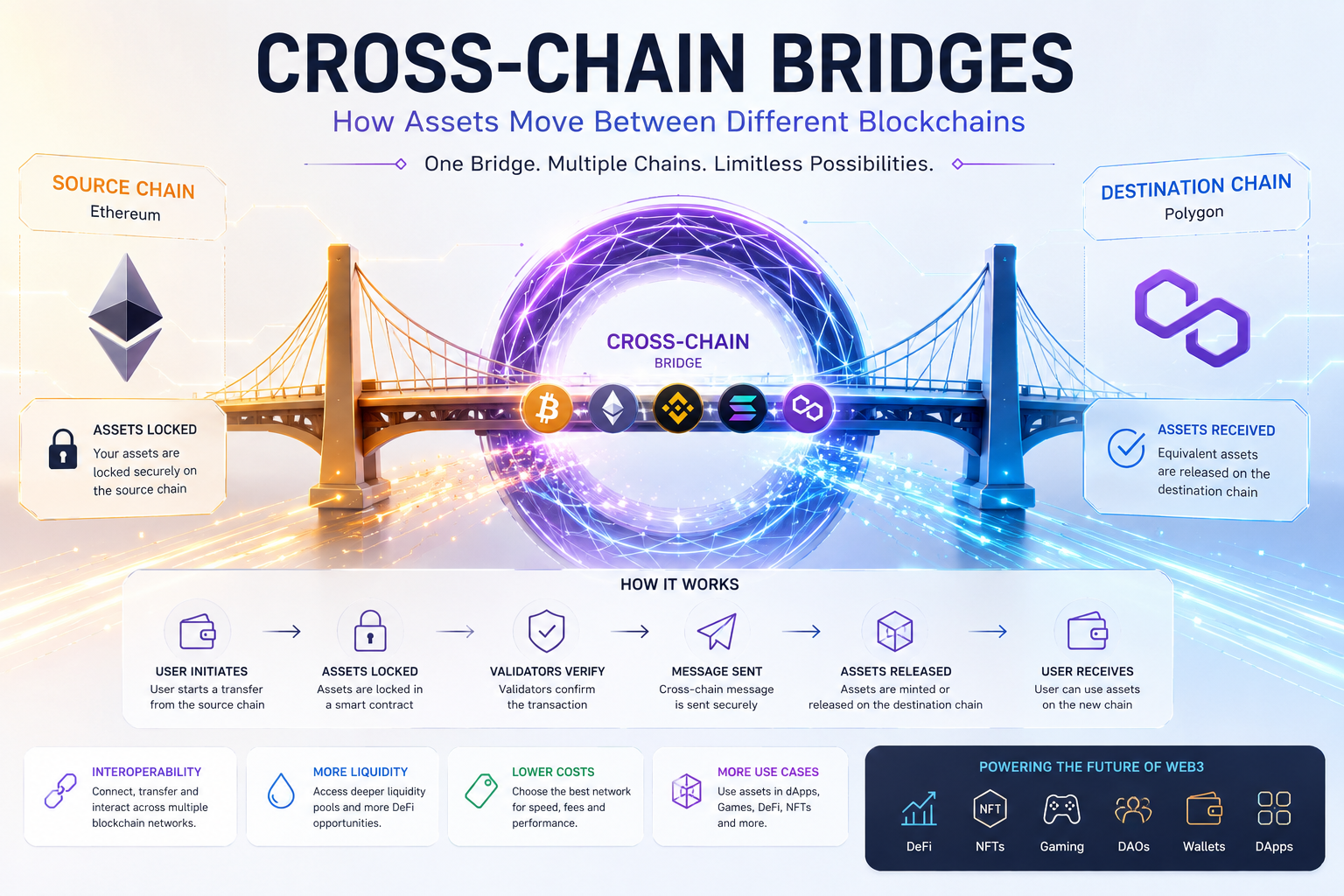
However, assets do not always physically travel from one blockchain to another. Depending on the bridge design, the original asset may be locked on the source blockchain while an equivalent token is created or released on the destination blockchain.
This gives users access to the value of their assets in another blockchain ecosystem.
Why Do Blockchains Need Bridges?
Different blockchain networks are built for different purposes.
Some focus on smart contracts and decentralized applications. Others are designed for faster transactions, lower fees, gaming, financial services, digital ownership, or specialized business applications.
The problem is that most blockchain networks operate independently.
For example, a user may hold an asset on one network but want to use a decentralized application available on another. Without interoperability technology, moving between these ecosystems can be complicated.
Cross-chain bridges help reduce this separation by creating pathways between networks.
They can allow users to access applications, services, liquidity, and opportunities across multiple blockchain ecosystems without remaining limited to one network.
How Do Cross-Chain Bridges Work?
The exact process depends on the design of the bridge, but the basic idea is easier to understand with a simple example.
Imagine that a user wants to use the value of a token from Blockchain A on Blockchain B.
The user sends the asset to a smart contract or another controlled mechanism on Blockchain A. The bridge confirms that the transaction has happened.
After verification, a corresponding token may be created or released on Blockchain B.
The user can then use that asset representation within supported applications on the destination network.
When the user wants to return, the process happens in reverse. The destination-side representation may be burned or locked, and the original asset is then released on the source blockchain.
The important point is that bridge designs can vary significantly. Some rely on smart contracts, some use validator groups, and others use specialized messaging or liquidity systems.
The Lock-and-Mint Method
Lock-and-mint is one of the easiest bridge models to understand.
In this method, the original token is locked in a smart contract on the source blockchain. After the bridge confirms the deposit, a corresponding representation of that token is minted on the destination network.
For example, imagine that a user locks 10 units of an asset on one blockchain. After confirmation, the bridge creates a corresponding amount of a wrapped or represented asset on another network.
The original tokens remain locked while the represented tokens are in circulation.
When the user moves back, the represented tokens are burned, and the original assets are released.
This model depends heavily on the security of the contracts, verification process, and asset custody design.
The Burn-and-Mint Method
Another approach is called burn-and-mint.
In this model, tokens are burned on one network and newly created on another network after the transfer is verified.
Burning means permanently removing tokens from circulation on the source chain. Once the bridge confirms this action, an equivalent amount can be minted on the destination chain.
This approach can be used in systems where the token issuer or protocol supports the same asset across multiple networks.
The goal is to maintain the correct total supply while allowing the asset to exist across different blockchain environments.
Liquidity-Based Bridges
Some cross-chain bridges use liquidity pools instead of creating wrapped versions of assets.
Liquidity providers deposit assets into pools on different blockchain networks. When a user wants to move assets from one network to another, the bridge accepts funds on the source side and releases available liquidity on the destination side.
For users, this can feel similar to a transfer. Behind the scenes, the bridge manages liquidity across multiple networks.
The performance of this model depends on having enough available liquidity.
If a destination pool does not have enough assets, transfers may become slower, more expensive, or temporarily limited.
Cross-Chain Messaging
Modern blockchain interoperability is not only about moving tokens.
Cross-chain messaging allows applications on different blockchains to send instructions, data, or verified messages to each other.
For example, an action on one blockchain could trigger an approved action on another blockchain.
This can support more advanced applications, including cross-chain governance, decentralized finance operations, gaming systems, identity solutions, and multi-chain applications.
Cross-chain messaging is a complex area because the receiving blockchain needs a reliable way to verify that the message from another network is valid.
What Is Blockchain Interoperability?
Blockchain interoperability means the ability of separate blockchain networks to communicate, exchange information, or work together.
The internet became more useful because different systems could communicate through common standards and protocols. Blockchain developers are exploring different approaches to achieve better connectivity between decentralized networks.
Cross-chain bridges are one part of this larger interoperability goal.
A more connected blockchain ecosystem could allow users and applications to interact across networks with less friction. However, interoperability systems must also solve important problems involving security, trust, verification, and user experience.
Cross-Chain Bridges in DeFi
Decentralized finance, commonly known as DeFi, is one of the major use cases for cross-chain technology.
Different blockchain networks can have separate lending platforms, decentralized exchanges, liquidity markets, and other financial applications.
A user may have assets on one blockchain but want to access a DeFi application on another network.
A cross-chain bridge can help move or represent those assets in the destination ecosystem.
This allows users to explore services across different networks. However, users should understand that bridging can introduce additional risks beyond the normal risks of using DeFi applications.
Cross-Chain Bridges in Blockchain Gaming
Blockchain games can also benefit from interoperability.
A game may use one blockchain for digital items while another network provides different applications, marketplaces, or community services.
Cross-chain technology can potentially help supported digital assets interact across multiple environments.
For example, a game asset might be represented or recognized in another compatible ecosystem.
However, true interoperability in gaming requires more than transferring a token. Different games may use completely different rules, graphics, item properties, and technical systems.
A sword in one game does not automatically become a useful sword in another game simply because its token can move between networks.
Benefits of Cross-Chain Bridges
One major benefit of cross-chain bridges is greater access.
Users can interact with applications and services available across multiple blockchain ecosystems.
Another benefit is improved movement of liquidity. Assets can potentially be used across different decentralized markets instead of remaining isolated on a single network.
Cross-chain technology can also support multi-chain applications. Developers can build systems that interact with different blockchain environments and use the strengths of multiple networks.
For the wider Web3 ecosystem, interoperability can reduce fragmentation and create better connections between blockchain communities and applications.
Security Risks of Cross-Chain Bridges
Security is one of the biggest challenges for cross-chain bridges.
A bridge may need to verify events on different blockchains, manage locked assets, operate smart contracts, process messages, and sometimes depend on validators or external systems.
Each additional component can create potential security risks.
Smart-contract vulnerabilities are one concern. If a contract contains a serious bug, attackers may attempt to exploit it.
Another concern is the verification system. If attackers gain control over enough validators or compromise the mechanism used to approve cross-chain messages, they may be able to authorize invalid transactions.
Bridges that hold large amounts of locked assets can also become attractive targets.
For this reason, strong security design, independent audits, careful testing, monitoring, and clear risk management are essential parts of bridge development.
The Problem of Trust
Not every blockchain bridge has the same trust model.
Some bridges depend on a small group of trusted organizations or validators. Others use larger decentralized networks or verification methods designed to reduce dependence on trusted third parties.
Users should understand who or what controls the bridge.
Important questions include: Who verifies transfers? Who controls upgrades? Can funds be frozen? What happens if validators fail? How are security incidents handled?
A bridge may be convenient and fast while still requiring users to trust certain operators.
Understanding the trust model is important before using any cross-chain system.
Cross-Chain Bridges vs Crypto Exchanges
Cross-chain bridges and cryptocurrency exchanges can both help users access assets on different networks, but they work differently.
A centralized exchange acts as an intermediary. Users deposit assets into an account, perform a transaction or conversion, and withdraw assets to a supported blockchain network.
A cross-chain bridge usually connects blockchain networks through smart contracts, validators, liquidity systems, or messaging protocols.
The best option depends on the user’s needs, supported networks, fees, security preferences, and the specific assets involved.
Users should carefully check network compatibility before sending digital assets because blockchain transactions are generally difficult or impossible to reverse.
Challenges Facing Cross-Chain Technology
Cross-chain bridges solve an important problem, but the technology still faces several challenges.
Security remains a major issue because connecting independent blockchain systems is technically difficult.
User experience is another challenge. New users may find concepts such as source networks, destination networks, wrapped assets, gas fees, liquidity, and transaction confirmation confusing.
Liquidity fragmentation can also create problems. Assets and trading activity may be spread across many different networks and applications.
There is also no single interoperability standard used by every blockchain ecosystem.
Developers are working on different methods, which means the future may include multiple approaches rather than one universal bridge system.
The Future of Cross-Chain Bridges
The future of blockchain technology is likely to be increasingly multi-chain.
Different blockchain networks may continue to serve different purposes rather than one blockchain replacing every other network.
In such an environment, interoperability becomes increasingly important.
Future cross-chain systems may focus on stronger verification, better security, simpler interfaces, faster transactions, and improved developer tools.
Users may eventually interact with multi-chain applications without needing to understand every technical step happening behind the scenes.
The goal is to make blockchain networks work together more smoothly while maintaining strong security and clear trust assumptions.
Final Thoughts
Cross-chain bridges play an important role in connecting separate blockchain ecosystems.
They can help users move or represent assets across networks, access applications on different blockchains, and participate in a more connected Web3 environment.
The basic idea is simple: create a secure connection between independent blockchain networks. The technology behind that connection, however, can be complex.
Different bridges use methods such as lock-and-mint systems, burn-and-mint mechanisms, liquidity pools, and cross-chain messaging.
While the benefits are significant, users and developers must also consider security risks, smart-contract vulnerabilities, validator trust, liquidity limitations, and technical complexity.
As blockchain technology continues to develop, cross-chain interoperability could become an important part of making decentralized networks more connected, useful, and accessible.
