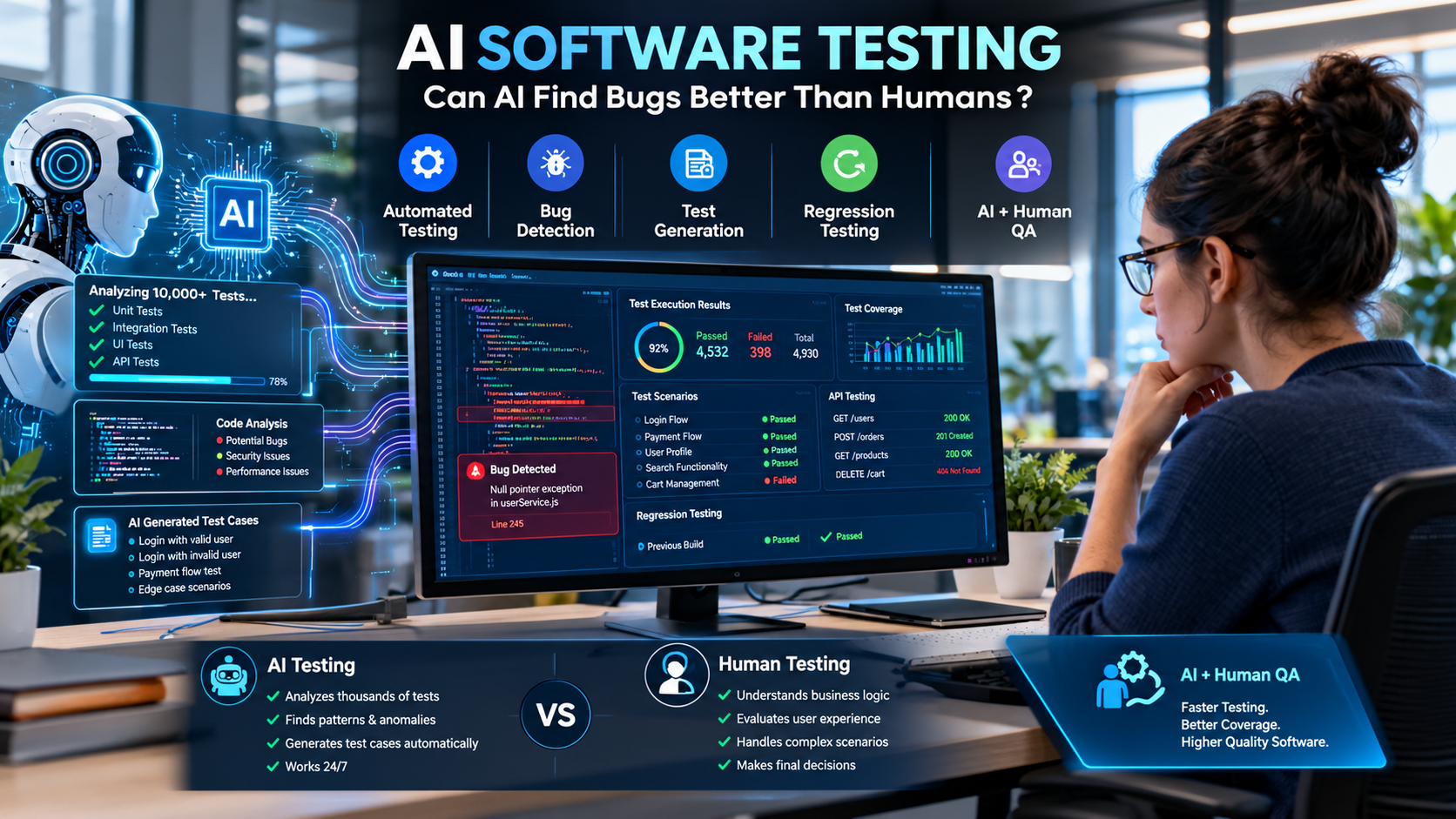
Software testing is an important part of building any application. Before software is released to users, developers and QA testers need to make sure that it works correctly and does not contain serious bugs.
Today, software is becoming more complex. Applications can include websites, mobile apps, APIs, databases, cloud services, payment systems, and artificial intelligence.
Testing all these parts manually can take a lot of time. This is where AI software testing is becoming useful.
Artificial Intelligence can help generate test cases, find possible bugs, analyze test results, and automate repetitive testing tasks.
But an important question remains:
Can AI find software bugs better than humans?
The answer is not always yes. AI can be faster and more efficient for many testing tasks, while humans are still better at understanding business requirements, user expectations, and unusual situations.
What Is AI Software Testing?
AI software testing means using Artificial Intelligence to help test software applications.
Traditional software testing often requires testers to manually create test cases, run tests, check results, and report bugs.
AI can automate many of these tasks.
For example, AI can analyze software requirements and suggest test cases. It can also examine test results and identify unusual behavior that may indicate a bug.
In simple words:
AI software testing uses AI to make software testing faster, smarter, and more automated.
Why Is AI Becoming Important in Software Testing?
Modern applications can contain thousands of features and millions of possible user interactions.
Testing everything manually is difficult.
For example, an e-commerce website may have:
- Login and registration
- Product search
- Shopping cart
- Multiple payment methods
- Discount codes
- Order tracking
- User accounts
- Different devices and browsers
A small change in one feature can sometimes affect another feature.
AI can help testers analyze large amounts of testing information and identify areas that need more attention.
This can save time and allow QA teams to focus on more important testing activities.
How Does AI Find Software Bugs?
AI can use software code, requirements, previous test results, and application behavior to identify possible problems.
It can look for unusual patterns and situations that may indicate a bug.
For example, AI may identify:
- Incorrect logic
- Missing conditions
- Unexpected application behavior
- Failed API requests
- Broken user interfaces
- Performance problems
- Repeated test failures
- Potential security issues
AI does not magically understand every bug. Instead, it analyzes available information and uses patterns to identify areas that may require attention.
AI Can Automatically Generate Test Cases
Creating test cases manually can take a lot of time.
AI can help generate test cases based on software requirements or existing code.
For example, consider a login page.
A human tester may create tests for:
- Correct username and password
- Incorrect password
- Empty username
- Empty password
- Invalid email
- Locked account
AI can automatically suggest many similar scenarios.
This helps testers increase test coverage without manually writing every possible test.
AI Can Test More Scenarios
One of the biggest advantages of AI is its ability to handle a large number of scenarios.
Imagine an application that works across:
- Different browsers
- Different smartphones
- Different operating systems
- Different screen sizes
- Different user accounts
- Different inputs
Testing every combination manually would be extremely difficult.
AI-powered testing can automatically create and execute many combinations.
This does not mean AI will find every possible bug, but it can help teams test more scenarios in less time.
AI and Regression Testing
Regression testing is performed after software changes to make sure that existing features still work correctly.
For example, developers may update the payment system of an online shopping application.
The change could accidentally affect:
- Shopping cart
- Order confirmation
- Invoices
- User accounts
- Notifications
AI can analyze the changes and help identify which existing tests should be run again.
This can make regression testing faster and more efficient.
AI Can Analyze Test Results
Software testing can generate a huge amount of information.
A large application may produce thousands of test results every day.
Checking all these results manually can be time-consuming.
AI can analyze test results and identify patterns.
For example, if the same test fails repeatedly after a particular software update, AI may identify that pattern and highlight it for the testing team.
This allows testers to focus on important failures instead of checking every result manually.
AI Can Help With Bug Detection
AI can help identify potential bugs by analyzing application behavior.
For example, suppose an application normally responds to an API request within one second.
After a new update, the response suddenly takes five seconds.
An AI-powered testing system may identify this unusual change and alert the team.
AI can therefore help detect problems that may not be immediately obvious.
AI vs Human Software Testers
The question is not simply whether AI is better than humans.
AI and humans have different strengths.
AI Is Good At
- Running repetitive tests
- Generating test cases
- Analyzing large amounts of data
- Finding patterns
- Performing regression testing
- Running tests continuously
- Identifying unusual behavior
Humans Are Good At
- Understanding business requirements
- Understanding customer expectations
- Exploratory testing
- Understanding real-world situations
- Evaluating user experience
- Making important decisions
- Understanding ambiguous requirements
This is why AI and human testers can work together instead of competing with each other.
Can AI Find Bugs Faster Than Humans?
In many repetitive testing situations, AI can be much faster than humans.
A human tester needs to follow steps, check the result, document the problem, and repeat the process.
An AI-powered system can execute many tests automatically and analyze their results quickly.
For example:
Human testing:
Create test → Run test → Check result → Report bug
AI-assisted testing:
Generate tests → Run tests → Analyze results → Identify possible bug → Report findings
AI can therefore reduce the time required for repetitive testing.
Where Are Humans Still Better?
AI is powerful, but software quality is not only about finding technical errors.
Humans understand context better.
For example, imagine a food-delivery application where the payment technically works correctly.
However, the payment confirmation message may be confusing to users.
A human tester may notice:
“The application works, but the user may not understand whether the payment was successful.”
This type of problem requires human judgment and understanding of user behavior.
Humans are also better at understanding unclear requirements and deciding whether a feature actually makes sense for customers.
Can AI Make Mistakes While Testing Software?
Yes.
AI is not perfect.
AI-generated tests may sometimes be:
- Incorrect
- Incomplete
- Repetitive
- Based on wrong assumptions
- Too simple
- Focused on the wrong scenarios
AI can also produce false positives.
A false positive happens when AI reports something as a problem even though it is not actually a bug.
There can also be false negatives, where an actual bug is missed.
This is why human review is still important.
What Is AI-Powered Test Automation?
AI-powered test automation combines traditional automated testing with artificial intelligence.
Traditional automation usually follows predefined instructions.
For example:
Open website → Click Login → Enter username → Enter password → Click Submit
AI-powered testing can potentially go further by understanding the application, generating new test scenarios, analyzing failures, and adapting tests when the application changes.
This can make automated testing more flexible.
What Is Agentic AI Testing?
One of the newer developments in software testing is Agentic AI.
An AI agent can potentially perform multiple steps without requiring a human to provide every instruction.
For software testing, an AI agent could potentially:
Understand requirement → Create test cases → Run tests → Analyze failures → Report bugs → Create additional tests
This could make future testing systems much more autonomous.
However, these systems still need proper controls and human oversight, especially for important software applications.
Can AI Test AI Applications?
AI is also changing what software needs to be tested.
Applications such as AI chatbots, AI assistants, and AI-powered search systems do not always produce exactly the same output for every input.
Therefore, testing AI applications can be more complicated than testing traditional software.
Testers may need to check:
- Accuracy
- Reliability
- Safety
- Response quality
- Unexpected behavior
- Bias
- Security
- Performance
For example, an AI chatbot may give a technically correct answer but explain it in a confusing way.
Testing AI software therefore requires both automated tools and human judgment.
Benefits of AI Software Testing
AI can provide several important benefits to software testing teams.
Faster Testing
AI can execute and analyze large numbers of tests quickly.
More Test Coverage
AI can generate additional test scenarios that testers may not manually create.
Less Repetitive Work
QA engineers can spend less time performing repetitive testing tasks.
Faster Bug Detection
AI can identify unusual patterns and potential problems earlier.
Continuous Testing
AI can support testing throughout the software development process.
Better Test Maintenance
AI can help update automated tests when application code or interfaces change.
What Are the Challenges of AI Software Testing?
AI software testing also has some challenges.
Accuracy
AI-generated tests are not always correct and may require human review.
False Results
AI can sometimes report problems that are not real bugs or miss bugs that actually exist.
Lack of Business Understanding
AI may understand the technical behavior of software but may not fully understand the business purpose behind a feature.
Security Concerns
AI-generated code and tests should be reviewed carefully because they can potentially introduce security problems.
Human Oversight
Important software releases should not depend only on AI-generated testing results.
Will AI Replace Software Testers?
AI is unlikely to completely replace software testers.
Instead, the role of QA engineers is likely to change.
Testers may spend less time on repetitive manual testing and more time on:
- Testing strategy
- Exploratory testing
- User experience
- Security testing
- AI testing
- Business requirements
- Risk analysis
- Reviewing AI-generated tests
- Final quality decisions
In the future, QA engineers may work more like AI-assisted quality engineers.
AI + Human Testing Could Be the Future
The most realistic future is not:
AI vs Humans
It is:
AI + Humans
AI can handle large-scale and repetitive testing, while humans can focus on creativity, context, business requirements, and user experience.
For example:
AI: Generates thousands of test cases.
Human: Decides which scenarios are most important.
AI: Runs automated tests.
Human: Investigates unusual results.
AI: Finds potential problems.
Human: Decides whether the problem is actually important.
This combination can make software testing more powerful.
What Could AI Software Testing Look Like in the Future?
Future AI testing systems could become more autonomous.
An AI system could potentially understand a software requirement and then automatically create a complete testing plan.
It could:
- Understand the requirement
- Identify possible risks
- Generate test cases
- Run automated tests
- Analyze test results
- Identify potential bugs
- Create bug reports
- Suggest fixes
- Run tests again after the fix
This could significantly change the way software quality is managed.
Why AI Software Testing Is Important for Developers
AI is already changing how software is developed.
Developers can use AI to generate code, explain code, find errors, and build applications faster.
As software development becomes faster, testing also needs to become faster.
If developers can generate hundreds of lines of code quickly with AI, manually testing every change may become a bottleneck.
AI-powered testing can help solve this problem by bringing more automation into the development process.
Is AI Better Than Human Testers?
The simple answer is:
AI is better at some testing tasks, while humans are better at others.
AI is excellent for speed, automation, repetitive testing, large-scale analysis, and pattern detection.
Humans are better at understanding users, business requirements, unexpected situations, and overall product quality.
Therefore, AI should not simply replace human testers.
Instead, it should help testers become faster and more effective.
Conclusion
AI software testing is changing the way developers and QA teams find and manage software bugs.
AI can generate test cases, automate repetitive tests, analyze large amounts of testing data, detect unusual behavior, and support regression testing.
However, AI is not perfect. It can make mistakes, misunderstand requirements, and miss important problems.
Human testers still play an important role because they understand business requirements, user expectations, and real-world situations.
The future of software testing is therefore likely to be a combination of Artificial Intelligence and human expertise.
AI may handle more repetitive testing work, while human testers focus on more complex decisions.
The goal is not to ask “Will AI replace software testers?”
The better question is:
“How can AI and human testers work together to build better and more reliable software?”
