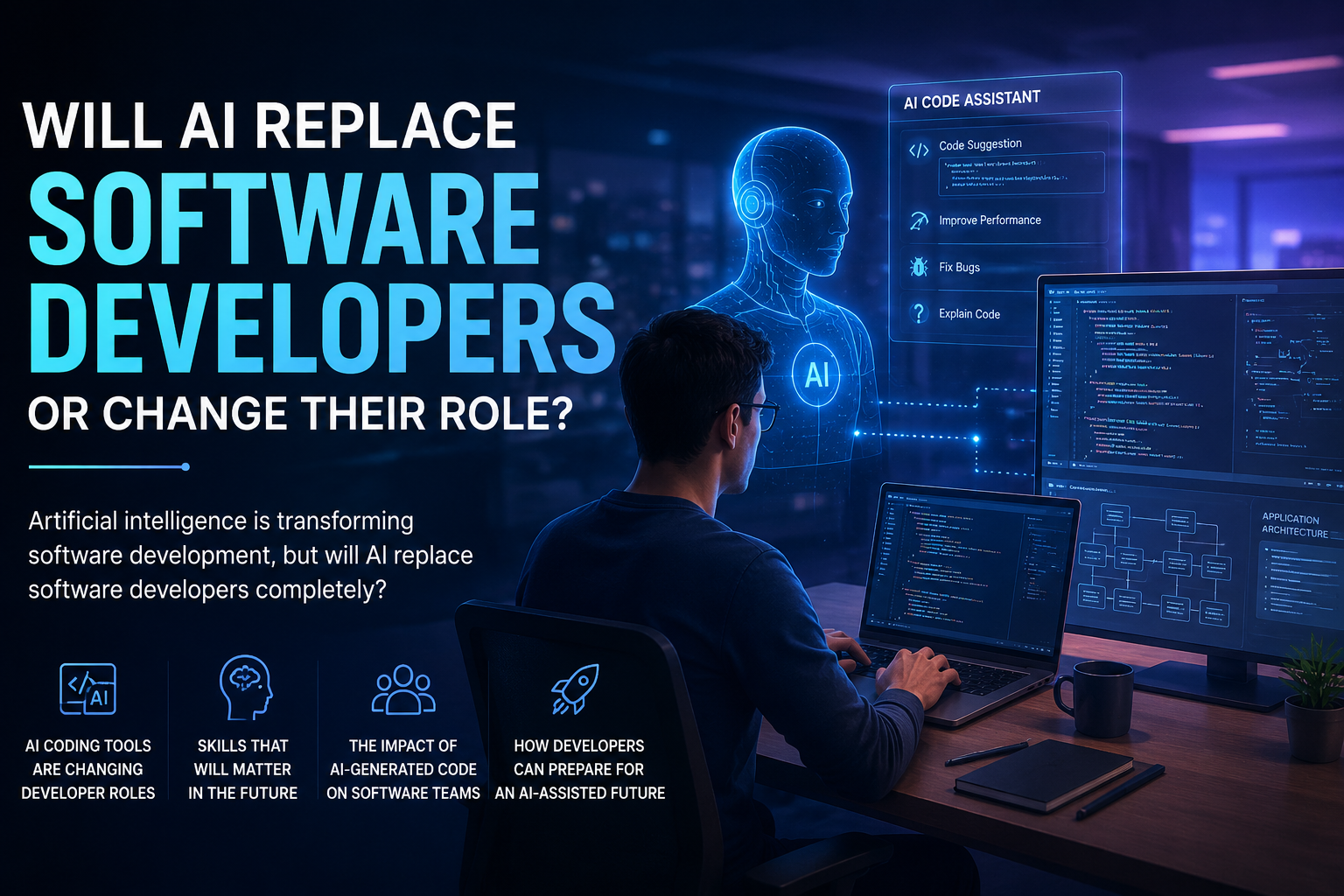
Artificial intelligence is changing the way software is created. AI tools can now write code, find errors, explain complex functions, create tests, and help developers complete tasks faster. Because of this rapid progress, many people are asking an important question: Will AI replace software developers, or will it simply change the way they work?
The simple answer is that AI is more likely to change the role of software developers than completely replace them. Software development involves much more than writing code. Developers need to understand real problems, communicate with clients and teams, make technical decisions, design reliable systems, and maintain software over time. AI can support these tasks, but human knowledge and judgment still play an important role.
Why People Think AI Could Replace Software Developers
AI coding tools have improved quickly. Today, developers can describe what they want in simple language and receive code suggestions within seconds. AI can generate functions, create basic applications, explain existing code, and suggest solutions for common programming problems.
This makes software development faster, especially for repetitive tasks. A developer who previously spent hours writing basic code may now complete the same work much faster with AI assistance.
However, generating code is only one part of building software. A piece of code can look correct but still contain security problems, performance issues, incorrect assumptions, or business logic errors. Someone still needs to understand the complete system and decide whether the generated solution is suitable.
How AI Is Already Changing Software Development
AI is becoming part of everyday development workflows. Developers use AI to generate code suggestions, understand unfamiliar codebases, write documentation, create test cases, debug errors, and explore different approaches to a problem.
This does not mean developers simply ask AI to build everything. In professional software projects, developers still need to review the output carefully. They must check whether the code follows project standards, works correctly with existing systems, protects user data, and can be maintained in the future.
The biggest change is that developers can spend less time on repetitive coding and more time thinking about the bigger picture.
AI Can Write Code, but Software Development Is More Than Coding
Writing code is an important development skill, but successful software starts with understanding the problem.
For example, a business may ask for an employee management system. Before writing code, developers need to understand who will use the system, what permissions each user should have, how employee information will be stored, which reports are required, and how the application should connect with other systems.
These decisions depend on conversations, business knowledge, technical experience, and understanding user needs. AI can suggest possible solutions, but developers and product teams must decide what should actually be built.
The Developer’s Role Is Moving Toward Problem Solving
As AI handles more routine coding tasks, developers will spend more time solving problems and making technical decisions.
Instead of manually writing every line of code, developers may describe requirements, review generated solutions, connect different services, improve performance, and verify that the application behaves correctly.
This means understanding the reason behind the code will become more important than simply producing a large amount of code. Developers who understand system architecture, databases, APIs, security, performance, and user experience will continue to provide strong value.
Developers Will Become Reviewers of AI-Generated Code
One of the most important responsibilities in AI-assisted development is code review.
AI-generated code can contain subtle mistakes. It may use outdated approaches, introduce unnecessary complexity, misunderstand requirements, or create security risks. These problems may not always be immediately visible.
Developers need to understand the generated code before adding it to a real application. They must test the solution, check edge cases, review security concerns, and confirm that it matches the project’s architecture.
Using AI without understanding its output can create more problems than it solves. The ability to evaluate code will therefore remain an essential developer skill.
Junior Developers Will Need a Different Learning Approach
AI can be especially helpful for beginners because it can explain errors, provide examples, and answer programming questions quickly. However, depending completely on AI can make learning difficult.
New developers still need to understand programming fundamentals. Topics such as variables, functions, data structures, APIs, databases, state management, debugging, and software architecture remain important.
The best way to use AI while learning is to treat it as a helpful assistant rather than a replacement for understanding. Ask why a solution works, explore alternative approaches, test the code, and try solving some problems independently.
Developers who combine strong fundamentals with effective AI usage will be better prepared for modern software jobs.
Human Skills Will Become More Valuable
AI is powerful at processing information and generating possible solutions, but software development also requires human communication.
Developers regularly talk with clients, designers, managers, testers, and other developers. Requirements are often incomplete or unclear. A client may explain what they want, but developers must ask questions and understand the actual problem behind the request.
Skills such as communication, critical thinking, teamwork, decision-making, and understanding business goals will become increasingly valuable.
A developer who understands both technology and people can help build software that solves the right problem, not just software that contains working code.
AI Will Create New Responsibilities for Developers
The growth of AI will also create new types of development work.
Software teams will need people who can integrate AI models into applications, build AI-powered workflows, manage AI-generated output, protect sensitive information, evaluate response quality, and control the cost of AI services.
Developers may also work more closely with AI agents that can perform multiple tasks. The developer’s responsibility will be to define goals, provide the right context, review results, and make sure the overall system remains reliable.
This creates opportunities for developers who learn how AI systems work and how to use them responsibly in real applications.
Which Developer Skills Will Matter in the AI Era?
Strong programming fundamentals will continue to matter, but developers will benefit from building a wider range of skills.
Understanding system design helps developers build applications that can grow. Database knowledge helps them manage data correctly. Security knowledge helps protect applications and users. Cloud and DevOps skills help developers understand how software is deployed and maintained.
Developers should also learn how to communicate effectively with AI tools. This includes providing useful context, breaking complex tasks into smaller parts, checking generated results, and recognizing when an AI answer may be incorrect.
The goal is not to compete with AI at typing code faster. The goal is to use AI while maintaining strong technical understanding and responsibility for the final result.
Will Companies Need Fewer Software Developers?
AI may change how software teams are structured. Some repetitive tasks will require less manual effort, and smaller teams may be able to build certain products faster.
At the same time, faster development can also increase the amount of software businesses want to create. When building software becomes easier, companies may develop more internal tools, automate more processes, improve existing products, and experiment with new ideas.
The exact impact will be different across companies and industries. What is clear is that developer roles will continue to evolve, and professionals who adapt their skills will be better positioned for future opportunities.
AI and Developers Will Work Together
The future of software development is likely to be based on collaboration between people and AI.
AI is useful for speed. It can quickly generate ideas, create starting points, explain code, and automate repetitive work. Developers provide context, judgment, creativity, experience, and responsibility.
A useful comparison is the introduction of calculators and spreadsheets. These tools changed how people worked with numbers, but they did not remove the need for financial experts, engineers, or analysts. Instead, professionals learned to use better tools and focus on more complex work.
AI may create a similar change in software development.
How Developers Can Prepare for the Future
Developers do not need to learn every new AI tool that appears. Tools will continue to change, but strong technical knowledge remains useful across different technologies.
Focus on understanding programming fundamentals and building real projects. Learn how APIs, databases, authentication, security, testing, deployment, and system architecture work together.
Use AI during development, but review what it produces. Ask questions when you do not understand something. Test generated code and compare different solutions.
It is also helpful to develop knowledge in a specific industry or business area. A developer who understands both software and a real business domain can make better decisions and solve more valuable problems.
Final Thoughts
AI is changing software development, but change does not automatically mean replacement.
The role of a software developer is becoming broader. Developers are moving from writing every line manually toward designing solutions, guiding AI tools, reviewing generated code, solving complex problems, and making important technical decisions.
AI will continue to become more capable, and some development tasks will become highly automated. However, building reliable software still requires understanding users, businesses, systems, security, and long-term consequences.
The developers who succeed in the AI era will not be those who ignore AI or depend on it for everything. They will be the ones who understand technology deeply, use AI effectively, question its output, and take responsibility for building software that genuinely solves problems.
