Introduction
In every industry, machines play a crucial role in daily operations. Whether it’s a manufacturing plant, power station, warehouse, or transportation system, equipment needs to run smoothly to keep business moving forward.
The biggest challenge companies face is unexpected machine breakdowns. When equipment suddenly stops working, production can slow down, repair costs can increase, and businesses can lose valuable time and money.
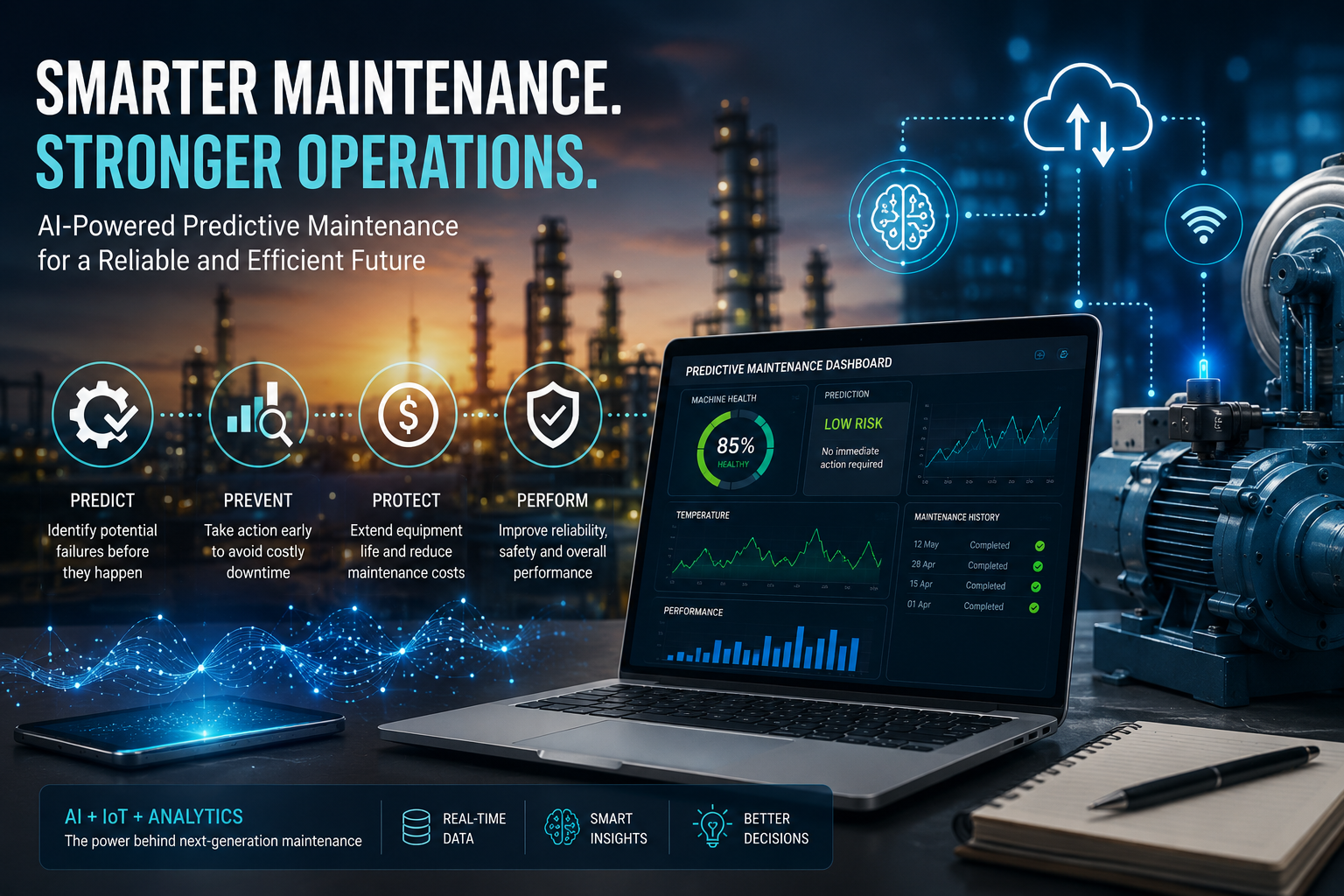
This is where AI-powered predictive maintenance is making a difference. Instead of waiting for machines to fail, businesses can now use Artificial Intelligence (AI) to detect problems early and fix them before they become serious. This smarter approach helps companies save money, improve efficiency, and avoid costly downtime.
Understanding Predictive Maintenance
Predictive maintenance is a maintenance strategy that uses data and technology to predict when equipment might develop a problem.
Traditionally, companies either repaired machines after they broke down or followed fixed maintenance schedules. While these methods can work, they often lead to unnecessary repairs or unexpected failures.
Predictive maintenance takes a different approach. It continuously monitors equipment performance and identifies warning signs before a breakdown happens. This allows maintenance teams to act at the right time and prevent costly disruptions.
How Artificial Intelligence Makes Maintenance Smarter
Artificial Intelligence helps maintenance teams make better decisions by analyzing large amounts of machine data.
Modern equipment is equipped with sensors that collect information such as temperature, vibration, pressure, energy consumption, and operating speed. AI systems study this information and look for unusual patterns that could indicate a developing problem.
If something doesn’t look normal, the system sends an alert so technicians can inspect the equipment before a failure occurs. Over time, AI becomes even more accurate because it learns from previous maintenance records and machine behavior.
Why Businesses Are Adopting AI-Powered Maintenance
Companies are constantly looking for ways to reduce costs and improve productivity. AI-powered predictive maintenance helps achieve both goals.
Instead of spending money on unnecessary maintenance or emergency repairs, businesses can focus their efforts where they are actually needed. This improves equipment reliability and helps operations run more efficiently.
As industries become more competitive, many organizations see predictive maintenance as an important investment for long-term growth.
Reducing Expensive Downtime
One of the biggest benefits of predictive maintenance is reducing unexpected downtime.
When a critical machine fails, production can stop completely. This can delay orders, affect customer satisfaction, and lead to significant financial losses.
AI helps identify potential issues before they cause failures. Maintenance can then be scheduled during planned downtime rather than during an emergency. This keeps operations running smoothly and minimizes disruptions.
Lowering Maintenance Costs
Traditional maintenance often involves replacing parts that are still working properly or performing inspections that may not be necessary.
With AI-powered predictive maintenance, companies only perform maintenance when there are actual signs of wear or damage. This reduces labor costs, lowers repair expenses, and prevents unnecessary part replacements.
Over time, these savings can have a significant impact on overall operating costs.
Improving Equipment Performance
Machines that receive timely maintenance tend to perform better and last longer.
AI systems continuously monitor equipment health and help ensure that machines operate under the best possible conditions. Small issues can be identified and resolved before they grow into larger problems.
As a result, businesses experience better productivity, improved product quality, and more reliable equipment performance.
Creating a Safer Workplace
Equipment failures can create dangerous situations for workers.
A malfunctioning machine can cause accidents, production hazards, or even serious injuries. Predictive maintenance helps reduce these risks by identifying potential problems early.
By keeping equipment in good condition, businesses can create safer working environments and protect both employees and assets.
Industries Benefiting from Predictive Maintenance
Many industries are already using AI-powered predictive maintenance to improve operations.
Manufacturing companies use it to monitor production equipment and reduce downtime. Energy providers rely on it to maintain power generation systems. Transportation companies use it to monitor vehicles and infrastructure.
The technology is also widely used in mining, oil and gas, logistics, healthcare, and many other industries where equipment reliability is critical.
The Connection Between Predictive Maintenance and Smart Factories
Modern factories are becoming smarter and more connected than ever before.
Machines, sensors, software platforms, and cloud systems work together to share information in real time. Predictive maintenance is an important part of this transformation because it helps businesses monitor equipment continuously and make data-driven decisions.
As Industry 4.0 continues to grow, predictive maintenance will become a standard practice in industrial operations around the world.
Challenges Businesses Should Consider
Although predictive maintenance offers many benefits, implementing the technology requires planning and investment.
Companies may need to install sensors, upgrade equipment, and invest in software platforms. They also need skilled professionals who can manage and interpret the data generated by AI systems.
Data quality is another important factor. The more accurate the data, the better the predictions will be.
Despite these challenges, most organizations find that the long-term benefits far outweigh the initial investment.
The Future of AI-Powered Predictive Maintenance
The future of predictive maintenance looks extremely promising.
Advancements in Artificial Intelligence, Machine Learning, Industrial IoT, Digital Twins, and Edge Computing are making predictive maintenance more accurate and accessible than ever before.
In the future, AI systems may automatically schedule repairs, order replacement parts, and optimize maintenance plans without human intervention.
These innovations will help businesses operate more efficiently while reducing costs and improving equipment reliability.
Conclusion
AI-powered predictive maintenance is changing the way industries manage their equipment. By using real-time data, intelligent analytics, and machine learning, businesses can identify problems before they lead to breakdowns.
The result is lower maintenance costs, reduced downtime, improved equipment performance, and safer working environments.
As industries continue to embrace digital transformation and smart manufacturing, predictive maintenance will play a key role in helping organizations stay productive, competitive, and prepared for the future.
