Introduction
Artificial Intelligence is changing the way businesses interact with customers and manage daily operations. Many companies already use chatbots to answer customer questions and provide support. However, a newer technology called AI agents is becoming increasingly popular because it can do much more than simply chat with users.
Although both AI agents and chatbots use artificial intelligence, they are designed for different purposes. Understanding their differences can help businesses choose the right solution for their needs.
What Are Traditional Chatbots?
Traditional chatbots are software programs designed to communicate with users through text or voice conversations. They are commonly found on websites, mobile apps, and messaging platforms where they answer common questions and help users complete simple tasks.
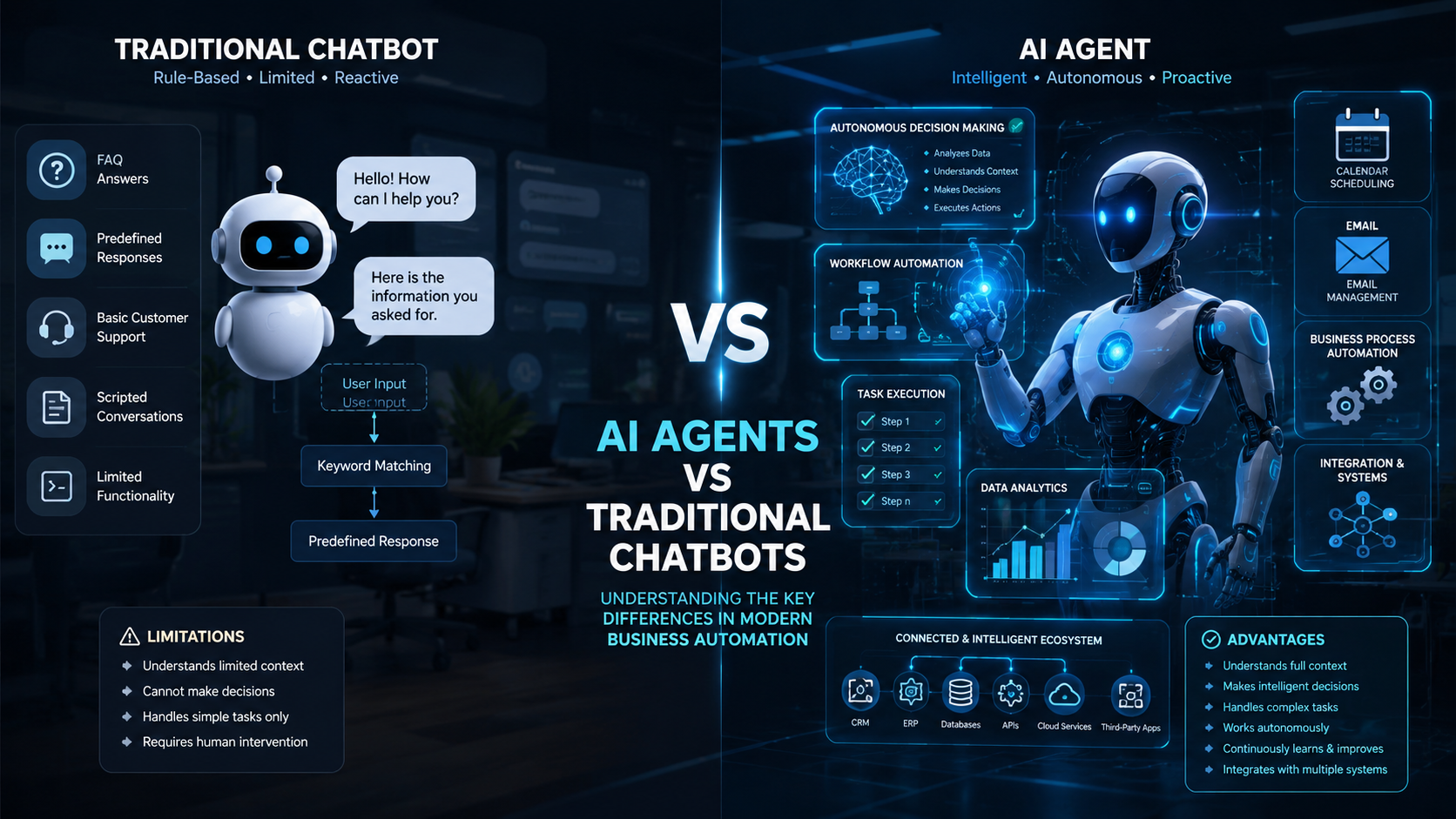
Most traditional chatbots follow predefined rules and conversation flows. They can only respond to questions they have been programmed to understand. If a user asks something unexpected, the chatbot may struggle to provide a useful answer.
Because of their simplicity, traditional chatbots are often used for basic customer service and support.
How Traditional Chatbots Work
A traditional chatbot works by matching keywords or user inputs with predefined responses. When a customer asks a question, the chatbot searches its database for the closest match and provides the appropriate answer.
For example, if a customer asks about an order status, the chatbot may request an order number and then display available information. The entire conversation follows a fixed path that has been created by developers.
This approach works well for simple requests but becomes less effective when conversations become more complex.
Benefits of Traditional Chatbots
Traditional chatbots offer several advantages for businesses that need simple automation.
They are affordable to implement, easy to maintain, and capable of handling a large number of customer inquiries at the same time. They can also reduce the workload of customer support teams by answering frequently asked questions instantly.
For small businesses or organizations with straightforward support requirements, traditional chatbots can be a practical solution.
Limitations of Traditional Chatbots
While traditional chatbots are useful, they have several limitations.
They often struggle to understand complex questions, lack contextual understanding, and cannot make decisions on their own. Their responses are limited to the information and workflows that have been programmed into them.
As customer expectations continue to grow, these limitations can lead to frustrating user experiences and missed business opportunities.
What Are AI Agents?
AI agents are advanced artificial intelligence systems that can understand goals, analyze information, make decisions, and perform tasks independently.
Unlike traditional chatbots, AI agents do not simply answer questions. They can take action, complete workflows, and interact with multiple systems to achieve a desired outcome.
You can think of an AI agent as a digital assistant that not only understands what you want but can also perform the work required to accomplish it.
How AI Agents Work
AI agents use advanced technologies such as Large Language Models (LLMs), machine learning, natural language processing, and workflow automation.
When a user provides a request, the AI agent understands the objective, creates a plan, gathers information, and executes the necessary steps to complete the task.
For example, if a user asks an AI agent to schedule a meeting, it can check calendars, find available time slots, send invitations, and confirm the appointment without requiring manual assistance.
This ability to perform multiple actions makes AI agents far more powerful than traditional chatbots.
Benefits of AI Agents
AI agents provide a higher level of automation and intelligence.
They can understand context, remember previous interactions, handle complex requests, and complete multi-step tasks. This allows businesses to automate processes that previously required human involvement.
AI agents can also improve productivity, reduce operational costs, and provide more personalized customer experiences.
As organizations continue to adopt automation, AI agents are becoming valuable tools for improving efficiency across many industries.
Comparing AI Agents and Traditional Chatbots
The biggest difference between AI agents and traditional chatbots is their level of intelligence and autonomy.
Traditional chatbots focus on answering questions and guiding users through predefined conversations. AI agents, on the other hand, can understand goals, make decisions, and take action to complete tasks.
Chatbots are best suited for simple interactions, while AI agents are designed to handle more advanced business processes and complex workflows.
In simple terms, a chatbot can tell you what to do, while an AI agent can actually do it for you.
Which Solution Is Better for Your Business?
The right choice depends on your business requirements.
If your goal is to answer customer questions, provide basic support, or automate simple interactions, a traditional chatbot may be enough.
However, if you want to automate business processes, improve productivity, and handle more complex tasks, AI agents offer significantly greater capabilities.
Many organizations are now combining both technologies, using chatbots for basic interactions and AI agents for advanced automation.
The Future of AI-Powered Automation
The future of artificial intelligence is moving beyond simple conversations. Businesses are increasingly adopting AI systems that can think, plan, and perform tasks independently.
As technology continues to advance, AI agents are expected to play a major role in customer service, software development, manufacturing, healthcare, finance, and many other industries.
While traditional chatbots will continue to serve specific purposes, AI agents are likely to become the preferred choice for organizations seeking smarter and more efficient automation.
Conclusion
Both AI agents and traditional chatbots help businesses improve efficiency and customer experience, but they serve different purposes.
Traditional chatbots are ideal for handling simple and repetitive conversations, while AI agents are designed to understand complex requests, make decisions, and complete tasks independently.
As businesses continue to embrace digital transformation, AI agents are emerging as the next step in intelligent automation. Understanding the strengths of each technology can help organizations choose the solution that best supports their goals and future growth.
