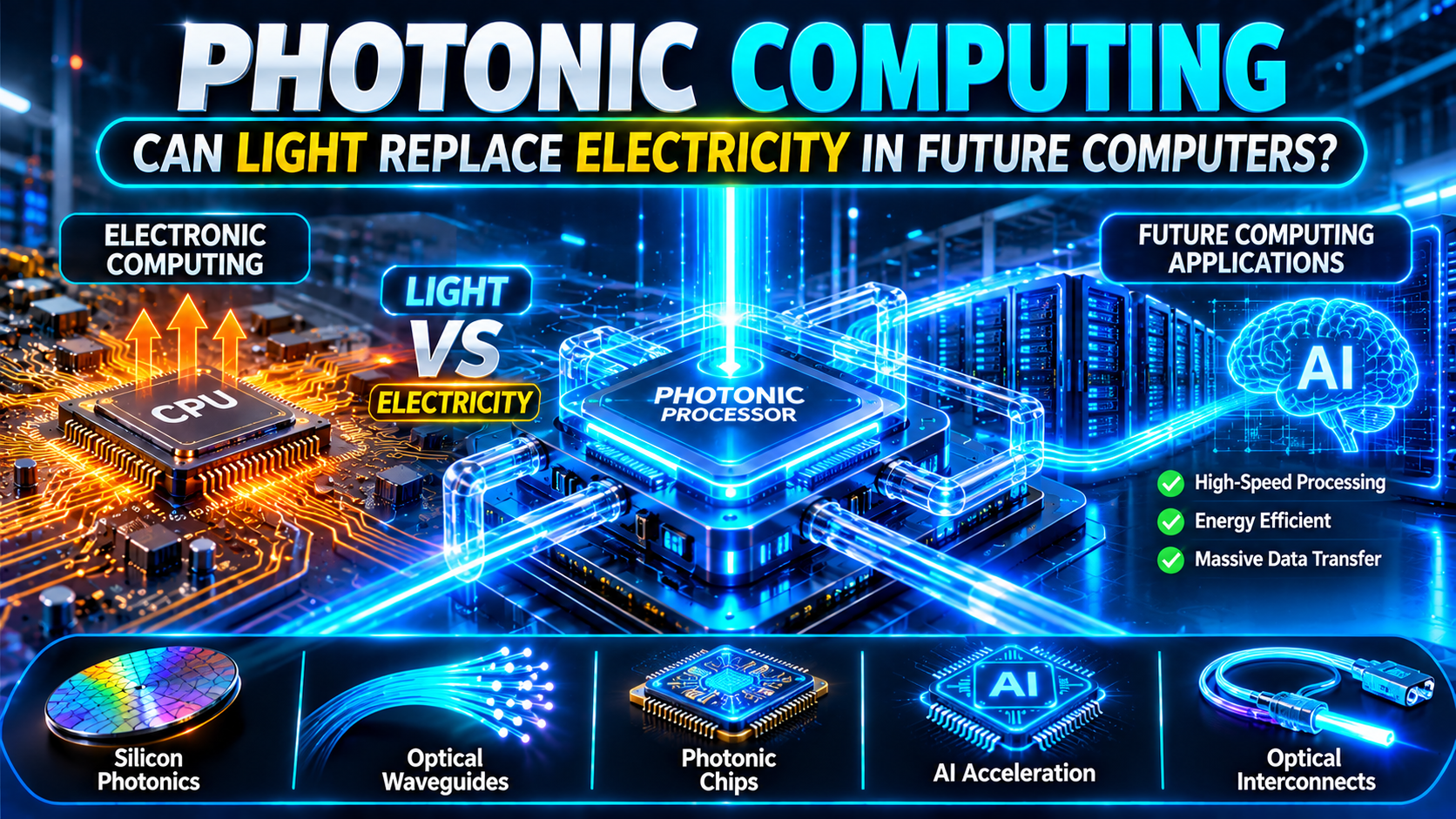
Computing technology is developing rapidly, and modern computers are expected to process more information than ever before. Artificial intelligence, cloud computing, scientific research, and advanced applications require powerful processors that can handle large amounts of data.
However, traditional electronic computers face challenges such as heat generation, energy consumption, and limitations in moving data between processors.
To address some of these challenges, researchers are exploring a new technology called Photonic Computing.
Photonic computing uses light signals instead of relying entirely on electrical signals to perform certain computing operations. It could help future computers process information faster, transfer large amounts of data, and improve energy efficiency.
But how does this technology work? Can light really replace electricity in computers? Let’s explore.
1. What Is Photonic Computing?
Photonic computing is a technology that uses photons, which are particles of light, to carry and process information.
Traditional computers use electrical signals that move through electronic components such as transistors and circuits. Photonic computers use light signals that travel through optical components such as waveguides, lasers, and optical switches.
These optical components can manipulate light to perform specific mathematical operations and information-processing tasks.
Example: Traditional computers use electrical signals to transfer data between processors. Photonic technology can use light travelling through optical pathways to transfer information at very high speeds.
An important technology behind this development is Silicon Photonics, which integrates optical components with silicon-based semiconductor technology.
2. Why Do We Need Photonic Computing?
Traditional electronic processors have become extremely powerful, but modern computing workloads are creating new challenges.
Increasing Data Processing Requirements
Artificial intelligence models, cloud platforms, and scientific applications require enormous amounts of computing power.
Moving large quantities of data between processors and memory can become a major performance limitation.
Heat Generation
Electronic components generate heat when electrical current flows through circuits.
As processors become more powerful and densely packed, managing heat becomes increasingly important.
Energy Consumption
Large data centers use significant amounts of electricity to operate processors, storage systems, networking equipment, and cooling infrastructure.
More efficient computing and communication technologies are needed to manage these demands.
Communication Bottlenecks
Traditional electrical connections can face bandwidth and signal-quality limitations when transferring large amounts of information between chips.
Photonic technology offers a possible solution by using optical connections with high bandwidth and low signal loss over suitable distances.
3. How Does Photonic Computing Work?
Photonic computing combines optical signals, specialized materials, and electronic control systems to process information.
The working process generally involves several stages.
Step 1: Generating Light Signals
A laser or another suitable light source generates optical signals.
These signals carry information that can be represented through different properties of light, such as intensity, phase, wavelength, or polarization.
Step 2: Encoding Information
The information is converted into optical signals using devices called optical modulators.
These devices control properties of light to represent digital or analogue information.
Step 3: Processing Information Using Light
The optical signals travel through specialized components such as waveguides, optical filters, and interferometers.
These components manipulate light to perform certain mathematical operations.
For example, photonic processors can perform matrix multiplication, an important operation used in artificial intelligence and machine learning.
Step 4: Detecting Optical Signals
After processing, photodetectors convert the optical signals into electrical signals.
These signals can then be analyzed by electronic circuits or other computing components.
Step 5: Producing Results
The electronic system interprets the processed information and provides the final output.
This combination of optical processing and electronic control is commonly called hybrid optoelectronic computing.
4. Key Technologies Behind Photonic Computing
Photonic computing depends on several advanced technologies that help generate, control, transmit, and process light.
Silicon Photonics
Silicon photonics integrates optical components into silicon-based chips.
It allows light to travel through tiny optical pathways and interact with specialized components.
This technology is particularly useful for high-speed communication between computer chips and data-center equipment.
Optical Waveguides
Optical waveguides are tiny structures that guide light from one location to another.
They work similarly to optical fibres but can be integrated directly onto a chip.
Optical Modulators
Optical modulators control properties of light to encode information.
They help convert electronic data into optical signals.
Photodetectors
Photodetectors receive light signals and convert them into electrical signals that electronic circuits can process.
Optical Switches
Optical switches control the direction of light signals, allowing information to move between different optical pathways.
Photonic Integrated Circuits
Photonic Integrated Circuits (PICs) combine multiple optical components into a single chip.
They help reduce the size of optical systems and make it possible to build more advanced photonic devices.
5. Photonic Computing vs Traditional Electronic Computing
Both technologies process information, but they use different methods.
| Feature | Electronic Computing | Photonic Computing |
|---|---|---|
| Information carrier | Electrons and electrical signals | Photons and light signals |
| Main components | Transistors and electronic circuits | Lasers, waveguides and optical components |
| Data transmission | Electrical connections | Optical pathways |
| Processing method | Electronic logic operations | Optical manipulation and computation |
| Heat generation | Electrical resistance contributes to heat | Optical pathways can reduce certain resistive losses |
| Bandwidth | Limited by electrical interconnect characteristics | Potentially very high optical bandwidth |
| Technology maturity | Widely established | Emerging for general-purpose computing |
Photonic computing does not automatically outperform electronic computing in every task. Each technology has different strengths and limitations.
6. Real-World Applications of Photonic Computing
Photonic computing has several promising applications across modern industries.
Artificial Intelligence and Machine Learning
AI systems perform large numbers of mathematical calculations, particularly matrix multiplications.
Photonic processors can perform certain mathematical operations using optical signals, potentially accelerating some AI workloads.
Data Centers and Cloud Computing
Modern data centers transfer enormous amounts of information between processors, servers, and storage systems.
Silicon photonics and optical interconnects can help improve communication speed and bandwidth while reducing certain energy costs.
High-Performance Computing
Scientific simulations, weather modelling, engineering research, and complex mathematical calculations require powerful computing systems.
Photonic accelerators may help speed up selected computational operations.
Autonomous Vehicles
Autonomous vehicles use cameras, sensors, and advanced computing systems to understand their surroundings.
Photonic technologies may support high-speed data processing and optical sensing applications.
Medical and Scientific Research
Photonic technologies can support advanced imaging, optical sensing, biomedical analysis, and scientific computing.
They may help researchers process complex information more efficiently.
Telecommunications
Optical communication already plays an important role in modern internet infrastructure.
Photonic components help transmit large amounts of information through optical fibre networks.
7. Benefits of Photonic Computing
Photonic computing offers several potential advantages over conventional electronic approaches.
High-Speed Data Transmission
Light can carry large amounts of information through optical communication channels.
This makes photonic technology attractive for high-bandwidth data transfer.
Lower Communication Energy
Optical connections can reduce certain electrical transmission losses, especially in high-speed chip-to-chip and data-center communication.
Reduced Heat from Certain Operations
Optical processing can avoid some resistive heating associated with electrical computation.
However, lasers, detectors, electronic interfaces, and supporting circuits still consume energy and generate heat.
Parallel Processing
Different optical signals can travel through the same system using different wavelengths, polarizations, or spatial paths.
This creates opportunities for parallel information processing.
AI Acceleration
Photonic processors can perform certain mathematical operations efficiently, making them promising candidates for specialized AI acceleration.
8. Challenges and Limitations of Photonic Computing
Despite its potential, photonic computing still faces several engineering challenges.
Optical Memory Limitations
Traditional electronic computers use memory technologies such as RAM and storage devices to store information.
Photonic systems do not yet have a widely practical equivalent of general-purpose electronic memory for storing arbitrary data directly in light.
Therefore, many photonic computing systems still depend on electronic memory.
Data Conversion Requirements
Photonic systems often need to convert electrical signals into optical signals and convert optical signals back into electrical signals.
These conversion processes consume energy and can introduce additional delays.
Manufacturing Complexity
Building advanced photonic chips requires precise optical components, specialized materials, and sophisticated manufacturing processes.
Producing large-scale systems at affordable costs remains challenging.
Processing Accuracy
Some photonic computing systems use analogue optical operations.
Small variations in light intensity, temperature, and component characteristics can affect computational accuracy.
Integration with Existing Computers
Photonic processors must work together with electronic processors, memory systems, and software platforms.
Creating reliable and efficient integration between these technologies is a major engineering challenge.
High Development Costs
Research, manufacturing, testing, and packaging of photonic chips can require significant investment.
9. The Future of Photonic Computing
The future of photonic computing is closely connected to the growing demand for artificial intelligence, high-performance computing, and faster data communication.
Researchers and technology companies are exploring new ways to integrate optical and electronic components into advanced computer systems.
Some important future developments include:
Optical AI Accelerators: Specialized photonic processors may accelerate selected AI calculations and machine learning workloads.
Co-Packaged Optics: Optical communication components may be integrated closer to electronic processors to improve data movement between chips.
Advanced Silicon Photonics: More compact and efficient photonic components may support larger optical systems.
Hybrid Computing Systems: Future computers may combine electronic processors, photonic accelerators, and electronic memory.
Energy-Efficient Data Centers: Optical communication and specialized photonic processing may help address increasing data-center bandwidth and energy requirements.
These developments could make photonic technology an important part of future computing infrastructure.
10. Can Light Completely Replace Electricity in Future Computers?
Photonic computing has exciting potential, but completely replacing electricity with light is unlikely in the near future.
Electronic circuits are still excellent at performing digital logic operations, controlling devices, storing information, and managing complex computing tasks.
Photonic systems are particularly promising for high-speed communication and selected mathematical operations.
Instead of replacing electronic computers entirely, the most practical future may involve hybrid systems where light and electricity work together.
For example, an electronic processor could control a system while a photonic accelerator handles specific mathematical calculations and optical connections transfer information between different chips.
This combination could provide better performance and efficiency for selected computing applications.
Conclusion
Photonic computing represents an exciting development in computer engineering. By using light to transmit and process information, it offers new possibilities for faster data communication, specialized AI acceleration, and more energy-efficient computing systems.
Technologies such as silicon photonics, optical waveguides, photonic integrated circuits, and optical processors are helping researchers develop the next generation of computing hardware.
Although challenges involving memory, accuracy, manufacturing, and electrical-to-optical conversion remain, photonic computing could become an important technology alongside traditional electronic computing.
The future of computers may not depend only on faster electronic chips. It may also depend on how effectively we can use light to process and transfer information.
