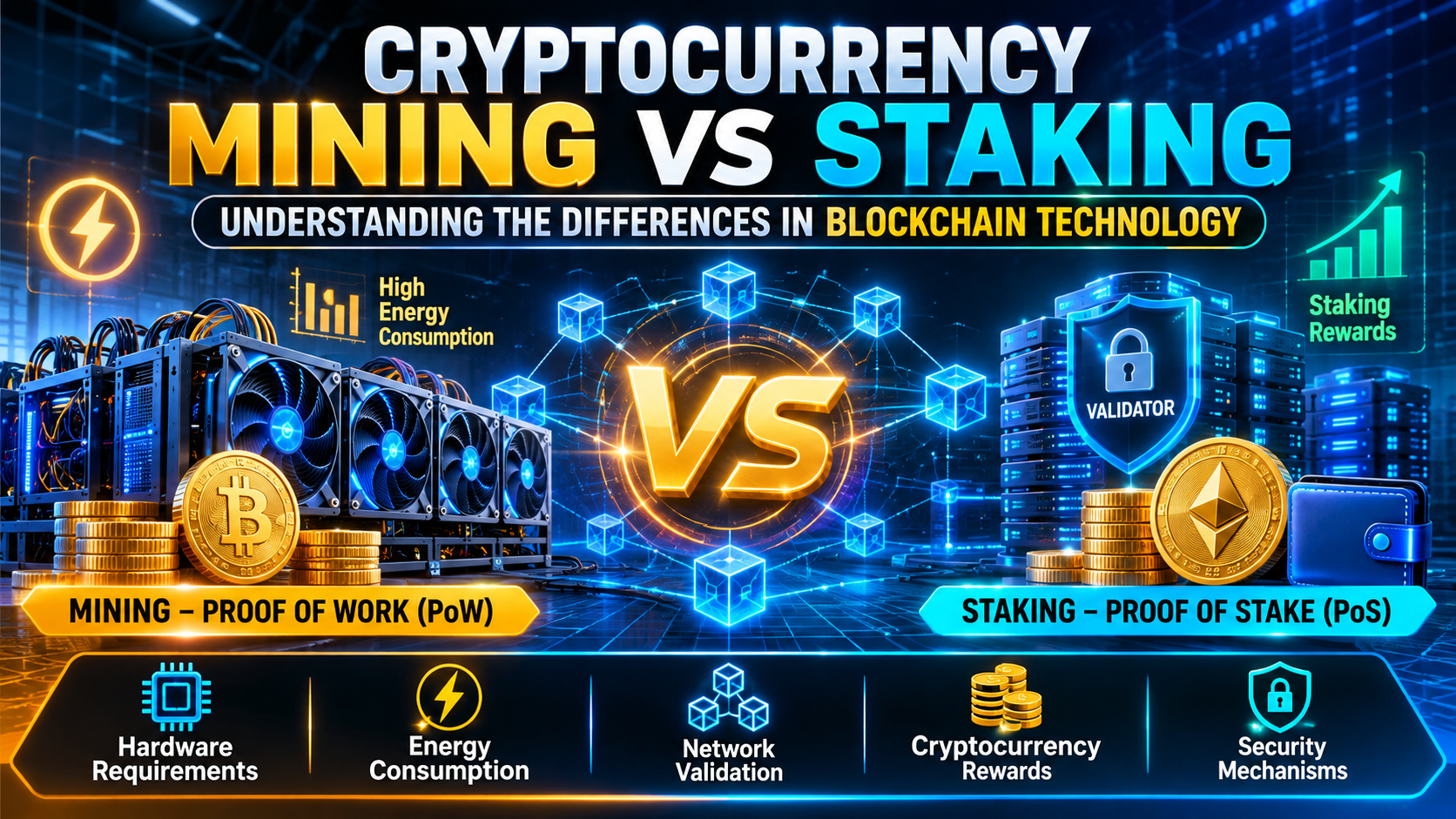
Cryptocurrency is changing the way people think about digital money and financial technology. Behind every cryptocurrency transaction, there is a system that helps verify transactions and keep the network secure.
Two important methods used by blockchain networks are cryptocurrency mining and cryptocurrency staking. Both help maintain blockchain networks, but they work in different ways.
Mining generally uses computer processing power to validate transactions, while staking uses cryptocurrency holdings to support the network. Understanding these methods can help readers learn how different blockchain systems operate.
1. What Is Cryptocurrency Mining?
Cryptocurrency mining is a process used by some blockchain networks to verify transactions and add new blocks to the blockchain.
Mining is mainly associated with a system called Proof of Work (PoW). In this system, miners use powerful computers to solve complex mathematical puzzles. The first eligible miner to solve the puzzle can add a new block to the blockchain, subject to the network’s rules.
As a reward, successful miners may receive newly created cryptocurrency and transaction fees.
Example: Bitcoin uses the Proof of Work system. Bitcoin miners use specialized computer equipment to compete in solving computational puzzles and help secure the network.
How Does Cryptocurrency Mining Work?
- Users make cryptocurrency transactions.
- Transactions are collected into a block.
- Miners use computer hardware to perform calculations.
- The network checks the proposed solution.
- A valid block is added to the blockchain.
- The successful miner receives the applicable block reward and transaction fees.
Mining requires specialized hardware, electricity, cooling systems, and technical knowledge. The cost of mining can be high, especially when competition increases.
2. What Is Cryptocurrency Staking?
Cryptocurrency staking is a process in which users commit or lock their cryptocurrency to help support a blockchain network.
Staking is commonly used by networks that operate through a system called Proof of Stake (PoS). Instead of solving complex mathematical puzzles, these networks select validators based partly on their stake and other protocol rules.
Validators help verify transactions and participate in adding new blocks. In return, they may receive staking rewards according to the network’s rules.
Example: Ethereum uses Proof of Stake. People can stake ETH directly or participate through supported staking services and pools.
How Does Cryptocurrency Staking Work?
- A user holds cryptocurrency supported by a Proof of Stake network.
- The user commits cryptocurrency to the staking process.
- The network selects validators according to its rules.
- Validators help verify transactions and propose or confirm blocks.
- The network distributes rewards according to its protocol.
Staking generally requires less computing power than mining. However, users may face lock-up periods, changing reward rates, network penalties, and price fluctuations.
3. Cryptocurrency Mining vs Staking: Key Differences
Mining and staking both help blockchain networks operate securely, but their methods are different.
| Feature | Mining | Staking |
|---|---|---|
| Technology | Proof of Work | Proof of Stake |
| Main requirement | Computing power | Cryptocurrency stake |
| Hardware | Often specialized equipment | Usually a compatible device or staking service |
| Electricity usage | Generally high | Generally much lower |
| Network participation | Miners compete to solve puzzles | Validators are selected by network rules |
| Rewards | Block rewards and transaction fees | Protocol-based staking rewards |
| Main costs and risks | Hardware, electricity, maintenance | Price changes, lock-ups, penalties |
| Example | Bitcoin | Ethereum |
4. Advantages of Cryptocurrency Mining
Network Security: Mining makes it expensive and difficult for attackers to control a Proof of Work blockchain.
Decentralization: Independent miners can participate in transaction validation, depending on the network and its mining requirements.
Potential Rewards: Successful miners may earn cryptocurrency rewards and transaction fees.
Established Technology: Proof of Work has been used by Bitcoin for many years and is a well-known blockchain consensus mechanism.
5. Disadvantages of Cryptocurrency Mining
High Electricity Consumption: Mining operations can consume significant amounts of electricity.
Expensive Hardware: Competitive mining may require specialized equipment, which can involve a large initial investment.
Maintenance Costs: Mining hardware produces heat and requires cooling, maintenance, and suitable operating conditions.
Competition: As more miners participate, mining difficulty and competition can increase, affecting potential profitability.
6. Advantages of Cryptocurrency Staking
Lower Energy Consumption: Proof of Stake does not require miners to solve energy-intensive mathematical puzzles.
No Specialized Mining Hardware: Many staking methods do not require expensive mining machines.
Network Participation: Staking allows cryptocurrency holders to help support blockchain operations.
Potential Rewards: Participants may receive rewards for helping secure and operate a Proof of Stake network.
7. Disadvantages of Cryptocurrency Staking
Market Risk: The value of staked cryptocurrency can decrease, even when staking rewards are received.
Lock-Up Periods: Some networks or staking services restrict access to staked assets for a certain period.
Slashing Risk: Certain Proof of Stake networks can penalize validators for specific failures or rule violations. Depending on the protocol, delegated participants may also be affected.
Changing Rewards: Staking rewards are not fixed and can change according to network conditions and protocol rules.
8. Which Is Better: Mining or Staking?
There is no single answer because mining and staking serve different blockchain systems.
Mining may be suitable for people interested in Proof of Work networks who have access to suitable hardware, affordable electricity, and the technical knowledge to operate mining equipment.
Staking may be more accessible to cryptocurrency holders who want to participate in Proof of Stake networks without running specialized mining machines.
However, both methods involve risks. Mining profitability depends on factors such as electricity costs, hardware prices, mining difficulty, and cryptocurrency prices. Staking involves risks such as market volatility, lock-up restrictions, validator penalties, and platform security.
Neither method guarantees profit.
9. The Future of Cryptocurrency Mining and Staking
Blockchain technology continues to develop, and both mining and staking are expected to remain important parts of the cryptocurrency ecosystem.
Proof of Work networks continue to focus on network security, mining efficiency, and improvements in hardware and energy use.
Proof of Stake networks are developing new approaches to validator participation, staking pools, and network scalability.
As blockchain adoption grows, understanding these two methods will become increasingly important for developers, businesses, and people interested in cryptocurrency technology.
Conclusion
Cryptocurrency mining and staking are two different methods used to maintain blockchain networks and verify transactions.
Mining uses computing power through Proof of Work, while staking uses cryptocurrency commitments through Proof of Stake. Mining generally requires more electricity and specialized hardware, whereas staking generally requires less energy but introduces risks related to locked assets and validator penalties.
Understanding their differences helps readers better understand how blockchain networks work and why different cryptocurrencies use different consensus mechanisms.
