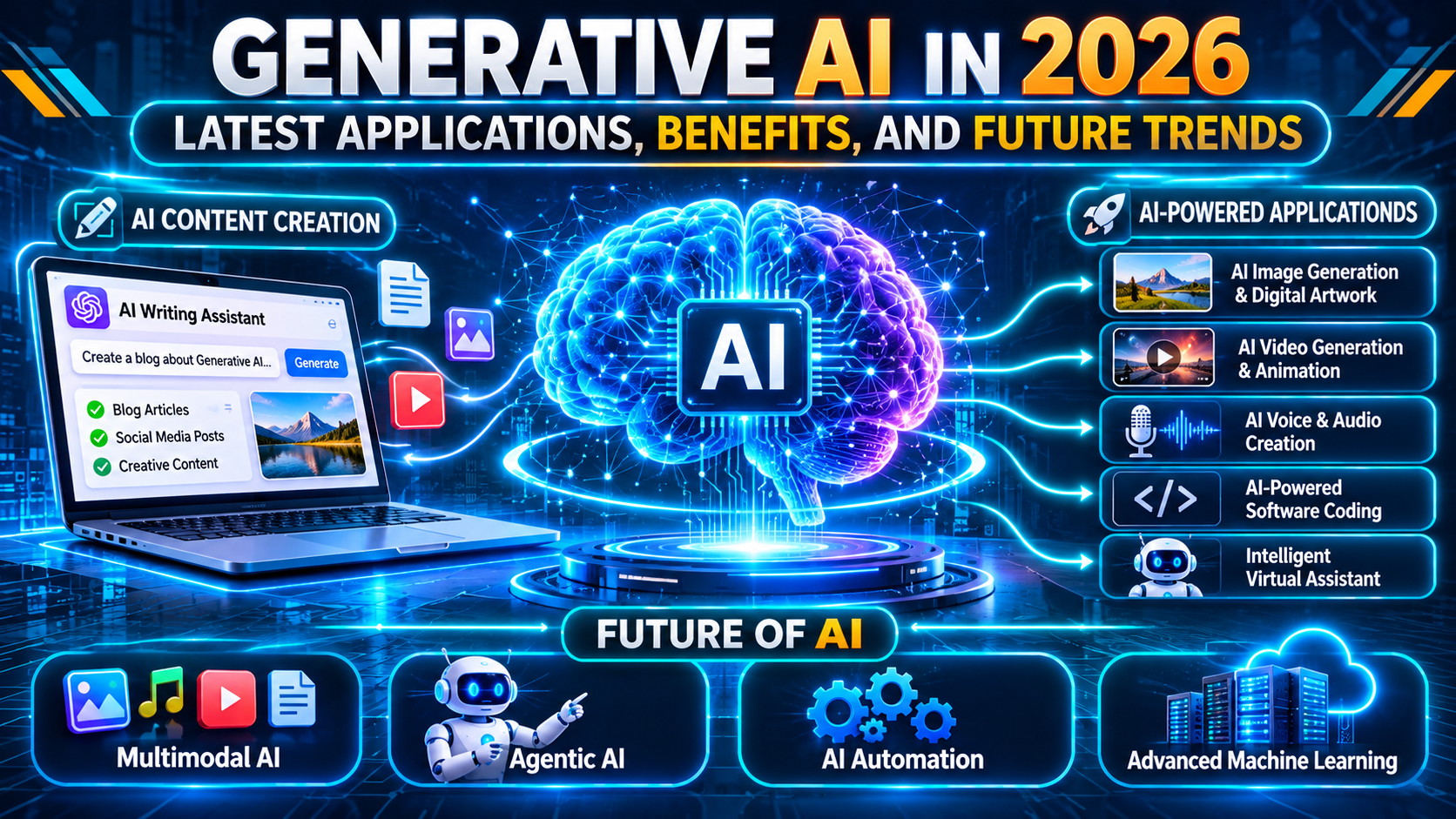
Artificial Intelligence (AI) is changing the way people work, learn, and use technology. One of the most exciting developments in AI is Generative AI. It is a technology that can create new content, such as text, images, videos, music, and computer code.
In 2026, Generative AI is becoming useful in many areas, including education, healthcare, software development, business, and digital marketing. It helps people save time, complete tasks faster, and explore new creative ideas.
For example, you can use Generative AI to write an article, create a website design, generate an image, or get help with programming. Let’s understand how this technology works, where it is used, what benefits it offers, and what we can expect in the future.
1. What Is Generative AI?
Generative AI is a type of Artificial Intelligence that can create new content based on information it has learned from large amounts of data.
Traditional AI is commonly used to analyze information, recognize patterns, or make predictions. Generative AI can also produce something new, such as a paragraph, an image, a video, or a piece of computer code.
For example, when you ask an AI tool to write a professional email or create an image of a futuristic city, it understands your instruction and generates content based on your request.
1.1 How Is Generative AI Different from Traditional AI?
Traditional AI mainly focuses on analyzing information and finding patterns. Generative AI focuses on creating new content using learned patterns.
For example:
- Traditional AI can identify whether an email is spam or not.
- Generative AI can write a new email based on your instructions.
- Traditional AI can recognize objects in an image.
- Generative AI can create a new image from a text description.
Both technologies are useful, but they are designed for different types of tasks.
1.2 Examples of Generative AI
Generative AI can perform many different tasks in everyday life.
- Text Generation: Writing articles, emails, reports, and descriptions.
- Image Generation: Creating digital artwork, posters, and illustrations.
- Video Generation: Producing video clips and animations.
- Audio Generation: Creating artificial voices, music, and sound.
- Code Generation: Helping developers write and understand programming code.
- Question Answering: Explaining topics and answering user questions.
In simple words, Generative AI allows computers to create useful content instead of only analyzing existing information.
2. How Does Generative AI Work?
Generative AI works by learning from large amounts of information. It uses advanced machine learning techniques to understand patterns and generate new results based on user instructions.
Let’s understand the process step by step.
2.1 Data Collection
First, an AI model is trained using large amounts of data. This information may include text, images, videos, audio, and other digital content.
The data helps the AI model understand language, images, and different types of information.
2.2 AI Model Training
After collecting data, machine learning algorithms process the information and learn patterns.
Technologies such as deep learning and neural networks help AI systems understand relationships between different pieces of information.
2.3 User Prompt
A prompt is an instruction or question given to an AI tool.
For example:
“Write a simple blog post about website development.”
The AI system uses this instruction to understand what the user wants.
2.4 AI Processing
The AI model processes the prompt and uses its learned patterns to generate a suitable response.
It considers the words, context, and instructions provided by the user.
2.5 Content Generation
Finally, the AI system generates the requested output.
It may create an article, image, video, computer code, or another type of content depending on the tool being used.
The quality of the result depends on the AI model, available information, and clarity of the user’s instructions.
3. Latest Applications of Generative AI in 2026
Generative AI is becoming useful in different industries. Businesses and individuals are using it to create content, improve productivity, and make everyday tasks easier.
Let’s explore some important applications.
3.1 AI Content Creation
Generative AI helps writers, bloggers, and digital marketers create content more quickly.
It can help prepare blog ideas, social media captions, product descriptions, email drafts, and website content.
For example, a blogger can use an AI assistant to generate article ideas or create an initial article draft. The writer can then review, edit, and improve the content before publishing it.
3.2 AI Image and Video Generation
AI image and video generation tools can create visual content from written instructions.
Users can describe what they want, and the AI system generates an image or video based on that description.
For example, a business can create promotional images, product concepts, social media graphics, and short video content using AI tools.
This technology is especially useful for designers, advertisers, and content creators.
3.3 AI in Software Development
Generative AI is also changing how developers write and manage computer programs.
AI coding assistants can help developers generate code, understand programming errors, create test cases, and prepare technical documentation.
For example, a beginner learning Python can ask an AI assistant to explain a program step by step.
However, developers should always check and test AI-generated code before using it in real projects.
3.4 AI in Healthcare
Generative AI can support healthcare professionals by helping them organize medical information, summarize documents, and support medical research.
It can also help explain general health information in simpler language.
However, AI should not replace qualified healthcare professionals. Medical information and AI-generated suggestions need proper professional review.
3.5 AI in Education
Generative AI is making learning more interactive and accessible.
Students can use AI tools to understand difficult topics, prepare study notes, generate practice questions, and learn programming concepts.
Teachers can also use AI to prepare educational materials and organize learning activities.
For example, a student can ask an AI assistant to explain database management in simple English with practical examples.
3.6 AI in Business and Customer Support
Businesses are using Generative AI to improve customer service and manage repetitive tasks.
AI-powered assistants can answer common customer questions, summarize conversations, prepare reports, and help employees find information.
For example, an online shopping website can use an AI assistant to answer questions about products, orders, and delivery information.
4. Major Benefits of Generative AI
Generative AI provides many benefits to individuals, developers, and businesses. It helps people complete tasks more efficiently and explore new possibilities.
4.1 Saves Time and Increases Productivity
Generative AI can help complete repetitive tasks such as writing emails, preparing reports, summarizing documents, and generating ideas.
Instead of spending hours preparing an initial draft, users can generate a starting point in less time and focus on improving the final result.
4.2 Reduces Workload and Costs
Businesses can use AI tools to support content creation, customer service, and other routine activities.
This can reduce the time employees spend on repetitive work and improve overall efficiency.
4.3 Improves Creativity
Generative AI can suggest new ideas, create designs, generate images, and help prepare marketing content.
Designers and content creators can use these suggestions as inspiration for their own creative projects.
4.4 Provides Personalized Experiences
AI systems can provide responses and suggestions based on user instructions and available context.
For example, an AI learning assistant can explain the same topic in different ways depending on what a student finds difficult.
4.5 Supports Software Development
Developers can use Generative AI to understand code, find possible errors, create examples, and prepare documentation.
It can be useful for both beginners and experienced programmers, but human review remains important for code quality and security.
5. Challenges and Future Trends of Generative AI
Although Generative AI offers many advantages, it also has some limitations. Understanding these challenges is important for using AI responsibly.
5.1 Incorrect Information
Sometimes Generative AI produces information that sounds correct but is actually wrong. This is often called an AI hallucination.
For example, an AI tool may provide an incorrect technical explanation or an inaccurate statistic.
Users should verify important information before publishing or using it.
5.2 Data Privacy and Security
Some AI tools process information provided by users. Sharing private documents, passwords, customer details, or confidential business information can create security risks.
Users and businesses should choose trusted tools and follow proper data protection practices.
5.3 Copyright and Originality
AI-generated images, text, and other content can raise questions about copyright and ownership.
Content creators should review the terms of the AI tools they use and make sure their published material follows applicable copyright rules.
5.4 AI Bias
AI models learn from training data. If the data contains incorrect or unfair patterns, the AI system may produce biased results.
Testing, human supervision, and responsible development are important to reduce these problems.
5.5 Future Trends of Generative AI
Generative AI is continuing to develop. In the coming years, AI systems may become more capable of understanding different types of information and performing complex tasks.
Some important trends include:
Multimodal AI: AI systems that can understand and work with text, images, audio, and video together.
Agentic AI: AI agents that can plan and perform multiple steps to complete tasks with suitable permissions and human supervision.
Smaller AI Models: More specialized AI models designed to perform particular tasks efficiently.
AI in Software Development: Advanced coding assistants that help with writing, testing, debugging, and understanding software.
AI-Powered Business Automation: AI systems that support business activities such as customer service, document processing, research, and workflow management.
These developments show that Generative AI is becoming more than just a content creation tool. It is developing into an important technology for software, business, education, and everyday digital activities.
Conclusion: What Is the Future of Generative AI?
Generative AI is changing the way people create content, develop software, learn new skills, and manage business activities.
From writing articles and generating images to supporting healthcare research and software development, its applications are growing across different industries.
However, users must also understand its limitations, including incorrect information, data privacy risks, copyright concerns, and AI bias.
As technology continues to improve, Generative AI is expected to become more powerful and useful in everyday life. Learning about this technology today can help students, developers, businesses, and content creators prepare for the future of Artificial Intelligence.
