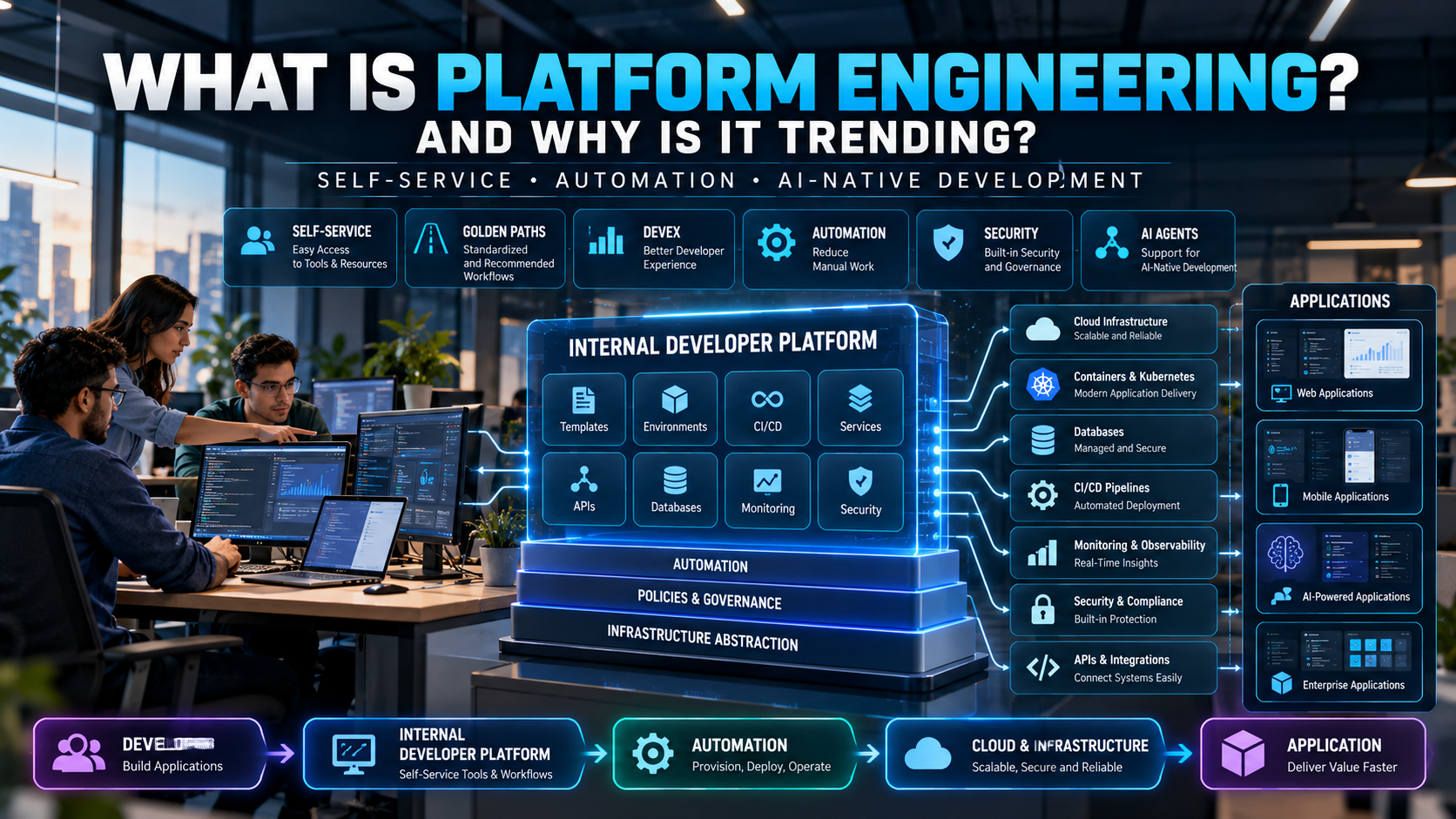
Software development has changed significantly over the last few years. Modern applications are no longer built using only a few servers and a simple database. Developers may now work with cloud platforms, containers, Kubernetes, APIs, CI/CD pipelines, databases, monitoring systems, security tools, and many other technologies.
This growing complexity can make software development slower and harder to manage.
Platform Engineering is becoming an important approach to solve this problem.
Instead of asking every developer to understand and manage complicated infrastructure, platform engineering creates a shared internal platform where developers can use ready-made tools, automated workflows, and self-service capabilities.
But what exactly is platform engineering, how does it work, and why is it becoming such an important software trend?
What Is Platform Engineering?
Platform engineering is the practice of designing and maintaining an internal platform that helps software development teams build, test, deploy, and operate applications more easily.
The platform provides developers with reusable tools, services, templates, automation, and workflows.
Instead of developers manually configuring infrastructure for every new application, they can use the platform to perform common tasks through a simpler interface.
For example, a developer might need to create a new application environment.
Without a platform, they may need to:
- Create cloud resources
- Configure networking
- Set up databases
- Configure authentication
- Create CI/CD pipelines
- Configure monitoring
- Set security policies
- Deploy the application
With a well-designed platform, many of these steps can be automated.
The developer could select a project template, provide a few details, and let the platform handle the underlying infrastructure.
The Cloud Native Computing Foundation describes platform engineering as a discipline focused on providing self-service capabilities to development teams, including workflows for provisioning, development, testing, deployment, and rollback.
What Is an Internal Developer Platform?
One of the most important concepts in platform engineering is the Internal Developer Platform (IDP).
An IDP is a collection of tools, services, automation, workflows, and infrastructure that developers inside an organization can use to build and deliver software.
Think of it as a self-service software development environment.
For example, a company might provide a developer portal where developers can:
- Create a new application
- Choose a technology template
- Create a development environment
- Provision a database
- Deploy an application
- View logs
- Check application health
- Access documentation
- Manage environments
- Monitor deployments
The developer does not necessarily need to understand every infrastructure detail behind these actions.
Microsoft describes internal developer platforms as a way to abstract technical complexity so developers can self-service common tasks while operating within security and governance controls.
How Does Platform Engineering Work?
Platform engineering usually works by placing a layer between developers and complex infrastructure.
A simplified workflow looks like this:
Developer → Internal Developer Platform → Automation → Cloud/Infrastructure
For example:
Developer requests application
↓
Platform provides approved template
↓
Infrastructure is automatically created
↓
Security and configuration policies are applied
↓
CI/CD pipeline is created
↓
Application is deployed
↓
Monitoring and logging are enabled
This means developers can focus more on building application features instead of repeatedly solving the same infrastructure problems.
What Problem Does Platform Engineering Solve?
Modern software teams face a major challenge: technology is becoming more powerful but also more complicated.
A development team may have to work with:
- Cloud services
- Kubernetes
- Docker
- Microservices
- APIs
- Databases
- CI/CD
- Infrastructure as Code
- Security systems
- Observability tools
- Multiple programming languages
- AI services
Learning and managing all of these technologies can create a large cognitive load for developers.
Platform engineering attempts to reduce this complexity.
Instead of every development team creating its own infrastructure solution, a platform team can create reusable solutions that many teams can use.
CNCF notes that platform engineering emerged partly because cloud-native architectures increased the complexity of software delivery and operations.
What Are Golden Paths in Platform Engineering?
Another important platform engineering concept is the Golden Path.
A Golden Path is an approved and simplified way of completing a common development task.
For example, a company may have a standard process for creating a Node.js application.
The Golden Path could automatically provide:
- Node.js project structure
- Docker configuration
- CI/CD pipeline
- Database configuration
- Logging
- Monitoring
- Security checks
- Deployment configuration
Developers can follow this predefined path instead of creating everything from scratch.
This does not mean developers lose flexibility.
They can still choose different approaches when necessary, but common projects can use standardized paths.
Google Cloud describes Golden Paths as part of internal developer platforms that help developers work with infrastructure through simpler, standardized workflows.
Why Is Platform Engineering Trending?
Platform engineering is trending because software development environments are becoming more complex.
Companies want developers to deliver software quickly, but they also need security, reliability, scalability, governance, and cost control.
Platform engineering attempts to balance these requirements.
Gartner’s 2026 Platform Engineering Hype Cycle identifies platform engineering as a major area focused on self-service internal developer platforms and improving developer experience and productivity.
Gartner also says that by 2026, 80% of large software engineering organizations are expected to establish platform engineering teams, compared with 45% in 2022.
This growing adoption is one reason platform engineering has become an important software engineering topic.
How Does Platform Engineering Improve Developer Experience?
Developer experience, often called DevEx, is another major reason behind platform engineering.
Developers can lose significant time on repetitive tasks.
For example:
A developer may spend time creating environments, configuring deployment files, requesting infrastructure, checking permissions, and troubleshooting deployment processes.
A platform can automate many of these activities.
This allows developers to spend more time on:
- Writing application code
- Designing features
- Solving business problems
- Testing products
- Improving user experiences
The goal is not simply to give developers more tools.
The goal is to make those tools easier to use.
Platform Engineering vs DevOps
Platform engineering and DevOps are closely related, but they are not exactly the same thing.
DevOps is a broader approach that encourages development and operations teams to work together and automate software delivery.
Platform engineering focuses on building reusable platforms and self-service capabilities that help development teams use DevOps practices at scale.
A simple way to understand the difference is:
DevOps:
“Developers and operations teams should collaborate and automate.”
Platform Engineering:
“Let’s build a platform that makes the right workflows easier and reusable for developers.”
CNCF describes platform engineering as an approach that can scale DevOps principles through a unified platform serving multiple development teams.
Platform Engineering vs Cloud Engineering
Cloud engineering focuses heavily on designing, operating, and managing cloud infrastructure.
Platform engineering uses that infrastructure to create a simpler experience for application developers.
For example:
A cloud engineer may configure Kubernetes infrastructure.
A platform engineer may create a developer workflow that allows developers to deploy applications to Kubernetes without needing to understand every Kubernetes configuration detail.
The two roles can work closely together.
What Tools Are Used in Platform Engineering?
Platform engineering is not based on one specific tool.
Organizations can combine different technologies depending on their requirements.
Common technologies can include:
- Kubernetes
- Docker
- Terraform
- GitHub
- GitLab
- CI/CD systems
- Cloud platforms
- Infrastructure as Code
- Monitoring platforms
- Logging systems
- Developer portals
- Service catalogs
- Secrets management
- Security tools
Open-source projects such as Backstage are also associated with internal developer portals and platform engineering.
The important part is not the number of tools.
The important part is how these tools are integrated into a useful developer experience.
What Is Platform as a Product?
A successful platform should not be treated as just an internal IT project.
Platform engineering teams increasingly use a Platform as a Product approach.
In this model, developers are treated as the customers of the internal platform.
The platform team needs to understand:
- What developers need
- Which workflows are difficult
- Which tasks are repetitive
- Which tools cause problems
- What developers actually use
- What improvements would save time
The platform can then be continuously improved based on developer feedback.
CNCF describes this mindset as treating the internal platform as a product and developers as its users or customers.
How Does AI Change Platform Engineering?
AI is creating another important reason for platform engineering.
Developers are increasingly using AI coding tools and AI agents to generate and modify software.
This can increase development speed, but it can also increase the number of changes moving through engineering systems.
Platform teams may therefore need to provide AI-friendly environments with:
- Secure access to infrastructure
- Standard development environments
- Automated testing
- Code quality checks
- Security controls
- Deployment policies
- Observability
- AI agent permissions
- Governance
In 2026, CNCF discussions around platform engineering are increasingly focused on supporting AI-native workloads and AI agents, not only human developers.
Gartner has also specifically highlighted the need to adapt platform engineering for AI-native software development.
Can Platform Engineering Support AI Agents?
Yes.
This is becoming an interesting future direction.
Imagine an AI coding agent that needs to:
- Create an application
- Provision a development environment
- Run tests
- Build a container
- Deploy the application
- Monitor the deployment
- Report problems
Instead of giving the AI agent unrestricted access to infrastructure, a platform could provide controlled workflows and permissions.
The platform could decide:
What the agent can do
Which resources it can access
Which environments it can use
Which actions require human approval
This creates a controlled environment where AI agents can interact with software infrastructure.
This is one reason platform engineering is becoming connected with the broader trend toward agentic software development.
What Are the Benefits of Platform Engineering?
Platform engineering can provide several potential benefits.
Faster Software Delivery
Automated workflows can reduce the time required to create environments and deploy applications.
Less Repetitive Work
Developers do not have to repeatedly perform the same infrastructure tasks.
Better Developer Experience
Self-service tools can make development workflows simpler.
Improved Consistency
Teams can use standardized templates and approved configurations.
Better Security
Security policies can be integrated into common development workflows.
Easier Scaling
A shared platform can support multiple development teams.
Better Governance
Organizations can define approved processes and controls.
Reduced Cognitive Load
Developers do not need to understand every underlying infrastructure component to perform common tasks.
These benefits explain why platform engineering is attracting attention as software systems become more distributed and complex.
What Are the Challenges of Platform Engineering?
Platform engineering is not automatically successful.
Building an internal platform can also introduce new challenges.
Platform Complexity
If a platform becomes too complicated, developers may avoid using it.
Poor Developer Experience
A platform should make development easier, not create another layer of bureaucracy.
High Initial Investment
Creating automation, infrastructure templates, security controls, and developer portals requires engineering effort.
Maintenance
The platform itself needs continuous updates and support.
Adoption
Developers need to understand the benefits and actually use the platform.
Too Much Abstraction
Hiding too much infrastructure can sometimes make debugging harder.
Tool Overload
Adding too many tools can make the platform harder to understand.
A successful platform therefore needs to balance standardization with developer flexibility.
Is Platform Engineering Replacing DevOps?
No.
Platform engineering is better understood as an evolution that can help organizations scale DevOps practices.
DevOps principles such as automation, collaboration, continuous delivery, monitoring, and shared responsibility remain important.
Platform engineering builds reusable systems around these principles.
Instead of every development team solving the same problems independently, a platform team can create shared solutions.
What Does the Future of Platform Engineering Look Like?
The future of platform engineering is likely to become increasingly connected with AI, automation, cloud infrastructure, security, and developer experience.
Future internal developer platforms may provide developers and AI agents with self-service access to:
- Development environments
- Cloud resources
- Databases
- APIs
- CI/CD pipelines
- Security tools
- Testing systems
- Observability
- AI infrastructure
- Deployment workflows
Instead of developers manually interacting with dozens of infrastructure tools, they may interact with one platform that coordinates these services.
The platform could become the common interface between developers, infrastructure, security systems, cloud services, and AI agents.
Will Platform Engineering Become More Important?
As software architectures become more complex, organizations need ways to reduce unnecessary complexity without slowing developers down.
Platform engineering addresses this challenge through self-service, automation, reusable components, standardized workflows, and better developer experiences.
The growing focus on AI-native development adds another dimension. Platform teams may increasingly need to support not only human developers but also AI agents that can create, modify, test, and deploy software.
That makes platform engineering an important part of the changing software development ecosystem.
Conclusion
Platform Engineering is the practice of building internal platforms that make software development easier, faster, safer, and more standardized.
Its main goal is not simply to create another tool.
The goal is to create a self-service developer experience where teams can build and deploy applications without repeatedly dealing with complex infrastructure.
As cloud-native systems, Kubernetes, microservices, DevOps, AI coding agents, and AI-native applications continue to grow, the infrastructure behind software is becoming more complex.
Platform engineering provides a way to manage that complexity.
The future may therefore be less about developers managing every infrastructure detail themselves and more about developers using intelligent platforms that automate the complexity behind modern software delivery.
