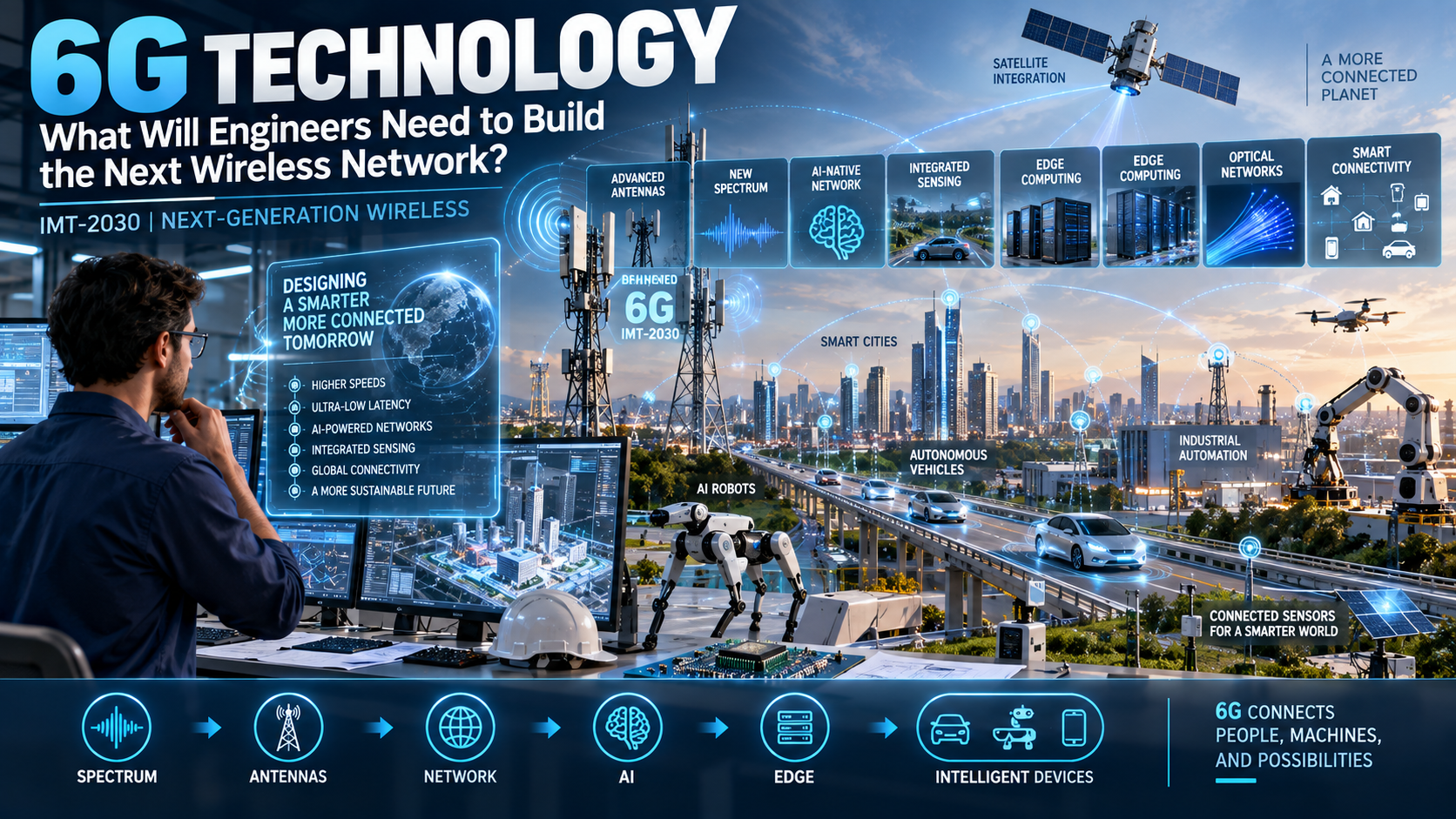
5G is still expanding around the world, but engineers are already working on the next generation of wireless communication: 6G.
6G is officially being developed by the International Telecommunication Union (ITU) under the name IMT-2030. The goal is not simply to create faster mobile internet. 6G is being designed to connect communication with artificial intelligence, sensing, computing and intelligent devices.
So, what will engineers need to build the next wireless network?
The answer includes advanced antennas, new spectrum technologies, AI, powerful chips, edge computing, optical networks, better security and energy-efficient infrastructure.
What Is 6G Technology?
6G Is the Next Generation of Wireless Communication
6G is the generation of wireless technology that will follow 5G.
The ITU calls this future technology IMT-2030. Its framework includes new capabilities and use cases that go beyond today’s 5G networks.
In simple terms:
4G → Faster mobile internet
5G → Faster connectivity + lower latency + more connected devices
6G → Connectivity + AI + sensing + computing + intelligent networks
This means 6G is being designed as more than just another faster mobile network.
Why Is 6G Being Developed?
What Problems Could 6G Solve?
The number of connected devices is increasing rapidly.
People are connecting smartphones, watches, vehicles, cameras, industrial machines, robots and many other devices to networks.
Future applications may also require extremely reliable communication and very low delays.
6G is being developed to support these changing requirements.
The ITU’s IMT-2030 framework includes six major usage scenarios:
- Immersive communication
- Hyper-reliable and low-latency communication
- Massive communication
- Ubiquitous connectivity
- AI and communication
- Integrated sensing and communication
How Fast Could 6G Be?
Will 6G Be Much Faster Than 5G?
Higher data speeds are one part of the 6G vision.
The ITU’s technical requirements include very high peak data-rate targets, but these are technical performance requirements, not a promise that every consumer will receive those speeds.
Faster networks could help support applications such as:
- Immersive video
- Augmented reality
- Virtual reality
- Cloud gaming
- Real-time industrial applications
- Large AI workloads
- Advanced connected devices
But speed is only one part of the 6G story.
6G Is More Than Speed
Why Is 6G Different From Simply Faster 5G?
Imagine a network that can do more than transfer data.
It could also help:
- AI systems communicate
- Machines understand their surroundings
- Robots communicate with edge computers
- Vehicles exchange information
- Sensors detect movement
- Networks automatically optimize themselves
This is why 6G is increasingly being discussed as an intelligent communication platform.
Current industry discussions also describe AI, sensing and AI-capable devices as important parts of the emerging 6G ecosystem.
What Will Engineers Need to Build 6G?
The Main Building Blocks of 6G
Building 6G will require many technologies to work together.
Some of the major building blocks include:
Advanced antennas + new spectrum + AI + semiconductors + edge computing + optical networks + sensing + cybersecurity
Each technology solves a different engineering challenge.
What Role Will Spectrum Play?
Why Does 6G Need New Frequencies?
Wireless communication depends on radio spectrum.
More connected devices and higher data requirements create pressure to use spectrum more efficiently.
Engineers are therefore researching additional frequency ranges and new ways to use existing spectrum.
The ITU’s IMT-2030 work includes evaluation of new radio technologies and channel models designed for advanced 6G capabilities.
Could 6G Use Very High Frequencies?
What About Terahertz Communication?
Researchers are investigating extremely high-frequency communication, including possible terahertz (THz) technologies.
Very high frequencies can provide large amounts of bandwidth.
However, they also create challenges.
Signals at very high frequencies can have difficulty traveling long distances and can be affected by obstacles and the surrounding environment.
Engineers therefore need new approaches to:
- Signal transmission
- Antenna design
- Beamforming
- Network coverage
- Hardware manufacturing
So, higher frequency does not automatically mean better communication.
Why Will 6G Need Advanced Antennas?
How Could Antennas Improve 6G?
Antennas send and receive wireless signals.
Future 6G networks could use highly advanced antenna arrays to direct signals more precisely toward devices.
Technologies such as:
- Massive MIMO
- Advanced beamforming
- Large antenna arrays
- Reconfigurable intelligent surfaces
could become important areas of research.
The goal is to use radio signals more efficiently and provide better connectivity.
What Is AI-Native 6G?
Could AI Become Part of the Network?
One of the most interesting ideas behind 6G is the integration of AI directly into communication systems.
Instead of AI simply running on a smartphone or computer connected to a network, AI could also help operate the network itself.
AI could help with:
- Network optimization
- Traffic management
- Resource allocation
- Fault detection
- Energy management
- Security
- Network planning
The idea is simple:
Network collects information → AI analyzes it → Network adapts
This could make future networks more automated.
Could 6G Networks Manage Themselves?
How Could AI Automate Network Operations?
A future network could continuously monitor its own condition.
For example:
Network detects congestion → AI analyzes traffic → Network changes resources → Performance improves
This could reduce some manual network management work.
However, highly automated networks will also require strong reliability, security and control mechanisms.
What Is Integrated Sensing and Communication?
Could a Wireless Network Also Sense the Environment?
This is one of the more interesting 6G concepts.
Today, communication networks mainly focus on sending and receiving information.
Integrated Sensing and Communication (ISAC) aims to combine communication and sensing capabilities.
This could allow wireless systems to help detect or understand things such as:
- Object movement
- Location
- Position
- Surrounding environments
- Motion
ISAC is one of the six usage scenarios included in the current IMT-2030 framework.
Could 6G Help Robots?
Why Would Robots Need 6G?
AI-powered robots need to communicate with other machines and computing systems.
For example:
Robot sensors → Wireless network → Edge AI → Decision → Robot action
A highly reliable network could be useful for applications involving:
- Factory robots
- Warehouse robots
- Autonomous vehicles
- Drones
- Smart machines
- Industrial automation
This could become especially interesting as Physical AI and intelligent robotics develop.
Why Will Edge Computing Matter?
What Is Edge Computing?
Edge computing means processing data closer to where it is created.
Instead of sending everything to a distant data center, some processing can happen closer to the device.
For example:
Robot → 6G network → Nearby edge computer → AI processing → Robot
This can reduce the distance data needs to travel and can support applications that require fast responses.
Future 6G network research is also considering closer integration between networking, computing and edge intelligence.
Will 6G Need Faster Fiber Networks?
Why Is Optical Infrastructure Important?
A mobile network is not only about wireless towers.
Behind those wireless connections are large optical and fiber networks that move data between towers, edge locations and data centers.
As wireless networks become faster, the infrastructure behind them also needs to handle more traffic.
This means building 6G will involve both:
Wireless engineering + optical network engineering
How Important Will Semiconductors Be?
Why Will 6G Need New Chips?
6G equipment will require advanced chips to:
- Process wireless signals
- Control antennas
- Run AI algorithms
- Handle network traffic
- Process sensor data
- Manage power consumption
This makes semiconductor engineering an important part of future 6G development.
Future network hardware may increasingly combine:
Communication + Computing + AI + Sensing
Could AI Chips Be Used in 6G?
Why Would Network Equipment Need AI Processing?
AI could be used inside network equipment and edge infrastructure.
Specialized AI processors could help networks perform tasks such as:
- Traffic prediction
- Network optimization
- AI inference
- Fault detection
- Security monitoring
This could help make networks more responsive and automated.
How Will 6G Improve Connectivity?
Could 6G Connect More Places?
One goal of IMT-2030 is ubiquitous connectivity.
This means future networks are being designed with broader connectivity in mind, including underserved and remote areas.
The ITU’s 6G framework specifically includes connecting the unconnected as one of its broader principles.
This could be important for:
- Rural communities
- Remote industries
- Disaster response
- Agriculture
- Transportation
- Healthcare
Will Satellites Be Part of 6G?
Could 6G Combine Ground and Satellite Networks?
Future connectivity may combine terrestrial networks with satellite communication.
This could help provide connectivity in places where traditional mobile infrastructure is difficult to deploy.
Possible applications include:
- Remote areas
- Ships
- Aircraft
- Disaster zones
- Rural locations
Current ITU work also includes development related to satellite radio interfaces for IMT-2030.
What About 6G Security?
Why Will Security Be Important?
A future 6G network could connect billions of devices and support important systems.
These could include:
- Healthcare
- Transportation
- Energy
- Manufacturing
- Robotics
- Smart infrastructure
This makes security extremely important.
Engineers will need to protect:
- Devices
- Networks
- Data
- AI systems
- Edge computers
- Communication protocols
6G is being developed with security and resilience as important design principles.
Why Will Energy Efficiency Matter?
Could 6G Consume Too Much Energy?
More data and more connected devices can increase energy consumption.
Engineers therefore need to make future networks more efficient.
They may need to improve:
- Network hardware
- AI processing
- Cooling systems
- Power amplifiers
- Network management
- Energy-aware software
Sustainability is explicitly included among the overarching principles of IMT-2030.
What Are the Biggest Engineering Challenges?
Challenge 1: Spectrum
Engineers need enough suitable spectrum and efficient ways to use it.
Challenge 2: Coverage
Higher frequencies can introduce difficult propagation and coverage problems.
Challenge 3: Hardware
New frequencies and higher performance require advanced components.
Challenge 4: AI Reliability
AI-based network decisions need to be reliable and controllable.
Challenge 5: Security
More connected and intelligent systems can create new security challenges.
Challenge 6: Energy
Future networks need to deliver more performance without creating excessive energy demand.
Challenge 7: Cost
Building a new global wireless infrastructure requires significant investment.
Is 6G Ready Today?
Are We Using 6G Smartphones in 2026?
No.
6G is still being developed and standardized.
In February 2026, ITU-R Working Party 5D completed draft minimum technical performance requirements for IMT-2030. The work defines 20 minimum technical performance requirements and provides a basis for evaluating future 6G radio technologies.
Candidate radio-interface technology submissions are planned for 2027–2029 as part of the ITU process.
So, 2026 is an important development and standardization period rather than a year when widespread consumer 6G service is already available.
When Could 6G Arrive?
Is 2030 the Target?
The ITU’s IMT-2030 development process is working toward the next generation of mobile standards around the 2030 timeframe.
The exact commercial launch date will depend on:
- Standards
- Spectrum
- Hardware
- Network infrastructure
- Operator investment
- Device availability
- Country-specific deployment
Therefore, 6G should not be thought of as a single launch event.
It will likely develop gradually.
What Could 6G Enable?
Possible Applications of 6G
If the technology develops as expected, 6G could support applications such as:
- Immersive communication
- Advanced AR and VR
- AI-powered robots
- Autonomous vehicles
- Smart factories
- Massive IoT
- Real-time digital twins
- Intelligent transportation
- Remote industrial operations
- Advanced sensing
However, these applications will depend on the complete technology ecosystem, not just wireless speed.
5G vs 6G
What Is Changing?
| 5G | 6G |
|---|---|
| High-speed connectivity | Intelligent connectivity |
| Low latency | More demanding low-latency scenarios |
| Massive IoT | Massive + ubiquitous connectivity |
| Cloud-assisted applications | Network + edge + AI integration |
| Communication | Communication + sensing |
| AI can optimize networks | AI becomes more deeply integrated |
| Existing wireless technologies | New radio technologies under development |
| Connected devices | Connected intelligent systems |
The important difference is that 6G is being designed around a broader combination of communication, intelligence and sensing.
How Could 6G Work With AI?
AI and 6G Could Work Together
AI could become both a user of 6G and a tool for improving 6G.
For example:
6G supports AI devices
At the same time:
AI helps optimize the 6G network
This creates a feedback loop:
AI devices → 6G network → AI processing → Better network decisions
Current 2026 industry discussions increasingly describe AI-native networking as an important part of the emerging 6G direction.
Could 6G Support Physical AI?
Why Is This Important for Robots?
Physical AI involves AI systems that interact with the real world through robots and other machines.
These systems need:
- Sensors
- Computing
- Communication
- Low-latency responses
- Reliable connectivity
6G could eventually become one part of this infrastructure.
For example:
Robot → Sensors → 6G → Edge AI → Decision → Physical Action
This could connect the development of 6G with the growing field of robotics and automation.
What Could the Future Network Look Like?
From Mobile Network to Intelligent Infrastructure
Today’s network can be simplified as:
Phone → Mobile Tower → Internet
The future could look more like:
Devices + Sensors + AI + Edge Computing + Wireless + Fiber + Cloud + Satellites
These technologies could work together as one connected infrastructure.
Is 6G Only for Smartphones?
6G Could Go Beyond Phones
Smartphones will probably remain an important part of wireless communication.
But 6G is being designed to support many other types of devices.
These could include:
- Robots
- Vehicles
- Industrial machines
- Sensors
- Drones
- Smart glasses
- AI devices
- Healthcare equipment
This is why 6G is better understood as a next-generation connectivity platform rather than simply a faster smartphone network.
Why Is 6G Important in 2026?
The Technology Is Moving From Ideas to Standards
6G has been discussed for years, but the process is becoming more structured.
In 2026, the ITU has completed draft technical performance requirements and evaluation guidelines for IMT-2030 radio technologies. The evaluation framework includes new environments and models for capabilities such as integrated sensing and communication.
This means engineers and technology companies are moving closer to the stage where competing 6G technologies can be formally evaluated.
What Will Engineers Need to Build 6G?
The Simple Answer
Engineers will need to combine many technologies:
Advanced Spectrum
Advanced Antennas
AI
Semiconductors
Edge Computing
Optical Networks
Integrated Sensing
Cybersecurity
Energy-Efficient Hardware
Satellite Connectivity
No single technology will build 6G.
It will require an entire ecosystem of hardware, software, networks and standards.
What Could the Future of Wireless Technology Look Like?
From Faster Connections to Intelligent Connections
The biggest change may be that wireless networks become much more closely connected with AI and computing.
Instead of simply moving information from one device to another, future networks could help intelligent systems communicate, sense their surroundings and process information.
That could make wireless infrastructure an important part of:
AI + Robotics + Smart Cities + Autonomous Vehicles + Industry + Healthcare
Conclusion
6G is not simply about getting faster internet on a smartphone.
The next generation of wireless technology is being designed to combine high-performance communication, artificial intelligence, sensing, computing, security and sustainability.
Engineers will need to develop advanced antennas, new spectrum technologies, powerful semiconductors, edge computing systems, optical infrastructure and intelligent network software.
The technology is still being standardized, so many details will continue to change.
But the direction is becoming clearer.
5G connected more devices. 6G aims to connect intelligent systems.
The real transformation could come when AI, wireless communication, sensing and computing work together as one connected infrastructure.
