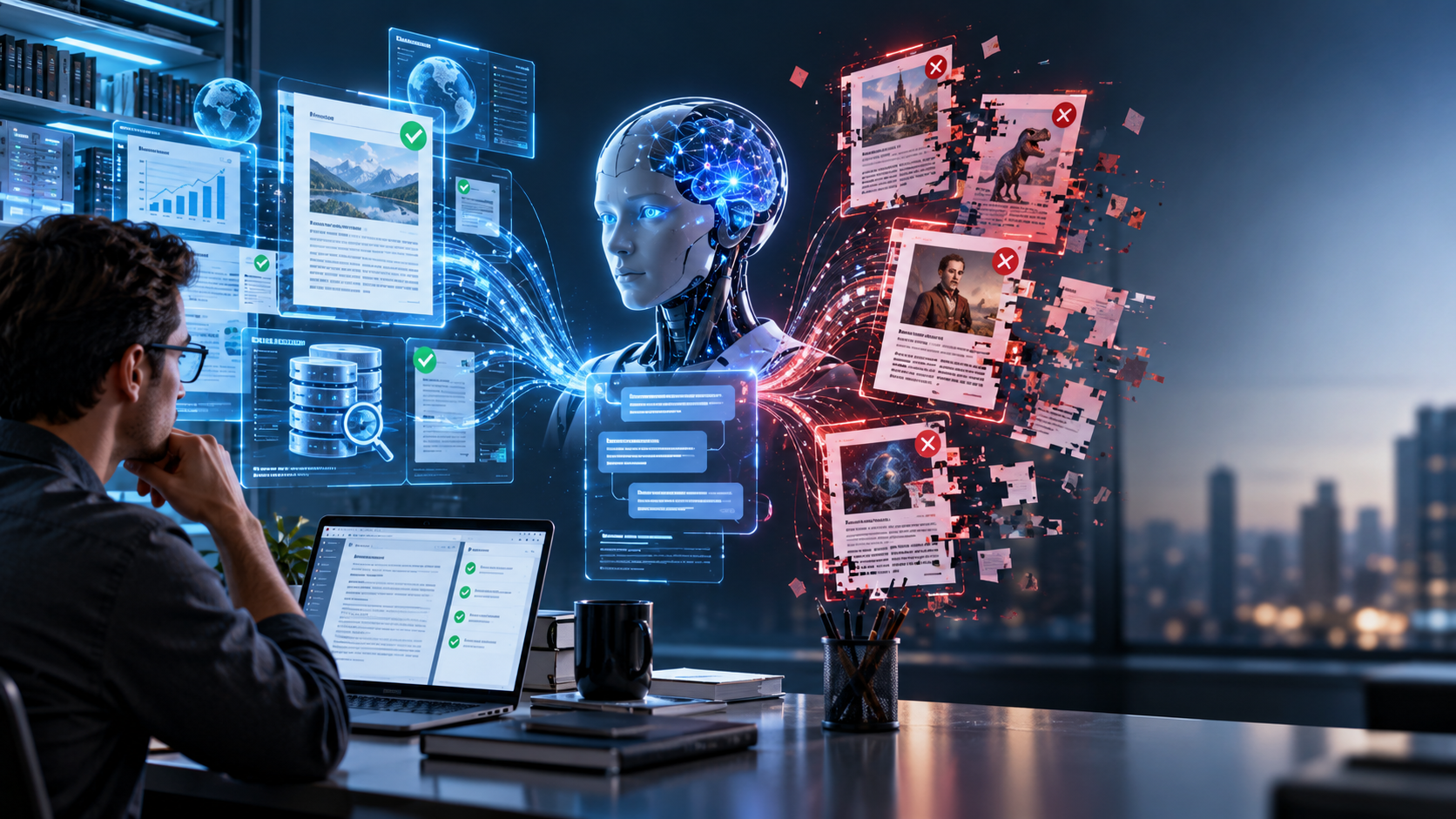
Artificial intelligence has become a useful part of everyday life. People use AI to answer questions, write emails, create content, analyze data, write code, and find information.
But AI is not always correct.
Sometimes, an AI system gives an answer that sounds confident and professional but is actually false or completely made up. This is known as an AI hallucination.
Understanding why AI hallucinates is important because it helps us know when we can trust an AI answer and when we should verify the information.
What Is an AI Hallucination?
An AI hallucination happens when an AI model produces information that is incorrect, misleading, or invented while presenting it as if it were true.
For example, you could ask an AI to find a research paper about a specific technology. The AI might give you a realistic-looking title, author, journal, and publication date.
The problem is that the research paper may not actually exist.
This is an AI hallucination because the system has generated information that sounds real but has no factual basis.
Why Does AI Hallucinate?
One of the main reasons AI hallucinates is the way many AI models generate text.
Large language models learn patterns from huge amounts of data. When you ask a question, the model generates a response by predicting which words or pieces of text are likely to come next.
It does not automatically check every sentence against a trusted database before giving you an answer.
Because of this, an AI system can sometimes produce an answer that sounds correct even when the information is wrong.
AI Is Not a Traditional Search Engine
It is important to understand that an AI chatbot and a search engine do not work in exactly the same way.
A search engine can find pages from the web and show you sources that you can check.
A language model generally generates an answer based on patterns it learned during training and, depending on the system, information it can access through tools.
This means an AI response should not always be treated as a verified fact.
AI May Guess When It Does Not Know
Another major problem is that AI may try to answer a question even when it does not have enough reliable information.
Instead of saying:
“I don’t know.”
the model may attempt to create a reasonable-sounding answer.
This can lead to incorrect names, dates, statistics, sources, technical details, or explanations.
A confident tone does not necessarily mean that the information is accurate.
Common Examples of AI Hallucinations
AI hallucinations can happen in different ways.
Fake Facts
An AI might provide an incorrect date, statistic, event, technical specification, or historical fact.
Fake Sources
AI can sometimes create realistic-looking research papers, books, websites, or citations that do not actually exist.
Incorrect Quotes
An AI may attribute a quote to the wrong person or generate wording that a person never actually said.
Made-Up Information
When information about a person, company, product, or event is difficult to find, AI may sometimes fill the gap with invented details.
Mixing Different Facts
AI can also combine information from different sources or subjects and create an answer that sounds logical but is actually incorrect.
Why Are AI Hallucinations Dangerous?
Not every AI hallucination is harmful.
If an AI makes a mistake while helping someone write a fictional story, the impact may be small.
The situation is very different when AI is used for important decisions.
Incorrect AI information can create serious problems in areas such as healthcare, finance, law, education, business, and cybersecurity.
For example, a company relying on incorrect AI-generated market information could make a poor business decision.
This is why human review remains important for high-stakes applications.
AI Hallucinations vs Simple AI Mistakes
An AI can make different types of mistakes.
A simple AI mistake might be something obvious, such as giving an incorrect calculation.
An AI hallucination is different because the system can invent information that appears believable.
For example:
Simple mistake:
“10 × 10 = 110.”
Hallucination:
“A 2025 study from a particular university proved that this technology increased productivity by 87%,” when the study never existed.
The second example can be more difficult to identify because it sounds like a genuine fact.
Does Training Data Cause Hallucinations?
Training data can contribute to AI errors.
AI models learn from very large collections of information. If the training material contains outdated, incomplete, conflicting, or incorrect information, it can affect the model’s responses.
However, hallucinations are not caused only by bad training data.
Even when the training data is high quality, language models can still generate incorrect information because they are designed to generate likely sequences of text rather than guarantee that every statement is factually true.
How Can AI Hallucinations Be Reduced?
AI developers are using several methods to reduce hallucinations.
One approach is to improve training data and model training techniques.
Another important approach is Retrieval-Augmented Generation, commonly called RAG.
With RAG, an AI system can retrieve relevant information from trusted documents or databases before generating its response.
For example, a company could connect an AI assistant to its internal documentation. When an employee asks a question, the system can first retrieve the relevant document and then use that information to create an answer.
This can reduce the chance of the AI inventing information.
AI Tools and External Sources
Modern AI systems can also use external tools such as search engines, databases, calculators, code execution environments, and APIs.
These tools can help AI verify information or perform tasks that would be difficult to do reliably from memory alone.
However, using external tools does not mean every AI response will automatically be correct.
The quality of the source and the way the AI uses the information still matter.
How Can Users Avoid AI Hallucinations?
Users can also take simple steps to reduce the risk of relying on incorrect AI information.
For important information:
- Check important facts using reliable sources.
- Verify dates, numbers, and statistics.
- Open and check cited sources.
- Ask the AI to explain its reasoning or provide supporting evidence.
- Use trusted databases for specialized information.
- Ask follow-up questions when an answer seems suspicious.
- Get expert review for high-risk decisions.
The most important rule is simple:
Do not assume an AI answer is true just because it sounds confident.
Are AI Models Getting Better?
Yes, AI systems are improving.
Developers are working on better training methods, reasoning capabilities, retrieval systems, tool use, evaluation techniques, and ways for AI models to recognize uncertainty.
Newer AI systems can have lower hallucination rates than earlier models, but hallucinations have not completely disappeared.
The goal is not just to make AI answer more questions. A better AI system should also know when it has enough information and when it should say that it is uncertain.
Why AI Reliability Matters in the Future
AI is becoming increasingly connected to software, databases, businesses, robots, and other systems.
As AI becomes capable of taking actions instead of simply generating text, incorrect information could have a bigger impact.
Imagine an AI agent making a decision based on a completely false piece of information. That mistake could then affect several other steps in an automated process.
This is why AI reliability and AI safety will become increasingly important as autonomous AI systems become more common.
The Future of More Reliable AI
Future AI systems may become better at checking their own answers before presenting them to users.
They could compare information from multiple trusted sources, identify uncertainty, use external tools, and ask users for clarification when necessary.
The ideal AI system would not try to answer every question.
Instead, it would understand when it has enough evidence to provide a reliable answer—and when it should simply say:
“I don’t have enough information to answer this confidently.”
Conclusion
AI hallucinations are one of the biggest challenges in modern generative AI.
The problem is simple to understand: AI can sometimes produce information that sounds true even when it is not.
This happens partly because language models generate responses based on learned patterns rather than automatically verifying every statement.
AI technology is improving rapidly, and developers are working on ways to reduce hallucinations through better models, trusted information sources, retrieval systems, external tools, and improved uncertainty handling.
Until AI becomes more reliable, the best approach is to use it as a powerful assistant—not an unquestionable source of truth.
When the information matters, always verify it.
