Introduction
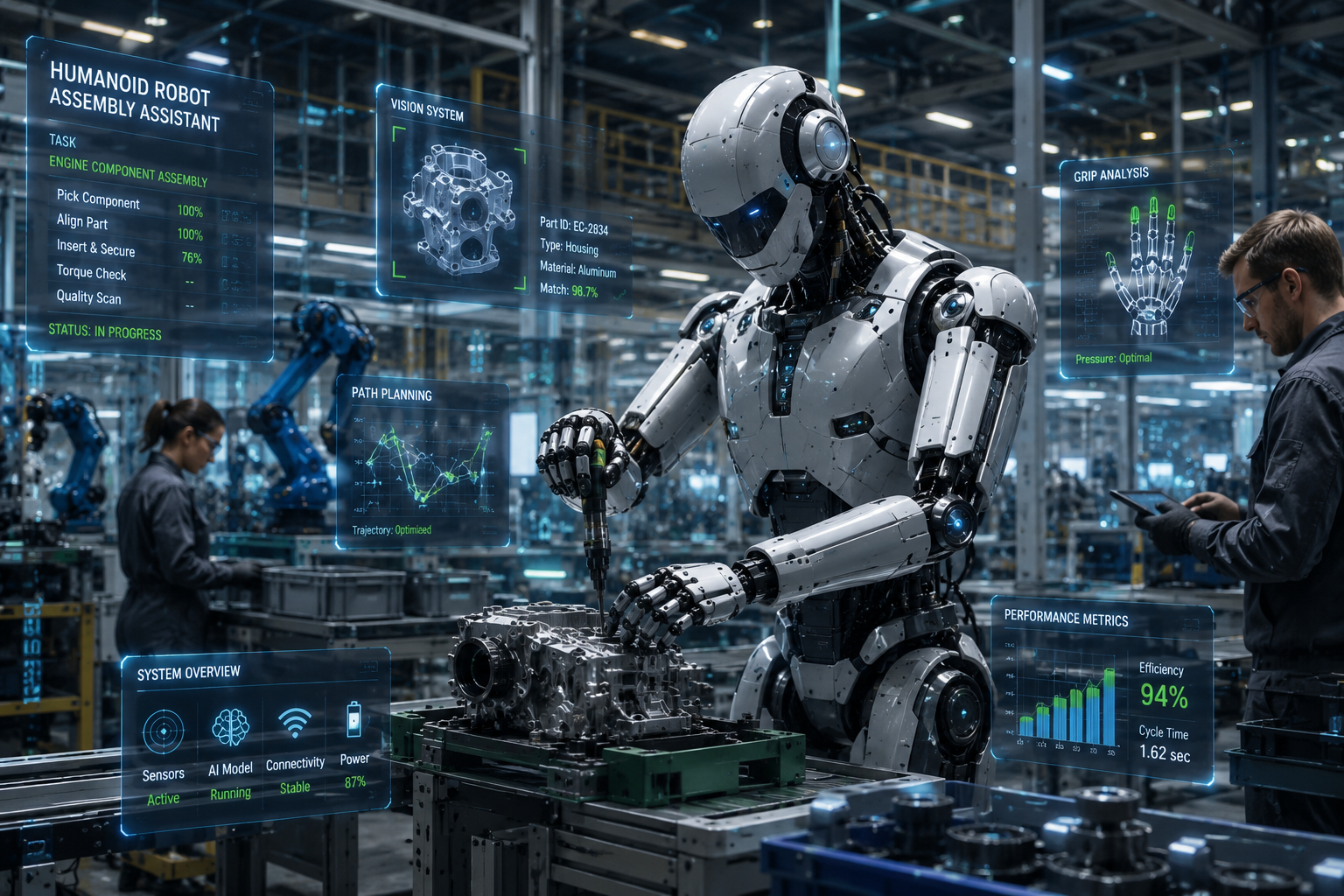
Humanoid robots are designed to move and work in spaces built for humans. In factories, they could use existing shelves, tools, workstations, and production lines without requiring major changes.
Their main advantage is flexibility. Unlike traditional robots built for one specific task, humanoid robots may be able to perform several different jobs.
What Can Humanoid Robots Do in Factories?
Move Materials
Humanoid robots can transport boxes, tools, and components between storage areas and production lines. This can reduce repetitive lifting and carrying for human workers.
Pick Up and Place Parts
Using cameras, sensors, and AI, robots can identify objects, pick them up, and place them in the correct location. This is useful for material handling and basic production tasks.
Support Assembly
Robots may perform repetitive assembly steps, such as positioning components or placing parts into a product. They can repeat these tasks consistently without becoming tired.
Handle Physically Demanding Work
Humanoid robots could assist with lifting, bending, reaching, and other physically demanding jobs. This may help improve workplace safety and reduce worker fatigue.
Inspect Products
With computer vision, robots can check products for scratches, missing parts, incorrect positioning, and other visible defects.
Support Factory Logistics
A robot could receive an instruction, find the required material, avoid obstacles, and deliver it to the correct workstation.
How Do Humanoid Robots Work?
Humanoid robots combine:
- Cameras
- Sensors
- Computer vision
- Artificial intelligence
- Motion planning
- Machine learning
Their basic process is:
See → Understand → Decide → Move → Check
For example, a robot can identify a box, plan how to pick it up, move it to another location, and confirm that it was placed correctly.
This is an example of physical AI, where artificial intelligence interacts with the real world.
Humanoid Robots vs. Traditional Robots
Traditional industrial robots are highly effective at specific tasks such as welding, painting, and assembly. Humanoid robots are being developed for greater flexibility.
A traditional robot may stay in one place and repeat one task. A humanoid robot could potentially move around a factory and perform different jobs.
In the future, both types of robots may work together.
Can Humanoid Robots Replace Factory Workers?
Not completely, at least for now.
Humanoid robots still face challenges involving cost, battery life, safety, reliability, and complex decision-making.
A more realistic future is human-robot collaboration. Robots may handle repetitive, heavy, or hazardous tasks, while people focus on supervision, maintenance, quality control, problem-solving, and decision-making.
Main Challenges
Cost
Humanoid robots require advanced motors, sensors, batteries, processors, and AI software.
Battery Life
Walking and lifting require significant energy, so robots need better batteries and efficient designs.
Reliability
Factories need robots that can perform the same task safely and consistently every day.
Safety
Robots working near people must detect workers, obstacles, and unexpected situations.
AI Limitations
Robots still need better training and physical reasoning before they can handle a wide range of factory tasks independently.
Are Humanoid Robots Already Used in Factories?
Yes, but mostly through pilot programs and limited applications.
Companies such as BMW have tested humanoid robots for tasks involving component handling and manufacturing support. These projects show that humanoid robots are moving from research labs into real factory environments.
However, they are not yet operating entire factories. Manufacturers are still identifying tasks where humanoid robots can provide clear value.
The Future of Humanoid Robots in Manufacturing
Future robots may understand natural-language instructions such as:
“Move these parts to the assembly station.”
To do this, they will need better AI, sensors, robotic hands, batteries, training data, and lower costs.
Humanoid robots could become another important part of smart factories alongside industrial arms, mobile robots, computer vision, and AI systems.
Conclusion
Humanoid robots can potentially move materials, handle parts, support assembly, inspect products, and perform repetitive or physically demanding work.
Their biggest advantage is flexibility. Because they are designed for human environments, they may work with existing factory equipment and workstations.
The technology is still developing, but the future of manufacturing will likely involve humans and robots working together rather than robots completely replacing people.
