Modern computers, smartphones, gaming systems, and AI tools all depend on powerful processors. As technology becomes more demanding, engineers need to find better ways to build faster and more efficient chips.
One technology getting a lot of attention is chiplet technology.
Instead of creating one huge chip that does everything, engineers can build a processor using several smaller pieces called chiplets. These small components can work together inside one package to create a powerful processor.
But what exactly are chiplets, and why are they becoming important?
What Is Chiplet Technology?
A chiplet is a small piece of silicon designed to perform a specific function.
A traditional processor may contain many different functions on one large piece of silicon. With chiplet technology, engineers can divide those functions into separate smaller components and connect them together.
A simple way to understand this is to think about LEGO blocks.
Instead of building one giant LEGO structure from a single piece, you use many smaller blocks and connect them to create something larger.
Chiplets work in a similar way. Different chiplets can perform different jobs, but they work together as one processor.
Why Are Chiplets Becoming Important?
Modern processors are becoming more powerful because applications such as artificial intelligence, cloud computing, gaming, and data centers require enormous amounts of computing power.
However, building one extremely large chip can be difficult and expensive.
As chips become larger, manufacturing becomes more challenging. A tiny defect can affect a large chip and reduce the number of usable processors produced from a wafer.
Chiplets offer another approach.
Instead of making one massive chip, engineers can create several smaller components and combine them into a single processor.
Traditional Chips vs Chiplet Processors
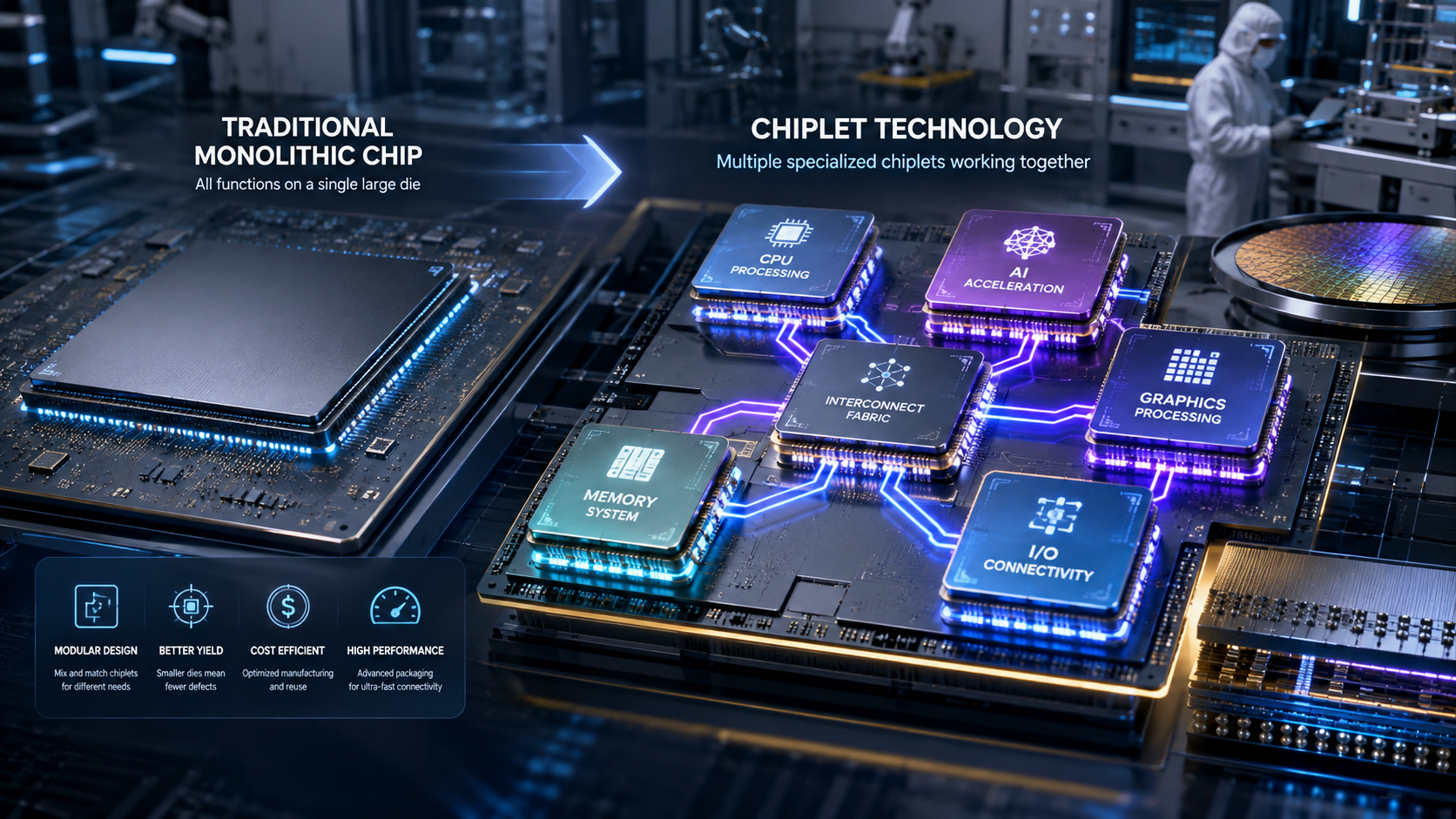
A traditional processor can be thought of as a single large piece of silicon containing many different functions.
A chiplet-based processor divides those functions into smaller components.
For example, a processor could include one chiplet for computing, another for input and output, another for AI acceleration, and another for memory-related tasks.
These components are connected together and work as one system.
This modular approach gives engineers more flexibility when designing new processors.
How Do Chiplets Work?
Chiplets need to communicate with each other extremely quickly.
Special high-speed connections allow the different chiplets to exchange data.
Imagine several people working on different parts of the same project. If they cannot communicate quickly, the project becomes slow.
Chiplets have a similar problem.
The faster and more efficiently they can communicate, the better the overall processor can perform.
This is why high-speed interconnects and advanced chip packaging are such important parts of chiplet technology.
Why AI Is Driving Chiplet Technology
Artificial intelligence is one of the biggest reasons processor technology is changing so quickly.
AI systems need enormous amounts of computing power to train models, process data, and run applications.
Instead of trying to make one giant processor handle everything, engineers can combine different specialized chiplets.
For example, one chiplet could handle general computing while another is optimized for AI calculations.
This makes chiplet technology particularly useful for AI accelerators, GPUs, data-center processors, and high-performance computing systems.
The Benefits of Chiplet Technology
One of the biggest benefits of chiplets is flexibility.
Engineers can create different chiplets for different tasks and combine them depending on the product.
Chiplets can also make it easier to reuse existing designs. A company may be able to use the same chiplet in several processor families while changing other components.
Another potential benefit is manufacturing efficiency. Smaller chiplets can sometimes achieve better manufacturing yields than a single very large chip.
This can help companies reduce waste and potentially lower some development and manufacturing costs.
Chiplets Can Make Processor Design More Flexible
Imagine a company wants to create three processors.
One processor is designed for laptops, another for gaming, and another for AI data centers.
With a traditional approach, each processor may require a large amount of new design work.
With a chiplet-based approach, engineers can reuse some components and replace others.
For example, the same input/output chiplet could be used across multiple processors while different computing chiplets are added depending on the product.
This modular design can make processor development more adaptable.
Chiplets and Advanced Chip Packaging
Chiplets are closely connected to another important technology called advanced chip packaging.
Instead of simply placing all components side by side, engineers can use technologies that allow different chiplets to be positioned very close together or even stacked vertically.
Some designs use 2.5D packaging, where components are placed next to each other on a special base.
Other designs use 3D packaging, where components can be stacked on top of each other.
The goal is to move data between components quickly while using as little space and energy as possible.
What Are the Challenges of Chiplets?
Chiplet technology has many advantages, but it also comes with challenges.
The first challenge is communication. Different chiplets need to exchange huge amounts of data quickly. If communication is slow, the benefits of using multiple chiplets can be reduced.
Heat is another issue.
Modern high-performance processors generate a lot of heat. Putting several powerful components close together can make cooling more difficult.
Manufacturing is also complicated. Building and connecting multiple chiplets requires advanced packaging equipment and precise engineering.
There are also software and system-level challenges because all the different components need to work together efficiently.
Chiplets vs Traditional Chips
Chiplet technology is not necessarily about completely replacing traditional chips.
Some applications may still benefit from a single-piece chip design.
However, chiplets provide another option for engineers who need to build powerful and specialized processors.
The right approach depends on the product, performance requirements, manufacturing process, and cost.
How Chiplets Could Change Future Processors
As computers and AI systems become more powerful, processors will need to handle increasingly specialized workloads.
A single processor may need to perform general computing, AI calculations, graphics processing, networking, and other tasks.
Chiplets could make it easier to combine these different capabilities into one package.
This could lead to processors that are more modular, specialized, and scalable.
Are Chiplets the Future of Processors?
Chiplets are becoming an important part of modern semiconductor engineering, particularly as chip designs become more complex.
They are already helping engineers explore new ways to build high-performance processors.
The future will likely include a mix of traditional chips, chiplet-based designs, and advanced 3D packaging.
As demand for AI, cloud computing, gaming, autonomous systems, and high-performance computing continues to grow, chiplet technology could become even more important.
The Future of Chiplet Technology
The processor of the future may not be one giant piece of silicon.
Instead, it could be a collection of specialized chiplets working together inside a single package.
One chiplet could focus on AI. Another could handle general computing. Another could manage connectivity. Together, they could create a powerful and flexible processor.
This approach could give engineers more ways to build the next generation of computing hardware.
Final Thoughts
Chiplet technology is changing the way engineers think about processor design.
Rather than putting everything into one large chip, engineers can divide different functions into smaller components and connect them together.
The idea is relatively simple: small specialized chips working together can create a powerful processor.
As AI and other demanding technologies continue to grow, chiplets could play an increasingly important role in building faster, more flexible, and more efficient computing systems.
For everyday users, the technology may remain hidden inside computers and data centers. But behind the scenes, chiplets could become one of the important building blocks of the next generation of processors.
