Introduction
Artificial Intelligence (AI) is now a part of our everyday lives. Whether you’re unlocking your phone with your face, using an AI chatbot, editing photos, translating languages, or asking a voice assistant a question, AI is working in the background.
But have you ever wondered how these AI features work so quickly?
The answer is AI chips. These are special computer chips designed to handle AI tasks much faster than traditional processors. One of the most important AI chips today is the Neural Processing Unit (NPU).
In this guide, we’ll explain what AI chips are, how NPUs work, why they are becoming popular, and how they are changing the future of computing—all in simple words that anyone can understand.
What Are AI Chips?
AI chips are computer processors specially designed to run artificial intelligence tasks. Unlike regular processors, they focus on the heavy calculations needed for AI instead of handling every type of computer task.
Think of an AI chip as a specialist. Instead of doing everything, it only focuses on AI work, making it much faster and more efficient.
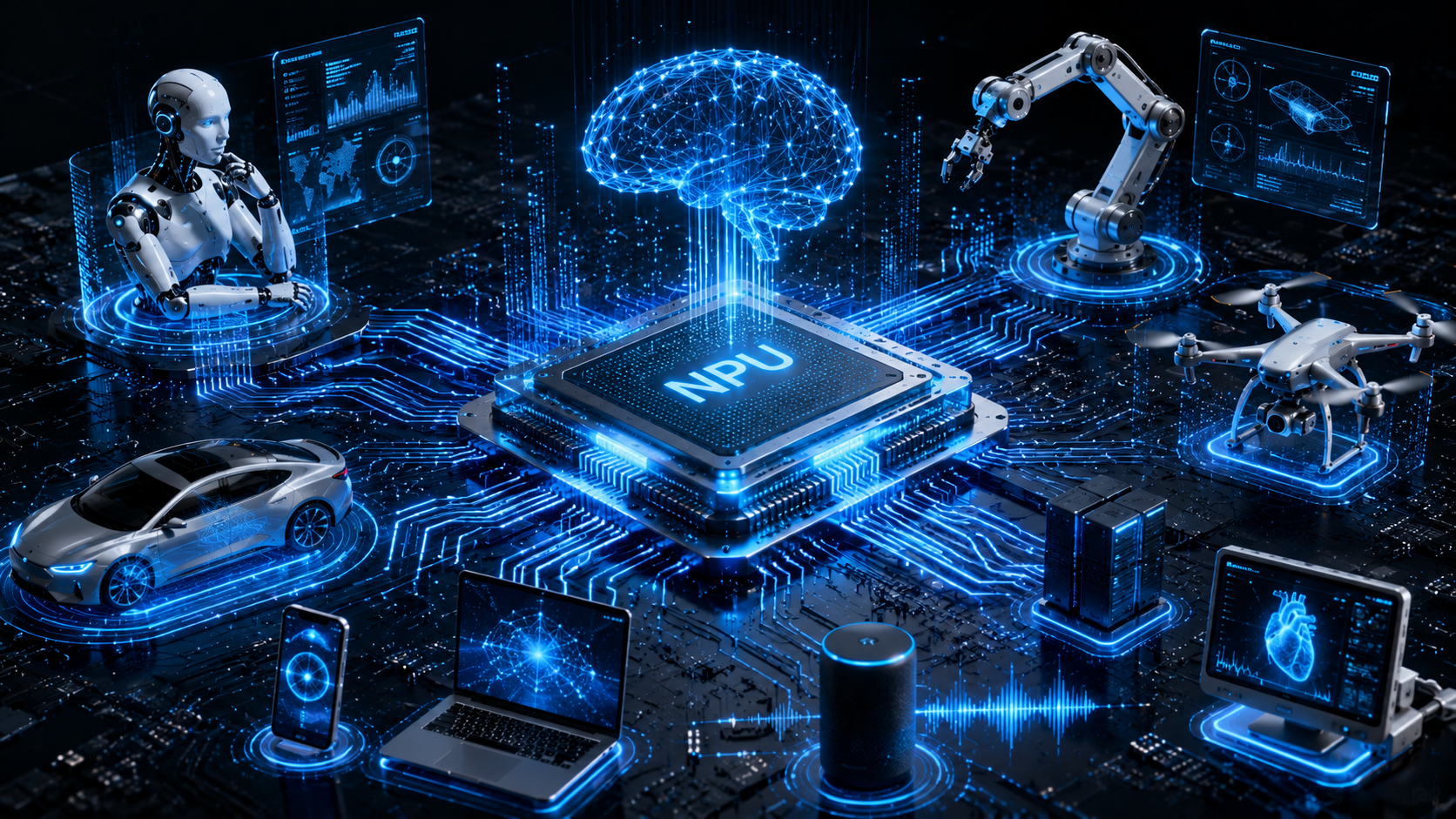
Today, AI chips are used in smartphones, laptops, smart cameras, self-driving cars, robots, healthcare devices, and even large data centers.
What Is an NPU?
An NPU, or Neural Processing Unit, is a processor built specifically for artificial intelligence.
It is designed to run AI models that recognize images, understand speech, translate languages, and generate content much faster than a normal processor.
You can think of different processors like this:
- CPU handles everyday computer tasks.
- GPU is great for graphics and processing many tasks at once.
- NPU focuses only on AI tasks.
Because of this specialization, an NPU can complete AI work quickly while using much less power.
Why Are NPUs Becoming More Popular?
AI features are growing every year. Modern devices now include live translation, AI writing tools, smart photo editing, voice recognition, and personal AI assistants.
Running these features on a regular processor can slow down your device and use more battery.
An NPU solves this problem by processing AI tasks directly on your device. This is called on-device AI.
Since everything happens locally, your device becomes faster, more responsive, and often doesn’t need an internet connection to perform AI tasks.
How Does an NPU Work?
An NPU is built to perform millions of small calculations very quickly.
Whenever you use an AI feature, the NPU analyzes data, finds patterns, and produces results almost instantly.
For example, when your phone recognizes your face to unlock the screen, the NPU compares your face with stored data in just a fraction of a second.
The same technology is used for voice assistants, photo editing, object detection, and language translation.
CPU, GPU, and NPU: What’s the Difference?
Modern computers usually have three different types of processors, and each has a different job.
A CPU is the main processor. It runs applications, manages files, and handles general computing tasks.
A GPU is designed for graphics and can process many calculations at the same time. This makes it useful for gaming, video editing, and training AI models.
An NPU is designed only for artificial intelligence. It performs AI tasks much faster while using less energy.
Instead of replacing one another, these processors work together to provide the best performance.
Where Are AI Chips Used?
AI chips are becoming common in many everyday devices.
Smartphones use NPUs to improve photography, recognize faces, remove background noise during calls, and power AI assistants.
Laptops use AI chips for smarter video calls, battery optimization, automatic background blur, and AI-powered productivity tools.
Self-driving vehicles use AI chips to recognize roads, traffic signs, pedestrians, and nearby vehicles in real time.
Smart security cameras use AI chips to detect people, animals, and unusual movement without sending every video to cloud servers.
Hospitals use AI chips to help doctors analyze medical images and detect diseases more quickly.
Factories also use AI chips to inspect products, predict machine failures, and improve automation.
Benefits of AI Chips
AI chips offer many advantages over traditional processors.
They make AI features faster and more responsive.
Since they are designed specifically for AI, they use less power, which helps improve battery life in laptops and smartphones.
Processing AI directly on the device also improves privacy because personal data doesn’t always need to be sent to cloud servers.
Many AI features continue working even without an internet connection.
Overall, AI chips make devices smarter, faster, and more efficient.
Challenges of AI Chips
Although AI chips are becoming more powerful, there are still some challenges.
Designing advanced AI chips requires expensive research and modern semiconductor technology.
AI models are becoming larger every year, so chip manufacturers must continue improving performance without increasing power consumption.
Software developers also need to update their applications so they can fully use the power of NPUs.
As AI continues to evolve, both hardware and software must improve together.
The Future of AI Chips
The future of computing will rely heavily on AI chips.
More devices will include dedicated NPUs, from smartphones and laptops to smart TVs, wearable devices, robots, and industrial machines.
Future AI chips will become faster, smaller, and more energy efficient.
They will support advanced AI features such as real-time language translation, intelligent personal assistants, autonomous robots, and smarter healthcare systems.
As on-device AI continues to grow, users will enjoy faster performance, stronger privacy, and less dependence on cloud computing.
Why AI Chips Matter
AI chips are doing much more than making devices faster. They are changing the way people interact with technology.
Instead of waiting for cloud servers to process information, many AI tasks can now happen instantly on your device.
This means quicker responses, better privacy, improved battery life, and a smoother user experience.
As AI becomes a standard part of everyday technology, AI chips will become just as important as CPUs are today.
Final Thoughts
AI chips are shaping the future of computing. By using specialized processors like NPUs, devices can run artificial intelligence faster, more efficiently, and with lower power consumption.
From smartphones and laptops to autonomous vehicles, healthcare equipment, and industrial robots, AI chips are making technology smarter than ever before.
As artificial intelligence continues to grow, AI chips will become an essential part of almost every modern device, helping create a future where technology is faster, more intelligent, and easier to use.
