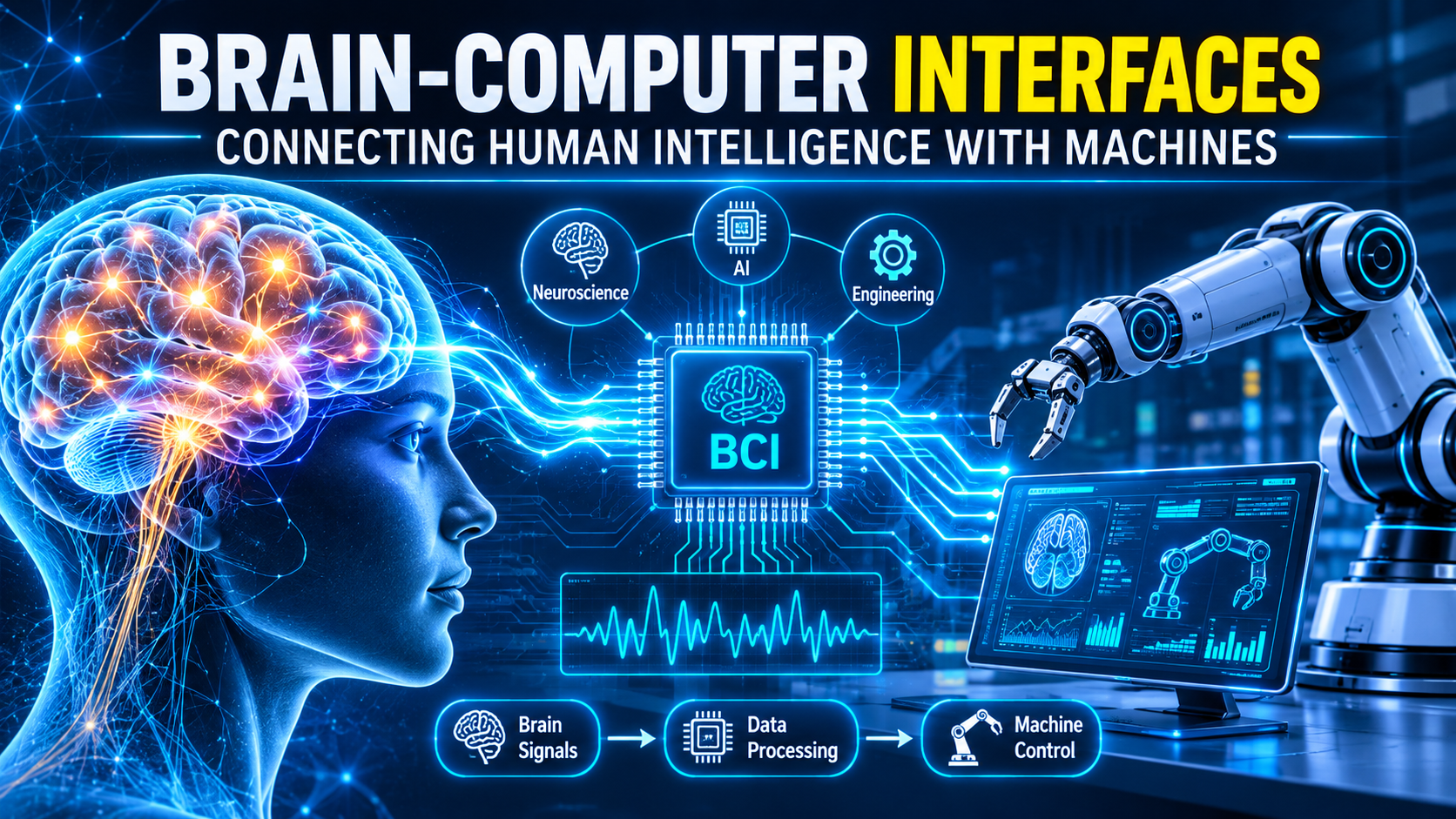
Technology is changing the way humans interact with computers and machines. Today, we use keyboards, touchscreens, and voice commands to control digital devices. But what if we could control machines using only our thoughts? This is where Brain-Computer Interface (BCI) technology comes into the picture.
A Brain-Computer Interface is an advanced technology that creates a direct connection between the human brain and an external device. It reads signals produced by the brain and converts them into commands that a computer or machine can understand. This technology could make communication with machines easier and help people who have difficulty moving or speaking.
BCI technology combines artificial intelligence, neuroscience, computer science, and engineering. It is becoming an important area of research because of its potential to improve healthcare, robotics, and human-machine communication.
1. What Is a Brain-Computer Interface (BCI)?
A Brain-Computer Interface (BCI) is a system that allows people to communicate with computers or control certain devices using brain activity instead of normal physical movements.
Our brain contains billions of nerve cells called neurons. These neurons communicate with each other through electrical and chemical signals. When we think, imagine an action, or perform a mental task, our brain produces different patterns of activity.
BCI technology uses special sensors to detect these patterns. A computer then processes the signals and converts them into digital instructions.
For example, a person who cannot move their hands may use a BCI system to control a computer cursor by imagining hand movements. This creates a new way for humans to interact with technology.
2. How Does Brain-Computer Interface Technology Work?
A Brain-Computer Interface works by collecting brain signals and converting them into commands. The complete process involves several important steps.
2.1 Brain Signal Collection
The first step is collecting signals from the brain. Special sensors, such as EEG electrodes, are placed on the person’s scalp to detect electrical activity. Some advanced systems use implanted electrodes to collect signals directly from the brain.
2.2 Signal Processing
The collected brain signals are usually weak and may contain unwanted noise. The computer uses signal-processing techniques to remove unnecessary information and prepare the signals for further analysis.
2.3 Identifying Brain Patterns
After processing the signals, the system searches for specific patterns related to different brain activities. For example, it may identify patterns associated with imagining hand movement or focusing on a particular task.
2.4 Converting Signals into Commands
Artificial intelligence and machine learning algorithms help understand the detected brain patterns. The system converts the identified patterns into commands that electronic devices can understand.
2.5 Controlling External Devices
Finally, the computer sends commands to an external device. This could include moving a computer cursor, selecting letters on a screen, or controlling a robotic arm.
In simple words, BCI technology reads brain activity, understands the user’s intended action, and sends instructions to a connected machine.
3. Different Types of Brain-Computer Interfaces
Brain-Computer Interfaces are divided into three main types based on how they collect signals from the brain.
3.1 Invasive Brain-Computer Interface
An invasive BCI uses tiny electrodes that are surgically implanted directly into brain tissue. These electrodes collect detailed information about brain activity.
This type of technology is mainly researched for advanced medical applications, including helping people with severe movement disabilities control external devices. However, it requires surgery and involves medical risks.
3.2 Partially Invasive Brain-Computer Interface
A partially invasive BCI uses electrodes placed on the surface of the brain, usually beneath the skull. It does not place electrodes deep inside brain tissue.
This approach can collect detailed brain signals and is being studied for medical and research purposes. However, it still requires a surgical procedure.
3.3 Non-Invasive Brain-Computer Interface
A non-invasive BCI collects brain signals without surgery. It commonly uses an EEG headset placed on the person’s head.
These headsets detect electrical activity through sensors attached to the scalp. They are generally easier to use and are widely used in research, brain training experiments, and human-computer interaction studies.
4. Real-World Applications of Brain-Computer Interface Technology
Brain-Computer Interface technology is not just a scientific concept. Researchers are already developing systems that can support different real-world activities. Some important applications are explained below.
4.1 Healthcare and Medical Rehabilitation
BCI technology has the potential to improve medical treatment and rehabilitation. It is being researched to help people who have experienced paralysis or other conditions that affect body movement.
For example, BCI-based rehabilitation systems can help patients practice movement-related brain activities while working with specialized medical equipment. This may support recovery and improve communication with assistive devices.
4.2 Controlling Robotic Arms
One interesting application of BCI technology is controlling robotic arms using brain signals. A BCI system can identify patterns related to a person’s intended movement and convert them into commands for a robotic arm.
This technology is being developed to help people who have lost the ability to move their natural arms. It may provide new opportunities for performing everyday activities with assistive robotic devices.
4.3 Communication for People with Disabilities
Some people cannot speak or use their hands because of serious physical disabilities. BCI technology may help them communicate through computers.
For example, a person may use brain signals to select letters, words, or options displayed on a computer screen. This can provide an alternative communication method for people with severe movement limitations.
4.4 Smart Wheelchair Control
BCI technology is also being explored for controlling wheelchairs. Instead of using traditional buttons or joysticks, users may be able to control certain wheelchair functions through recognized brain activity.
This approach could improve accessibility for people who cannot easily use their hands.
4.5 Gaming and Virtual Reality
BCI technology could introduce new ways to interact with video games and virtual reality environments. Researchers are exploring systems that use brain activity to control certain game interactions.
For example, a player might use a specific mental activity to select an option or perform an action in a virtual environment. However, these applications are still developing and are not a replacement for traditional gaming controls.
4.6 Brain Activity Monitoring and Research
BCI systems can also help researchers understand how the brain responds to different activities. By collecting and analyzing brain signals, scientists can study attention, mental activity, and responses to different tasks.
This information can support neuroscience research and the development of future brain-related technologies.
5. How Artificial Intelligence Helps Brain-Computer Interfaces
Artificial Intelligence (AI) plays an important role in modern Brain-Computer Interface systems. Brain signals are complex and can change from person to person. Understanding these signals manually can be difficult, so AI helps computers identify useful patterns more efficiently.
Machine learning algorithms can study previously collected brain signals and learn to recognize different activities. When new signals are received, the system uses this learning to identify possible commands.
AI also helps improve signal classification, remove unwanted noise, and adjust systems to changes in brain activity. By combining AI with BCI technology, engineers are working to create smarter and more responsive systems for controlling external devices.
6. Advantages of Brain-Computer Interface Technology
Brain-Computer Interface technology offers several important benefits for healthcare, engineering, and digital communication.
6.1 Better Accessibility
BCI systems can provide new ways for people with physical disabilities to interact with computers and other electronic devices.
6.2 Improved Human-Machine Communication
This technology creates another communication method between humans and machines without depending entirely on physical movements.
6.3 Support for Medical Rehabilitation
BCI-based systems are being researched to support rehabilitation activities for people with movement-related disabilities.
6.4 Advanced Robotic Control
Brain signals can be converted into commands for robotic arms and other assistive devices, creating new possibilities in robotics.
6.5 New Technology Experiences
BCI technology may create new ways to interact with gaming systems, virtual reality, and other digital environments.
7. Challenges and Limitations of BCI Technology
Although Brain-Computer Interface technology has many benefits, it still faces several challenges. Engineers and researchers need to solve these problems before the technology becomes widely available.
7.1 Accuracy of Brain Signals
Brain signals are often weak and can contain unwanted noise. Different people may also produce different signal patterns, which can make accurate interpretation difficult.
7.2 High Development Costs
Developing advanced BCI systems requires specialized sensors, medical equipment, software, and research facilities. These requirements can make the technology expensive.
7.3 Privacy and Data Security
Brain signals contain sensitive information about brain activity. Protecting this data from unauthorized access is an important challenge for BCI developers.
7.4 Medical and Safety Risks
Invasive BCI systems require surgical procedures. These procedures may involve risks such as infection, tissue damage, or other medical complications.
7.5 Technical Complexity
BCI technology combines several complex fields, including neuroscience, electronics, computer programming, and artificial intelligence. Developing reliable systems requires expertise in all these areas.
8. Future of Brain-Computer Interface Technology
The future of Brain-Computer Interface technology looks promising as researchers continue to improve brain signal detection, computer processing, and artificial intelligence systems.
Future BCI systems may become smaller, more comfortable, and more accurate. Improved wireless communication and advanced sensors could also make some systems easier to use outside research laboratories.
In healthcare, this technology may provide better communication options for people with severe physical disabilities. In robotics, improved BCI systems could help users control advanced prosthetic limbs and assistive machines.
BCI technology may also become part of future virtual reality experiences and advanced human-computer interaction systems. However, its widespread use will depend on improvements in safety, affordability, reliability, and data protection.
9. Conclusion
Brain-Computer Interface technology is an important development in modern engineering that connects human brain activity with computers and machines. It allows brain signals to be converted into digital commands, creating new ways for people to interact with technology.
From healthcare and medical rehabilitation to robotic arms and computer communication, BCI technology has many potential applications. Artificial intelligence is also helping improve the way these systems understand and process brain signals.
Although challenges such as high costs, signal accuracy, privacy, and medical safety still exist, ongoing research is making this technology more advanced. In the coming years, Brain-Computer Interfaces could play an important role in improving human-machine communication and developing more accessible technologies.
