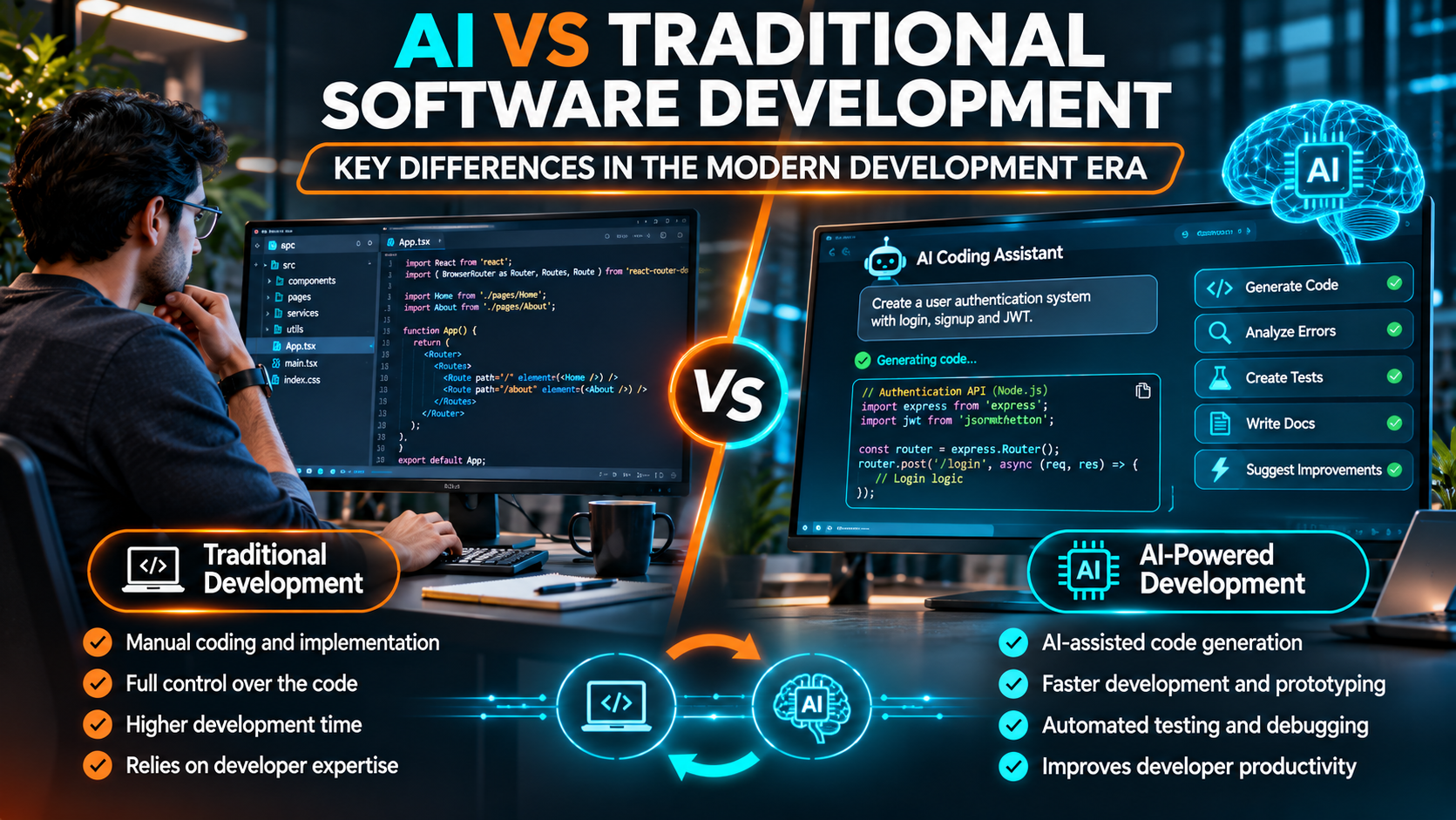
Software development is evolving rapidly as artificial intelligence becomes an important part of the technology industry. Developers are no longer limited to writing every line of code manually. AI-powered tools can now generate code, suggest improvements, identify bugs, create test cases, and assist with technical documentation.
Traditionally, software development has depended heavily on human developers for planning, coding, debugging, testing, and deployment. Every stage requires technical knowledge, logical thinking, and continuous collaboration between development teams.
Today, AI is changing this process by introducing intelligent tools that can automate repetitive tasks and support faster development workflows.
This raises an important question: AI vs Traditional Software Development — which approach is better for building modern applications?
Both approaches have advantages and limitations. Understanding their differences can help developers, businesses, and technology teams choose the right development strategy.
In this article, we will explore how AI-powered and traditional software development work, their key differences, benefits, challenges, practical applications, and future possibilities.
What Is AI-Powered Software Development?
AI-powered software development refers to the use of artificial intelligence technologies to assist or automate different activities throughout the software development lifecycle.
These systems use technologies such as machine learning, natural language processing, large language models (LLMs), and code analysis to understand programming requirements and support developers.
AI-powered development tools can help with:
- Generating code from natural language instructions.
- Explaining existing code and programming concepts.
- Detecting potential bugs and suggesting fixes.
- Generating unit tests and test cases.
- Improving code readability and structure.
- Creating technical documentation.
- Suggesting database queries and API implementations.
- Supporting code reviews and debugging.
For example, a developer can describe a requirement such as creating a user authentication system. An AI coding assistant can suggest a React login component, generate an API integration, or explain how authentication should be implemented.
However, generated code still needs to be reviewed, tested, and validated before it is used in production.
Popular AI development tools include:
- GitHub Copilot
- ChatGPT
- Cursor
- Claude
- Amazon Q Developer
- Gemini Code Assist
These tools act as development assistants rather than guaranteed replacements for professional software engineering.
What Is Traditional Software Development?
Traditional software development is the conventional approach in which developers manually perform most software engineering activities using programming languages, development frameworks, libraries, and established engineering practices.
Developers analyse requirements, design application architecture, write code, debug errors, conduct testing, and deploy applications.
This approach relies on human expertise, logical reasoning, programming knowledge, and collaboration.
A typical traditional software development process includes:
- Requirement Analysis
- Software Planning
- System Architecture Design
- UI/UX Design
- Manual Coding
- Testing and Debugging
- Deployment
- Maintenance and Updates
For example, when building an e-commerce application, developers manually implement product listings, shopping carts, payment integrations, authentication, database operations, and order management.
Traditional development provides direct control over implementation and allows engineering teams to make decisions based on project-specific requirements.
How AI and Traditional Software Development Work
The main difference between these approaches is how development tasks are performed and how much assistance comes from artificial intelligence.
AI-Powered Development Workflow
In AI-assisted development, developers collaborate with AI tools throughout the development process.
A typical workflow looks like this:
Step 1: Requirement Input
Developers provide application requirements, technical instructions, or prompts to an AI development tool.
Step 2: AI-Assisted Planning
AI can suggest application structures, component designs, database models, and implementation approaches.
Step 3: Code Generation
The AI tool generates code snippets, functions, components, or complete implementation drafts.
Step 4: Developer Review
Developers review the generated code for correctness, security, performance, maintainability, and compatibility.
Step 5: AI-Assisted Testing
AI can help generate test cases, explain failures, and identify potential problems.
Step 6: Deployment and Maintenance
Developers deploy the application and may use AI tools to assist with monitoring, documentation, debugging, and future improvements.
Traditional Development Workflow
In traditional development, engineers handle most implementation activities manually.
Step 1: Requirement Analysis
The team understands business requirements and defines the project scope.
Step 2: Architecture Planning
Developers select technologies, design system architecture, and plan database structures.
Step 3: Manual Coding
Developers write application code using programming languages and frameworks.
Step 4: Manual Debugging
Errors are identified and fixed through code inspection, logs, debugging tools, and testing.
Step 5: Software Testing
Testing teams and developers create and execute test cases to verify application functionality.
Step 6: Deployment and Maintenance
The completed application is deployed, monitored, updated, and maintained.
Both workflows can produce high-quality software. The final result depends on engineering practices, team expertise, requirements, and quality assurance.
AI vs Traditional Software Development: Key Differences
Let’s compare both development approaches across important software engineering activities.
| Comparison | AI-Powered Development | Traditional Development |
|---|---|---|
| Coding | AI generates or suggests code | Developers write code manually |
| Development speed | Can accelerate repetitive tasks | Depends heavily on manual implementation |
| Debugging | AI suggests possible fixes | Developers investigate and resolve issues |
| Testing | Can generate test cases and assist automation | Test cases are created and executed through established testing processes |
| Documentation | Can generate initial documentation | Usually written manually or through documentation tools |
| Architecture | AI can suggest design approaches | Engineers make architecture decisions |
| Customisation | Depends on prompts, tools, and developer review | Direct control over implementation |
| Human involvement | Human oversight remains important | Human developers perform most tasks |
| Code quality | Depends on generated code and validation | Depends on engineering practices and developer expertise |
| Security | Requires verification of AI-generated code | Requires manual and automated security reviews |
| Learning curve | Requires prompting and AI tool knowledge | Requires programming and engineering knowledge |
| Maintenance | AI can assist with updates and debugging | Developers manage changes and maintenance |
Major Advantages of AI-Powered Software Development
AI-powered software development offers several advantages when used correctly.
1. Faster Code Generation
One of the biggest advantages of AI development tools is their ability to generate code from natural language instructions.
Developers can use AI to create reusable components, functions, API integrations, and basic application structures.
This can reduce the time required for repetitive implementation tasks.
2. Improved Developer Productivity
AI assistants can help developers complete routine work more efficiently.
For example, instead of manually searching through documentation, developers can ask an AI tool to explain a function, suggest an implementation, or identify an error.
This allows engineers to spend more time on architecture, complex logic, and problem-solving.
3. Faster Debugging Assistance
Debugging can consume significant development time, especially in large applications.
AI tools can analyse error messages, explain potential causes, and suggest possible solutions.
However, developers must verify that suggested fixes address the actual root cause.
4. Automated Test Generation
AI can help generate unit tests, integration tests, and test scenarios based on existing code.
It can also suggest edge cases that developers may overlook.
This can improve test coverage when combined with proper review and execution.
5. Easier Learning and Knowledge Sharing
AI coding assistants can explain programming concepts, framework behaviour, unfamiliar codebases, and technical errors.
This can help developers understand new technologies and become productive in unfamiliar projects.
6. Faster Prototyping
AI tools can generate initial UI components, backend functions, and application structures.
This can help teams create prototypes and validate ideas before investing in complete production implementations.
Advantages of Traditional Software Development
Traditional development remains essential because many software engineering activities require detailed technical understanding and human decision-making.
1. Greater Direct Control
Developers can control how application logic, architecture, and integrations are implemented.
This is particularly important for complex enterprise applications with specific business requirements.
2. Better Understanding of Business Logic
Human developers can communicate with stakeholders, understand business processes, and translate complex requirements into software functionality.
AI can assist with analysis, but it may misunderstand incomplete or ambiguous requirements.
3. Custom Engineering Solutions
Traditional development allows engineers to create highly specialised solutions based on project constraints.
This is useful when an application requires complex calculations, custom workflows, or unusual integrations.
4. More Predictable Implementation
With a well-defined architecture and development process, engineering teams can maintain clear ownership of code and implementation decisions.
AI-generated suggestions still require evaluation because their correctness can vary.
5. Stronger Human Accountability
Developers and engineering teams remain responsible for software behaviour, quality, security, and production reliability.
Traditional engineering practices provide established processes for reviewing and approving changes.
Limitations of AI-Powered Software Development
Although AI can improve productivity, it also introduces challenges.
1. Incorrect Code Generation
AI tools can generate code that appears correct but contains logical errors, incorrect assumptions, or incompatible implementations.
Developers must review and test all important generated code.
2. Security Risks
AI-generated code may contain insecure authentication logic, improper input validation, weak access controls, or vulnerable dependencies.
Security reviews and automated scanning remain necessary.
3. Dependency on AI Tools
Excessive reliance on AI can reduce a developer’s understanding of the underlying implementation.
Developers should understand the code they accept rather than blindly copying generated solutions.
4. Context Limitations
AI tools may not fully understand large application architectures, undocumented business rules, or relationships between different modules.
Providing accurate project context and reviewing changes is essential.
5. Data Privacy Concerns
Sharing proprietary source code, credentials, customer information, or confidential business data with AI services can create privacy and compliance risks.
Organisations should establish clear policies for approved AI tools and sensitive data.
6. Unpredictable Results
Similar prompts can sometimes produce different implementations.
Developers need consistent coding standards, tests, and review processes to maintain application quality.
Limitations of Traditional Software Development
Traditional development also has limitations.
1. More Manual Work
Developers must manually complete repetitive tasks such as creating boilerplate code, writing documentation, and preparing basic test cases.
2. Longer Development Cycles
Building complex applications entirely through manual implementation can require significant time and engineering resources.
3. Higher Resource Requirements
Projects may need additional developers and testing resources to complete large amounts of implementation work.
4. Repetitive Debugging
Developers can spend considerable time investigating common errors, understanding unfamiliar code, and searching documentation.
5. Slower Prototyping
Creating multiple prototype versions manually may take longer than using AI-assisted code generation.
These limitations do not make traditional development outdated. They highlight opportunities where automation and AI assistance can improve existing workflows.
AI vs Traditional Software Development: Which Is More Cost-Effective?
Cost depends on the size of the project, development complexity, team experience, technology choices, and long-term maintenance requirements.
AI-powered development may reduce some implementation costs by accelerating repetitive work. However, AI subscriptions, infrastructure, code review, security testing, and maintenance still create expenses.
Traditional development may require more manual engineering time, but its cost structure can be easier to estimate in established projects.
| Cost factor | AI-Powered Development | Traditional Development |
|---|---|---|
| Initial development | May reduce repetitive coding effort | Depends on manual development effort |
| Tool expenses | AI subscriptions and infrastructure | Development tools and infrastructure |
| Developer resources | Human expertise still required | Human expertise required |
| Testing | AI can assist test generation | Established manual and automated testing |
| Maintenance | AI can assist with debugging and updates | Developers handle maintenance |
| Risk management | Requires AI output validation | Requires normal engineering validation |
The most cost-effective approach is often a hybrid development model in which AI accelerates suitable tasks while experienced engineers manage architecture, implementation quality, and production reliability.
Real-World Applications of AI in Software Development
AI is already being used across different stages of software development.
1. Frontend Development
AI tools can assist with:
- React component generation
- HTML and CSS development
- Responsive layout suggestions
- Form validation logic
- UI component documentation
- Accessibility improvement suggestions
For example, a developer can describe a dashboard interface and use AI to generate an initial React and Tailwind CSS implementation.
The developer can then customise the layout, connect APIs, and validate responsive behaviour.
2. Backend Development
AI can assist with:
- API endpoint generation
- Database query suggestions
- Authentication implementation drafts
- Error-handling patterns
- Backend documentation
- Data validation logic
Generated backend code must still be reviewed for security, database consistency, and business-rule correctness.
3. Software Testing
AI can help generate test cases, identify edge cases, analyse test failures, and assist with test automation.
This is useful for applications with complex forms, workflows, and API integrations.
4. DevOps and Deployment
AI assistants can help developers understand deployment errors, review configuration files, generate infrastructure templates, and investigate CI/CD failures.
Human review is still necessary before making changes to production infrastructure.
5. Enterprise Software Development
Enterprise applications often include ERP, CRM, HRMS, inventory management, and document management systems.
AI can help developers implement repetitive modules, generate documentation, analyse logs, and support testing.
However, complex business rules, financial calculations, access permissions, and data integrity requirements still need careful engineering.
Can AI Replace Traditional Software Developers?
AI is changing software development, but completely replacing professional developers is not a realistic description of its current role.
AI tools can generate code and automate selected engineering tasks, but software development involves much more than writing code.
Developers are responsible for:
- Understanding business requirements.
- Designing scalable architecture.
- Making technology decisions.
- Managing databases and integrations.
- Protecting sensitive information.
- Reviewing application security.
- Solving complex technical problems.
- Maintaining production systems.
AI can support these responsibilities, but human judgement, technical understanding, and accountability remain important.
The role of developers is evolving from writing every line manually toward designing, reviewing, integrating, and managing AI-assisted software systems.
AI-Assisted Development vs Traditional Development: Which Should Businesses Choose?
There is no single development approach that works best for every business.
The right choice depends on project requirements, technical complexity, available expertise, compliance obligations, and delivery timelines.
Choose AI-Powered Development When:
- Building prototypes and MVPs.
- Generating repetitive code.
- Creating initial test cases.
- Preparing technical documentation.
- Exploring implementation alternatives.
- Accelerating routine development tasks.
Choose Traditional Development When:
- Building complex enterprise systems.
- Implementing sensitive business logic.
- Working with strict regulatory requirements.
- Designing critical security architecture.
- Handling complex database transactions.
- Developing highly specialised software.
Choose a Hybrid Approach When:
- Developing scalable business applications.
- Building complex frontend and backend systems.
- Improving developer productivity.
- Maintaining existing enterprise applications.
- Combining AI automation with human code review.
For most modern software teams, a hybrid approach offers a practical balance between development speed, engineering control, and software quality.
The Future of Software Development
The future of software development will likely involve closer collaboration between human developers and AI-powered systems.
Several trends are influencing this transformation.
1. AI Coding Agents
AI coding agents are becoming more capable of working across multiple development tasks, such as analysing repositories, editing files, running tests, and suggesting fixes.
Their usefulness depends on tool access, task complexity, permissions, and human supervision.
2. Natural Language Programming
Developers can increasingly describe requirements in natural language and use AI to generate initial implementations.
This may make software prototyping more accessible while leaving complex engineering decisions to experienced developers.
3. Automated Software Testing
AI-assisted testing may improve test generation, failure analysis, and identification of potential edge cases.
4. AI-Powered Code Reviews
AI tools can help review code for potential bugs, maintainability issues, and security weaknesses.
Human reviewers remain important for understanding business context and approving critical changes.
5. Intelligent Development Environments
Modern development environments are increasingly integrating AI assistants for code completion, debugging, documentation, and repository-level assistance.
6. Human-AI Collaboration
Rather than completely replacing traditional engineering practices, AI is likely to become a regular part of software development workflows.
Developers who understand both software engineering fundamentals and AI-assisted tools will be better positioned to work with these evolving systems.
Conclusion
AI vs Traditional Software Development is not simply a comparison between two competing approaches. It represents the evolution of software engineering toward more intelligent and automated workflows.
Traditional development provides technical control, engineering discipline, and human decision-making. AI-powered development adds code generation, debugging assistance, test generation, and productivity improvements.
Both approaches have advantages, and neither is suitable for every situation.
For most businesses and development teams, combining AI-powered tools with traditional software engineering practices is a practical way to build modern applications efficiently while maintaining security, reliability, and quality.
The future of software development will not depend only on how quickly code can be generated. It will depend on how effectively developers use technology to solve real-world problems.
