Introduction
Serverless computing has changed the way developers build and deploy modern applications. Instead of managing virtual machines, operating systems, server capacity, and infrastructure scaling, developers can deploy application code while the cloud provider manages the underlying infrastructure.
But in 2026, an important question remains: Is serverless computing still relevant?
The short answer is yes—but serverless has evolved.
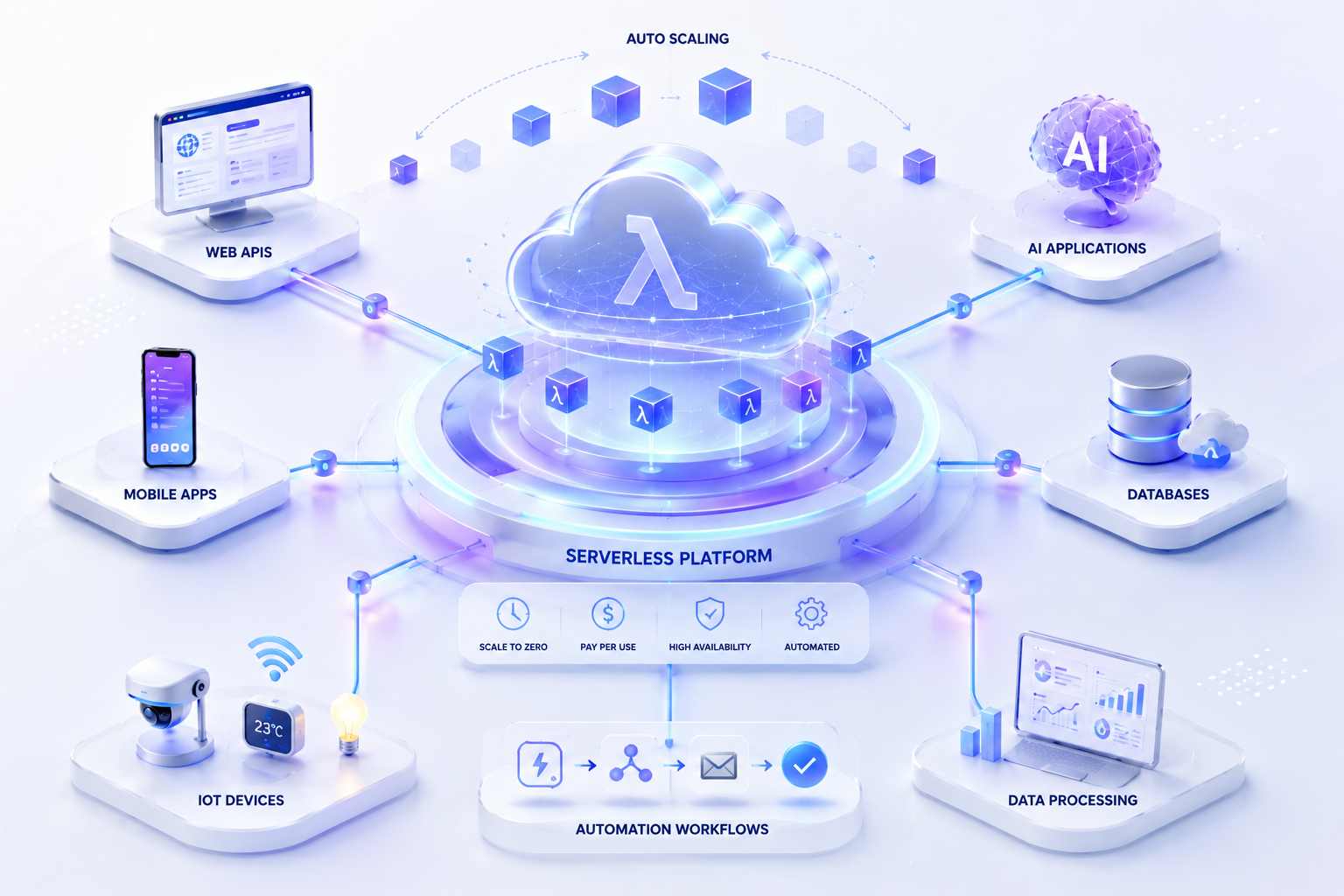
Modern serverless computing goes beyond traditional Function-as-a-Service (FaaS). Cloud platforms now support a broader range of serverless workloads, including event-driven applications, APIs, background processing, data pipelines, container-based workloads, and applications that can automatically scale toward zero when they are idle. Google Cloud describes serverless as an execution model where infrastructure resources are allocated based on actual usage, while the provider handles provisioning and scaling.
This makes serverless particularly attractive for startups, modern web applications, unpredictable workloads, and development teams that want to reduce infrastructure management.
What Is Serverless Computing?
Serverless computing is a cloud computing model where developers build and deploy applications without directly managing the underlying servers.
Despite the name, servers still exist. The difference is that the cloud provider manages them on behalf of the developer.
In a traditional cloud architecture, developers may need to manage:
- Virtual machines
- Operating systems
- Server capacity
- Scaling
- Security patches
- Infrastructure configuration
- Load balancing
With serverless, much of this responsibility moves to the cloud provider.
For example, a serverless application can execute a function when a user uploads an image, submits a form, places an order, or triggers an API request. The platform provisions the required resources, executes the code, and can scale the application based on demand. AWS describes this event-driven model as a core characteristic of serverless architecture.
How Does Serverless Computing Work?
A typical serverless application consists of multiple managed services working together.
For example:
User → API → Serverless Function → Database → Response
A request might trigger a function that:
- Receives the request.
- Validates the data.
- Processes business logic.
- Reads or writes data.
- Calls another service.
- Returns a response.
The infrastructure required to execute these operations is managed by the cloud provider.
Serverless platforms can also scale resources automatically according to demand. When there is little or no traffic, some workloads can scale down significantly or even reach zero active instances.
Why Is Serverless Still Relevant in 2026?
Serverless remains relevant because modern software applications increasingly require elastic scalability, rapid development, event-driven processing, and reduced infrastructure management.
Some of the strongest reasons include:
1. Automatic Scaling
One of the biggest advantages of serverless computing is automatic scaling.
Traditional applications often require developers to estimate how much server capacity they will need. Too much capacity can result in wasted resources, while too little can cause performance problems.
Serverless platforms can automatically allocate resources according to incoming demand.
This makes serverless useful for applications with:
- Unpredictable traffic
- Seasonal demand
- Sudden traffic spikes
- Event-driven workloads
- Variable API traffic
2. Pay-for-Usage Pricing
Serverless computing can reduce infrastructure costs for workloads that are intermittent or unpredictable.
Instead of continuously paying for an allocated server, serverless platforms generally charge based on resource consumption or execution.
This can make serverless particularly attractive when an application spends significant periods with little activity. AWS highlights the ability of serverless workloads to scale to zero when idle as one of the reasons serverless can improve resource efficiency.
However, serverless is not automatically cheaper.
Applications with consistently high workloads can sometimes be more cost-effective on containers or dedicated compute resources.
Therefore, developers should compare:
- Number of requests
- Execution duration
- Memory requirements
- Network usage
- Database costs
- Observability costs
- Always-on requirements
3. Faster Development
Serverless reduces the amount of infrastructure developers need to configure and maintain.
Developers can focus more heavily on:
- Application logic
- APIs
- Features
- User experience
- Business requirements
Instead of spending time managing servers, teams can use managed cloud services for common infrastructure requirements.
This can accelerate development and deployment cycles.
Serverless Computing in the Age of AI
One of the most interesting developments in 2026 is the relationship between serverless computing and AI applications.
Modern AI applications often need backend components for:
- API requests
- Data processing
- Authentication
- File processing
- Model orchestration
- Background jobs
- Event processing
- AI agent workflows
Serverless functions and scale-to-zero infrastructure can be useful for these supporting workloads because demand can vary significantly.
For example:
User → AI Application → Serverless API → AI Model → Database → Response
Instead of maintaining a continuously running backend server for every operation, developers can use serverless components for individual tasks.
This makes serverless particularly interesting for AI-powered SaaS applications and event-driven AI workflows.
Serverless vs Traditional Cloud Computing
| Feature | Serverless | Traditional Cloud |
|---|---|---|
| Server management | Minimal | Developer-managed |
| Scaling | Automatic | Often configured manually |
| Billing | Usage-based | Often capacity-based |
| Infrastructure control | Lower | Higher |
| Deployment | Usually faster | More infrastructure required |
| Idle cost | Can scale toward zero | Usually continues |
| Architecture | Event-driven | Broad range |
| Vendor dependency | Potentially high | Generally more flexibility |
The key difference is control versus abstraction.
Traditional cloud computing provides developers with greater infrastructure control.
Serverless provides greater abstraction and reduces infrastructure management.
The Biggest Serverless Challenges in 2026
Serverless is powerful, but it is not the perfect architecture for every application.
1. Cold Starts
Cold starts occur when a serverless environment needs to initialize before processing a request.
This can introduce additional latency, particularly for applications that require very fast responses.
Cold-start performance remains an active engineering and research area in 2026. Recent research has explored techniques for reducing application startup latency, demonstrating that cold-start optimization is still an important serverless concern.
Developers can reduce cold-start impact through techniques such as:
- Smaller deployments
- Lightweight dependencies
- Efficient initialization
- Runtime optimization
- Provisioned or pre-warmed capacity where available
2. Vendor Lock-In
Serverless applications often depend heavily on cloud-provider-specific services and APIs.
For example, an application may use:
- Cloud-specific functions
- Managed databases
- Event buses
- Authentication services
- Workflow engines
- Storage systems
Moving such an application to another cloud provider can therefore require significant architectural changes.
Google Cloud identifies vendor lock-in as one of the major serverless disadvantages.
3. Observability and Debugging
Serverless applications can contain dozens or hundreds of small functions and managed services.
A single user request might trigger several components.
This can make debugging more complicated than debugging a traditional monolithic application.
Developers need:
- Centralized logging
- Distributed tracing
- Metrics
- Error tracking
- Performance monitoring
- Request correlation
AWS specifically recommends collecting traces, function-level metrics, infrastructure metrics, and application-level metrics for effective serverless observability.
4. Cost Complexity
Although serverless can reduce costs, poorly designed architectures can become expensive.
For example, excessive function invocations, inefficient database queries, unnecessary network traffic, and heavy logging can increase costs.
Therefore, serverless cost optimization should be treated as an architectural concern rather than simply assuming that pay-per-use means cheaper.
Recent research also identifies serverless cost assessment as a multidimensional challenge involving workload behavior and resource consumption.
Where Is Serverless Computing Used?
Serverless is especially useful for applications with event-driven or variable workloads.
Common use cases include:
APIs and Backend Services
Serverless functions can power REST APIs, authentication workflows, and lightweight backend services.
Image and Video Processing
Uploading a file can automatically trigger processing functions for:
- Image resizing
- Format conversion
- Thumbnail generation
- Video processing
Data Processing
Serverless architectures can process streams, files, and events without maintaining dedicated processing servers.
IoT Applications
IoT devices can generate large numbers of unpredictable events. Serverless architectures can process these events dynamically.
Scheduled Jobs
Serverless functions can execute scheduled tasks such as:
- Database cleanup
- Report generation
- Notifications
- Data synchronization
AI Applications
Serverless can support AI application backends, asynchronous processing, APIs, and event-driven AI workflows.
Serverless vs Containers in 2026
Containers and serverless are not necessarily competitors.
In fact, modern applications often use both.
For example:
Frontend → Serverless API → Containerized AI Service → Database
A short-running API operation may be ideal for serverless, while a long-running or highly customized workload may be better suited to containers.
This leads to an important trend in 2026:
Hybrid cloud-native architectures.
Developers increasingly choose the appropriate compute model for each workload rather than forcing an entire application into one architecture.
What Is the Future of Serverless Computing?
Serverless computing is likely to continue evolving rather than disappearing.
Important areas of development include:
- Stateful serverless applications
- Serverless containers
- Edge computing
- WebAssembly-based workloads
- AI-powered applications
- Serverless data processing
- Better observability
- Improved cold-start performance
- Greater portability between cloud providers
Research published in 2026 is also exploring stateful serverless execution and WebAssembly-based serverless platforms for edge-cloud environments.
This suggests that the future of serverless is not simply about running small functions. It is increasingly about abstracting infrastructure across different compute environments.
Is Serverless Computing Still Relevant in 2026?
Yes—but serverless should be viewed as an architectural strategy rather than a universal replacement for servers.
Serverless is particularly valuable when you need:
- Automatic scaling
- Event-driven architecture
- Rapid development
- Low infrastructure management
- Variable workloads
- Usage-based resource consumption
However, traditional servers or containers may be better when you require:
- Long-running processes
- Highly predictable workloads
- Maximum infrastructure control
- Consistent low latency
- Specialized hardware
- Highly optimized compute economics
The best architecture depends on the workload.
Final Verdict
Serverless computing is still highly relevant in 2026, but the technology has matured.
The conversation has moved beyond the simple question of whether developers should use functions.
Today, the more important question is:
Which parts of an application should be serverless?
For event-driven workloads, unpredictable traffic, APIs, background processing, automation, and many AI application components, serverless can provide significant advantages.
At the same time, containers, virtual machines, and dedicated infrastructure remain important for workloads that require greater control or predictable performance.
Therefore, the future is unlikely to be “serverless replaces servers.”
Instead, the future is more likely to be:
“Developers choose the right compute model for each workload.”
And that is why serverless computing remains an important part of modern cloud architecture in 2026.
