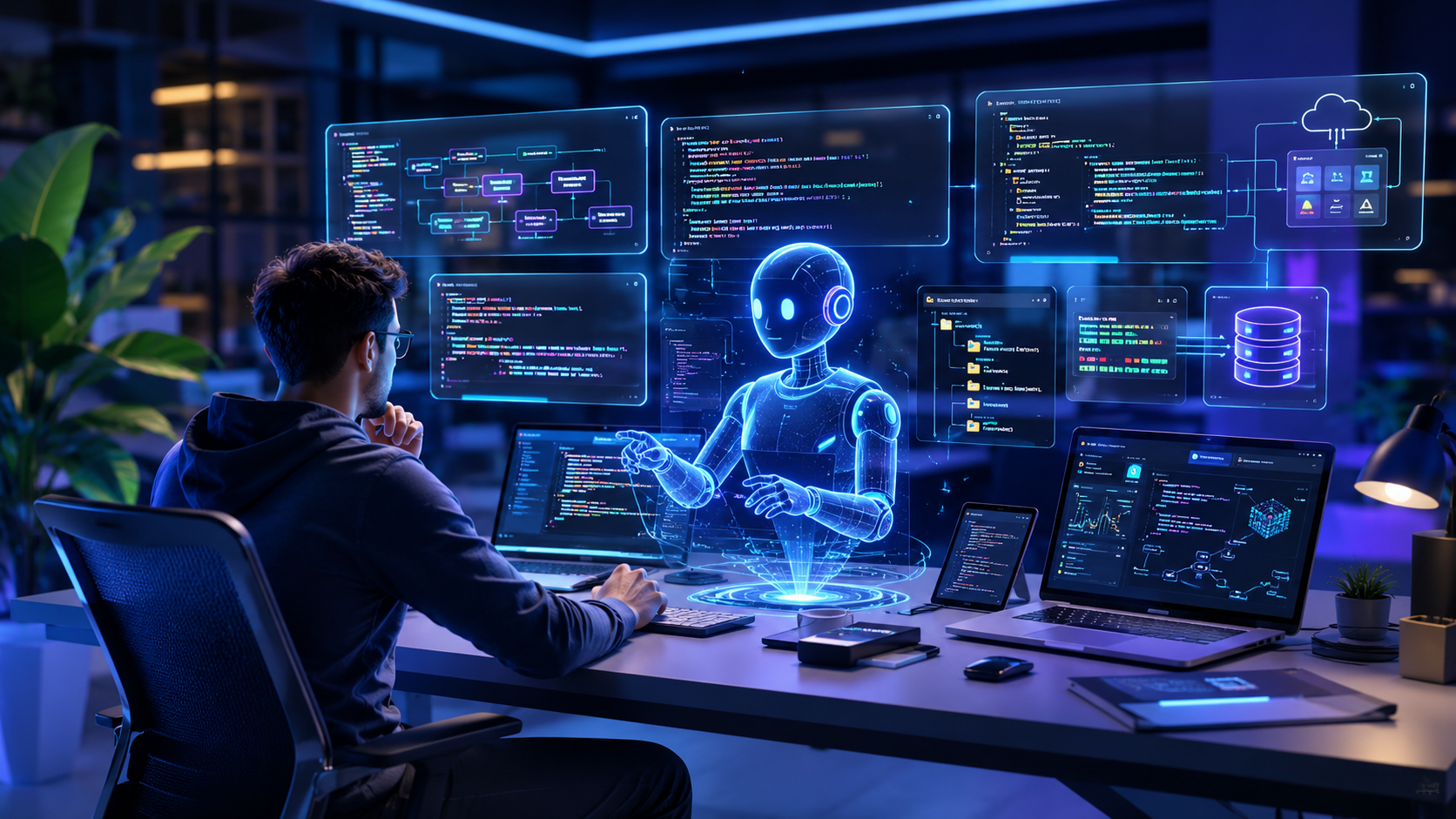
Artificial intelligence is changing the way software is built. Today, AI tools can do much more than suggest a line of code or fix a small error. New AI coding agents can understand a task, work with an existing codebase, write code, run tests, find problems, and make changes on their own.
This is creating a big question in the software industry: Will developers still need to write code manually?
The answer is yes, but the role of developers is changing. AI may handle more of the repetitive coding work, while developers focus more on planning, architecture, problem-solving, security, and making important technical decisions.
What Are AI Coding Agents?
AI coding agents are AI-powered tools that can perform software development tasks with less step-by-step guidance from a developer.
A traditional AI coding assistant usually helps with a specific request. For example, you might ask it to create a JavaScript function or explain an error.
An AI coding agent can go further. You can give it a larger task, such as asking it to add a new feature to an application. The agent can inspect the project, understand related files, write the required code, run tests, find errors, and make changes.
In simple words, an AI coding assistant helps you write code, while an AI coding agent can help you complete a development task.
How AI Coding Agents Work
AI coding agents usually work by combining an AI model with access to a development environment.
A developer gives the agent a task. The agent then looks at the relevant parts of the project and tries to understand how the existing code works.
After that, it creates a plan and starts making changes. It may create new files, update existing files, run commands, execute tests, and check the results.
If something fails, the agent can analyze the error and try to fix it.
The process can look like this:
Task → Understand the code → Plan → Write code → Test → Fix errors → Review
This ability to work through several steps is what makes coding agents different from simple code-generation tools.
AI Coding Assistants vs AI Coding Agents
AI coding assistants and AI coding agents are related, but they are not exactly the same.
A coding assistant is usually designed to help a developer with smaller tasks. It might autocomplete code, suggest a function, explain an error, or generate a code snippet.
A coding agent can work on a much larger task. It may inspect multiple files, make changes across a project, run tests, and continue working until it reaches a useful result.
Think of it this way:
A coding assistant is like a helpful programmer sitting next to you.
A coding agent is more like a junior developer who can take a task and work through several steps independently.
The developer still needs to guide, check, and approve the work.
Why AI Coding Agents Are Becoming Popular
Software development involves many repetitive tasks.
Developers often spend time creating similar components, writing basic API code, updating configuration files, fixing simple bugs, writing tests, and working through routine changes.
AI coding agents can help automate many of these tasks.
This can save developers time and allow them to focus on more difficult problems.
For example, instead of spending hours creating basic CRUD operations, a developer could describe the required feature and let an AI agent create an initial implementation.
The developer can then review the result and make the necessary improvements.
Will Developers Still Need to Write Code?
Yes.
AI coding agents are becoming powerful, but that does not mean developers will suddenly stop writing code.
There will still be situations where developers need to write code themselves, especially when dealing with complex business logic, unusual technical problems, performance issues, security-sensitive systems, and important architectural decisions.
More importantly, developers need to understand code even when AI writes much of it.
If an AI agent creates a complicated piece of code, someone needs to check whether that code is actually correct.
This is why programming knowledge will remain important.
Developers May Write Less Repetitive Code
The bigger change is that developers may spend less time writing repetitive code manually.
Imagine building a web application that needs several forms, API endpoints, database operations, validation rules, and basic tests.
Some of this work can be generated by AI.
Instead of spending most of the day typing boilerplate code, a developer may spend more time describing requirements, reviewing AI-generated code, testing the application, and solving difficult problems.
So the future is not necessarily about developers versus AI.
It is more likely to be developers working with AI.
Why Human Developers Are Still Important
Writing code is only one part of software development.
Before writing a single line of code, developers need to understand what the software should actually do.
They need to talk with customers, understand business requirements, choose the right technology, design the system, think about security, handle unexpected situations, and make decisions when there is no obvious answer.
AI can help with many of these activities, but it can still misunderstand requirements or make decisions that look reasonable but are wrong for the actual product.
Human judgment is therefore still extremely important.
AI-Generated Code Can Still Have Problems
AI-generated code should not automatically be trusted.
An AI coding agent can produce code that works in a simple test but creates problems later.
It may introduce a security issue, use an inefficient approach, misunderstand an existing feature, add an unnecessary dependency, or accidentally break another part of the application.
AI can also make confident mistakes.
That is why developers should always review important AI-generated code instead of blindly accepting it.
AI can write code quickly, but developers are still responsible for making sure that code is correct.
The Developer’s Role Is Changing
As AI becomes better at writing code, developers may spend more time on higher-level work.
Instead of focusing only on implementation, developers will increasingly work on system architecture, product requirements, security, performance, testing, code review, and technical strategy.
This does not make programming knowledge less useful.
In many cases, it makes understanding software even more important because developers need to know whether the AI’s solution is good or bad.
The developer becomes less like someone who only types code and more like someone who guides, reviews, and controls the development process.
What Skills Should Developers Learn?
Developers should continue learning programming fundamentals.
Understanding languages such as JavaScript, TypeScript, Python, Java, or other technologies remains valuable.
But developers should also build skills that help them work effectively with AI.
System design is one important area.
A developer who understands databases, APIs, authentication, caching, scalability, cloud systems, and application architecture can give AI much better direction and can also identify poor AI-generated solutions.
Testing and debugging are also becoming more important.
If an AI agent writes hundreds of lines of code, developers need reliable ways to check whether everything works correctly.
Security knowledge is equally important because AI-generated code can contain vulnerabilities.
AI Coding Agents Could Make Developers More Productive
One of the biggest benefits of AI coding agents is productivity.
A developer who normally spends several hours on a repetitive task may be able to complete the first version much faster with AI assistance.
This does not mean the developer can completely ignore the work.
Instead, the developer can use that saved time to improve the application, test more carefully, solve harder problems, or work on new features.
The goal is not simply to write more code.
The goal is to build better software in less time.
Could AI Replace Software Developers?
The idea that AI will completely replace software developers is more complicated than it first appears.
AI can already perform many programming tasks, and its capabilities will likely continue to improve.
However, software development involves more than generating code.
Real projects contain changing requirements, business decisions, legacy systems, security concerns, users, budgets, deadlines, and unexpected problems.
Someone still needs to understand the bigger picture.
Instead of completely replacing developers, AI is more likely to change the way developers work.
Developers who know how to use AI effectively may become much more productive.
The Future of AI-Powered Software Development
The future of software development could involve developers working with several AI agents.
One agent might help create a development plan. Another could write code. Another could generate tests. A security-focused agent could look for vulnerabilities, while another agent could review the implementation.
The developer would remain responsible for deciding what should be built and checking whether the final result meets the requirements.
This could create a new development workflow where AI handles more of the repetitive implementation work while humans focus on important decisions.
What This Means for Developers
Developers do not need to panic about AI coding agents.
Instead, they should learn how to work with them.
The most valuable developers in the future may not be the ones who write every line of code manually. They may be the developers who understand software deeply and know how to use AI to solve problems faster.
Learning AI-assisted development, system design, testing, security, and strong programming fundamentals can help developers stay competitive as the industry changes.
Final Thoughts
AI coding agents are changing software development, but they are not making developers unnecessary.
They can write code, modify files, run tests, and solve many repetitive development tasks. This can make software development faster and more efficient.
However, developers are still needed to understand requirements, make technical decisions, review code, protect applications, and solve problems that require human judgment.
The future is therefore unlikely to be AI replacing every developer.
It is more likely to be developers and AI working together.
The developers who learn to use AI as a powerful development partner may have an important advantage in the next generation of software engineering.
