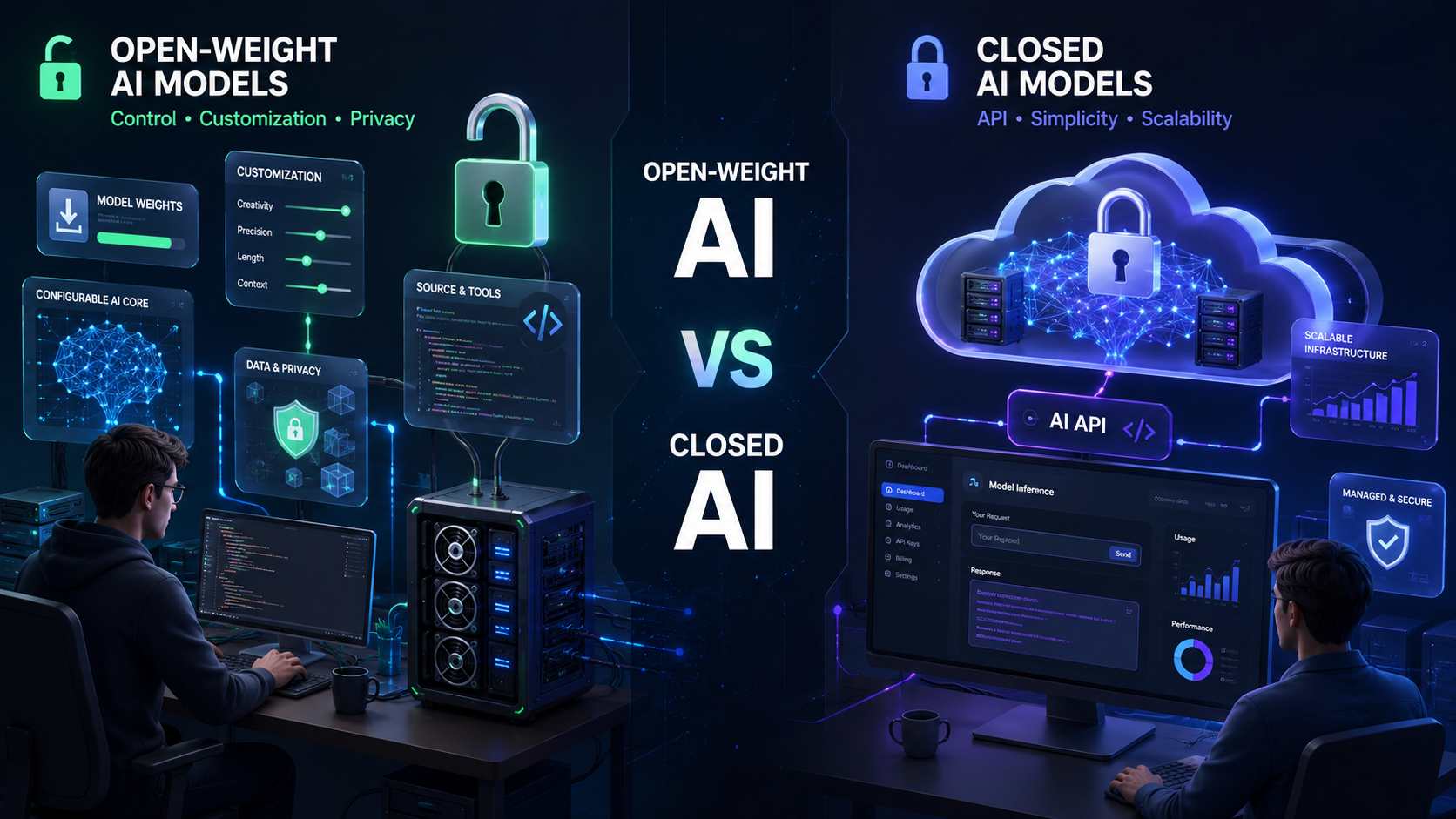
Artificial intelligence is changing quickly, and developers now have more choices than ever when selecting an AI model for a software project. One important choice is whether to use an open-weight AI model or a closed AI model.
Both approaches can be powerful, but they work in very different ways. Open-weight models can give developers more control and customization, while closed models are usually easier to use because the provider manages the infrastructure.
So, which one is better for developers?
The answer depends on what you are building, how much control you need, your budget, your technical resources, and how important privacy and customization are for your application.
What Is an Open-Weight AI Model?
An open-weight AI model is an AI model whose trained weights are made available for developers to download and use, subject to the model’s license.
Think of the model weights as the information the AI learned during training. When those weights are available, developers can potentially run the model on their own servers, customize it, fine-tune it, or connect it directly to their applications.
Popular AI model families such as Llama, Qwen, DeepSeek, Mistral, and other models have helped make this approach more common.
The important point is that open-weight does not always mean completely open-source. A model may provide its weights while keeping training data, training code, or other parts of the development process private. The exact rights also depend on the model’s license.
What Is a Closed AI Model?
A closed AI model keeps its model weights private.
Developers normally use these models through an API or a hosted AI service instead of downloading and running the model themselves.
The basic process is simple:
Your application → AI API → AI provider → Response
The AI provider takes care of much of the complicated infrastructure behind the model, including servers, GPUs, model deployment, and scaling.
This makes closed AI models attractive to developers who want to add AI features without building and maintaining their own AI infrastructure.
Open-Weight vs Closed AI Models at a Glance
The biggest difference is control versus convenience.
With an open-weight model, developers can have much more control over how and where the model runs. With a closed model, developers usually get a simpler development experience because the provider manages the underlying system.
| Feature | Open-Weight AI Models | Closed AI Models |
|---|---|---|
| Model weights | Usually available | Private |
| Self-hosting | Often possible | Usually not |
| Customization | High | Provider-dependent |
| Fine-tuning | Often available | Depends on provider |
| Infrastructure | Developer manages it | Provider manages it |
| Setup | More technical | Usually easier |
| Data control | Higher with self-hosting | Depends on provider |
| Vendor lock-in | Lower | Potentially higher |
| Scaling | Developer’s responsibility | Provider handles it |
| Maintenance | Developer/team | Provider |
| Best for | Control and customization | Speed and simplicity |
Why Are Open-Weight Models Becoming Popular?
Open-weight AI models are getting more attention because developers and businesses want more control over their AI systems.
Recent industry activity shows this trend clearly. Companies are investing heavily in open-weight models as organizations look for AI that can be customized and operated at a lower cost for certain workloads.
The OECD also reports that open-weight models are becoming increasingly competitive with closed models. Its 2026 analysis found that, in the models it studied, open-weight models entered the market at around 90% of the quality index of closed models while having a much lower price ratio in cloud-based comparisons.
This does not mean open-weight models are always cheaper or better. It means developers now have a more serious alternative to consider.
The Main Benefits of Open-Weight AI Models
More Control Over Your AI
One of the biggest advantages is control.
If you run an open-weight model on your own infrastructure, you can decide where the model runs and how your application communicates with it.
This can be useful for companies that want greater control over their data and software environment.
For example, a company could run an AI assistant inside its private cloud instead of sending every request to an external AI service.
More Customization
Open-weight models can be customized for specific tasks.
Imagine you are building an AI assistant for a company’s internal documents. Instead of relying only on a general-purpose model, your team may be able to fine-tune or adapt an open model for the company’s particular needs.
This can make the AI more useful for specialized applications.
The OECD notes that open or semi-open models can give businesses more opportunities to fine-tune models with their own data and create applications tailored to specific industries or use cases.
Greater Data Control
Privacy is another important reason companies consider open-weight models.
When a model is self-hosted, sensitive information can potentially remain within the organization’s own infrastructure.
For example, a company handling confidential documents may prefer an AI system that runs inside its private environment.
However, self-hosting does not automatically make an AI application secure. Developers still need proper authentication, access control, encryption, monitoring, and other security measures.
Less Dependence on One AI Provider
Closed AI applications can become closely connected to a specific provider’s API.
If the provider changes its pricing, limits, model availability, or API behavior, your application may also need changes.
With an open-weight model, developers can have more flexibility because they have access to the model itself.
This can reduce some forms of vendor lock-in, although infrastructure and model-specific dependencies can still exist.
Potentially Lower Costs at Scale
Open-weight models can be attractive for applications that process a very large amount of data.
Instead of paying an external provider for every API request, a company can run its own model infrastructure.
But there is an important catch.
Self-hosting is not free.
You may need GPUs, cloud servers, storage, networking, electricity, monitoring, security, and engineers to maintain the system.
The OECD highlights this trade-off: self-hosting can remove recurring token or license fees, but it can also require significant investment in hardware, infrastructure, energy, maintenance, and support.
The Challenges of Open-Weight AI Models
Open-weight models sound attractive, but they are not the right choice for every developer.
The biggest challenge is infrastructure.
Running a large AI model can require powerful GPUs and a properly configured environment. Your team may also need to handle model updates, performance optimization, monitoring, security, scaling, and failures.
This can become difficult for a small development team.
There is also the issue of licensing.
Developers should never assume that an open-weight model can be used for anything without restrictions. Different models can have different licenses and commercial conditions.
Always check the license before using a model in a production or commercial application.
The Main Benefits of Closed AI Models
Closed AI models offer a different advantage: simplicity.
Instead of worrying about GPUs and model deployment, developers can usually connect their application to an API.
The workflow may look like this:
Your application → API request → AI model → API response
This is much easier for many software teams.
Faster Development
If you are building a prototype, SaaS product, chatbot, coding assistant, or AI-powered website, a closed model can help you get started quickly.
You do not need to purchase or configure expensive hardware.
You can focus on your application instead of managing the AI infrastructure.
For startups and small development teams, this can be a major advantage.
Easier Scaling
Imagine your application suddenly grows from 1,000 users to 100,000 users.
With a hosted AI service, much of the infrastructure scaling is handled by the provider.
With a self-hosted model, your team has to make sure there is enough compute capacity to handle the increased workload.
That difference can save a lot of engineering time.
Access to Advanced AI Capabilities
Closed AI providers often invest heavily in training, improving, evaluating, and operating large models.
Developers can access these capabilities through an API without having to build the model themselves.
This is especially useful when your application needs strong reasoning, coding, multimodal capabilities, or other advanced AI features.
The Challenges of Closed AI Models
The biggest downside is that you give up some control.
You generally cannot download the underlying model weights or completely control how the model works internally.
Your application also becomes dependent on the provider’s API.
There can also be ongoing usage costs. For applications that make millions of AI requests, API expenses can become an important part of the software budget.
This is why developers should consider not only the model’s quality but also the long-term cost of running the application.
Open-Weight or Closed AI: Which One Should Developers Choose?
There is no universal winner.
The right choice depends on your project.
If you need maximum control, customization, self-hosting, or data control, an open-weight model may be a better option.
If you need quick development, simple integration, managed infrastructure, and easy scaling, a closed AI model may make more sense.
Think of it like choosing between owning a car and using a taxi service.
With your own car, you have more control, but you also have to pay for maintenance, fuel, insurance, and repairs.
With a taxi, you have less control, but someone else handles most of the work.
AI models can work in a similar way.
When Should You Choose an Open-Weight Model?
An open-weight model may be a good choice when:
- You need strong control over your AI infrastructure.
- Your application handles sensitive information.
- You need significant customization or fine-tuning.
- You have a team capable of managing AI infrastructure.
- You have a large and predictable workload.
- You want to reduce dependence on a single AI provider.
- You need offline or private deployment.
When Should You Choose a Closed Model?
A closed model may be a better choice when:
- You want to launch quickly.
- You do not want to manage GPUs.
- Your team is small.
- You need simple API integration.
- Your workload changes frequently.
- You want the provider to manage scaling and infrastructure.
- You need access to advanced hosted AI capabilities.
The Hybrid Approach May Be the Best Option
Developers do not always have to choose one model type.
A hybrid AI architecture can use both open-weight and closed models.
For example, a company could use an open-weight model for simple, high-volume tasks and a closed model for more difficult requests.
The architecture could look like this:
User Request → AI Router → Open-Weight Model or Closed Model → Response
This approach allows developers to choose the right model for each task.
For example, a smaller open-weight model could handle document classification, while a more powerful hosted model could handle complex reasoning.
This can help balance cost, performance, privacy, and flexibility.
What Should Developers Check Before Choosing an AI Model?
Before choosing a model, look beyond benchmark scores.
Ask yourself:
How sensitive is my data?
If you are processing confidential information, data handling and deployment options should be major considerations.
How much customization do I need?
If your AI needs to understand a specialized industry or workflow, customization may be important.
How much traffic will my application generate?
A small application and a large AI-powered SaaS platform may have very different cost requirements.
Can my team manage AI infrastructure?
Self-hosting can require much more technical work than using an API.
What is the model’s license?
Always check the actual license and commercial conditions before using an open-weight model.
How easy is it to change models later?
Using a flexible architecture can make it easier to switch between models as technology and pricing change.
The Future of Open-Weight and Closed AI Models
The future probably will not be about one model type completely replacing the other.
Instead, developers will likely use different models for different jobs.
Open-weight models are becoming more competitive, while closed models continue to offer convenience and access to highly capable hosted systems. Recent developments from major AI companies show that the competition between these approaches is still accelerating.
For developers, this is good news.
More choices mean more opportunities to build AI applications that match specific requirements.
The most important question is no longer simply:
“Which AI model is the best?”
A better question is:
“Which AI model is best for my application?”
Final Thoughts
Open-weight and closed AI models both have an important place in modern software development.
Open-weight models can provide greater control, customization, privacy, and deployment flexibility. Closed models can provide easier integration, managed infrastructure, and faster development.
For some projects, an open-weight model will be the better choice. For others, a closed model will save significant time and effort.
And for many businesses, using both may be the smartest strategy.
As AI becomes a bigger part of software development, developers who understand these trade-offs will be better prepared to choose the right model for the right job.
