Introduction
Electric vehicles (EVs) are becoming more common every year. People choose them because they produce fewer emissions, cost less to maintain, and help reduce the use of fossil fuels. However, one thing still worries many buyers—the battery.
Questions like “How far can it go?”, “How long does charging take?”, and “Is the battery safe?” are common.
This is where solid-state batteries are getting a lot of attention.
Many experts believe solid-state batteries could be the next big step in electric vehicle technology. They promise longer driving range, faster charging, improved safety, and longer battery life.
In this guide, you’ll learn what solid-state batteries are, how they work, why they are important, and whether they really are the future of electric vehicles.
What Are Solid-State Batteries?
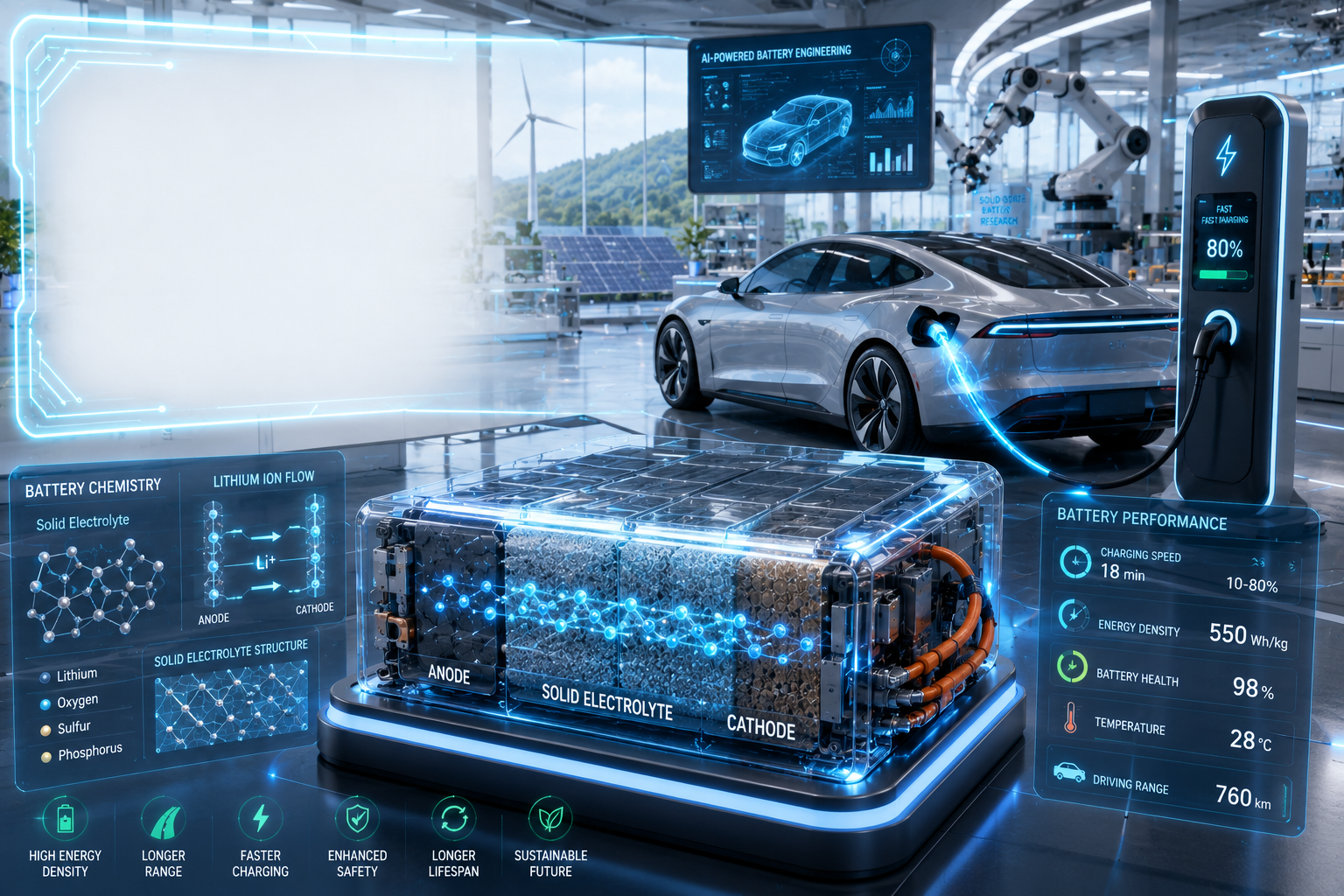
A solid-state battery is a new type of rechargeable battery.
The biggest difference between a solid-state battery and a regular lithium-ion battery is the material inside the battery.
Today’s lithium-ion batteries use a liquid electrolyte to move energy between different parts of the battery.
A solid-state battery replaces that liquid with a solid material.
Although this sounds like a small change, it makes the battery safer, more powerful, and more efficient.
Think of it like replacing an old road with a modern highway. The destination is the same, but the journey becomes faster, safer, and smoother.
How Do Solid-State Batteries Work?
To understand how a solid-state battery works, let’s keep it simple.
Every rechargeable battery stores energy and releases it when needed.
Inside the battery are tiny particles called lithium ions. These ions move back and forth between two sides of the battery whenever it charges or powers a device.
In a traditional battery, the ions travel through a liquid.
In a solid-state battery, they move through a solid material instead.
This solid material is more stable than liquid, which helps improve safety and overall battery performance.
The basic job of the battery stays the same—it stores electricity and provides power—but it does it more efficiently.
Why Are Solid-State Batteries So Important?
The battery is one of the most important parts of an electric vehicle.
A better battery means a better driving experience.
Today’s EV batteries work well, but they still have some limitations. Charging can take time, driving range is limited, and batteries slowly lose performance after years of use.
Solid-state batteries are being developed to solve many of these problems.
If they become widely available, electric vehicles could become more practical, reliable, and convenient for millions of people.
Benefits of Solid-State Batteries
Longer Driving Range
One of the biggest advantages of solid-state batteries is their ability to store more energy in the same amount of space.
This means an electric vehicle can travel farther before needing another charge.
For drivers, this means fewer charging stops and more confidence on long journeys.
Faster Charging
Nobody likes waiting for a battery to charge.
Solid-state batteries are expected to support much faster charging than today’s batteries.
Although exact charging times will depend on the vehicle and charger, the goal is to make charging much quicker and more convenient.
Better Safety
Safety is one of the biggest reasons companies are investing in this technology.
Traditional lithium-ion batteries contain a liquid that can become unstable if damaged or overheated.
Solid-state batteries use a solid material that is much less likely to catch fire or leak.
This makes them a safer option for electric vehicles.
Longer Battery Life
Every battery slowly wears out after being charged many times.
Solid-state batteries are designed to last longer and maintain their performance over more charging cycles.
This means drivers may not need to replace their batteries as often, which can save money in the long run.
Smaller and Lighter Batteries
Solid-state batteries can store more energy while taking up less space.
Because of this, manufacturers can build smaller and lighter battery packs without reducing performance.
Lighter batteries can improve vehicle efficiency and overall driving performance.
Solid-State Batteries vs Lithium-Ion Batteries
Both battery types power electric vehicles, but they work in slightly different ways.
Lithium-ion batteries use a liquid electrolyte, while solid-state batteries use a solid electrolyte.
This simple difference gives solid-state batteries several advantages.
They are expected to be safer, charge faster, last longer, and provide more driving range.
However, lithium-ion batteries are currently much cheaper to produce, which is why they are still used in most electric vehicles today.
Where Can Solid-State Batteries Be Used?
Although electric vehicles receive most of the attention, solid-state batteries have many other uses.
Electric Vehicles
Future electric cars, buses, trucks, and motorcycles can benefit from improved battery performance.
Smartphones and Laptops
Smaller batteries with longer life could allow devices to stay charged for longer without increasing their size.
Medical Equipment
Medical devices need reliable and safe power sources. Solid-state batteries could improve both safety and performance.
Renewable Energy Storage
Solar panels and wind farms produce clean energy, but that energy needs to be stored efficiently. Solid-state batteries could become an excellent solution for energy storage.
Aerospace
Aircraft, satellites, and space missions need lightweight and reliable batteries. Solid-state technology could make future aerospace systems even more efficient.
What Challenges Still Need to Be Solved?
Although solid-state batteries have great potential, they are still being developed.
One of the biggest challenges is cost.
Today, they are much more expensive to manufacture than lithium-ion batteries.
Another challenge is large-scale production.
Building millions of batteries with the same quality and performance is not easy.
Researchers are also working to improve battery durability and manufacturing methods before they can be widely used.
Which Companies Are Working on Solid-State Batteries?
Many of the world’s biggest automotive and technology companies are investing heavily in this technology.
Some of the leading companies include:
- Toyota
- Nissan
- BMW
- Mercedes-Benz
- Volkswagen
- Hyundai
- Honda
- Samsung SDI
- Panasonic
- QuantumScape
These companies believe solid-state batteries could become the next major advancement in electric vehicle technology.
What Does the Future Look Like?
The future of solid-state batteries looks very promising.
As technology improves and manufacturing becomes more affordable, these batteries are expected to appear in more electric vehicles.
They could help reduce charging times, increase driving range, improve safety, and make EV ownership more convenient.
Although it may take a few more years before they become common, many experts believe they will play a major role in the future of transportation.
Are Solid-State Batteries Really the Future of Electric Vehicles?
Many experts believe they are.
Solid-state batteries solve several of the biggest problems with today’s EV batteries.
They offer better safety, higher energy storage, faster charging, and longer battery life.
While they are not yet ready to completely replace lithium-ion batteries, they are moving closer to commercial use every year.
As production increases and costs come down, solid-state batteries could become the standard battery technology for future electric vehicles.
Final Thoughts
Solid-state batteries represent one of the most exciting developments in electric vehicle technology.
By replacing the liquid inside traditional batteries with a solid material, they offer a safer and more efficient way to store energy.
There are still challenges to overcome, especially when it comes to manufacturing costs and large-scale production.
However, with major companies investing billions of dollars in research, the technology is improving rapidly.
In the coming years, solid-state batteries could help make electric vehicles more practical, affordable, and reliable for everyday drivers.
If this technology continues to progress as expected, it may become one of the biggest breakthroughs in the future of clean transportation.
