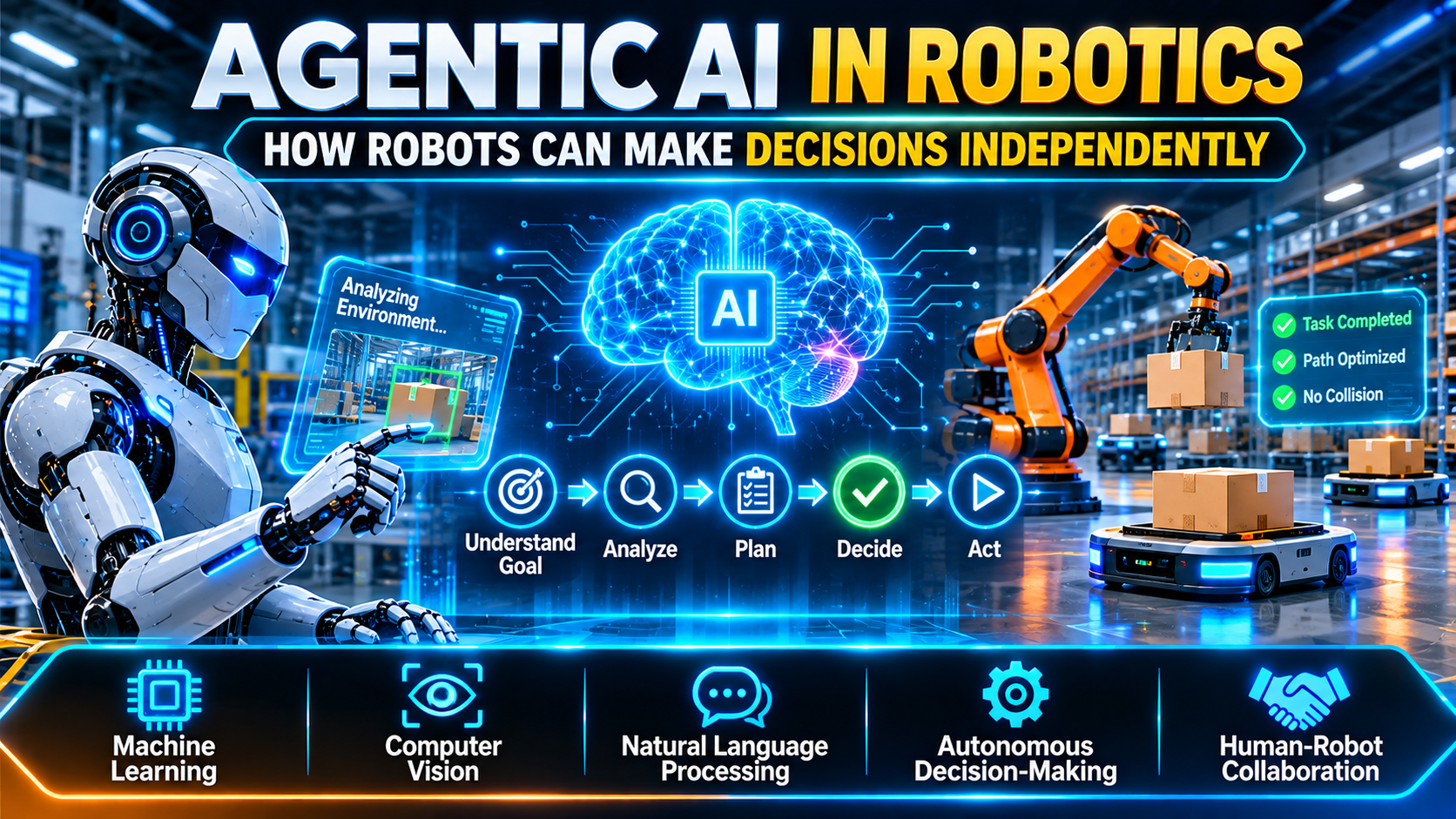
Robotics is changing rapidly with the development of Artificial Intelligence (AI). Traditional robots usually follow predefined instructions and perform specific tasks. However, modern AI-powered robots are becoming more intelligent and capable of handling complex situations.
One important development in this field is Agentic AI. It allows robots to understand goals, analyze their surroundings, make decisions, and take actions with less human intervention.
For example, imagine a warehouse robot that receives an instruction to collect a particular product. Instead of following only a fixed route, the robot can identify the product, choose a suitable path, avoid obstacles, and adjust its actions when something unexpected happens.
This is how Agentic AI is helping create a new generation of intelligent and autonomous robots.
1. What Is Agentic AI in Robotics?
Agentic AI refers to artificial intelligence systems that can work toward specific goals by planning tasks, making decisions, using available tools, and taking actions based on changing situations.
When Agentic AI is integrated into robotics, it helps machines perform tasks with greater flexibility instead of depending entirely on fixed programming.
Traditional robots generally follow predefined commands. Agentic AI-powered robots can analyze situations, decide what action is appropriate, and adjust their plans when conditions change.
Example: A traditional cleaning robot may follow a fixed cleaning pattern. An AI-powered agentic robot could identify dirty areas, plan a cleaning route, avoid people and furniture, and return to its charging station when its battery becomes low.
However, these robots still operate within programmed objectives, safety restrictions, and operational limits.
2. How Does Agentic AI Work in Robots?
Agentic AI combines several technologies to help robots understand their environment and perform tasks intelligently.
Step 1: Understanding the Goal
The robot first receives a task or objective.
For example, a warehouse robot may receive an instruction to pick up a package and deliver it to a particular location.
Step 2: Understanding the Environment
The robot uses cameras, sensors, and other technologies to collect information about its surroundings.
Computer vision and sensor processing help it identify objects, people, obstacles, and available paths.
Step 3: Planning the Task
After understanding the environment, the AI system creates a plan to complete the assigned task.
It may divide a complex objective into smaller steps, prioritize actions, and select suitable tools.
Step 4: Making Decisions
The robot evaluates available information and chooses an appropriate action.
For example, if an obstacle blocks its path, the robot may calculate an alternative route instead of stopping completely.
Step 5: Taking Action
The robot uses its motors, robotic arms, wheels, or other mechanical components to perform the selected action.
Step 6: Learning and Improving
The system can use feedback from sensors and previous task results to improve future decisions.
Some systems use machine learning and reinforcement learning to improve their performance through training and experience.
3. Key Technologies Behind Agentic AI Robotics
Agentic AI robotics combines multiple technologies to make intelligent machines more capable.
Machine Learning
Machine learning allows robots to identify patterns in data and improve specific tasks through training.
For example, a robot can learn to recognize different objects using image datasets.
Computer Vision
Computer vision helps robots understand visual information collected through cameras.
It allows robots to recognize objects, identify obstacles, understand their surroundings, and interact with physical environments.
Natural Language Processing (NLP)
Natural Language Processing helps robots understand human instructions.
For example, a person can tell a robot, “Move the box near the storage area,” and the AI system can interpret the instruction and convert it into suitable actions.
Large Language Models (LLMs)
Large Language Models can help robots understand complex instructions, break goals into smaller tasks, and communicate with users.
However, an LLM alone cannot physically control a robot safely. It must work with robotics software, sensors, control systems, and safety mechanisms.
Sensor Fusion
Sensor fusion combines information from different sensors, such as cameras, LiDAR, radar, and motion sensors.
This helps robots build a more complete understanding of their surroundings.
Planning and Decision-Making Systems
Planning systems help robots determine the sequence of actions required to achieve a goal.
They can also help robots adjust their plans when unexpected situations occur.
4. Agentic AI vs Traditional Robotics
Traditional robotics and Agentic AI robotics use different approaches to complete tasks.
| Feature | Traditional Robotics | Agentic AI Robotics |
|---|---|---|
| Working method | Predefined instructions | Goal-oriented planning and actions |
| Decision-making | Mostly fixed logic | Context-based decisions |
| Flexibility | Limited in changing situations | Can adapt within defined limits |
| Environment | Often controlled | Can handle more dynamic environments |
| Task execution | Repetitive programmed tasks | Complex multi-step tasks |
| Human involvement | Often requires reprogramming | Can reduce repeated human intervention |
| Learning | Usually requires explicit updates | May use feedback and learning systems |
Traditional robots remain extremely useful for repetitive industrial operations. Agentic AI adds greater flexibility for tasks that require environmental understanding and decision-making.
5. Real-World Applications of Agentic AI in Robotics
Agentic AI has the potential to improve different industries by helping robots perform complex tasks more intelligently.
Warehouse and Logistics Automation
Agentic AI-powered warehouse robots can identify products, select routes, avoid obstacles, and transport packages.
They can also coordinate tasks with other warehouse systems to improve operational efficiency.
Manufacturing Industry
In manufacturing, intelligent robots can assist with material handling, product inspection, assembly, and production processes.
They may adjust certain operations based on sensor information and changing production requirements.
Healthcare and Medical Robotics
AI-powered robotic systems can assist healthcare professionals with selected tasks, including hospital logistics, rehabilitation support, and surgical assistance.
Medical applications require strict safety procedures, professional supervision, and regulatory approval.
Agriculture and Smart Farming
Agricultural robots can use cameras and sensors to identify crops, monitor field conditions, and support tasks such as targeted spraying and harvesting.
Agentic AI can help these systems plan actions according to changing field conditions.
Autonomous Vehicles and Delivery Robots
Autonomous robots can analyze their surroundings, detect obstacles, plan routes, and make navigation decisions.
Agentic AI can help coordinate complex delivery tasks, although physical navigation still depends on specialized perception and control systems.
Household Automation
Future household robots may help with cleaning, organizing objects, and performing everyday tasks.
They could understand user instructions and adjust their actions according to the home environment.
6. Benefits of Agentic AI in Robotics
Agentic AI offers several potential advantages for businesses and industries.
Reduced Human Intervention
Robots can handle certain multi-step tasks without requiring humans to provide instructions for every action.
Better Decision-Making
AI systems can analyze sensor information and evaluate different options before selecting an action.
Improved Flexibility
Agentic robots can adjust their plans when environmental conditions change or unexpected obstacles appear.
Increased Productivity
Intelligent robots can automate repetitive and complex tasks, helping organizations improve operational efficiency.
Task Coordination
Multiple AI-powered robots can coordinate activities and share information to complete larger tasks.
Continuous Operation
Robots can perform suitable automated operations for extended periods, depending on their energy, maintenance, and safety requirements.
7. Challenges and Limitations of Agentic AI in Robotics
Although Agentic AI offers exciting possibilities, several challenges must be addressed before it can be used safely and reliably everywhere.
Safety Concerns
Robots interact with physical environments where incorrect actions can cause damage or injuries.
Strong safety systems, emergency stops, and human supervision are important.
High Development Costs
Developing intelligent robots requires hardware, sensors, AI models, software, testing, and maintenance.
These requirements can make implementation expensive.
Decision-Making Errors
AI systems can misunderstand instructions, misinterpret sensor information, or select inappropriate actions.
Reliable testing and safety restrictions are necessary.
Data Privacy and Security
Connected robots may collect sensitive information through cameras, microphones, and other sensors.
Organizations must protect collected data and prevent unauthorized access.
Technical Complexity
Integrating AI models with robotic hardware, real-time control systems, and multiple sensors requires advanced technical knowledge.
Dependence on Reliable Data
Poor-quality sensor data or incomplete environmental information can affect the robot’s decisions and performance.
8. Agentic AI and the Future of Humanoid Robots
Humanoid robots are becoming an important area of robotics research and development.
Unlike traditional industrial robots designed for specific tasks, humanoid robots are developed to operate in environments designed for humans.
Agentic AI could help humanoid robots understand spoken instructions, plan activities, recognize objects, and perform multiple tasks.
For example, a future humanoid robot in a warehouse might receive an instruction to collect a package, identify its location, pick it up, and deliver it to the correct destination.
This requires a combination of AI reasoning, computer vision, robotic manipulation, motion planning, and physical control.
As these technologies improve, humanoid robots may become more useful in manufacturing, logistics, healthcare support, and household applications.
9. The Future of Agentic AI in Robotics
The future of Agentic AI in robotics is expected to involve more intelligent, adaptive, and collaborative machines.
Several developments could shape this technology.
Physical AI: AI systems will increasingly interact with the physical world through robots, machines, and autonomous devices.
Multi-Agent Robotics: Multiple intelligent robots may collaborate, divide tasks, and coordinate their activities.
Advanced Human-Robot Interaction: Robots may understand natural language instructions and communicate more effectively with people.
Self-Adaptive Systems: Future robots may adjust their behavior according to environmental changes and task requirements.
Edge AI: Processing AI tasks directly on robotic devices may reduce delays and support faster decision-making.
Smarter Industrial Automation: Manufacturing facilities may use intelligent robots to handle more flexible production tasks.
These developments could make robotics more useful across different industries, although widespread adoption will depend on reliability, affordability, and safety.
10. Are Agentic AI Robots Fully Independent?
Agentic AI robots can perform certain tasks independently, but this does not mean they can operate without any human involvement.
Their independence depends on their design, training, available sensors, operating environment, and safety restrictions.
For example, a warehouse robot may independently transport packages inside a controlled facility. However, a human operator may still be required to handle unusual situations, approve sensitive actions, or perform maintenance.
The goal of Agentic AI is not necessarily to remove humans from every process. It is to help machines perform suitable tasks more intelligently while allowing people to supervise important decisions.
Conclusion
Agentic AI is an important development in modern robotics. It allows robots to move beyond fixed instructions and work toward specific goals through planning, decision-making, and environmental understanding.
By combining machine learning, computer vision, language models, sensor fusion, and robotic control systems, Agentic AI can make robots more flexible and capable of handling complex tasks.
From warehouses and manufacturing facilities to healthcare and household automation, this technology has the potential to transform how humans and machines work together.
Although challenges such as safety, cost, privacy, and reliability remain, Agentic AI could play an important role in the next generation of intelligent robotics.
