Traffic congestion has become a major problem in many cities around the world. As the number of vehicles increases, roads become crowded, travel times become longer, and the chances of road accidents can also increase.
Traditional traffic management systems often depend on fixed traffic signals, manual monitoring, and basic traffic cameras. These systems can help manage roads, but they may not always provide enough information about changing traffic conditions.
This is where smart road sensors play an important role.
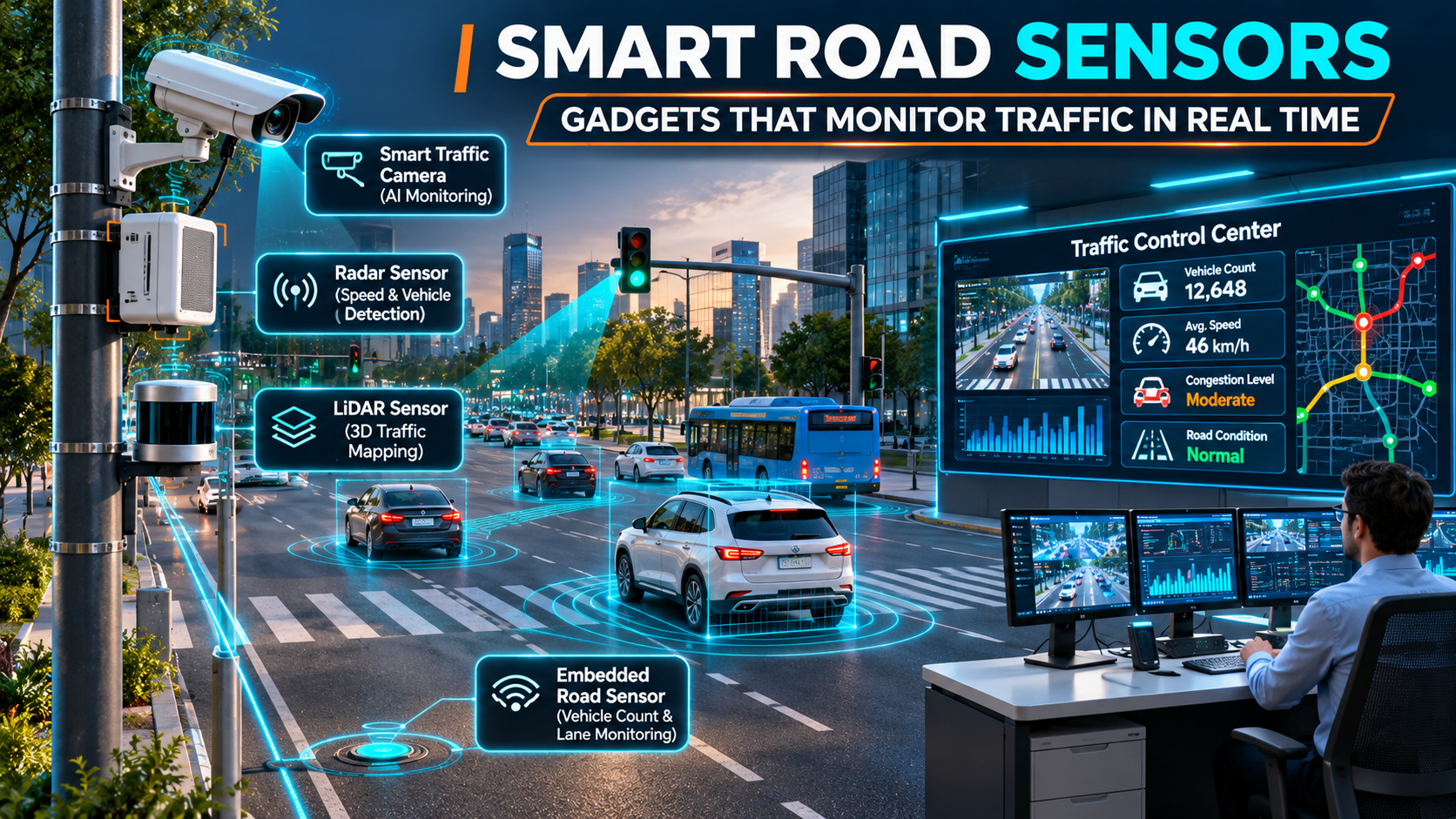
Smart road sensors are modern electronic devices installed on roads, traffic signals, bridges, and roadside structures to collect real-time information about vehicles and road conditions.
These devices can detect passing vehicles, measure traffic speed, estimate vehicle density, identify congestion, and provide useful information to traffic management systems.
When connected with Artificial Intelligence (AI), the Internet of Things (IoT), and intelligent traffic control systems, smart road sensors can help cities make better traffic management decisions.
In this article, we will explore what smart road sensors are, how they work, their different types, real-world applications, benefits, challenges, and their role in the future of smart transportation.
2. What Are Smart Road Sensors?
Smart road sensors are electronic devices that collect and transmit information about road traffic and surrounding conditions.
They use different technologies, such as radar, LiDAR, cameras, magnetic sensors, infrared technology, and wireless communication, to monitor road activity.
For example, a sensor installed near a busy road intersection can detect how many vehicles pass through a particular lane within a specific period.
The collected information can be sent to a central traffic management system, where software analyzes the data and helps traffic authorities understand current road conditions.
Some smart road sensors can monitor:
- Number of vehicles passing through a road.
- Vehicle speed and movement.
- Traffic density and congestion.
- Vehicle type and lane occupancy.
- Pedestrian and cyclist movement.
- Road surface and environmental conditions.
- Possible accidents or unusual road activity.
Smart road sensors are an important part of Intelligent Transportation Systems (ITS), which use connected technologies to make transportation safer and more efficient.
3. How Do Smart Road Sensors Work?
Smart road sensors work by detecting vehicles or environmental changes and converting the collected information into digital data.
This information is then processed by traffic monitoring software or intelligent transportation systems.
The general working process includes the following steps.
Step 1: Detect Vehicles and Road Activity
Sensors installed on roads or nearby structures detect vehicles as they pass through a particular area.
Depending on the technology, they may use electromagnetic signals, radio waves, laser measurements, cameras, or pressure changes.
Step 2: Collect Traffic Information
After detecting vehicles, the sensors collect useful information such as vehicle count, speed, direction, and lane occupancy.
Some advanced systems can also identify traffic patterns and detect unusual road activity.
Step 3: Send Data to the Traffic Management System
The collected information is transmitted to a central system using communication technologies such as cellular networks, Wi-Fi, Ethernet, or other wireless connections.
Step 4: Analyze Traffic Conditions
Traffic management software processes the incoming information to identify congestion, traffic flow changes, and possible problems.
Artificial Intelligence can also be used to analyze historical and real-time traffic data.
Step 5: Take Traffic Management Actions
Based on the analyzed information, traffic authorities or automated systems can make appropriate decisions.
For example:
- Adjust traffic signal timing.
- Display traffic warnings on digital road signs.
- Notify traffic control teams about congestion.
- Identify roads where traffic is moving slowly.
- Support emergency response teams.
Example: Imagine a busy road intersection during office hours. Sensors detect that one road has a much higher number of vehicles than the other roads. The traffic management system can use this information to recommend a longer green signal duration for the busier road, subject to safety rules and signal-control policies.
This helps traffic systems respond to actual road conditions instead of depending only on fixed signal timings.
4. Different Types of Smart Road Sensors
Smart road monitoring uses different sensor technologies. Each type has its own working method, advantages, and applications.
4.1 Radar Traffic Sensors
Radar sensors use radio waves to detect moving vehicles and measure their speed.
They are commonly installed on poles, roadside structures, and traffic monitoring equipment.
These sensors can monitor traffic without requiring physical contact with vehicles.
Main Features:
- Detect vehicle movement.
- Measure vehicle speed.
- Monitor multiple lanes, depending on the device.
- Work in different lighting conditions.
- Support traffic flow monitoring.
Common Applications:
- Highway speed monitoring.
- Traffic signal control.
- Vehicle counting.
- Road congestion detection.
4.2 LiDAR Sensors
LiDAR stands for Light Detection and Ranging.
These sensors use laser pulses to measure distances and create detailed information about nearby objects.
In traffic monitoring, LiDAR can help detect vehicles, measure their positions, and understand movement around intersections.
Main Features:
- Accurate distance measurement.
- Detailed object detection.
- Vehicle position tracking.
- Three-dimensional environmental mapping.
- Detection of multiple objects within the sensor’s range.
Common Applications:
- Smart intersections.
- Autonomous vehicle infrastructure.
- Roadside traffic monitoring.
- Pedestrian and cyclist detection.
4.3 Inductive Loop Sensors
Inductive loop sensors are installed beneath the road surface.
They usually consist of a wire loop placed inside a cut in the road. When a vehicle passes over the loop, it changes the electromagnetic field, allowing the system to detect the vehicle.
These sensors are widely used in traffic signal systems.
Main Features:
- Detect vehicles passing over the sensor.
- Estimate vehicle presence and occupancy.
- Support traffic signal activation.
- Provide vehicle counting information.
Common Applications:
- Traffic signal control.
- Vehicle counting.
- Intersection monitoring.
- Road access control.
4.4 Magnetic Traffic Sensors
Magnetic sensors detect changes in the Earth’s magnetic field caused by nearby metal objects, such as vehicles.
They can be installed inside or near road surfaces to identify vehicle movement.
Main Features:
- Detect passing vehicles.
- Support vehicle counting.
- Require relatively little installation space.
- Can be used in wireless sensor networks.
Common Applications:
- Smart parking systems.
- Vehicle detection.
- Traffic flow monitoring.
- Roadside monitoring networks.
4.5 Infrared Traffic Sensors
Infrared sensors use infrared light or thermal information to detect objects and movement.
Depending on the sensor type, they can detect vehicles, pedestrians, and movement in a specific monitoring area.
Main Features:
- Detect movement without physical contact.
- Support pedestrian detection.
- Work in different lighting conditions depending on the technology.
- Provide useful information for traffic monitoring.
Common Applications:
- Pedestrian crossings.
- Vehicle detection.
- Smart traffic signals.
- Road safety systems.
4.6 Video-Based Traffic Sensors
Video-based traffic sensors use cameras and computer vision software to monitor roads.
Unlike basic CCTV cameras, advanced video analytics systems can automatically analyze recorded or live video to identify vehicles and traffic patterns.
Main Features:
- Vehicle counting.
- Vehicle classification.
- Lane occupancy monitoring.
- Traffic congestion detection.
- Incident and unusual movement detection.
Common Applications:
- Smart city traffic monitoring.
- Highway surveillance.
- Traffic violation monitoring.
- Accident detection systems.
4.7 Piezoelectric Road Sensors
Piezoelectric sensors generate an electrical signal when mechanical pressure is applied to them.
When vehicles pass over a road-mounted piezoelectric sensor, the pressure creates signals that can be analyzed to identify vehicle movement and other characteristics.
Main Features:
- Detect vehicle passage.
- Measure axle-related information in suitable systems.
- Support vehicle classification.
- Provide traffic measurement data.
Common Applications:
- Highway traffic monitoring.
- Vehicle classification.
- Weigh-in-motion systems.
- Transportation research.
5. Important Features of Smart Road Sensors
Modern smart road sensors offer several features that help traffic authorities understand road conditions more effectively.
5.1 Real-Time Vehicle Counting
Smart sensors can count vehicles passing through a road or intersection.
This information helps traffic authorities understand how busy a particular road is during different times of the day.
5.2 Vehicle Speed Detection
Radar and other traffic monitoring technologies can measure vehicle speed.
This information can help identify speeding vehicles and support road safety monitoring.
5.3 Traffic Density Monitoring
Traffic density refers to the number of vehicles occupying a particular section of road.
Smart sensors help identify roads where vehicle density is increasing, allowing authorities to monitor congestion more effectively.
5.4 Lane Occupancy Detection
Some advanced sensors can identify how much of a lane is occupied by vehicles.
This information is useful for understanding traffic flow and adjusting signal operations.
5.5 Accident and Incident Detection
Video analytics, radar, and connected monitoring systems can help identify unusual road conditions.
For example, if a vehicle stops unexpectedly on a highway, a monitoring system may generate an alert for further investigation.
However, not every sensor can independently confirm that an accident has occurred.
5.6 Weather and Road Condition Monitoring
Specialized roadside sensors can monitor environmental conditions such as temperature, humidity, rainfall, visibility, and road surface conditions.
This information can help transportation authorities issue warnings and plan appropriate road safety measures.
6. How Smart Road Sensors Help Reduce Traffic Congestion
Traffic congestion often happens when the number of vehicles exceeds the available road capacity.
Smart road sensors help traffic management systems understand where congestion is developing and how traffic conditions are changing.
Here are some important ways they can help.
6.1 Adaptive Traffic Signal Control
Traditional traffic signals often follow fixed timing schedules.
Smart traffic signal systems can use sensor information to adjust signal timings based on current traffic demand.
For example, if one direction has significantly more vehicles than another, the system may allocate green time according to configured traffic-control rules.
6.2 Better Traffic Flow Monitoring
Sensors provide information about traffic movement across different roads and intersections.
Traffic authorities can use this data to identify bottlenecks and understand where congestion regularly occurs.
6.3 Early Congestion Detection
By monitoring vehicle counts and speeds, smart systems can identify signs of increasing congestion.
Authorities can then investigate the issue and take suitable action.
6.4 Improved Route Management
Traffic monitoring data can be shared with navigation and traffic information services.
This may help drivers understand road conditions and choose alternative routes when available.
6.5 Emergency Vehicle Support
Connected traffic systems can help prioritize emergency vehicles at selected intersections.
For example, a properly integrated system may detect an authorized ambulance approaching an intersection and coordinate traffic signals to support its movement.
7. Applications of Smart Road Sensors in Smart Cities
Smart road sensors are used in several transportation and infrastructure applications.
7.1 Highway Traffic Monitoring
Highways need continuous traffic monitoring because vehicles often travel at high speeds.
Sensors can help measure vehicle speed, count traffic, identify congestion, and support incident detection.
7.2 Smart City Traffic Management
Smart cities use connected sensors, cameras, and software platforms to monitor road conditions across multiple locations.
This information helps transportation authorities understand traffic patterns and improve traffic planning.
7.3 Smart Parking Management
Parking sensors can detect whether parking spaces are occupied or available.
This information can be shared through digital displays or mobile applications to help drivers locate available parking spaces.
7.4 Pedestrian Safety
Smart sensors can detect pedestrians near selected crossings and provide information to traffic signal systems.
These technologies can help improve pedestrian awareness and support safer crossing operations.
7.5 Toll Collection and Vehicle Classification
Traffic monitoring technologies can support vehicle detection and classification at toll facilities.
When integrated with appropriate identification and payment systems, they can help automate parts of the toll collection process.
7.6 Public Transportation Management
Sensors can help transportation authorities monitor traffic conditions along bus routes and other public transport corridors.
When combined with GPS and fleet management systems, this information can support better route planning and service management.
8. Benefits of Smart Road Sensors
Smart road sensors provide several benefits for transportation authorities, drivers, and city planners.
8.1 Reduced Traffic Congestion
Real-time traffic information helps authorities identify congestion and make more informed traffic management decisions.
8.2 Improved Road Safety
Speed monitoring, incident detection, and pedestrian monitoring can help support safer roads.
8.3 Better Traffic Planning
Historical sensor data helps city planners understand traffic patterns and identify locations that may require infrastructure improvements.
8.4 Faster Incident Response
Connected monitoring systems can generate alerts when unusual traffic activity is detected, helping authorities investigate potential incidents.
8.5 Reduced Manual Monitoring
Automated vehicle detection and traffic counting can reduce the need for continuous manual observation.
8.6 Better Transportation Efficiency
By improving traffic visibility and supporting more informed decisions, smart road sensors can contribute to smoother transportation operations.
9. Challenges of Smart Road Sensor Technology
Although smart road sensors offer many advantages, their implementation also comes with challenges.
9.1 High Installation Costs
Advanced sensors, roadside equipment, communication networks, and traffic management software can require significant investment.
9.2 Maintenance Requirements
Roadside devices are exposed to dust, rain, temperature changes, vibration, and physical damage.
Regular inspection and maintenance are important for reliable operation.
9.3 Data Accuracy
Different sensor technologies may produce inaccurate readings under certain conditions.
For example, camera-based systems can face difficulties during heavy rain, fog, glare, or poor visibility.
9.4 Data Privacy and Security
Video cameras and vehicle monitoring systems may collect sensitive information.
Organizations should use appropriate access controls, data protection measures, secure communication, and data retention policies.
9.5 Integration with Existing Infrastructure
Many cities already use traditional traffic signals and monitoring equipment.
Integrating modern sensors with older systems can require additional hardware, software updates, and technical planning.
9.6 Network Connectivity
Smart sensors often depend on communication networks to send information to central systems.
Poor connectivity can delay data transmission and affect real-time monitoring capabilities.
10. Smart Road Sensors vs Traditional Traffic Monitoring Systems
Traditional traffic monitoring systems and modern smart road sensors use different methods to collect and process road information.
| Feature | Traditional Traffic Monitoring | Smart Road Sensors |
|---|---|---|
| Vehicle detection | Basic cameras or manual observation | Radar, LiDAR, magnetic, loop, and video sensors |
| Traffic data | Often limited | Can provide detailed traffic measurements |
| Monitoring | May require manual observation | Can support automated monitoring |
| Traffic information | May be periodic or limited | Can provide near-real-time information |
| Signal control | Often fixed timing | Can support adaptive signal control |
| Data analysis | Basic reporting | Can integrate with advanced analytics |
| Integration | Limited or legacy systems | Can connect with IoT and intelligent transport platforms |
Smart road sensors can provide more detailed information than basic monitoring systems, but the actual capabilities depend on the devices, software, and infrastructure being used.
11. Future of Smart Road Sensors and Traffic Management
The future of traffic management will involve more connected devices, advanced analytics, and intelligent transportation infrastructure.
Several developments are expected to influence this area.
11.1 AI-Powered Traffic Monitoring
Artificial Intelligence can analyze information from cameras, radar sensors, and other devices to identify traffic patterns and unusual road activity.
This can help transportation authorities make better decisions.
11.2 Internet of Things (IoT) Integration
IoT allows roadside sensors and connected devices to exchange information through communication networks.
This creates opportunities for centralized traffic monitoring across multiple roads and intersections.
11.3 Connected Vehicle Technology
Connected vehicles can exchange information with road infrastructure through Vehicle-to-Everything (V2X) communication.
This can support traffic warnings, road hazard notifications, and cooperative transportation systems.
11.4 Autonomous Vehicle Infrastructure
Autonomous vehicles may benefit from roadside sensors that provide additional information about traffic signals, pedestrians, road conditions, and nearby vehicles.
11.5 Predictive Traffic Management
By combining historical traffic information with real-time sensor data, AI-powered systems can estimate where congestion may develop.
These predictions can help authorities prepare traffic management strategies in advance.
11.6 Smart and Sustainable Cities
Smart road sensors can support better traffic planning, reduce unnecessary vehicle delays, and contribute to more efficient urban transportation systems.
12. Frequently Asked Questions (FAQs)
What are smart road sensors?
Smart road sensors are electronic devices used to detect vehicles, monitor traffic movement, measure speed, and collect information about road conditions.
How do smart road sensors monitor traffic in real time?
They use technologies such as radar, LiDAR, cameras, magnetic sensors, and inductive loops to collect traffic information and send it to monitoring systems for analysis.
Which sensors are used for traffic monitoring?
Common traffic monitoring sensors include radar sensors, LiDAR sensors, inductive loop detectors, magnetic sensors, infrared sensors, video-based sensors, and piezoelectric sensors.
How do smart road sensors reduce traffic congestion?
They provide real-time information about vehicle counts, speed, and road occupancy. Traffic management systems can use this information to support adaptive signal timing and congestion management.
What is the difference between radar and LiDAR traffic sensors?
Radar sensors use radio waves to detect vehicles and measure speed. LiDAR uses laser pulses to measure distance and create detailed information about the position and movement of nearby objects.
Are smart road sensors part of smart city technology?
Yes. Smart road sensors are an important component of Intelligent Transportation Systems and smart city infrastructure.
Can smart road sensors detect accidents?
Some advanced traffic monitoring systems can identify unusual vehicle movement, stopped vehicles, or other potential incident patterns. However, detection capabilities depend on the sensor and software being used.
Do smart road sensors use artificial intelligence?
Some modern traffic monitoring systems use AI to analyze sensor data, classify vehicles, detect congestion, and identify unusual traffic conditions.
Where are smart road sensors installed?
They can be installed beneath road surfaces, on traffic signal poles, roadside structures, highways, bridges, parking facilities, and selected intersections.
What is the future of smart road sensors?
Future systems are likely to combine AI, IoT, connected vehicles, V2X communication, and predictive analytics to support more intelligent traffic management.
Conclusion
Smart road sensors are becoming an important part of modern transportation infrastructure. They help cities collect real-time information about vehicles, traffic speed, road conditions, and congestion.
Technologies such as radar, LiDAR, inductive loops, magnetic sensors, and intelligent cameras allow traffic management systems to understand road activity more effectively.
When combined with Artificial Intelligence, IoT, and connected transportation platforms, these devices can support adaptive traffic signals, better road safety, faster incident response, and improved traffic planning.
As cities continue to grow and the number of vehicles increases, smart road sensors will play an important role in building safer, more connected, and more efficient transportation systems.
The future of traffic management is not just about building more roads. It is also about using smart technology to understand and manage the roads we already have.
