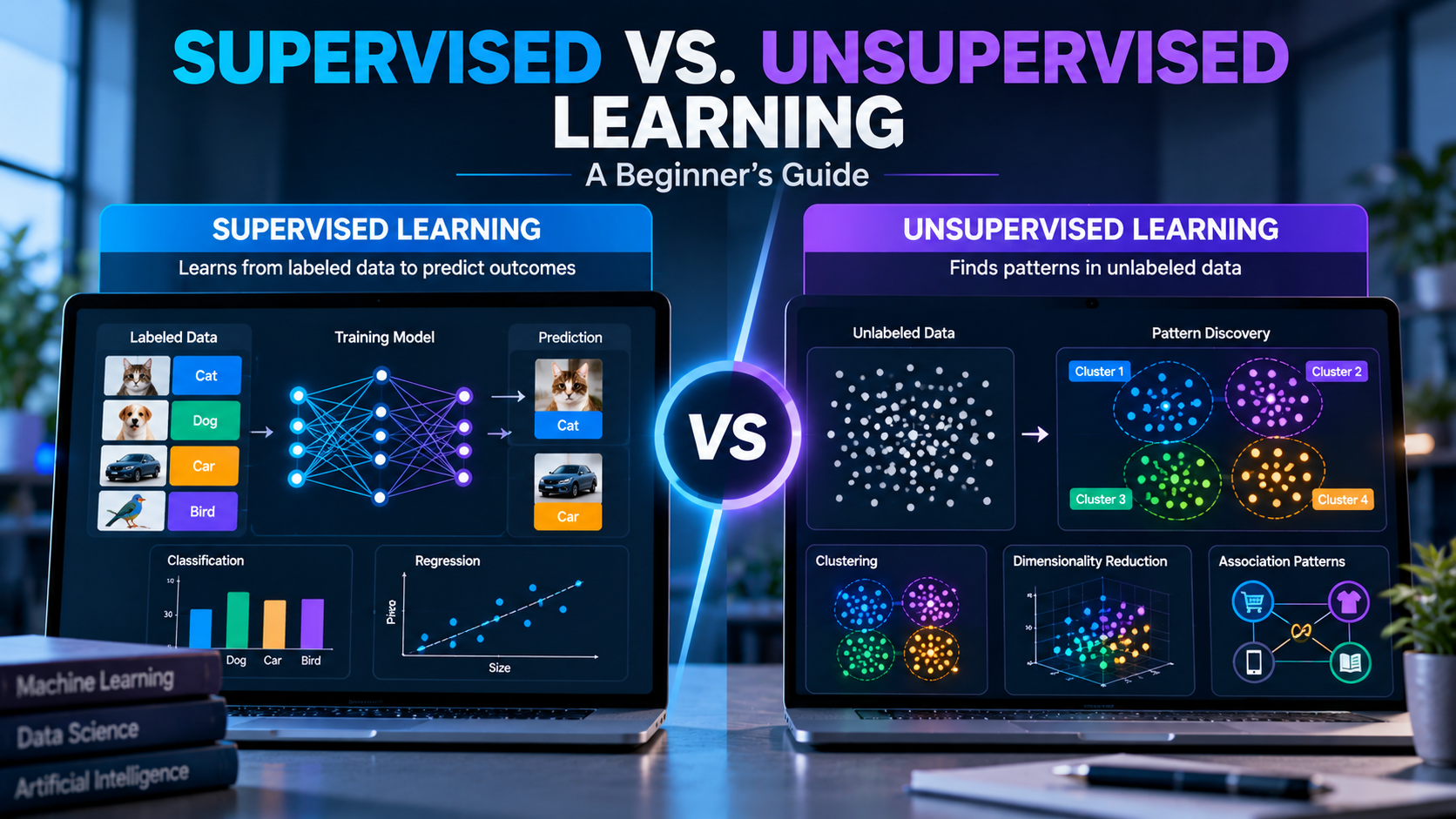
Machine learning is an important part of modern artificial intelligence (AI). It helps computers learn from data, identify patterns, make predictions, and support decisions without requiring developers to program every rule manually.
However, machine learning includes different approaches, and two of the most common are supervised learning and unsupervised learning.
Understanding supervised vs. unsupervised learning is an essential first step for anyone interested in artificial intelligence, data science, or machine learning development.
Although both approaches help computers learn from data, they differ in how they use that data, what they aim to discover, and the types of problems they solve.
In this beginner’s guide, we will explain supervised and unsupervised learning, explore their differences, examine real-world examples, and help you understand when each approach is useful.
What Is Supervised Learning?
Supervised learning is a machine learning approach in which a model learns from labeled data. Labeled data contains examples with known answers, allowing the model to learn the relationship between inputs and their corresponding outputs.
During training, the model compares its predictions with the correct answers and adjusts its parameters to reduce prediction errors.
After training, the model can use what it has learned to make predictions about new, previously unseen data.
How Does Supervised Learning Work?
Supervised learning generally follows these steps:
- Collect data: Gather relevant information for the problem you want to solve.
- Label the data: Associate each training example with the correct answer or outcome.
- Train the model: Allow the algorithm to learn patterns from the labeled examples.
- Evaluate performance: Test the model using data that was not used for training.
- Make predictions: Use the trained model to predict outcomes for new inputs.
For example, imagine you want to develop a machine learning model that identifies spam emails.
You provide the model with thousands of emails labeled as either “Spam” or “Not Spam.” The model learns patterns associated with each category, such as suspicious phrases, sender information, and message characteristics.
Once trained, it can predict whether a new email is likely to be spam.
Types of Supervised Learning
Supervised learning is commonly divided into two main types.
1. Classification
Classification predicts a category or class.
Examples include:
- Identifying spam and legitimate emails.
- Classifying images of cats and dogs.
- Detecting potentially fraudulent transactions.
- Predicting whether a customer may cancel a subscription.
2. Regression
Regression predicts a numerical value.
Examples include:
- Estimating house prices.
- Forecasting product sales.
- Predicting electricity consumption.
- Estimating delivery times.
The main difference is that classification predicts categories, while regression predicts numerical values.
Advantages of Supervised Learning
Supervised learning offers several benefits:
- It can make predictions when sufficient labeled training data is available.
- Its performance can be evaluated against known answers.
- It supports classification and numerical prediction tasks.
- It can be applied to many business and scientific problems.
- Its results can improve as training data and model development improve.
Limitations of Supervised Learning
Despite its benefits, supervised learning has some limitations:
- Preparing labeled data can require significant time and effort.
- Poor-quality or biased labels can affect model performance.
- Models may perform poorly on data that differs significantly from their training data.
- Training on labeled examples does not guarantee accurate predictions in every situation.
Supervised learning is particularly useful when you have historical examples with known outcomes and want to predict outcomes for new cases.
What Is Unsupervised Learning?
Unsupervised learning is a machine learning approach that works with data that does not have predefined target labels.
Instead of learning from known answers, the model attempts to discover patterns, similarities, groups, or structures within the data.
This approach can be useful when you have a large dataset but do not know exactly which categories or relationships exist within it.
For example, an online store may have thousands of customers but no predefined customer segments. An unsupervised learning algorithm can analyze purchasing behavior and identify groups of customers with similar interests.
The business can then use these groups to develop more relevant marketing campaigns or product recommendations.
How Does Unsupervised Learning Work?
Unsupervised learning generally follows these steps:
- Collect data: Gather information relevant to your analysis.
- Prepare the dataset: Clean the data and select useful features.
- Choose an algorithm: Select an approach suited to the problem, such as clustering or dimensionality reduction.
- Discover patterns: Allow the algorithm to identify similarities, relationships, or underlying structures.
- Interpret the results: Examine the discovered patterns to determine whether they are meaningful and useful.
Unlike supervised learning, this process does not rely on predefined correct answers for each training example.
However, the results still need to be evaluated. A model may discover groups or patterns that are mathematically valid but not useful for the intended business problem.
Types of Unsupervised Learning
Three commonly discussed unsupervised learning tasks are clustering, dimensionality reduction, and association rule learning.
1. Clustering
Clustering groups similar data points together based on their characteristics.
Examples include:
- Grouping customers by purchasing behavior.
- Segmenting products based on their features.
- Grouping news articles by topic.
- Identifying similar usage patterns among website visitors.
Algorithms such as K-means and hierarchical clustering are commonly used for clustering.
2. Dimensionality Reduction
Dimensionality reduction reduces the number of features used to represent a dataset while attempting to preserve important information.
It can help simplify complex datasets, support visualization, and reduce computational requirements in some applications.
Examples include:
- Simplifying datasets with hundreds of features.
- Visualizing high-dimensional data in two dimensions.
- Reducing redundant information before further analysis.
Principal Component Analysis (PCA) is a widely used dimensionality-reduction technique.
3. Association Rule Learning
Association rule learning identifies items or events that frequently occur together.
For example, a retailer might discover that customers who purchase a particular product frequently purchase another related product.
This information can support product placement, cross-selling, and recommendation strategies.
Association rule learning is commonly associated with market basket analysis.
Advantages of Unsupervised Learning
Unsupervised learning provides several benefits:
- It can analyze datasets without predefined target labels.
- It can uncover patterns that may not be obvious to people.
- It supports customer segmentation and exploratory data analysis.
- It can help identify unusual observations or potentially interesting relationships.
- It can be useful when labeling data is expensive or impractical.
Limitations of Unsupervised Learning
Unsupervised learning also has limitations:
- The results may be difficult to interpret.
- Discovered patterns are not automatically meaningful.
- Evaluating performance can be more challenging without known answers.
- Different algorithms or parameter settings may produce different groupings.
- Data quality and feature selection can strongly influence the results.
Unsupervised learning is most useful when the goal is to explore data and discover patterns rather than predict a known target.
Supervised vs. Unsupervised Learning: Key Differences
The main difference between supervised and unsupervised learning is the type of data used and the objective of the learning process.
Supervised learning learns from labeled examples to predict known types of outcomes. Unsupervised learning analyzes data without predefined target labels to discover patterns and structure.
Here is a quick comparison.
| Feature | Supervised Learning | Unsupervised Learning |
|---|---|---|
| Training data | Labeled data | Data without predefined target labels |
| Main goal | Predict an outcome | Discover patterns or structure |
| Learning process | Learns from input-output examples | Identifies similarities and relationships |
| Typical tasks | Classification and regression | Clustering, dimensionality reduction, and association analysis |
| Expected output | Predicted category or numerical value | Groups, patterns, associations, or reduced representations |
| Evaluation | Often compared with known answers | Often evaluated using structural measures and domain knowledge |
| Data labeling | Requires labeled target examples | Does not require predefined target labels |
| Example | Predicting house prices | Grouping customers by buying behavior |
| Common algorithms | Linear regression, logistic regression, decision trees, and random forests | K-means, hierarchical clustering, and PCA |
Important: These categories describe common approaches, but machine learning includes other learning paradigms, such as semi-supervised learning and reinforcement learning. Some algorithms can also be used in different ways depending on their setup.
Real-World Examples of Supervised Learning
Supervised learning is used in many applications where historical examples with known outcomes are available.
1. Email Spam Detection
Email providers can train classification models using emails labeled as spam or legitimate.
The model learns patterns from previous examples and predicts the likely category of incoming messages.
2. House Price Prediction
A real estate model can learn from historical property data containing features such as location, size, number of rooms, and sale price.
After training, it can estimate prices for properties with similar information.
3. Fraud Detection
Financial institutions can use labeled historical transactions to train models that identify transactions associated with fraudulent activity.
These predictions can help prioritize transactions for further investigation. Model accuracy depends on data quality, fraud patterns, and how the system is evaluated.
4. Medical Image Classification
A model can learn from medical images labeled by qualified professionals to help identify patterns associated with particular conditions.
Such systems can support clinical workflows, but they require appropriate validation and professional oversight.
Real-World Examples of Unsupervised Learning
Unsupervised learning helps organizations understand datasets and identify patterns that may not be known in advance.
1. Customer Segmentation
An online retailer can group customers based on purchase frequency, spending patterns, and product preferences.
These segments can help the business tailor its marketing and customer engagement strategies.
2. Anomaly Detection
Unsupervised techniques can help identify observations that differ significantly from typical data patterns.
For example, an organization may investigate unusual network activity or unexpected equipment readings.
However, unusual behavior is not necessarily malicious or faulty. Additional analysis may be required to determine its significance.
3. Product Recommendation Analysis
Retailers can analyze purchasing patterns to identify products that customers frequently buy together.
These relationships may inform product recommendations, cross-selling, or store layouts.
4. Data Exploration
Data scientists can use clustering and dimensionality-reduction techniques to explore complex datasets before building predictive models.
This can reveal potential patterns, outliers, or relationships that deserve further investigation.
Can Supervised and Unsupervised Learning Work Together?
Yes. Supervised and unsupervised learning can complement each other within the same machine learning workflow.
For example, a company may first use unsupervised learning to group customers according to purchasing behavior. Analysts can then study these groups, develop useful labels where appropriate, and train a supervised model to predict which group a new customer is most likely to resemble.
Another workflow might use unsupervised learning to explore a dataset and identify potential patterns before creating a labeled dataset for supervised training.
This combination can be helpful when a dataset is large, complex, or only partially labeled.
However, the best approach depends on the business objective, available data, and the reliability of the discovered patterns.
Which Is Better: Supervised or Unsupervised Learning?
Neither approach is universally better. The right choice depends on what you want the model to accomplish.
Choose supervised learning when:
- You have labeled training data.
- You want to predict a specific outcome.
- You need to classify observations into predefined categories.
- You want to estimate a numerical value.
- You can evaluate predictions against known results.
Choose unsupervised learning when:
- You want to explore a dataset.
- You do not have predefined target labels.
- You want to identify groups or similarities.
- You need to simplify complex data.
- You want to investigate patterns that are not yet well understood.
For example, if you want to predict whether a customer will cancel a subscription, supervised learning may be appropriate when historical cancellation labels are available.
If you want to discover different types of customers based on their behavior without predefined categories, unsupervised learning may be a better starting point.
The best algorithm and learning approach should always be selected according to the problem rather than popularity alone.
The Future of Supervised and Unsupervised Learning
Machine learning continues to develop as organizations collect more data and apply AI to increasingly complex problems.
Supervised learning remains important for prediction and classification tasks where labeled examples are available. At the same time, unsupervised learning continues to support data exploration, representation learning, clustering, and pattern discovery.
Other approaches are also becoming increasingly important. Self-supervised learning, for example, allows models to generate learning signals from the structure of unlabeled data. Semi-supervised learning combines a smaller amount of labeled data with a larger amount of unlabeled data.
These approaches can help address situations where manually labeling large datasets is difficult or expensive.
In practice, many modern AI systems combine techniques from multiple learning paradigms rather than relying on only one approach.
Conclusion
Understanding supervised vs. unsupervised learning is a fundamental step toward learning machine learning and artificial intelligence.
Supervised learning uses labeled examples to predict categories or numerical values. Unsupervised learning works without predefined target labels to discover patterns, groups, and relationships in data.
Both approaches have important applications, advantages, and limitations. Supervised learning is often suitable for prediction tasks, while unsupervised learning is useful for exploring data and identifying hidden structure.
If you are beginning your machine learning journey, start by understanding these two approaches, their common algorithms, and the types of problems they solve. With practical examples and experimentation, you can develop a stronger foundation for more advanced AI concepts.
