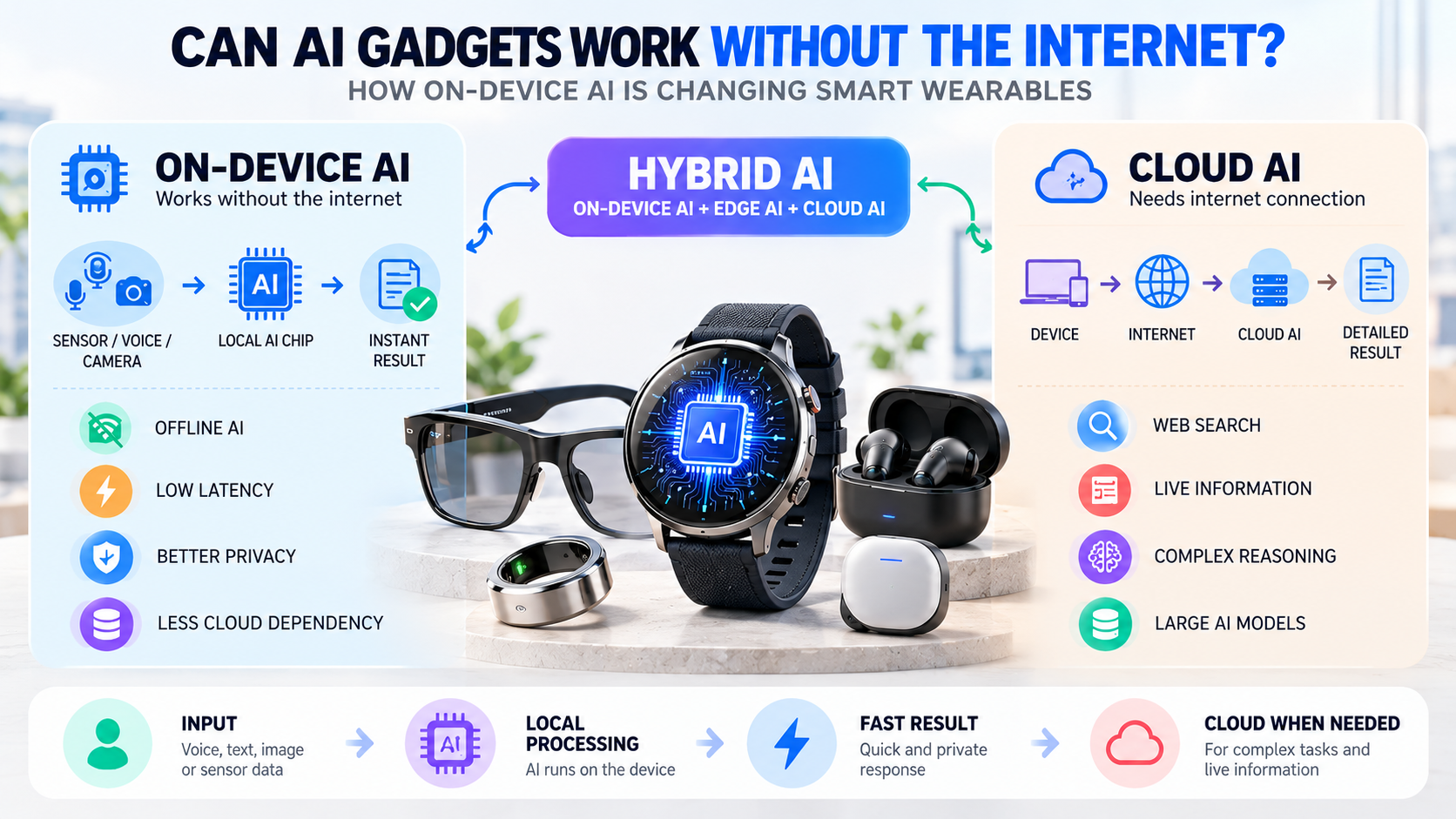
AI means that artificial intelligence runs directly on the device.
Instead of sending data to a remote cloud server, the gadget uses its own processor and AI hardware to analyze the information.
Modern wearable platforms are increasingly adding dedicated NPUs (Neural Processing Units) for this purpose. Qualcomm’s Snapdragon Wear Elite, for example, includes an NPU designed for on-device AI and supports AI models with up to two billion parameters.
This technology is helping smartwatches, glasses, earbuds, and other wearables become more intelligent without depending completely on cloud AI.
How Does Offline AI Work?
An AI gadget needs three main things to perform AI tasks without the internet.
AI Model
The device needs an AI model installed or optimized for its hardware.
AI Processor
The gadget needs enough processing power to run the model.
Modern AI chips and NPUs are designed to perform these calculations efficiently.
Local Data
The device also needs access to the information required for the task.
For example, a smartwatch can use its motion and other sensors to recognize activity without sending every sensor reading to the cloud.
The basic process is:
Sensors → AI Chip → Local Processing → Result
What Can AI Gadgets Do Offline?
The exact features depend on the device, but some AI functions can work locally.
These may include:
- Voice recognition
- Wake-word detection
- Activity recognition
- Sensor analysis
- Noise detection
- Basic translation
- Fitness analysis
- Some health insights
- Basic personalization
- Certain voice commands
- Some image or object recognition
The trend is moving toward more local intelligence. Qualcomm’s 2026 wearable platform, for example, is designed to support context-aware AI, natural voice interactions, and other personal AI experiences directly on wearables.
Can AI Smartwatches Work Without the Internet?
Yes, some smartwatch features can work offline.
A smartwatch can continue performing many basic functions without an internet connection.
For example, it may still be able to:
- Count steps
- Record workouts
- Track movement
- Collect sensor data
- Store information
- Run some apps
- Perform certain AI tasks
Google says the Pixel Watch 5 can process some core AI actions directly on the device, allowing those actions to work with low latency even when the watch is completely offline.
However, internet-dependent features such as live information, online searches, cloud services, and some connected applications may still require connectivity.
Can AI Earbuds Work Without the Internet?
Yes, some AI-related functions can work directly inside or alongside smart earbuds.
For example, earbuds can locally handle tasks such as:
- Noise cancellation
- Voice detection
- Audio processing
- Environmental sound recognition
- Wake-word detection
More advanced AI features may use a combination of on-device processing and cloud services.
This is becoming an important trend in audio wearables. In September 2026, Qualcomm introduced Snapdragon Sound Elite Gen 2 with a focus on on-device intelligence, real-time translation, contextual assistance, and multimodal audio experiences.
Can AI Smart Glasses Work Without the Internet?
Some smart-glass features can work without an internet connection.
For example, local processing can potentially handle:
- Basic voice commands
- Audio processing
- Sensor information
- Wake-word detection
- Some camera-related processing
But features that require external information may need the internet.
For example, if you ask smart glasses:
“What is the latest news about AI?”
the device needs access to current online information.
Similarly, web search, cloud-based AI conversations, online maps, and other connected services generally require network access.
Why Is Offline AI Important?
Offline AI is important because gadgets cannot always depend on a reliable internet connection.
Imagine using an AI wearable while:
🏔️ Hiking in a remote location
✈️ Traveling on an airplane
🚇 Traveling underground
🌲 Exploring an area with poor network coverage
🚨 Experiencing a network outage
If an AI feature is processed locally, the gadget may still be able to provide certain functions.
This makes AI devices more useful in everyday situations where internet connectivity is limited.
Can Offline AI Make Gadgets Faster?
Yes, for many tasks.
When information is processed directly on the device, it does not always need to travel to a remote server and come back.
The process can be:
Input → Local AI → Result
This can reduce latency.
For wearable devices, this is especially useful because users expect quick responses from small devices such as watches and earbuds.
Qualcomm specifically highlights lower latency and improved efficiency as benefits of on-device AI in wearable devices.
Can Offline AI Improve Privacy?
It can.
When an AI task is handled locally, the device may not need to send that particular information to a cloud server.
For example:
Sensor → Local AI → Result
instead of:
Sensor → Internet → Cloud → AI Processing → Result
This can reduce the amount of personal information that needs to leave the device.
Modern wearable platforms are increasingly emphasizing local processing for more private personal AI experiences. Qualcomm says its Snapdragon Wear Elite is designed to keep sensitive interactions and data closer to the user while still allowing coordination with other devices and the cloud when needed.
However, on-device AI does not automatically guarantee complete privacy. The device may still synchronize or transmit information depending on its software, settings, and connected services.
What Are the Limitations of Offline AI?
Offline AI also has some important limitations.
Limited Processing Power
A smartwatch or pair of earbuds has much less computing power than a large cloud data center.
Battery Usage
AI processing requires electricity. Running AI models continuously can affect battery life.
Smaller AI Models
Small devices usually need smaller and more efficient AI models.
Limited Storage
A wearable cannot store unlimited AI models and data.
No Live Information
Without internet access, a device cannot easily access current news, online databases, websites, or live services.
These limitations mean that offline AI is powerful, but it cannot completely replace cloud AI.
Why Can’t Every AI Feature Work Offline?
Some AI tasks require huge amounts of computing power or access to current information.
For example, imagine asking an AI gadget:
“Search today’s technology news and explain the latest developments in wearable AI.”
The gadget needs the internet to access current information.
Other examples include:
- Web search
- Live weather
- Current news
- Online maps
- Cloud databases
- Online shopping
- Cloud applications
- Large AI models
- Real-time internet information
For these tasks, cloud computing is still very useful.
What Is Hybrid AI?
The future of AI gadgets is likely to be hybrid AI.
Hybrid AI combines:
On-Device AI + Cloud AI
The device performs some tasks locally, while the cloud handles tasks that require more computing power or current information.
For example:
Voice detection → On-device
Basic sensor analysis → On-device
Simple personalization → On-device
Web search → Cloud
Complex reasoning → Cloud
Large AI generation → Cloud
This approach allows gadgets to use the strengths of both local and cloud computing.
Why Is Hybrid AI Important for Wearables?
Wearable devices have strict limitations.
They are small, have limited battery capacity, and cannot contain huge computing systems.
At the same time, users want powerful AI features.
Hybrid AI provides a practical solution.
A smartwatch could process simple information locally.
A smartphone could handle a larger AI model.
The cloud could handle complex tasks.
All three could work together.
This type of distributed AI is becoming an important direction for personal computing. Qualcomm describes a future where intelligence can move between wearables, smartphones, PCs, XR devices, and cloud services depending on the task.
Can AI Gadgets Work Without a Smartphone?
Some AI gadgets can perform certain functions without being completely dependent on a smartphone.
However, smartphones will likely remain important because they provide:
- Larger displays
- More storage
- More processing power
- Internet connectivity
- Apps
- Communication
- Cloud access
The future may therefore not be about completely replacing smartphones.
Instead, different devices may work together as one personal AI ecosystem.
How Will AI Gadgets Work Together?
Imagine starting your day with several connected devices.
Your:
Smartwatch → Smart Glasses → AI Earbuds → Smartphone → Cloud AI
could share information with each other.
For example:
Your smartwatch collects activity information.
Your earbuds understand your voice.
Your smart glasses understand your surroundings.
Your smartphone provides additional computing power.
The cloud provides advanced AI and internet-based information.
This creates a connected AI ecosystem rather than a single AI gadget.
Is Offline AI the Future of Gadgets?
Offline AI is likely to become a bigger part of future gadgets.
As AI processors become more powerful and energy efficient, more AI models can run directly on devices.
Current wearable platforms are already moving in this direction, including dedicated NPUs, sensor processing, and support for larger local AI models.
This could make future gadgets:
- Faster
- More private
- More independent
- More responsive
- Less dependent on constant connectivity
Offline AI vs Cloud AI
| Feature | Offline / On-Device AI | Cloud AI |
|---|---|---|
| Internet | Not always required | Usually required |
| Speed | Fast for supported tasks | Depends on connection |
| Privacy | More data can stay local | Data may be sent to servers |
| AI Models | Usually smaller | Can use much larger models |
| Battery | Uses device power | Uses network + cloud resources |
| Live Information | Limited | Excellent |
| Complex Reasoning | More limited | Generally stronger |
| Personal Sensor Data | Excellent for local processing | Can also be processed remotely |
What Is the Future of AI Gadgets?
The future probably won’t be completely offline or completely cloud-based.
Instead, we are likely to see AI distributed across multiple devices.
Your smartwatch may handle sensor information.
Your earbuds may process voice and audio.
Your smart glasses may process visual information.
Your smartphone may provide additional computing power.
Cloud AI may handle complex reasoning and online information.
The AI system can decide where each task should be processed.
Will AI Gadgets Replace Smartphones?
AI gadgets may reduce our dependence on smartphones for some tasks, but completely replacing smartphones is a much bigger challenge.
Smart glasses, earbuds, smartwatches, and rings can provide quick interactions, but smartphones still offer a combination of:
Screen + Apps + Connectivity + Storage + Processing + Communication
The more realistic future is that AI gadgets will work alongside smartphones, allowing users to interact with technology without constantly looking at a screen.
Conclusion: Can AI Gadgets Work Without the Internet?
Yes, AI gadgets can work without the internet for certain tasks.
The main technology making this possible is on-device AI, where AI models run directly on the gadget’s processor.
This can provide:
- Faster responses
- Better privacy
- Lower cloud dependency
- Offline functionality
- More personalized experiences
But offline AI has limitations. Large AI models, web searches, live information, and many advanced services still benefit from cloud computing.
That is why the most practical future is likely to be:
On-Device AI + Edge Computing + Cloud AI = Hybrid AI
As AI chips become smaller, faster, and more power efficient, more intelligence will move directly into smartwatches, smart glasses, earbuds, smart rings, smartphones, and other everyday gadgets.
The future of smart gadgets may not simply be about connecting to the internet.
It may be about understanding and assisting you even when the internet is unavailable.
