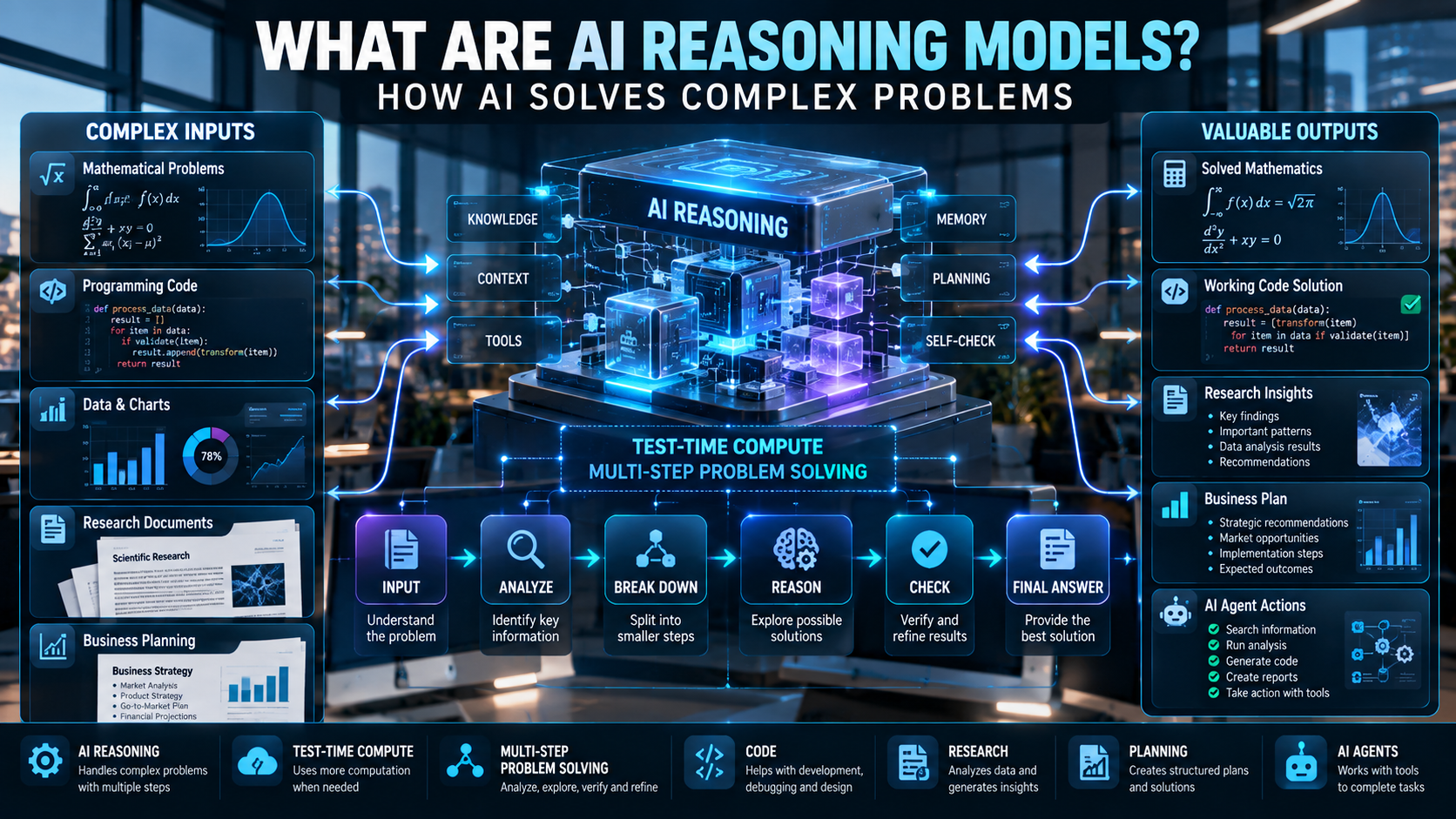
Artificial intelligence has become very good at answering questions, creating content, writing code, and understanding images. But some problems are more difficult than simply generating an answer.
For example, designing a large software system, solving a difficult mathematical problem, analyzing scientific data, or creating a detailed business plan may require many steps. AI reasoning models are designed to handle these kinds of complex tasks by using additional computation to analyze a problem before producing the final answer.
What Are AI Reasoning Models?
AI reasoning models are AI models designed to solve problems that require multiple steps of analysis.
A traditional AI model may try to provide an answer quickly based on patterns it learned during training. A reasoning model can spend more computational effort working through a difficult problem, comparing possible solutions, and improving its response.
In simple terms:
Normal AI:
Question → Answer
Reasoning AI:
Question → Analyze → Plan → Check → Answer
This makes reasoning models especially useful for mathematics, programming, research, planning, and other complex tasks.
How Do AI Reasoning Models Work?
Reasoning models are based on technologies similar to large language models, but they are trained and optimized to handle more complicated reasoning tasks.
When a difficult question is given to the model, it can use additional computation during the response process. It may break the problem into smaller parts, explore different approaches, and evaluate possible results before producing the final response.
This additional processing is often associated with test-time compute or inference-time compute.
What Is Test-Time Compute?
Test-time compute simply means giving an AI model more computing resources while it is solving a problem.
Imagine a student answering two questions.
For an easy question, the student may immediately know the answer.
For a difficult question, the student may need to read the question carefully, break it into smaller parts, try different methods, check the calculations, and then choose the final answer.
Reasoning models use a similar idea. Difficult problems can receive more computational effort than simple problems.
Why Do AI Models Need Reasoning?
Not every question needs deep reasoning.
If you ask an AI to translate one sentence, there is usually no need for extensive problem solving.
But consider a question such as:
“Design a secure application that can support millions of users.”
The AI needs to think about many things:
- Application architecture
- Database design
- Security
- Performance
- Authentication
- Scalability
- Caching
- Monitoring
- Failure recovery
These decisions are connected to each other. A reasoning model can analyze these different parts before suggesting a solution.
AI Reasoning Models for Coding
Software development is one of the most interesting applications of reasoning AI.
Writing a simple function may be easy for an AI model. But fixing a complex application can require understanding many files and technologies at the same time.
A reasoning model can help developers with:
- Debugging
- Code generation
- Code review
- Architecture design
- Testing
- Refactoring
- Error analysis
- Database problems
- API development
For example, if an application has a login problem, a reasoning model can analyze the frontend, backend, API requests, authentication logic, and database interaction to find possible causes.
AI Reasoning Models and AI Coding Agents
Reasoning models are also becoming important for AI coding agents.
A normal AI assistant may generate a piece of code when asked.
An AI coding agent can potentially take a larger goal and work through multiple steps.
For example:
User: “Fix the login problem in my application.”
An advanced AI coding agent could:
- Inspect the project.
- Find the authentication code.
- Analyze the error.
- Check related API requests.
- Modify the code.
- Run tests.
- Check the results.
- Fix additional problems.
- Prepare the final changes.
Here, reasoning helps the system decide what to do next.
Can Reasoning Models Solve Mathematics?
Yes. Mathematics is an important area for reasoning models.
Simple calculations can usually be handled quickly. More difficult mathematical problems may require several connected steps.
Reasoning models can be useful for:
- Algebra
- Geometry
- Probability
- Statistics
- Optimization
- Algorithms
- Mathematical proofs
However, reasoning does not guarantee that an answer is always correct. AI systems can still make calculation or logical mistakes, so important results should be verified.
Can Reasoning Models Help Scientists?
AI reasoning can also be useful for scientific research.
Scientists often work with large amounts of information and complicated problems. AI systems can help researchers analyze information, compare possible explanations, generate ideas, and work with scientific tools.
For example, an AI system could analyze research data, create a simulation using code, examine the result, and then suggest another experiment.
This combination of reasoning + tools could make AI more useful for scientific discovery.
Can Reasoning Models Work With AI Agents?
Yes.
AI agents are systems that can use AI capabilities to perform tasks and interact with external tools.
Reasoning can help an AI agent decide what it should do next.
For example:
Goal → Reason → Select Tool → Take Action → Check Result → Continue
Imagine a business agent that receives the request:
“Find customers with unpaid invoices and prepare follow-up emails.”
The agent could potentially:
- Search customer records
- Check invoice information
- Identify unpaid accounts
- Prepare emails
- Ask for approval
- Send the approved messages
The reasoning model helps determine the sequence of actions.
Are Reasoning Models the Same as Human Thinking?
No.
The word “reasoning” can sometimes make AI sound like a human brain, but AI reasoning is different from human thinking.
AI reasoning models do not have human consciousness, emotions, personal experiences, or human understanding.
They are machine-learning systems trained to perform complex computational tasks.
Therefore, it is better to think of reasoning models as AI systems optimized for complex problem solving, rather than artificial humans.
Are AI Reasoning Models Always Better?
No.
A reasoning model is not automatically better for every task.
For a simple task such as translating a sentence or rewriting a paragraph, a fast AI model may be more practical.
For a complex programming problem, mathematical problem, research task, or detailed planning problem, additional reasoning may provide more value.
The important idea is:
Simple task → Fast response
Complex task → More reasoning
Future AI systems may automatically decide how much computational effort a particular task needs.
What Are the Benefits of AI Reasoning Models?
Better Problem Solving
Reasoning models can handle problems that contain multiple connected steps.
Better Planning
They can help break a large goal into smaller actions.
Better Coding Assistance
They can help developers understand complex code, debug applications, and design software.
Support for AI Agents
Reasoning helps AI agents decide which action or tool should be used next.
Research Assistance
Reasoning models can help analyze complicated information and explore possible solutions.
More Flexible AI
AI systems can potentially use more or less computational effort depending on how difficult the problem is.
What Are the Limitations of AI Reasoning Models?
Reasoning models are powerful, but they still have limitations.
AI Can Still Make Mistakes
A longer reasoning process does not guarantee a correct answer.
Reasoning Can Take More Time
Using additional computation can make some responses slower.
Reasoning Can Cost More
More computing power means higher infrastructure and processing costs.
AI Reasoning Is Not Human Reasoning
AI does not understand the world exactly like a person does. Its reasoning capabilities come from machine-learning training and computation.
Human Review Is Still Important
For important areas such as healthcare, finance, engineering, law, and cybersecurity, AI results should be reviewed and controlled appropriately.
AI Reasoning Models vs Traditional AI
The difference can be understood very simply.
| Traditional AI | AI Reasoning Models |
|---|---|
| Focuses on fast responses | Can spend more computation on difficult tasks |
| Good for simple tasks | Stronger for complex multi-step tasks |
| Usually produces an answer directly | Can analyze multiple possible approaches |
| Useful for content generation | Useful for planning and problem solving |
| Lower computation can be enough | May require more inference computation |
Both types of models have their own advantages. The best choice depends on the task.
Why Are Reasoning Models Important for the Future of AI?
AI is gradually moving beyond simple question answering.
The next generation of AI systems is expected to combine:
Reasoning + AI Agents + Tools + Automation
This could allow AI systems to understand a goal, create a plan, use external tools, check results, and continue working through a task.
For example:
Understand → Reason → Plan → Use Tools → Check → Act
This approach could be useful in software development, business automation, scientific research, robotics, engineering, and many other industries.
Will AI Reasoning Models Replace Humans?
Reasoning models are unlikely to simply replace humans in every type of work.
Instead, they are more likely to become powerful tools that help people complete complicated tasks faster.
Developers can use them for coding and debugging.
Scientists can use them for research.
Engineers can use them for design and analysis.
Businesses can use them for automation.
Humans can continue to provide goals, judgment, creativity, domain knowledge, and final decisions.
The future may therefore be more about humans working together with AI than AI simply replacing humans.
What Is the Future of AI Reasoning?
The future of reasoning AI could involve much more than answering questions.
AI systems could become better at understanding goals, planning actions, using tools, checking their results, and completing longer workflows.
We could see reasoning models combined with:
- AI agents
- Search systems
- Code execution
- Databases
- Scientific simulations
- Robotics
- Business software
- Real-world sensors
This could turn AI from a system that mainly provides answers into a system that can increasingly solve problems and complete tasks.
Conclusion
AI reasoning models are designed to handle problems that require more than a simple answer.
They can use additional computational effort to analyze difficult problems, explore possible solutions, and produce better responses.
They are especially useful for coding, mathematics, research, planning, and AI agents.
The important change is that AI is moving from simply answering questions toward solving complex problems and completing multi-step tasks.
As reasoning models continue to improve, they could become one of the most important technologies behind the next generation of AI applications.
