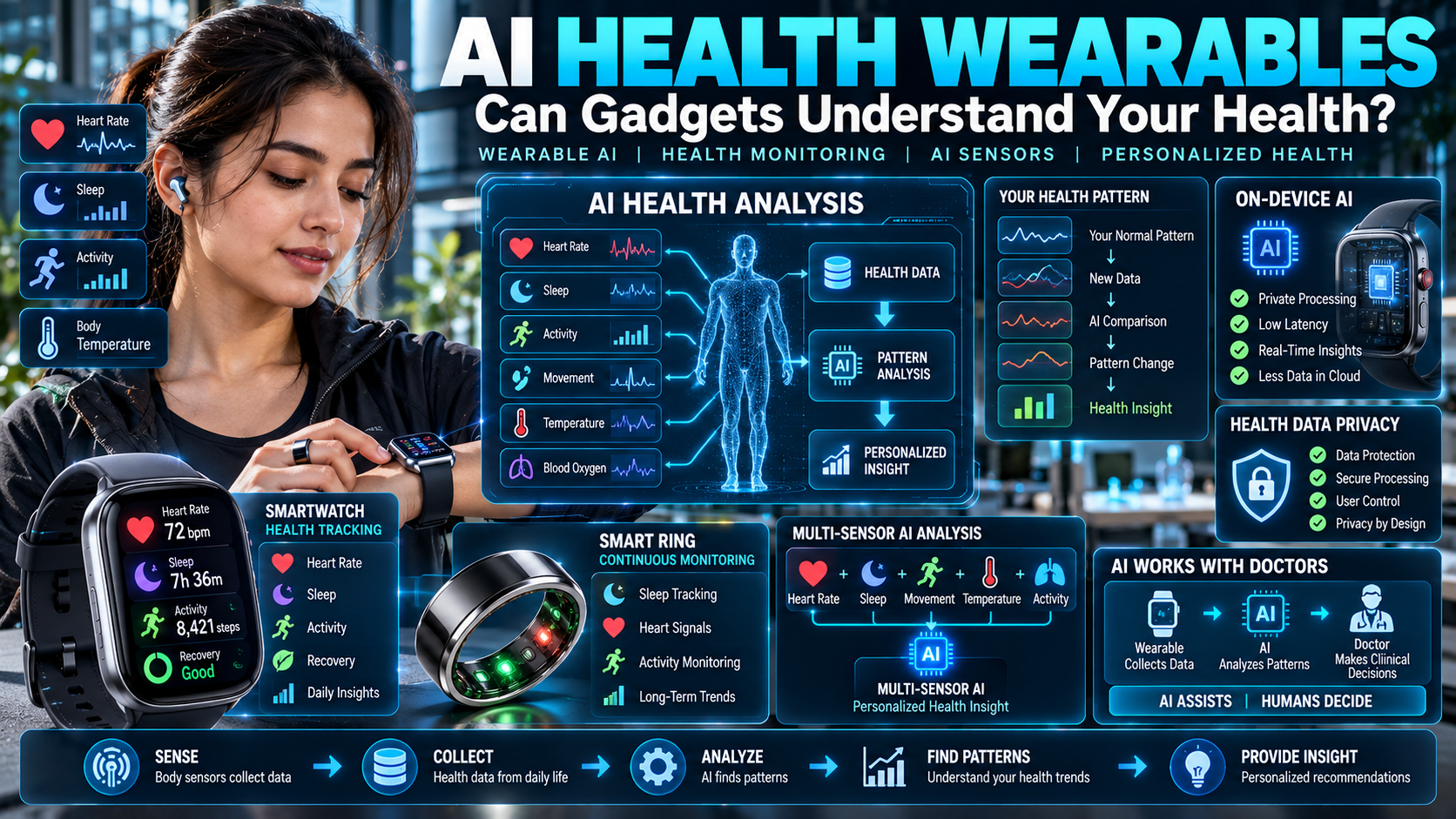
Smartwatches, smart rings, fitness trackers, and other wearable devices have become common gadgets for tracking daily activity, sleep, heart rate, and exercise.
But wearable technology is changing. Instead of simply collecting numbers and displaying them on a screen, newer AI-powered wearables can analyze sensor data and look for patterns. This can help turn large amounts of health data into easier-to-understand information.
This leads to an interesting question: Can AI health wearables actually understand your health?
The answer is more complicated than simply saying yes or no. AI can analyze patterns and provide useful insights, but a wearable is not the same thing as a doctor or a complete medical examination.
What Are AI Health Wearables?
AI health wearables are wearable devices that combine body sensors with artificial intelligence or machine learning.
They can include:
- Smartwatches
- Smart rings
- Fitness trackers
- Health bands
- Smart earbuds
- Continuous health monitors
- Specialized medical wearables
The basic idea is simple:
Body → Sensors → Health Data → AI Analysis → Personal Insights
Traditional wearables mainly focus on collecting and displaying information. AI-powered wearables can go a step further by analyzing that information and identifying patterns.
How Do Health Wearables Collect Data?
Wearables use different sensors to collect information from the body and the user’s activities.
Depending on the device, sensors may monitor things such as heart rate, movement, sleep, temperature, blood oxygen, or other physiological signals.
For example, a smartwatch can continuously collect heart-related and movement data while a person goes through their normal day.
The device can then send this information to software for analysis.
Sensors → Data Collection → Data Processing → Health Information
What Does AI Add to Wearable Technology?
A normal wearable might show you a number such as:
Heart Rate: 82 BPM
AI can potentially look beyond that single number.
It can compare the measurement with other information such as your activity, sleep, previous measurements, and longer-term patterns.
This changes the experience from:
“Here is your health data.”
to:
“Here is a pattern found in your health data.”
That shift from simple measurement to analysis is one of the most interesting developments in AI wearable technology.
What Health Information Can Wearables Track?
Different devices have different sensors and capabilities, but health wearables can track many types of information.
Common examples include:
- Heart rate
- Heart rhythm
- Physical activity
- Steps
- Sleep
- Movement
- Body temperature
- Blood oxygen
- Exercise intensity
- Other physiological signals
Some specialized devices can measure additional health information.
However, not every wearable measures every type of health data, and the accuracy can vary between devices.
Can AI Understand Heart Health?
Heart monitoring is one of the most important areas for health wearables.
Smartwatches and other devices can use sensors to monitor heart rate and, depending on the device, provide additional heart-related measurements.
AI can analyze these measurements over time and look for unusual patterns.
For example:
Heart Data → Pattern Analysis → Possible Abnormal Pattern → Alert
This can be useful because the device may observe a person’s data outside a hospital or doctor’s office.
However, an alert from a wearable does not automatically mean that a person has a medical condition.
Wearable data may need to be confirmed through appropriate medical evaluation. Research on wearable cardiovascular technology also highlights differences in device methods, validation, and clinical usefulness.
Can AI Wearables Track Sleep?
Sleep tracking is one of the most popular features of smartwatches and smart rings.
Wearables can use movement and other available sensor signals to estimate sleep patterns.
Instead of looking at only one night, AI can potentially analyze information collected over many nights.
For example:
Night 1 → Night 2 → Night 3 → Long-Term Pattern → AI Analysis
This can help users understand changes in their sleep behavior.
However, sleep measurements from consumer wearables should not automatically be treated as equivalent to a clinical sleep study.
Can AI Wearables Understand Stress?
Some wearable systems use physiological signals to estimate patterns associated with stress or recovery.
AI can combine different measurements and compare them with a person’s previous data.
For example:
Heart Signals + Activity + Sleep + Historical Data → AI → Possible Stress Pattern
The important word here is possible.
Stress is complex, and wearable measurements cannot completely understand a person’s emotional or psychological state.
AI can identify patterns in measurable signals, but that is not the same as fully understanding how someone feels.
Can Smart Rings Understand Your Health?
Smart rings are becoming an important category in wearable technology.
Unlike smartwatches, rings generally have no large screen. This allows them to focus on quietly collecting information throughout the day and night.
Smart rings are particularly interesting for:
- Sleep tracking
- Activity monitoring
- Heart-related measurements
- Recovery insights
- Long-term health trends
Their small size also makes them suitable for continuous use.
As AI becomes more integrated into wearable devices, smart rings could increasingly move from simple tracking devices toward personalized health and computing platforms.
Can AI Combine Data From Multiple Sensors?
Yes.
One of the biggest advantages of AI is that it can analyze different types of information together.
For example:
Heart Rate + Sleep + Movement + Temperature + Activity
Instead of analyzing each measurement separately, AI can search for relationships between them.
This is sometimes described as multi-sensor or multimodal analysis.
Research into wearable biosensors is exploring how multiple physiological and biochemical signals can be combined with AI for more continuous and personalized health monitoring.
What Is Personalized Health Monitoring?
People do not all have exactly the same normal health patterns.
For example, one person’s normal resting heart rate or sleep pattern may be different from another person’s.
AI can therefore compare current information with the user’s own historical information.
A simplified process looks like this:
Your Previous Data → Your Normal Pattern → New Data → AI Comparison → Personalized Insight
This can make wearable insights more personal than simply comparing everyone with the same fixed number.
Can AI Wearables Detect Changes in Health Patterns?
Potentially, yes.
AI can continuously analyze incoming data and look for changes from a person’s previous patterns.
For example:
Normal Pattern → New Pattern → AI Detects Difference → User Alert
This does not necessarily mean that the AI has discovered a disease.
It means that the system has identified something that may deserve attention.
That distinction is important when discussing AI health technology.
Can Wearables Help Detect Health Problems Earlier?
Continuous monitoring creates an opportunity that traditional occasional measurements may not provide.
A person may visit a doctor once every few months, while a wearable can potentially collect data every day.
This creates two different approaches:
Traditional Monitoring
Occasional measurements
Wearable Monitoring
Continuous or repeated measurements
AI can then analyze the larger dataset to identify changes over time.
Researchers are studying wearable systems for personalized and preventive healthcare because continuous sensing can provide information outside traditional clinical environments.
Can AI Health Wearables Help Doctors?
Wearable data may also become useful to healthcare professionals.
For example, a patient could potentially provide longer-term health information collected outside a clinic.
This could give doctors additional context when evaluating a patient’s health.
However, integrating wearable data into healthcare is not always simple.
The U.S. Government Accountability Office notes that wearables have potential clinical benefits, but differences in reliability and difficulties integrating wearable data into clinical workflows remain important challenges.
Are All Health Wearables Medical Devices?
No.
This is an important difference.
Some wearables are primarily wellness devices.
Others are designed for specific medical purposes and may be subject to medical-device requirements depending on their intended use and jurisdiction.
A fitness tracker that helps you understand your daily activity is not automatically equivalent to a clinically validated medical monitoring device.
Therefore, users should look at the specific capabilities, intended use, and validation of a product instead of assuming that every health feature has medical-grade accuracy.
Can AI Health Wearables Replace Doctors?
No.
AI wearables can collect information and identify patterns, but they cannot replace professional medical judgment.
A doctor can consider many things that a wearable cannot fully understand, including:
- Symptoms
- Medical history
- Physical examination
- Laboratory tests
- Medical imaging
- Other diagnostic information
Wearable data can provide useful additional information, but it should not automatically be treated as a diagnosis.
What Are the Biggest Problems With AI Health Wearables?
AI health wearables are promising, but they also have limitations.
Some common challenges include:
- Sensor accuracy
- Movement-related measurement errors
- Poor sensor contact
- Different measurement methods
- Battery limitations
- Algorithm errors
- Data interpretation
- Device reliability
- Lack of standardized clinical workflows
Research and government assessments both highlight reliability, validation, interoperability, and clinical integration as important challenges for health wearables.
Can Wearable AI Make Mistakes?
Yes.
AI systems depend on the quality of the data they receive.
If a sensor collects inaccurate information, the AI may also produce an inaccurate result.
For example:
Incorrect Sensor Data → Incorrect Analysis → Incorrect Insight
This is why users should not assume that every alert or recommendation from a wearable is automatically correct.
What About Health Data Privacy?
Health data is highly sensitive.
A wearable may collect information about:
- Heart activity
- Sleep
- Exercise
- Location
- Daily routines
- Physiological patterns
This creates important privacy questions.
Users should understand:
What data is collected?
Where is it stored?
Who can access it?
Is it processed on the device or in the cloud?
Can it be shared with other companies?
Research on wearable privacy has highlighted concerns around data storage, sharing, security, and the difficulty users may have understanding how their health data is handled.
Can AI Health Wearables Process Data on the Device?
Increasingly, AI processing can happen directly on wearable devices or nearby hardware.
This approach is commonly called on-device AI or edge AI.
Instead of:
Wearable → Cloud → AI → Result
a device may use:
Wearable → On-Device AI → Result
This can potentially reduce latency and limit how much sensitive data needs to leave the device.
Industry research expects on-device AI to become much more common across wearables over the coming years.
What Is Federated Learning for Health Wearables?
Another interesting technology is federated learning.
Instead of sending all user data to one central location for model training, federated learning can allow models to learn across devices while keeping more of the underlying data on the local devices.
A simplified idea is:
Wearable Data → Local Learning → Model Update → Shared AI Model
This approach is being studied as a way to improve privacy in AI-powered wearable health systems.
It does not automatically solve every privacy problem, but it is an important direction for future wearable AI.
Smartwatch vs Smart Ring vs Health Wearable
Different wearable categories have different strengths.
| Feature | Smartwatch | Smart Ring | Health Wearable |
|---|---|---|---|
| Heart-related tracking | Often | Often | Depends on device |
| Sleep tracking | Common | Common | Depends on device |
| Activity tracking | Strong | Common | Depends on device |
| Large display | Yes | Usually no | Depends |
| Notifications | Strong | Limited | Usually limited |
| AI insights | Increasing | Increasing | Increasing |
| Continuous monitoring | Common | Common | Depends |
| Medical use | Device-specific | Device-specific | Device-specific |
The device category alone does not determine accuracy. Sensors, algorithms, validation, intended use, and software quality all matter.
What Could AI Health Wearables Look Like in the Future?
Future wearables may move beyond simply showing measurements.
Instead of giving users hundreds of separate numbers, AI could combine different signals and provide more understandable summaries.
For example:
Sensors → Data → AI Analysis → Pattern Detection → Personalized Insight
Wearables could also become more connected with smartphones, healthcare platforms, AI assistants, and other devices.
Research is already exploring flexible sensors, continuous monitoring, AI analysis, and personalized healthcare systems.
Will Wearables Become Personal Health Assistants?
This is one possible direction for wearable AI.
Imagine a future device that can continuously monitor your available health signals, understand your normal patterns, notice changes, and provide useful reminders or questions to discuss with a healthcare professional.
The wearable would not replace the doctor.
Instead:
Wearable → Collects Data
AI → Finds Patterns
User → Gets Insight
Doctor → Makes Clinical Decision
This human-plus-AI approach is more realistic than expecting a wearable to independently diagnose everything.
So, Can Gadgets Understand Your Health?
AI health wearables can analyze health-related data and recognize patterns, but the word “understand” needs to be used carefully.
A wearable does not understand the human body in the same way a medical professional does.
Instead, it can:
- Collect health-related data
- Analyze measurements
- Compare current data with historical patterns
- Detect certain changes
- Provide alerts or insights
- Help users understand trends
- Potentially provide useful information to healthcare professionals
The basic process is:
SENSE → COLLECT → ANALYZE → FIND PATTERNS → PROVIDE INSIGHT
Conclusion: Are AI Health Wearables the Future?
AI is turning wearables from simple tracking gadgets into increasingly intelligent health-monitoring systems.
Smartwatches, smart rings, fitness trackers, and specialized health devices can collect information continuously. AI can then analyze that information and look for patterns that may be useful to the user.
However, the future of AI health wearables will depend on more than smarter algorithms.
Accuracy, clinical validation, privacy, security, battery life, regulation, and user trust will all be important.
The goal is not to replace doctors with gadgets.
The bigger opportunity is to build wearable technology that helps people understand their health information more continuously, personally, and intelligently.
