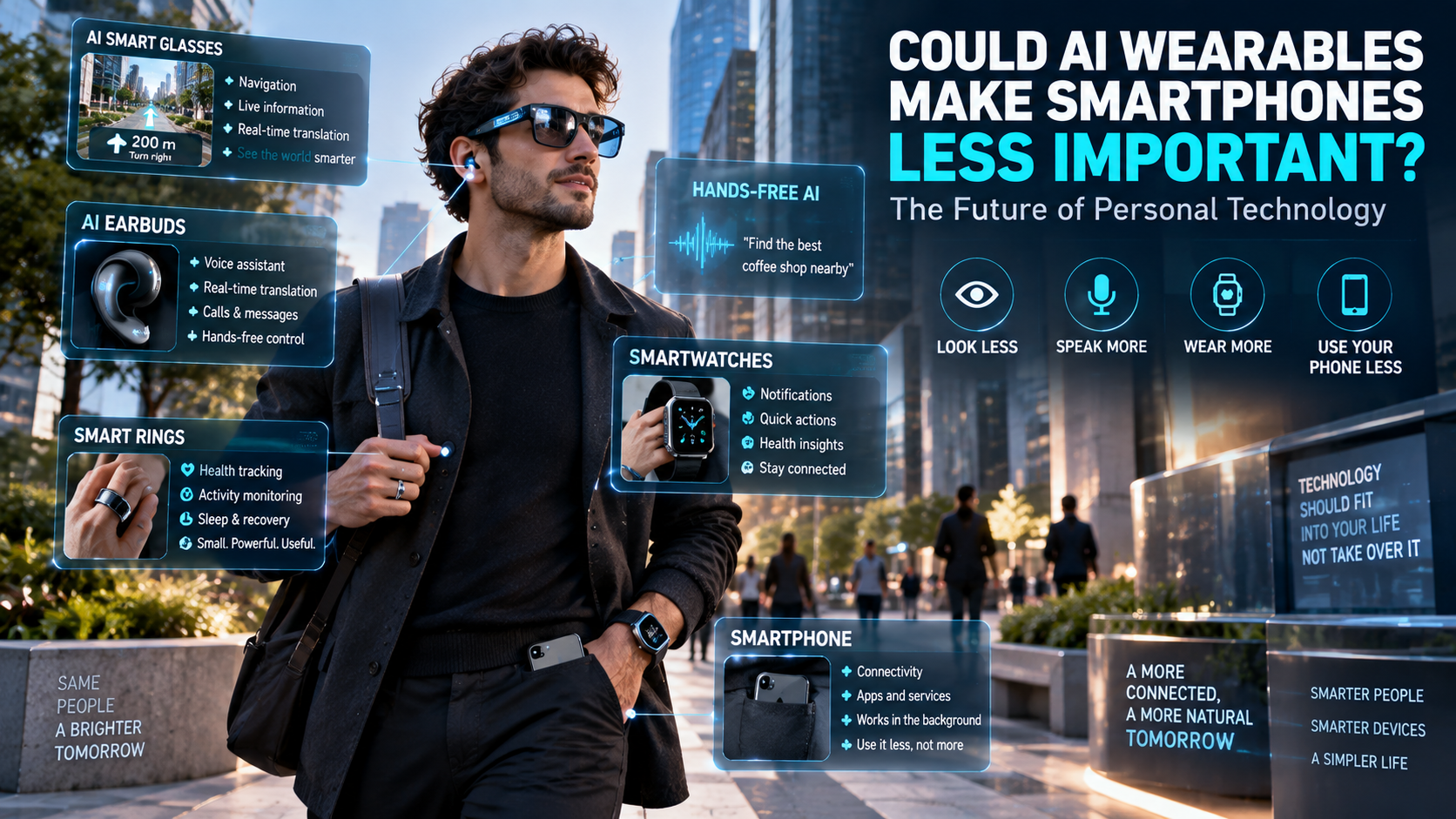
For many years, smartphones have been one of the most important gadgets in our daily lives.
We use them for calls, messages, photos, videos, maps, banking, shopping, social media and much more.
But technology is changing.
New devices such as AI smart glasses, smart rings, AI earbuds and smartwatches are becoming smarter.
These devices can use artificial intelligence to understand voice commands, collect information and provide useful assistance.
This raises an interesting question:
Could AI wearables make smartphones less important?
What Are AI Wearables?
Understanding AI Wearable Technology
AI wearables are smart devices that we can wear on our body and that use artificial intelligence.
Some common examples include:
- AI smart glasses
- Smart rings
- AI earbuds
- Smartwatches
- Smart clothing
- Fitness trackers
These devices can collect information and use AI to make that information more useful.
For example, a smart ring can track your sleep, while AI glasses can provide information using voice commands.
Why Are AI Wearables Becoming Popular?
Smaller Devices Are Becoming Smarter
Technology is becoming smaller and more powerful.
Modern processors, sensors and AI software can now fit inside very small devices.
This means wearables can perform tasks that previously required a smartphone.
Instead of taking your phone out of your pocket, you may simply speak to your wearable.
Could Smart Glasses Reduce Smartphone Use?
Information Without Looking at a Phone
Smart glasses are one of the most interesting AI wearables.
Imagine walking through a new city and asking your glasses:
“Where is the nearest restaurant?”
Or you could ask:
“What building am I looking at?”
Smart glasses can combine cameras, microphones, speakers, sensors and AI to provide hands-free information.
This could reduce the need to constantly look at a smartphone.
What Can AI Earbuds Do?
Earbuds Are Becoming More Than Headphones
Wireless earbuds were originally designed mainly for music and calls.
AI is now adding new possibilities.
AI earbuds could provide features such as:
- Voice assistants
- Language translation
- Noise cancellation
- Voice commands
- Audio summaries
- Context-based assistance
For example, imagine talking to someone who speaks another language and getting a translation through your earbuds.
What Can Smart Rings Do?
A Smart Device Without a Screen
Smart rings are very different from smartphones.
They usually do not have a screen.
Instead, they focus on collecting information such as:
- Sleep
- Activity
- Heart-related measurements
- Recovery
- Other health signals
This makes smart rings useful for people who want health tracking without wearing a large device.
Can Smartwatches Replace Smartphones?
Useful for Quick Tasks
Smartwatches can already handle many small smartphone tasks.
You can use them to:
- Check notifications
- Read messages
- Make calls
- Track exercise
- Check your schedule
- Control music
- Monitor health information
- Make some payments
However, smartphones still have much larger screens and support many more applications.
So smartwatches are more likely to reduce smartphone use rather than completely replace smartphones.
What Does AI Add to Wearables?
From Tracking Data to Understanding It
Traditional wearables mainly collect data.
AI can help understand that data.
For example:
A normal fitness tracker might show:
“You slept for 6 hours.”
An AI-powered wearable could provide a more useful explanation:
“Your sleep was shorter than your recent average.”
The important difference is that AI can help turn raw data into information that people can understand and use.
Can AI Wearables Understand What You Are Doing?
Context-Aware Technology
One important goal of AI wearables is context awareness.
This means the device can understand what is happening around you and provide relevant help.
For example, your smart glasses could recognize a sign and translate it.
Your earbuds could help translate a conversation.
Your smartwatch could remind you about an appointment.
The idea is simple:
Understand the situation → Provide useful help.
Could AI Wearables Reduce Screen Time?
Less Looking at Your Phone
One possible advantage of AI wearables is that they can provide information without requiring you to look at a screen.
With a smartphone, you may need to:
Unlock → Open an app → Search → Read
With an AI wearable, the process could be:
Ask → Get an answer
This could make simple tasks faster and more convenient.
Could Smartphones Become Less Important?
The Smartphone Could Become a Hub
A smartphone may not disappear even if people start using wearables more.
Instead, it could become a central device that connects different wearables.
For example:
Smart Ring → Smartphone → Health App
AI Glasses → Smartphone → AI Services
AI Earbuds → Smartphone → Internet
The user may interact more with the wearable while the smartphone handles connectivity, apps and other background tasks.
What Would a Phone-Free Experience Look Like?
Different Wearables Working Together
Imagine starting your day without constantly touching your smartphone.
Your:
Smart Ring → Tracks your sleep
Smartwatch → Shows your schedule
AI Earbuds → Read an important message
Smart Glasses → Provide directions
AI Assistant → Helps you complete tasks
The smartphone could still be working in the background.
You simply would not need to interact with it as often.
Are AI Wearables Ready to Replace Smartphones?
Not Completely
AI wearables are becoming more useful, but smartphones still have many advantages.
Smartphones offer:
- Large displays
- Powerful processors
- Large batteries
- Thousands of apps
- Advanced cameras
- Gaming
- Banking apps
- Video editing
- Social media
- File management
Wearables are better for quick, simple and hands-free tasks.
So both technologies have different strengths.
What Is the Biggest Advantage of Smartphones?
The Large Screen
A large screen is still extremely useful.
For example, smartphones are better for:
- Editing videos
- Reading long documents
- Working with spreadsheets
- Watching movies
- Playing games
- Creating content
- Using complex applications
A small wearable screen cannot easily replace all of these activities.
What Is the Biggest Advantage of AI Wearables?
Hands-Free Technology
The biggest advantage of wearables is convenience.
You can use them while your hands are busy.
For example:
Cooking: Ask your glasses for the next recipe step.
Walking: Ask your earbuds for directions.
Traveling: Use AI to translate a foreign language.
Exercising: Check information through your smartwatch.
This makes technology feel more natural and less dependent on screens.
Could AI Wearables Become Personal Assistants?
AI That Is Always With You
AI wearables could eventually become personal assistants that are available throughout the day.
They could help with:
- Reminders
- Navigation
- Communication
- Translation
- Information
- Health insights
- Daily tasks
Instead of opening an app every time, you could simply ask your wearable.
What About Privacy?
Wearables Can Collect More Information
More intelligent wearables also create privacy concerns.
Smart glasses may have cameras.
Earbuds may have microphones.
Smart rings and watches can collect health-related information.
This means wearables can collect a lot of personal data.
Companies need to protect this information and clearly explain how it is being used.
Users also need to understand what information their devices collect.
Will AI Wearables Need Smartphones?
They May Continue Working Together
Many AI wearables still depend on smartphones for certain features.
A smartphone can provide:
- Internet connectivity
- Apps
- Storage
- Processing
- Authentication
- Device settings
- Data synchronization
Because of this, the future may not be:
Wearables vs Smartphones
Instead, it could be:
Wearables + Smartphones + AI
Could Smart Glasses Become the Next Big Gadget?
A New Way to Use Technology
Smart glasses are interesting because they combine several technologies in one device.
They can include:
- Cameras
- Microphones
- Speakers
- AI
- Sensors
- Voice assistants
- Wireless connectivity
Instead of looking down at a screen, users can receive information while looking at the real world.
This could create a new type of computing experience.
What About Battery Life?
A Major Challenge for Wearables
Battery life remains an important problem.
Wearables are small, which means there is limited space for a large battery.
Adding cameras, AI processing and sensors can also increase power consumption.
Future improvements in chips and battery technology will be important for making AI wearables more useful.
What About Cost?
Advanced Wearables Can Be Expensive
AI hardware can increase the cost of wearable devices.
Smart glasses with cameras and AI, for example, require several technologies to work together.
For AI wearables to become widely used, manufacturers will need to make them:
- Affordable
- Comfortable
- Reliable
- Easy to use
- Long-lasting
What About Social Acceptance?
Will People Feel Comfortable Wearing AI Devices?
Technology needs to be accepted by society, not just technically possible.
Some people may feel uncomfortable around smart glasses because of cameras.
Others may not want devices constantly listening for voice commands.
This means manufacturers need to consider privacy, design and social behavior along with technology.
AI Wearables vs Smartphones
What Is the Difference?
| AI Wearables | Smartphones |
|---|---|
| Hands-free | Usually held in the hand |
| Small and lightweight | Larger |
| Good for quick tasks | Good for complex tasks |
| Health tracking | Apps and communication |
| Voice interaction | Touch + voice |
| Limited screen | Large screen |
| Smaller battery | Larger battery |
| Convenient for daily use | More powerful and flexible |
Both can work together rather than competing directly.
Could Smartphones Become Background Computers?
The Phone May Become Less Visible
One possible future is that smartphones continue to exist but become less noticeable in everyday life.
Instead of constantly using the phone screen, people could interact through:
- Smart glasses
- Earbuds
- Smartwatches
- Smart rings
- Voice assistants
The smartphone could quietly handle connectivity and computing in the background.
What Could Personal Technology Look Like in the Future?
A Connected Wearable Ecosystem
Future personal technology could include several devices working together.
For example:
Smart Ring → Health
Smartwatch → Notifications
AI Earbuds → Audio and Voice
Smart Glasses → Vision and Information
Smartphone → Apps and Connectivity
AI Assistant → Connects Everything
Instead of depending on one device, users could have a complete ecosystem of connected devices.
Will Smartphones Disappear?
Probably Not Anytime Soon
AI wearables are improving, but smartphones still perform many important tasks.
They are likely to remain useful for:
- Work
- Banking
- Entertainment
- Photography
- Gaming
- Content creation
- Complex applications
The bigger change may be that people use smartphones less frequently, rather than stop using them completely.
Could AI Wearables Make Smartphones Less Important?
The Simple Answer
Yes, AI wearables could make smartphones less important for some everyday activities.
Smart glasses could handle navigation and visual information.
AI earbuds could handle voice commands and translation.
Smart rings could focus on health tracking.
Smartwatches could handle notifications and quick actions.
But smartphones are still better for activities that require a large screen or powerful applications.
So the future is more likely to be about using smartphones differently, rather than completely replacing them.
What Is the Future of AI Wearables?
From Gadgets to Personal Technology
The next generation of wearables could become more intelligent and more connected.
Instead of simply showing information, they could understand what users need and provide help at the right time.
This could lead to a future where technology becomes less about looking at screens and more about natural interaction with AI.
Conclusion
AI wearables are changing the way we think about personal technology.
Smart glasses, smart rings, AI earbuds and smartwatches are becoming more capable.
They can provide information, track health, understand voice commands and perform simple tasks.
However, smartphones still have important advantages, especially their large screens, powerful hardware and huge app ecosystems.
So AI wearables are unlikely to completely replace smartphones in the near future.
Instead, they could make smartphones less important for everyday tasks.
The future may look like this:
Smartphone = Powerful computer in your pocket
AI Wearables = Technology you interact with throughout the day
Together, they could create a more convenient and natural way to use technology.
