Artificial intelligence has become very good at answering questions, creating images, writing content, and analyzing large amounts of information. However, most AI systems still have limited understanding of how the real world works.
Humans naturally understand that a glass may break if it falls, a moving car needs time to stop, and pushing an object can change its position. We learn these things by watching, experiencing, and interacting with the world.
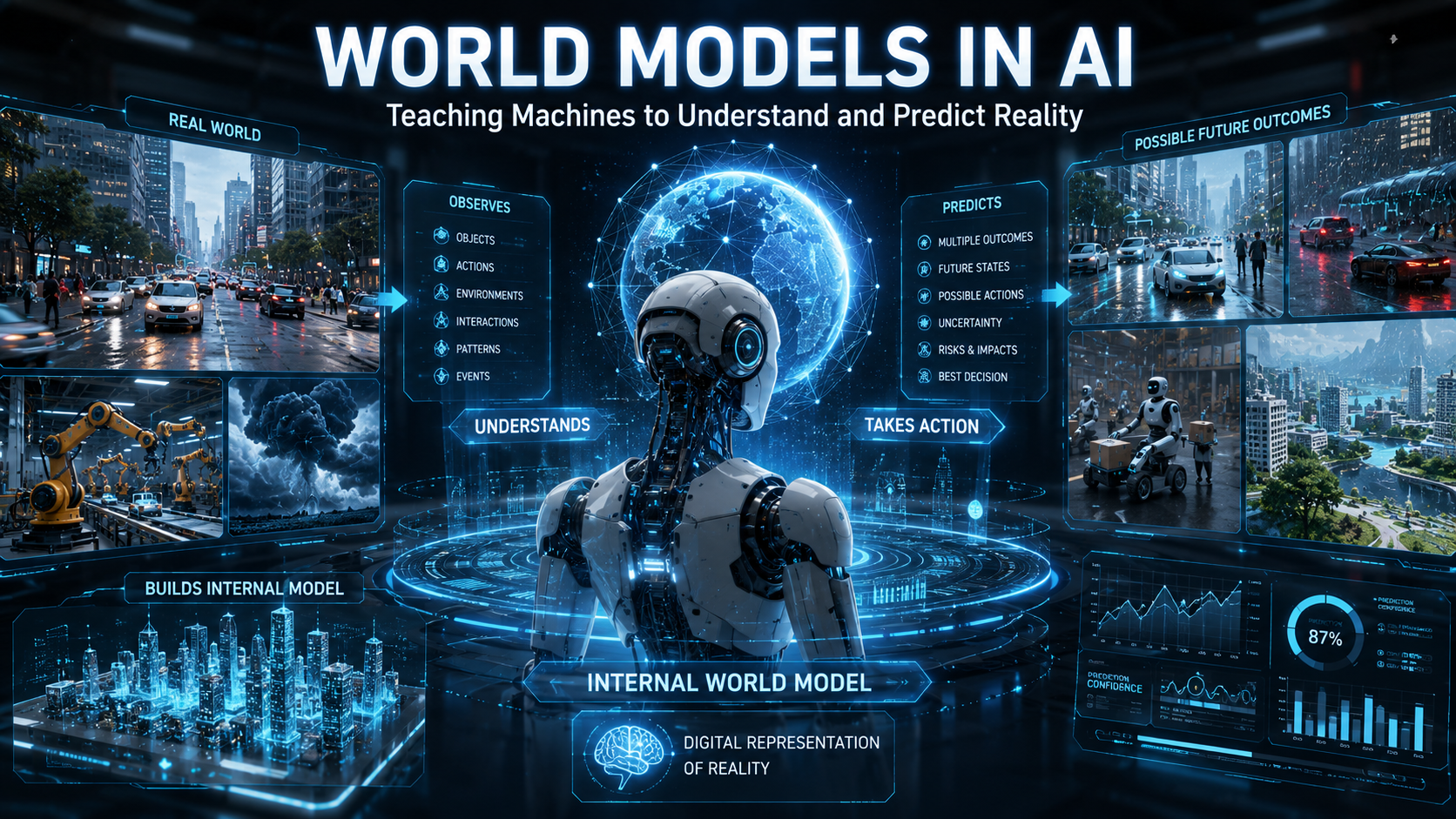
World models aim to give AI systems a similar ability to understand environments, predict what could happen next, and make better decisions before taking action.
What Are World Models in AI?
A world model is an AI system that builds an internal understanding of an environment and how things within it behave.
In simple words, it works like a small virtual version of the world inside an AI system. The AI can use this internal model to understand the current situation, imagine possible actions, and predict their results.
For example, imagine a robot standing in a room with a chair blocking its path. A basic AI system may simply detect the chair as an object. An AI system using a world model can go further. It may understand that the chair is a physical object, recognize that it cannot walk through it, and predict that moving around the chair is a safer way to reach its destination.
This ability to understand situations and predict outcomes is one reason world models are becoming an important area of artificial intelligence and machine learning research.
How Do World Models Work?
World models learn by observing information and finding patterns in how environments change over time.
The information can come from videos, images, simulations, sensors, robot movements, or other forms of real-world data. By studying sequences of events, the AI learns how one action can lead to another result.
For example, if an AI system studies videos of a ball rolling across different surfaces, it may learn that the ball moves differently on smooth flooring than on thick carpet. With enough useful training data, the AI can begin predicting the possible movement of the ball in a new situation.
The main idea is simple: observe the environment, learn how it changes, predict possible outcomes, and choose an appropriate action.
Why Are World Models Important for AI?
Many current AI systems are highly capable, but generating a good response is different from understanding how actions affect a real environment.
AI systems that interact with the physical world need more than pattern recognition. They need to understand movement, space, objects, cause and effect, and possible future outcomes.
World models can help AI move from simply reacting to information toward planning ahead.
For example, before a robot performs an action, it could predict several possible results. It can then choose the action that is most likely to complete the task successfully and safely.
This ability can be valuable for robotics, autonomous systems, AI agents, scientific simulations, and many other advanced applications.
World Models and Human Learning
The basic idea behind world models has some similarities to the way people learn.
A child does not understand every rule of the physical world from the beginning. Over time, the child observes objects, interacts with the environment, and learns from the results of different actions.
AI researchers are exploring ways for machines to learn from observation and interaction in a somewhat similar way.
For example, an AI system can watch video sequences and learn that objects continue moving across frames, that actions can change an environment, and that certain events are more likely to follow others.
However, AI learning and human understanding are not the same. Humans use experience, common sense, social knowledge, and many other abilities that remain difficult to reproduce in machines.
World models are one approach to making AI systems better at prediction and interaction, but they are not complete copies of human intelligence.
How World Models Can Improve Robotics
Robotics is one of the most promising areas for world models.
A robot working in a warehouse, factory, hospital, or home may face situations that were not exactly included in its original training data. It needs to understand its surroundings and adjust its actions when conditions change.
A world model can help a robot predict what may happen before it moves.
Imagine a warehouse robot carrying a box. It detects another object in its path. Instead of following a fixed instruction, the robot could use its understanding of the environment to predict different routes and choose a suitable path.
For more complex tasks, a robot may also need to predict how objects react when they are picked up, pushed, placed, or moved.
This could help robots become more adaptable when working in changing environments.
World Models in Autonomous Vehicles
Autonomous vehicles operate in complex and constantly changing environments.
A self-driving system must process information about roads, traffic signals, pedestrians, cyclists, vehicles, weather conditions, and unexpected events. Detecting these elements is important, but prediction is also necessary.
A world model could help an autonomous system estimate what might happen next.
For example, if a pedestrian is standing near a crossing, the system may consider the possibility that the person could enter the road. If a nearby vehicle begins changing direction, the AI can estimate possible future movement and respond appropriately.
Better prediction can support safer planning and decision-making, although real-world autonomous driving still requires extensive testing, reliable sensors, safety systems, and strong engineering controls.
World Models and AI Agents
AI agents are designed to complete tasks, make decisions, use tools, and perform actions with different levels of independence.
World models could make these agents better at planning.
Instead of immediately performing an action, an AI agent could estimate possible results first. It may compare different paths, identify potential problems, and select a more effective approach.
For example, an AI agent managing a complex workflow might predict that completing one task before another could cause delays. By understanding dependencies between actions, it could create a better plan.
This combination of AI agents and predictive world models could lead to systems that are more capable of handling complex, multi-step tasks.
World Models in Gaming and Virtual Environments
Games and virtual environments provide useful spaces for developing and testing intelligent systems.
An AI system can learn how a virtual world works by observing movement, actions, objects, and rewards. It can experiment with different strategies without creating risks in the physical world.
World models can also help create more dynamic virtual environments.
Instead of relying only on fixed rules and scripted events, future AI-powered systems may be able to predict and generate changing environments based on user actions.
This technology could support new possibilities in gaming, simulation, training, education, and virtual reality.
World Models for Scientific Research
World models may also support scientific research by helping researchers simulate complex systems and explore possible outcomes.
In many areas of science, real-world experiments can be expensive, slow, or difficult to perform. AI-powered predictive models may help researchers test ideas in simulated environments before moving to physical experiments.
Potential applications can include climate research, material science, biology, engineering, and other fields where understanding how complex systems change over time is important.
AI cannot replace careful scientific experiments and validation, but it can become a useful tool for exploring possibilities and supporting research.
World Models and Digital Twins
A digital twin is a virtual representation of a physical object, system, process, or environment.
For example, a factory can have a digital model that uses data from machines and sensors. Engineers can study this model to understand performance, detect possible problems, and test changes.
World models can make these virtual systems more intelligent and predictive.
Instead of only showing what is happening now, an AI-powered digital twin could help estimate what may happen in the future. A factory system might predict equipment problems, while a smart city model could simulate the possible effects of changes in traffic flow.
Combining AI world models with digital twins could help organizations improve planning and decision-making.
How Are World Models Trained?
Training a useful world model requires large amounts of relevant information.
Depending on the application, training data may include video, images, sensor readings, movement data, simulations, text, and records of actions and outcomes.
The AI studies relationships within this information. It learns how environments change over time and how actions can affect future states.
Simulation is especially useful because an AI system can experience many different situations without creating physical risk.
For robotics, a machine may first practice tasks in a simulated environment before using what it has learned in the real world. However, moving from simulation to reality is difficult because real environments contain unexpected details and changes.
Benefits of World Models in AI
One major benefit of world models is better prediction. AI systems can estimate possible future outcomes instead of only responding to the current situation.
They can also support improved planning by allowing AI to consider different actions before choosing one.
Another potential benefit is more efficient learning. If an AI system develops a useful understanding of how an environment behaves, it may be able to apply that knowledge to new situations instead of learning every task completely from the beginning.
World models may also help AI systems adapt to changing environments, which is especially important for robotics and autonomous machines.
Challenges of Building World Models
Creating an accurate model of the real world is extremely difficult.
The real world is complex, unpredictable, and constantly changing. Even small differences in an environment can affect what happens next.
One challenge is data. AI systems need large amounts of high-quality and diverse training information. If the training data does not represent enough situations, the model may make poor predictions when it faces something unfamiliar.
Another challenge is computing power. Training advanced models on video, simulation data, and large environments can require significant computing resources.
Prediction errors are another important issue. A world model is still a model, which means its predictions may be wrong. In safety-critical areas such as transportation, healthcare technology, and industrial systems, incorrect predictions can have serious consequences.
For this reason, world models need careful testing, monitoring, safety controls, and human oversight.
Can World Models Give AI Common Sense?
One of the biggest questions in artificial intelligence is whether machines can develop something similar to common sense.
Humans understand many everyday situations without needing detailed instructions. We know that objects can fall, doors can block movement, and certain actions can create predictable results.
AI systems often struggle with this type of everyday understanding, especially in situations that are very different from their training data.
World models may help AI systems develop better practical understanding by learning how objects, actions, and environments relate to each other.
However, building true machine common sense remains a major challenge. Predicting physical movement is only one part of understanding reality. Human common sense also includes social situations, intentions, emotions, cultural knowledge, uncertainty, and context.
The Future of World Models in AI
World models could play an important role in the next generation of artificial intelligence.
Today, many people interact with AI mainly through text, images, voice, and software tools. In the future, more AI systems may interact directly with physical and virtual environments.
Robots may need to understand homes and workplaces. AI agents may need to plan complex tasks across software systems. Autonomous machines may need to predict changes in dynamic environments.
World models could help these systems become better at understanding situations, planning actions, and predicting possible results.
The progress will likely happen gradually. Building AI systems that can accurately understand and predict complex reality remains a difficult research and engineering problem.
Final Thoughts
World models represent an important direction in artificial intelligence and machine learning. Their goal is to help machines do more than recognize patterns or generate responses. They aim to help AI build useful representations of environments, understand how situations can change, and predict what might happen next.
The technology could support advances in robotics, autonomous vehicles, AI agents, gaming, scientific research, simulation, and digital twins.
At the same time, many challenges remain. Real-world environments are complex, training can require significant data and computing resources, and predictions are never guaranteed to be correct.
The future of AI may depend not only on systems that can answer questions, but also on systems that can understand environments, consider possibilities, and make better decisions based on what may happen next.
