Introduction: What Is Edge AI in Simple Words?
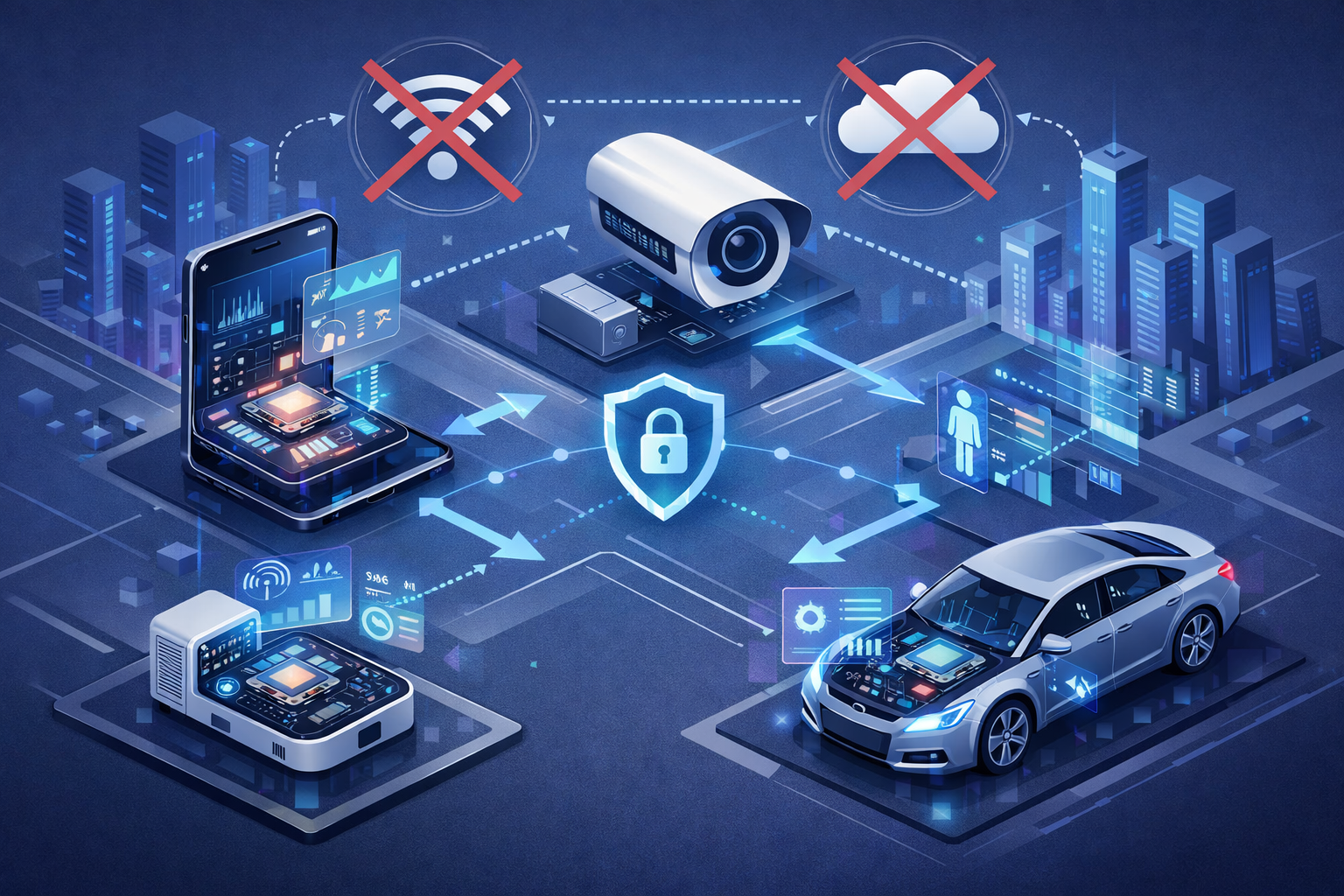
Edge AI means running artificial intelligence directly on a device instead of sending data to the internet or cloud servers. These devices can be mobile phones, smart cameras, machines, or sensors. Because the AI works on the device itself, it can make decisions faster and even without internet access.
Traditional AI vs Edge AI
In traditional AI systems, data is sent to cloud servers where the AI processes it and sends results back. This needs a stable internet connection and can cause delays.
Edge AI is different. Here, the AI model is already inside the device, so data is processed locally. This makes the system faster, safer, and more reliable.
How Edge AI Works Offline
Edge AI works offline by using a pre-trained AI model stored inside the device.
First, the AI model is trained on powerful computers using large datasets. After training, the model is made smaller and optimized so it can run on low-power devices. Once installed, the device can analyze data and make decisions without connecting to the internet.
For example, a smartphone can recognize your face even in airplane mode because the AI model is already on the phone.
Why Edge AI Is Important
Faster Response Time
Since data does not need to travel to the cloud, Edge AI gives instant results. This is very useful for real-time tasks like facial recognition or accident detection.
Works Without Internet
Edge AI continues working even when the internet is slow or unavailable. This makes it ideal for remote areas, factories, and moving vehicles.
Better Privacy and Security
Data stays on the device instead of being sent online. This reduces the risk of data leaks and protects user privacy.
Lower Data and Cloud Costs
Processing data on devices reduces the need for cloud storage and internet usage, saving costs for businesses.
Common Examples of Edge AI
Smartphones and Wearables
Face unlock, voice commands, and fitness tracking all use Edge AI.
Smart Cameras
Security cameras use Edge AI to detect motion, faces, or unusual activity in real time.
Healthcare Devices
Edge AI helps monitor patient health and detect issues instantly without sending sensitive data online.
Industrial Machines
Factories use Edge AI to predict machine failures and improve efficiency.
Self-Driving Vehicles
Cars use Edge AI to detect objects, traffic signs, and obstacles instantly.
Edge AI vs Cloud AI (Simple Comparison)
Edge AI processes data on the device, while Cloud AI processes data on remote servers. Edge AI is faster and more private, while Cloud AI is better for large-scale data processing. Many modern systems use both together for the best results.
Challenges of Edge AI
Edge AI devices have limited processing power and battery life. Running AI models on small devices can be difficult. However, new AI chips and optimized models are solving these problems quickly.
The Future of Edge AI
With the growth of IoT, 5G, and smart devices, Edge AI will become more common. More devices will be able to think and act on their own, making technology faster, safer, and more intelligent.
Conclusion
Edge AI allows artificial intelligence to work offline, faster, and more securely by running directly on devices. It reduces dependence on the internet, improves privacy, and enables real-time decision-making. As technology advances, Edge AI will play a major role in everyday smart systems.
