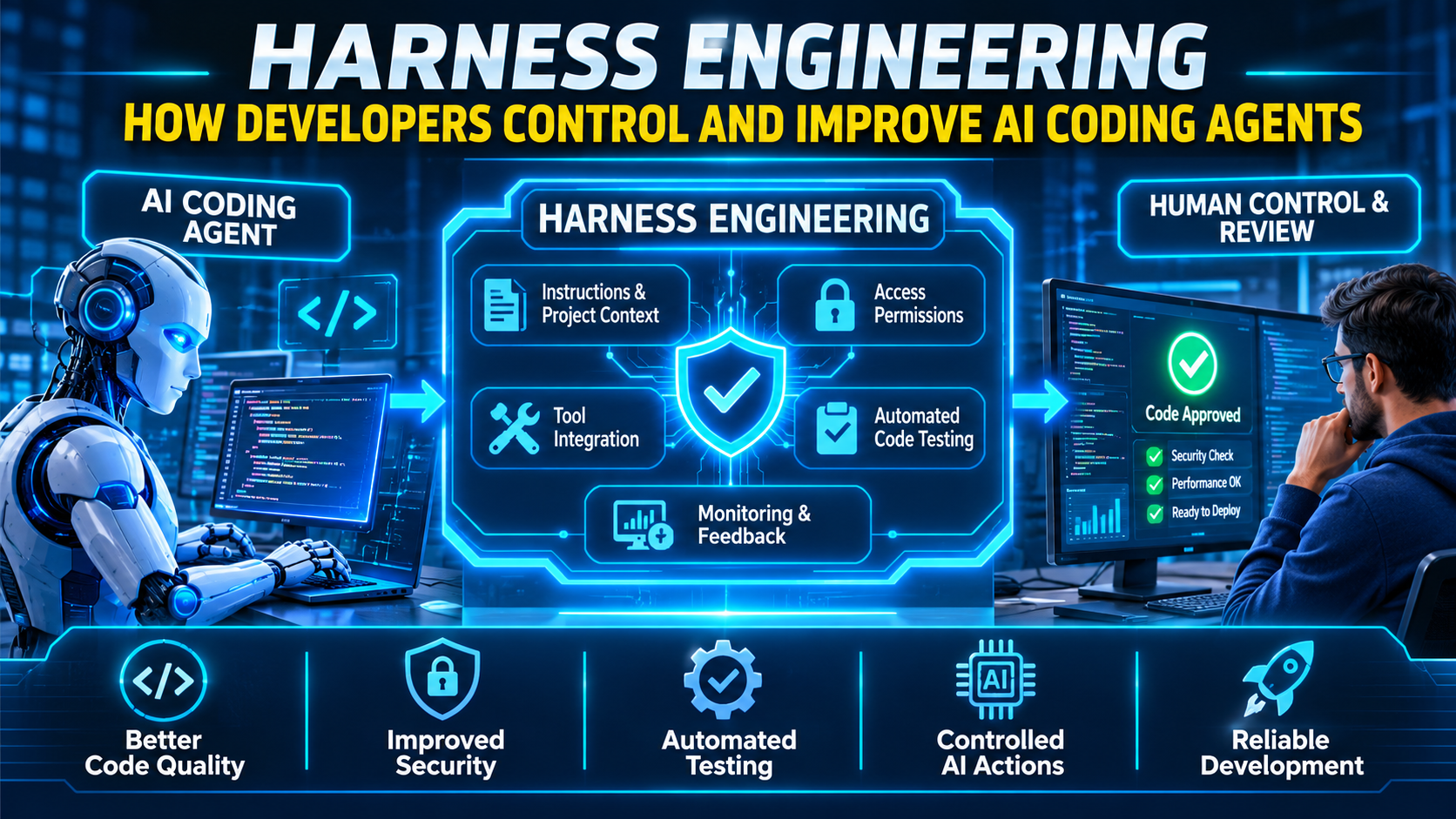
Artificial Intelligence (AI) is changing the way people develop software. Today, AI coding agents can write programming code, find errors, fix bugs, create tests, and help developers build applications. These tools can save time and make software development easier. However, AI agents can sometimes make mistakes, generate incorrect code, or change important files without proper guidance.
This is why Harness Engineering is becoming important in modern software development. It helps developers create rules, tools, and testing systems that guide AI coding agents. In simple words, Harness Engineering means creating a controlled working environment where AI agents can perform coding tasks safely and correctly.
1. What Is Harness Engineering?
Harness Engineering is a method of managing and controlling AI coding agents with the help of instructions, tools, permissions, and testing systems. An AI agent can write code, but it needs proper guidance to understand what it should do and what it should avoid.
For example, imagine asking an AI agent to create a login system for a website. The agent may write the login code and connect it to a database. However, developers must check whether the login system works correctly, protects user information, and follows security rules. Harness Engineering helps manage these activities and makes the development process more reliable.
2. Why Is Harness Engineering Important?
AI coding agents can complete many programming tasks quickly, but their results are not always perfect. They may generate incorrect code, create security problems, or make changes that affect other parts of an application.
Harness Engineering helps developers manage these problems by setting clear instructions and checking the work completed by AI agents. It improves code quality, protects important files, reduces unnecessary mistakes, and makes AI-assisted software development more organized.
3. How Does Harness Engineering Work?
Harness Engineering works by creating a step-by-step process that guides an AI coding agent from the beginning of a task to the final result.
Step 1: Give the AI Agent a Clear Task
First, the developer explains what the AI agent needs to do. For example, the task could be creating a registration form, connecting it to a database, or fixing an error in an existing application. Clear instructions help the agent understand the expected result.
Step 2: Provide Project Information
The AI agent needs information about the existing project. Developers can provide source code, folder structures, programming languages, and project documentation. This helps the agent understand how the application is built before making changes.
Step 3: Set Rules and Permissions
Developers decide what the AI agent can access and which actions it can perform. For example, an agent may be allowed to edit website files but not access confidential passwords or production database settings. These rules help prevent unwanted changes.
Step 4: Let the AI Agent Write Code
After receiving the task and project information, the AI agent starts working. It can create new code, update existing files, find errors, and use development tools. The harness manages these activities according to the rules set by developers.
Step 5: Test the Generated Code
After the code is created, it needs to be tested. Automated testing tools can check whether the code works correctly and identify possible errors. If a problem is found, the AI agent can receive feedback and try to fix it.
Step 6: Review and Approve the Work
Finally, developers review the generated code before accepting important changes. They check whether the code meets project requirements and follows security rules. Human approval is especially important before making changes to a live application.
4. Main Components of Harness Engineering
Harness Engineering uses different tools and techniques to guide AI coding agents and improve their performance.
4.1 Instructions and Project Information
AI agents need clear instructions and information about the software project. Developers provide coding rules, project documents, and examples so that the agent can understand how to complete its tasks.
4.2 Development Tool Integration
AI coding agents use tools such as code editors, terminals, Git repositories, and testing frameworks. These tools allow agents to perform development activities instead of only suggesting code.
4.3 Permission Management
Permission management controls which files and resources an AI agent can access. It helps protect important information and prevents agents from performing actions that are not allowed.
4.4 Automated Testing
Automated testing checks whether the generated code works as expected. It can identify coding errors, broken features, and other problems before developers accept the changes.
4.5 Monitoring and Activity Records
Monitoring helps developers observe what an AI agent is doing. Activity records can show which files were changed, which tools were used, and whether any errors occurred.
4.6 Feedback and Error Correction
When the AI agent makes a mistake, the system can provide feedback through error messages or failed test results. The agent can use this information to correct its code and improve the result.
5. Harness Engineering vs Traditional Software Development
Traditional software development mainly depends on developers writing and testing code themselves. In AI-assisted development, coding agents can complete some tasks automatically. Harness Engineering adds rules, testing, and monitoring to manage these AI-powered activities.
For example, a developer may manually write a login form in traditional development. With an AI coding agent, the developer can describe the required login form and let the agent generate the code. Harness Engineering helps ensure that the generated code follows project rules and passes the required tests.
Both approaches still need developers. AI agents can help with coding tasks, but humans remain responsible for important decisions and final software quality.
6. Real-World Applications of Harness Engineering
Harness Engineering can be useful in different types of software projects. It helps developers manage AI agents while building, testing, and maintaining applications.
6.1 Website and Web Application Development
AI agents can help create website pages, design frontend components, connect APIs, and fix programming errors. Harness Engineering helps check whether the generated code follows the project’s rules and works correctly.
6.2 Business Software Development
Companies use large software applications to manage employees, customers, payments, inventory, and other business activities. Harness Engineering can help control AI agents working on these applications and protect important business information.
6.3 Software Testing
AI agents can help create test cases, check application features, and find possible errors. A harness can manage the testing process and help developers identify problems before releasing software.
6.4 Bug Fixing and Code Maintenance
Developers can ask AI agents to find bugs, update old code, improve existing features, and fix programming errors. Testing and review systems help ensure that these changes do not create new problems.
6.5 Software Deployment
AI agents can assist with preparing software for deployment, checking configuration files, and analyzing error logs. Harness Engineering helps restrict sensitive operations and ensures that important deployment actions receive proper approval.
7. Benefits of Harness Engineering
Harness Engineering offers several advantages for developers and software companies.
7.1 Saves Development Time
AI agents can handle repetitive coding tasks, allowing developers to spend more time on complex problems and important project decisions.
7.2 Improves Code Quality
Automated testing and code checks help identify mistakes in AI-generated code. This makes it easier to maintain reliable applications.
7.3 Provides Better Security
Permission controls help prevent AI agents from accessing sensitive files or performing unauthorized actions.
7.4 Maintains Coding Standards
Developers can provide common coding rules and instructions so that AI agents follow the same standards across a project.
7.5 Makes Debugging Easier
Monitoring and activity records help developers understand what changes an AI agent made and where a problem occurred.
7.6 Supports Larger Projects
Organizations can use structured workflows to manage multiple AI agents and different development tasks more effectively.
8. Challenges of Harness Engineering
Although Harness Engineering provides many benefits, developers may face some challenges when using it.
8.1 Difficult Setup
Creating proper instructions, permissions, testing systems, and monitoring tools can take time and technical knowledge.
8.2 AI Can Still Make Mistakes
Even with clear instructions, AI agents may misunderstand a task or generate incorrect code. Developers must check important results.
8.3 Security Problems
If permissions are not configured correctly, an AI agent may access sensitive information or perform unsafe actions.
8.4 Testing Cannot Find Every Error
Automated tests only check the conditions they are designed for. Some bugs, security weaknesses, and unexpected problems may still remain.
8.5 Human Supervision Is Required
AI agents cannot take full responsibility for software quality. Developers must review important changes and make final decisions.
9. Popular Tools Used in AI-Assisted Software Development
Different tools can help developers build and manage AI coding workflows. These tools do not all provide the same features, but they can be combined as part of a Harness Engineering setup.
- GitHub Copilot: Helps developers write, understand, and improve programming code using AI.
- Claude Code: An AI coding agent that can work with project files and development tools.
- Cursor: An AI-powered code editor that helps developers understand and modify software projects.
- LangGraph: Helps developers create structured workflows for AI agents.
- Docker: Provides separate environments for running applications and development tools.
- GitHub Actions: Automates software workflows such as testing and code checks.
- Playwright: Helps developers automatically test websites and web applications.
10. Future of Harness Engineering
AI coding agents are becoming more useful in modern software development. In the future, developers may use more advanced systems to manage multiple AI agents, check generated code automatically, monitor activities, and control access to important resources.
Harness Engineering may also become more common in software companies because organizations need reliable ways to manage AI-generated code. However, powerful AI agents will still need proper instructions, security controls, testing, and human supervision.
The future of software development will not depend only on creating smarter AI models. It will also depend on building better systems that help those models work safely and effectively.
Conclusion
Harness Engineering is an important emerging approach in AI-powered software development. It helps developers control AI coding agents using clear instructions, development tools, permissions, automated testing, and monitoring systems.
AI agents can make programming faster and easier, but they can also make mistakes. Harness Engineering helps manage these risks and improves the reliability of AI-assisted development.
In simple words, AI coding agents help write the code, while Harness Engineering helps manage, check, and control their work. Together, they can make software development more organized, efficient, and reliable.
