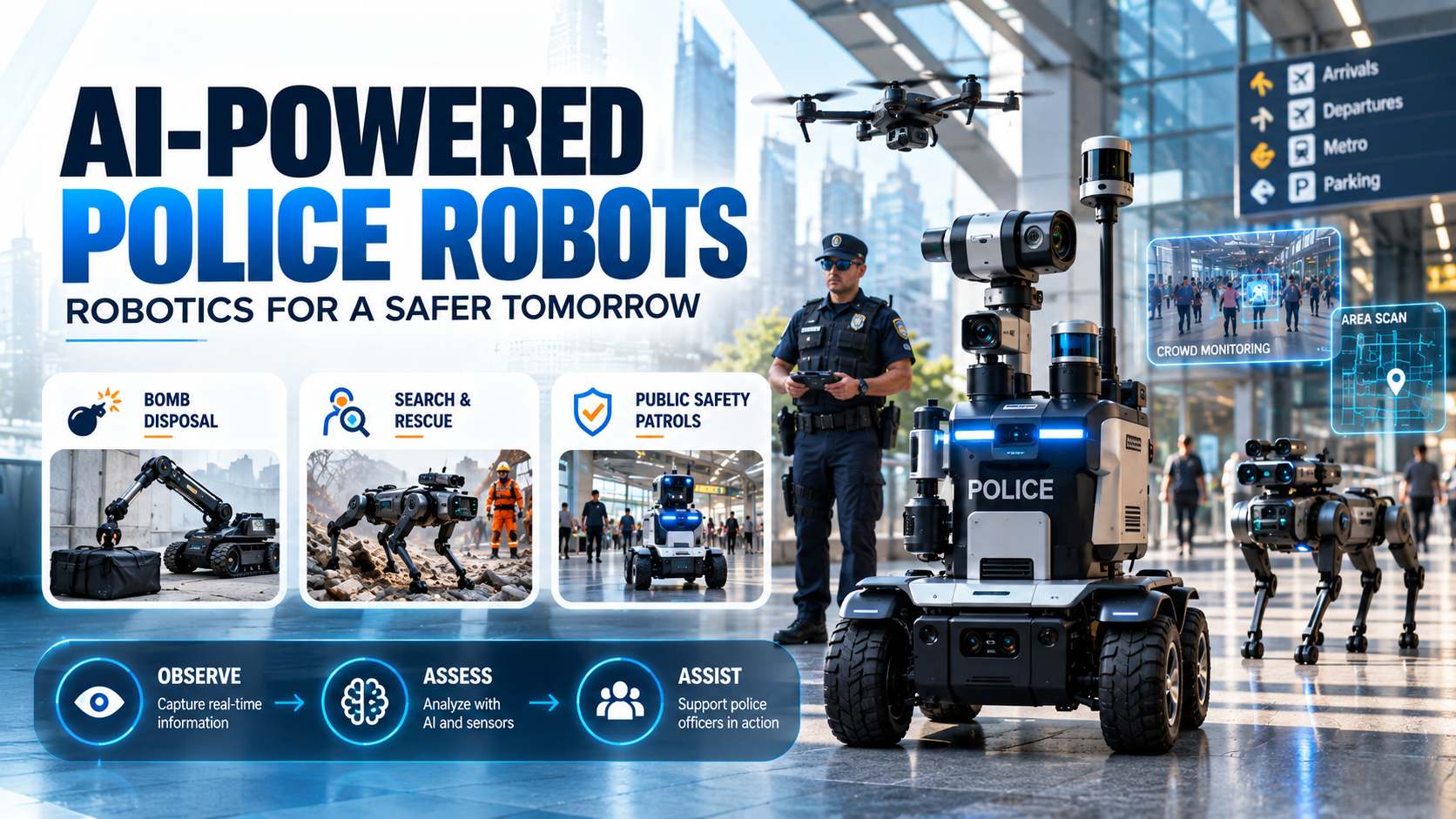
Technology is changing the way police officers protect people and respond to emergencies. Today, robots, drones, cameras, and artificial intelligence are helping police teams perform certain tasks more safely and efficiently.
AI-powered police robots are designed to support officers in situations where collecting information or approaching a location may be dangerous. They can help inspect suspicious objects, monitor selected public areas, and support search-and-rescue operations.
For example, a bomb disposal robot can help trained specialists examine a suspicious package from a safer distance. These machines do not replace police officers. Instead, they provide additional tools to help officers make informed decisions.
2. What Are AI-Powered Police Robots?
AI-powered police robots are machines that use cameras, sensors, software, and sometimes artificial intelligence to assist law enforcement teams.
Some robots move on wheels, while others use four legs or fly as drones. They may be controlled remotely by a police officer or perform specific movements automatically.
Artificial intelligence can help certain robots recognize objects, analyze images, or understand their surroundings. However, not every police robot uses advanced AI. Many systems depend on human operators to control their movements and interpret the information they collect.
The main purpose of these robots is to help police perform selected tasks while reducing risks to people.
3. How Do AI-Powered Police Robots Work?
3.1 Cameras and Sensors
Police robots often use cameras and sensors to collect information about their surroundings. Cameras provide visual information, while sensors can help detect obstacles, measure distances, or support navigation.
For example, if officers need to inspect a damaged building, a remotely operated robot may help them see inside before entering. This additional information can help the team understand the situation and plan its response.
3.2 Artificial Intelligence
Some police robots use AI software to analyze images, recognize certain objects, or assist with navigation. These features can help officers process information more efficiently.
For example, AI-assisted software may help organize footage or identify objects that require further inspection. However, AI can make mistakes, so its results should be checked by trained personnel.
3.3 Remote Control and Automatic Movement
Many police robots are operated remotely. An officer can control the machine from a safer location and use its cameras or other equipment to inspect an area.
Other robots can follow predefined routes, avoid certain obstacles, or move through an environment with limited human input. Their level of automation depends on the model and its intended purpose.
4. Types of Police Robots Used for Public Safety
4.1 Bomb Disposal Robots
Bomb disposal robots help trained specialists inspect suspicious packages and deal with explosive hazards. Some models have robotic arms that can manipulate objects under controlled conditions.
These robots allow specialists to examine dangerous situations from a greater distance. Their main benefit is reducing the need for people to approach a potential explosive threat directly.
4.2 Police Patrol Robots
Police patrol robots can move around selected public spaces, such as transport hubs, large facilities, and other designated areas.
Depending on their capabilities, they may provide video monitoring, communicate safety information, or help security teams observe their surroundings.
These robots can support routine monitoring, but they cannot guarantee that every crime or emergency will be detected.
4.3 Police Drones
Police drones are small flying devices equipped with cameras and, in some cases, additional sensors. They can provide aerial views of large areas that may be difficult to inspect from the ground.
Police teams may use drones to help locate missing people, assess traffic accidents, monitor emergency scenes, or search areas affected by disasters.
Their use must follow applicable aviation rules, privacy requirements, and operational policies.
4.4 Robotic Police Dogs
Robotic police dogs are four-legged machines designed to move across certain types of terrain.
They may help officers inspect dangerous locations, explore difficult-to-access areas, or gather information during high-risk operations.
Unlike living police dogs, robotic dogs use cameras, sensors, and mechanical movement. Their usefulness depends on battery life, terrain, connectivity, and the equipment installed.
5. How Police Robots Improve Public Safety
5.1 Inspecting Dangerous Areas
Police officers sometimes need to investigate locations where there may be explosives, hazardous materials, fire, or structural damage.
A suitable robot can help inspect the area remotely and provide useful visual information. This may reduce the need for officers to enter a dangerous location before understanding the risks.
5.2 Helping With Search and Rescue
Finding missing people can be difficult when an area is large, damaged, or difficult to reach.
Robots and drones can help responders examine these locations and gather information. For example, a drone may provide an aerial view of a search area, while a ground robot may inspect a narrow or unstable space.
These tools can support search teams, although they do not guarantee that a missing person will be found.
5.3 Monitoring Public Places
Some police and security robots are designed to operate in designated public spaces. They may use cameras and sensors to help operators observe activity and identify situations that need attention.
For example, a patrol robot at a transport hub may help security personnel monitor an area or provide directions to visitors.
Because these systems can collect information about people, their use should follow clear privacy rules and appropriate oversight.
5.4 Supporting Emergency Response
During emergencies, police and rescue teams need accurate information to decide what to do next.
Robots can help inspect affected buildings, examine hazardous locations, and provide visual information from areas that are difficult to reach. This can support planning and coordination between emergency responders.
6. Real-World Examples of Police Robotics
6.1 Singapore Police Force
Singapore has introduced robotic systems to support selected policing and public-safety operations. Reported applications include robotic patrol platforms used in locations such as Changi Airport.
These systems demonstrate how robots can support officers with monitoring, communication, and public engagement in designated areas.
6.2 Bomb Disposal Robotics in the United Kingdom
Robotic systems are used by specialist teams to inspect and handle certain explosive hazards remotely. UK defence and bomb-disposal initiatives have also explored robotic technologies for these tasks.
These examples show how remotely operated machines can help trained personnel work at a safer distance from dangerous objects.
It is important to remember that capabilities vary between systems. A robot designed for bomb disposal may have very different equipment and functions from a patrol robot or a police drone.
7. Benefits of AI-Powered Police Robots
7.1 Reduced Risk to Officers
One of the main benefits of police robots is that they can help officers inspect some dangerous locations remotely. This can reduce their direct exposure to certain hazards.
7.2 Better Information Collection
Cameras and sensors can provide additional views of an incident. This information may help police teams understand the environment before deciding how to respond.
7.3 Support for Difficult Operations
Robots can reach some locations that are difficult or unsafe for people to enter. Depending on their design, they may help inspect damaged buildings, search difficult terrain, or examine suspicious objects.
7.4 More Efficient Monitoring
In selected environments, patrol robots can support routine observation and provide information to human operators. This can help security teams manage their workload, although robots still require maintenance, supervision, and operational planning.
7.5 Assistance During Emergencies
Robots and drones can help responders collect information during accidents, natural disasters, and other emergencies. This information can support decisions about where assistance is needed.
8. Challenges and Risks of Police Robots
8.1 Privacy Concerns
Police robots equipped with cameras and sensors may collect images or other information about people in public spaces.
Authorities need clear rules about when data can be collected, who can access it, how long it is stored, and when it must be deleted. People should not be subjected to unnecessary or excessive surveillance.
8.2 Technical Problems
Robots can experience battery failures, connectivity problems, damaged sensors, or difficulties moving across certain surfaces.
If a robot stops working during an operation, officers must have backup procedures and other ways to complete the task.
8.3 AI Errors
AI systems may misunderstand images, misidentify objects, or produce incorrect results. These mistakes can be especially serious in policing because decisions may affect people’s safety and rights.
AI-generated information should therefore be reviewed carefully. Important decisions must remain subject to appropriate human judgment and accountability.
8.4 High Costs
Buying police robots can be expensive. Departments must also pay for training, maintenance, software updates, repairs, and equipment replacement.
Before investing in robotics, authorities should consider whether a system provides enough practical benefit for the cost.
8.5 Public Trust and Accountability
People need to understand how police robots are being used and what rules control their operation.
Clear policies, independent oversight where appropriate, transparent reporting, and safeguards for personal information can help build public trust.
9. The Future of AI-Powered Police Robots
Police robotics may become more capable as AI software, sensors, batteries, and navigation systems improve.
Future robots could help officers examine complex environments, share information more effectively, and support emergency-response teams. AI-assisted systems may also become better at organizing information collected during operations.
However, technological improvements alone will not determine whether these systems succeed. Reliability, cost, privacy, safety, legal requirements, and public acceptance will remain important.
The most useful police robots will be those that solve real problems, operate within clear limits, and support trained officers rather than replace human responsibility.
10. Conclusion: Robots as Tools for Safer Policing
AI-powered police robots are becoming useful tools for selected public-safety tasks. They can support bomb disposal, remote inspection, search and rescue, and monitoring in designated areas.
These technologies may help police officers collect information and reduce exposure to certain dangers. However, they also bring challenges involving privacy, technical reliability, cost, and AI accuracy.
Police robots should be used with appropriate human supervision, clear operating rules, and strong safeguards for the public. When used responsibly, they can support law enforcement while keeping safety, accountability, and public trust at the center of their purpose.
