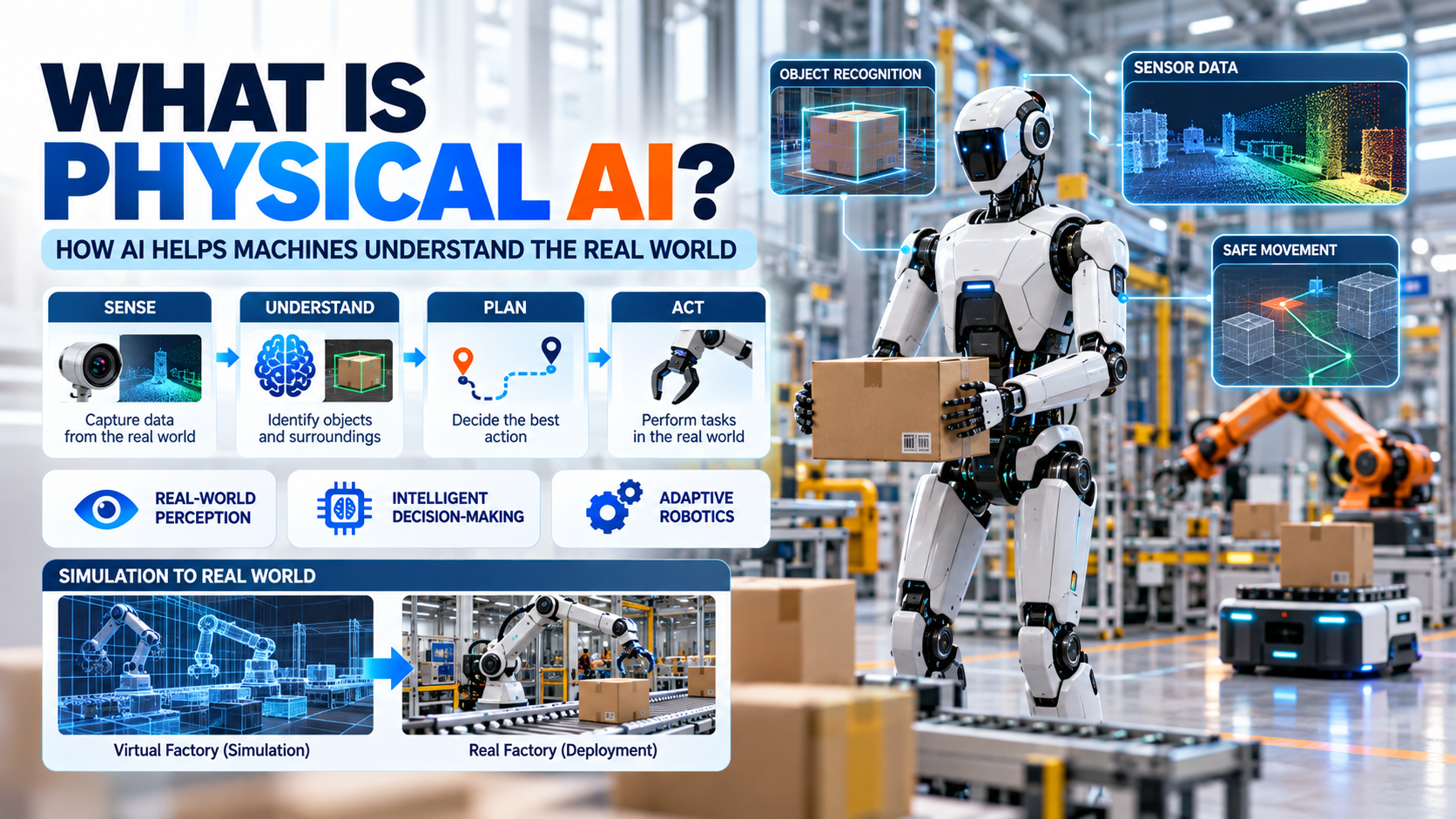
Artificial intelligence is no longer limited to chatbots, image generators, and software applications. It is increasingly being used in machines that can observe their surroundings, understand physical objects, and perform tasks in the real world. This technology is known as Physical AI.
Physical What Is Physical AI? How Is It Changing Robotics in 2026?AI combines artificial intelligence, robotics, sensors, computer vision, and machine learning to help machines interact with their physical environment. It is being developed for applications such as factory automation, warehouse operations, autonomous vehicles, and humanoid robots.
In 2026, Physical AI is an important area of robotics research and development. Instead of following only fixed instructions, AI-powered machines are being designed to handle more varied situations, respond to changing conditions, and perform tasks with greater autonomy.
But what is Physical AI, how does it work, and how could it change the future of robotics? Let’s explore it in simple terms.
1. What Is Physical AI?
Physical AI refers to artificial intelligence systems that can perceive, reason about, and act within the physical world. Unlike a conventional chatbot that mainly processes digital information, a Physical AI system interacts with real objects, spaces, and environments.
For example, a traditional industrial robot might be programmed to move a component from one fixed position to another. It performs this task repeatedly under predefined conditions.
A robot powered by Physical AI can potentially use cameras and sensors to identify an object, estimate its position, plan how to pick it up, and adjust its movements if the object is placed differently.
Physical AI can combine several technologies, including machine learning, computer vision, sensor processing, motion planning, and robotics control. These technologies help machines understand what is happening around them and choose suitable actions.
Physical AI is not limited to humanoid robots. It can also be used in robotic arms, autonomous mobile robots, inspection systems, and self-driving vehicles.
The main idea is to give machines the ability to connect digital intelligence with physical actions.
2. How Does Physical AI Work?
Physical AI combines sensing, intelligent decision-making, and physical movement. A typical system follows a continuous cycle in which the machine observes its surroundings, decides what to do, performs an action, and checks the result.
Step 1: Perceiving the Environment
The robot collects information through cameras, depth sensors, LiDAR, force sensors, or other input devices. These sensors help it identify objects, measure distances, detect obstacles, and understand its surroundings.
For example, a warehouse robot can use cameras and distance sensors to detect shelves, packages, and people in its path.
Step 2: Understanding and Reasoning
AI models process the collected information to identify relevant objects, understand the task, and estimate what action might be appropriate.
A robot handling packages may need to recognize different package shapes, determine their positions, and identify a suitable way to grip them.
Step 3: Planning an Action
The system uses its task requirements, learned behavior, and motion-planning software to decide how to proceed. It must consider physical limitations, possible collisions, and safety requirements.
For example, a robotic arm needs to calculate a movement that allows it to reach an object without hitting nearby equipment.
Step 4: Performing the Action
The robot sends commands to motors, actuators, wheels, or robotic grippers. These components carry out the planned movement in the physical world.
Step 5: Learning and Adjusting
Sensors provide new information about the result. If an object moves unexpectedly or an obstacle appears, the robot may need to adjust its plan.
Depending on its design, the system may also improve through training, simulation, and feedback collected from previous tasks. Not every Physical AI robot learns continuously while operating; some use models trained before deployment.
This cycle helps Physical AI systems respond to changing conditions rather than depending entirely on fixed movements.
3. What Are the Main Technologies Behind Physical AI?
Physical AI depends on several technologies working together. Each technology plays a different role in helping robots understand and interact with the real world.
Artificial Intelligence and Machine Learning
AI models process information, recognize patterns, and support decision-making. Machine learning enables systems to develop useful capabilities from training data instead of relying only on manually written rules.
Computer Vision
Computer vision allows machines to interpret images and video from cameras. It helps robots identify objects, estimate positions, recognize obstacles, and inspect products for visible defects.
Sensors and Sensor Fusion
Robots use sensors to gather information about distance, movement, force, temperature, and other physical conditions. Sensor fusion combines information from multiple sources to provide a more useful understanding of the environment.
Robotics and Motion Control
Robotics software translates decisions into physical movements. Motion planning and control help a robot move its joints, operate a gripper, navigate a warehouse, or position a tool accurately.
Simulation and Digital Twins
Developers can train and test robot behaviors in simulated environments before deploying them in real locations. Digital twins can represent factories, warehouses, machines, or other physical systems in a virtual environment.
Simulation helps developers test many situations, including uncommon or risky scenarios, without needing to recreate every situation physically. However, simulated performance must still be validated in the real world because physical conditions can differ from the simulation.
Together, these technologies help connect AI models with machines that operate outside the digital world.
4. How Is Physical AI Changing Robotics in 2026?
Physical AI is influencing how developers design robots and how businesses evaluate automation. Its impact is not identical across every industry: some applications are already established, while others remain in research, testing, or early deployment.
Humanoid Robots
Humanoid robots are designed with a human-like body structure, allowing them to operate in environments built for people. Physical AI may help them recognize objects, follow instructions, coordinate movements, and perform multiple tasks.
Potential applications include material handling, basic inspection, and assistance with repetitive or physically demanding work. However, reliably performing complex tasks in unpredictable environments remains challenging, and widespread deployment is still developing.
Smart Manufacturing
In factories, Physical AI can help robotic systems adapt to changes in product position, identify defects, and coordinate operations with other machines.
Traditional automation often works best when products and processes remain consistent. AI-enabled systems can potentially handle more variation, although their reliability depends on training data, sensor quality, integration, and safety controls.
Warehouse and Logistics Automation
Warehouses use mobile robots to transport goods, move inventory, and support order fulfillment. Physical AI can help these systems interpret their surroundings, navigate changing layouts, and coordinate certain activities.
Robotic picking systems may also use computer vision to recognize packages and select suitable gripping actions.
Autonomous Vehicles and Mobile Machines
Autonomous vehicles and other mobile machines use sensors, AI models, and control systems to interpret their surroundings and plan movement. Physical AI concepts are relevant to navigation, obstacle detection, and responding to changing road or worksite conditions.
These systems require extensive testing and safety measures because incorrect decisions can cause physical harm.
Agriculture and Healthcare
Agricultural robots can assist with crop monitoring, targeted spraying, harvesting, and other specialized tasks. In healthcare, robotic systems may support logistics, rehabilitation, and certain medical procedures.
The capabilities and level of autonomy vary significantly by application. Human supervision and professional oversight remain important in many sensitive environments.
Overall, Physical AI is helping robotics move toward more flexible and context-aware automation, but its practical benefits must be evaluated for each task.
5. What Are the Benefits of Physical AI?
Physical AI offers several potential benefits for businesses and organizations when it is deployed in suitable applications.
Greater flexibility: AI-enabled robots may adapt to changes in object position, task requirements, or environmental conditions without requiring every movement to be manually programmed.
Improved productivity: Robots can handle repetitive tasks and operate for extended periods when the equipment, workflow, and safety arrangements support continuous operation.
Support for workers: Robots can assist with physically demanding, repetitive, or hazardous tasks, allowing people to focus on activities that require judgment, communication, and specialized skills.
More consistent inspection: Computer vision and sensor-based systems can help identify certain defects or irregularities consistently. Accuracy depends on the quality of the system and the conditions in which it operates.
Safer testing through simulation: Developers can test robot behaviors in virtual environments before trying them in real facilities, reducing the need for some risky or expensive physical experiments.
Potential long-term efficiency: Automation may reduce certain operating costs over time, but organizations must account for equipment, integration, maintenance, training, energy, and safety expenses.
Physical AI does not guarantee that every robot will be faster, cheaper, or more accurate than a traditional system. The outcome depends on the task and the quality of the implementation.
6. What Are the Challenges of Physical AI?
Although Physical AI is developing rapidly, several challenges must be addressed before it can be used reliably at a larger scale.
High Development and Deployment Costs
Advanced robots can require expensive hardware, sensors, computing resources, integration work, and specialist support. Smaller businesses may find it difficult to justify the initial investment without a clear return.
Limited Real-World Training Data
Robots need data about physical interactions, movement, object handling, and changing environments. Collecting high-quality data can be difficult because real-world situations are more varied than many digital tasks.
Safety and Reliability
A software error in a chatbot may produce an incorrect answer. A similar error in a physical robot could cause equipment damage or injury.
Robots operating near people need appropriate safeguards, reliable controls, testing, monitoring, and emergency-stop systems.
Difficulty Handling Unexpected Situations
Objects may be damaged, lighting may change, surfaces may become slippery, or equipment may behave differently than expected. A robot that performs well in a controlled demonstration may struggle when conditions become less predictable.
Integration With Existing Systems
Companies may need to connect new robots to existing machines, warehouse systems, production software, and safety procedures. Poor integration can reduce the benefits of automation.
Workforce Training and Accountability
Organizations need employees who can operate, maintain, supervise, and troubleshoot AI-powered equipment. They also need clear procedures that establish who is responsible when a system fails.
Addressing these challenges is essential for turning successful demonstrations into dependable real-world applications.
7. Physical AI vs Traditional AI: What Is the Difference?
Physical AI and traditional AI can use similar machine-learning techniques, but they differ in how they interact with the world.
| Feature | Traditional Digital AI | Physical AI |
|---|---|---|
| Main environment | Digital systems and information | Physical environments and machines |
| Inputs | Text, images, documents, digital data | Cameras, sensors, images, and physical measurements |
| Outputs | Text, predictions, recommendations, or digital actions | Physical movements and machine actions, often alongside digital outputs |
| Interaction | Primarily through software interfaces | Through sensors, actuators, and the surrounding environment |
| Examples | Chatbots, document analysis, recommendation systems | Autonomous robots, robotic arms, mobile robots |
| Main challenges | Accuracy, privacy, security, and reliability | These same challenges plus physical safety, movement, and real-world uncertainty |
The distinction is not absolute. Some AI systems combine digital reasoning with physical actions, while some robots use conventional automation without advanced AI.
Physical AI specifically focuses on intelligent systems that perceive and act in the physical world.
8. What Is the Future of Physical AI?
The future of Physical AI will depend on progress in AI models, robotics hardware, simulation, training data, safety, and real-world deployment.
One important direction is the development of more general-purpose robot models. Rather than training a robot for only one narrowly defined task, developers are exploring systems that can learn related tasks and adapt to different environments.
Another direction is the use of simulation to train robots across many scenarios. Virtual environments can help generate training experiences and test robot behavior before physical deployment.
Businesses are also exploring how AI models can help robots interpret natural-language instructions, recognize unfamiliar objects, and coordinate activities with other systems.
These developments could make robotics useful in a wider range of settings, including manufacturing, logistics, agriculture, and selected service applications.
However, progress will not be determined by AI models alone. Hardware costs, battery life, dexterity, reliability, safety requirements, and maintenance will continue to influence adoption.
Physical AI is therefore best understood as an evolving field rather than a technology that has already solved every robotics challenge.
Conclusion: Is Physical AI the Next Step in Robotics?
Physical AI connects artificial intelligence with machines that can sense, understand, and act in the real world. By combining AI models, computer vision, sensors, robotics, and simulation, developers are working to make robots more adaptable and capable of handling tasks that involve changing physical conditions.
In 2026, Physical AI is an important direction for robotics development, with potential applications in factories, warehouses, agriculture, transportation, and healthcare. At the same time, cost, reliability, safety, and real-world performance remain significant challenges.
For businesses, the most practical approach is to identify tasks where intelligent automation can provide measurable value, test systems carefully, and introduce them with appropriate human oversight.
As the technology develops, Physical AI could expand what robots can do and change how humans and machines work together.
