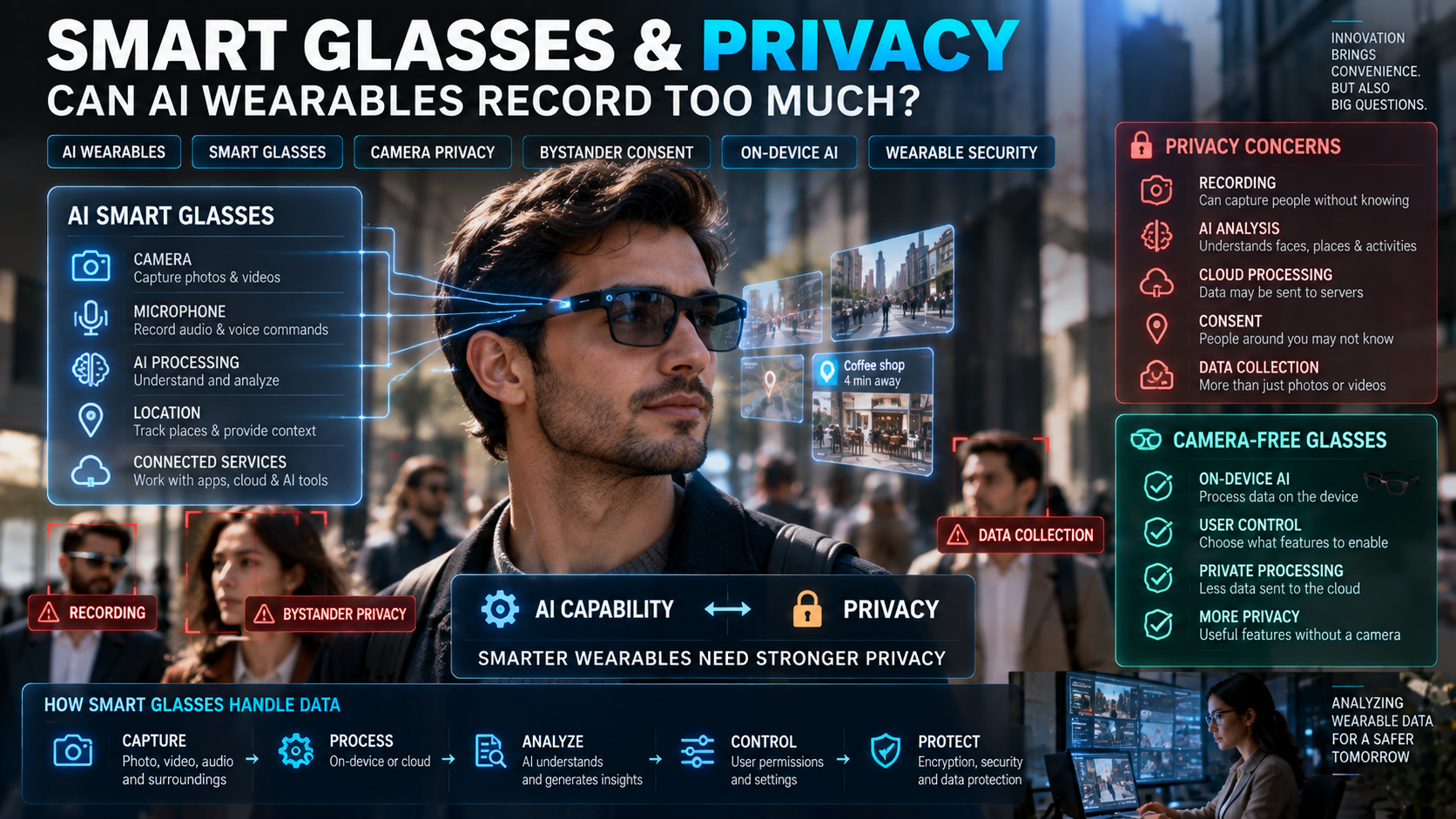
Smart glasses are becoming one of the most interesting wearable technologies of 2026. Unlike traditional glasses, they can include cameras, microphones, speakers, sensors and AI features that allow users to interact with technology without constantly using a smartphone.
AI-powered smart glasses can answer questions, take photos, translate text, provide directions, make calls and understand parts of the user’s surroundings. But these features also create an important question: Can smart glasses collect too much information about the people and places around us?
Privacy concerns are growing as smart glasses become more common. Recent reporting has highlighted concerns about recording without clear consent, workplace use and how information captured by AI wearables is processed.
What Are AI Smart Glasses?
AI smart glasses are wearable devices that combine normal eyewear with technologies such as cameras, microphones, speakers, sensors and artificial intelligence.
Instead of taking out a smartphone for every small task, users can interact with an AI assistant directly through their glasses.
For example, a user could ask the glasses to:
- Translate a sign
- Take a photo
- Answer a question
- Give directions
- Make a phone call
- Identify an object
- Read information
- Set a reminder
- Provide information about the user’s surroundings
This makes smart glasses more than just another wearable device. They are increasingly being designed as a hands-free AI interface.
Why Are Smart Glasses Becoming Popular?
One major reason is convenience.
A smartphone requires users to look at a screen and physically interact with an application. Smart glasses can potentially provide information through voice, audio or visual overlays while the user continues doing something else.
For example, someone walking through a new city could ask for directions without constantly checking a phone. A traveler could use AI translation while looking at a sign, while a professional could use hands-free information during work.
This move toward more natural, hands-free computing is one reason companies are investing heavily in smart glasses and AI wearables.
Can Smart Glasses Record People Without Them Knowing?
This is one of the biggest privacy concerns surrounding camera-equipped smart glasses.
A smartphone camera is usually obvious because the user has to hold the phone and point it at something. Smart glasses can look much more like ordinary eyewear, making recording less obvious to people nearby.
This creates a difficult question: Does a small recording indicator provide enough notice to people who may appear in the video?
Recent scrutiny in countries including France has focused on privacy, harassment and the difficulty of informing people when camera-equipped smart glasses are being used around them.
The issue becomes even more complicated when recorded content is later uploaded, analyzed or shared.
What Information Can AI Wearables Collect?
Smart glasses can potentially collect several different types of information depending on their hardware and software.
Camera Data
Camera-equipped glasses can capture photos and videos of the surrounding environment.
Audio Data
Microphones can process voice commands and, depending on the device and feature being used, surrounding sounds.
Location Data
Connected devices can potentially use location information for navigation and contextual features.
AI Interaction Data
Questions asked to an AI assistant and the responses generated by the system can also become part of the service’s data processing.
Environmental Information
AI can potentially analyze objects, signs, text and other parts of the user’s surroundings.
The privacy question therefore goes beyond “Can these glasses record?” It also becomes “What happens to the information after it is collected?”
Where Does Smart Glass Data Go?
This depends on the device and its software architecture.
Some processing can happen directly on the glasses or a connected smartphone. Other features may require cloud-based processing.
A simplified data journey could look like this:
Capture → Process → Analyze → Store or Delete → Generate AI Response
If information is sent to cloud servers, users need to understand how that information is protected, how long it is retained and who can access it.
This is why privacy policies, permissions, encryption, data retention and deletion controls are important parts of wearable technology.
Can AI Make Smart Glass Privacy Concerns Bigger?
AI can make wearable technology more useful, but it can also make privacy questions more complicated.
A camera simply capturing a video is one thing. An AI system that can analyze what the camera sees introduces another layer.
For example, AI may be able to recognize objects, read text, understand scenes or provide information based on visual input.
That creates a bigger question:
Are smart glasses simply recording the world, or are they continuously understanding the world around the user?
The more capable AI becomes, the more important transparency and user control become.
What About Bystander Privacy?
Bystander privacy means protecting people who are near the person using the wearable.
Imagine someone sitting in a café, working in an office or walking through a public area while another person is wearing camera-equipped smart glasses.
The person being recorded may not know:
- Whether the camera is active
- When recording started
- Whether audio is being captured
- Where the information will be stored
- Whether AI is analyzing the recording
- Whether the content could be shared
Recent privacy discussions around smart glasses have focused heavily on consent and awareness, particularly because people appearing in recordings may not have chosen to participate.
Are Recording Lights Enough?
Many camera-equipped smart glasses use a visible indicator to show that recording is taking place.
This is intended to make recording more noticeable.
However, privacy experts and critics have questioned whether a small light is enough to provide meaningful consent, especially in busy environments.
A person might see the indicator but still not know:
- What is being recorded
- Who will receive the recording
- Whether AI is analyzing it
- How long it will be stored
This is why future wearable designs may need stronger privacy controls instead of relying on a single indicator light.
Could Camera-Free Smart Glasses Improve Privacy?
One possible solution is to remove the camera.
Recent reporting says Meta has been developing a camera-free version of its smart glasses as privacy concerns around camera-equipped wearables increase. Other companies are also exploring camera-free glasses and devices designed around more deliberate recording controls.
Camera-free glasses could still provide features such as:
- Voice interaction
- Audio assistance
- Notifications
- AI responses
- Navigation
- Music
- Calls
Removing the camera would not eliminate every privacy concern, but it could reduce the risk of unwanted visual recording.
Can On-Device AI Protect Privacy?
Another possible solution is on-device AI.
Instead of sending every piece of information to a remote server, some AI processing can happen directly on the device or a connected smartphone.
The basic idea is:
Camera/Sensor → Local AI → Result
instead of:
Camera/Sensor → Cloud → AI Processing → Result
Local processing can reduce unnecessary data transmission, although it does not automatically guarantee privacy.
The actual protection depends on the device’s security design, software permissions, data storage and other privacy controls.
What Should You Check Before Buying AI Smart Glasses?
Consumers should look at more than design, battery life and AI features.
Before buying smart glasses, check:
- Does the device have a camera?
- Does it have microphones?
- How is recording indicated?
- Can recording be disabled?
- Does AI processing happen locally?
- Is cloud processing required?
- What information is stored?
- How long is data retained?
- Can users delete their information?
- What permissions does the companion app require?
- Which third-party services can access the data?
- Does the manufacturer provide clear privacy controls?
Understanding these details can help users make better decisions about wearable technology.
What Is the Future of Smart Glasses Privacy?
The future of smart glasses will depend on finding a balance between usefulness and privacy.
Manufacturers may increasingly explore:
- Camera-free smart glasses
- Better recording indicators
- User-controlled recording
- On-device AI processing
- Stronger encryption
- Shorter data retention
- Better permission controls
- Clearer privacy settings
- Bystander-friendly recording features
- Enterprise policies for workplaces
The industry is also experimenting with different wearable designs as companies try to make AI devices more useful without making users feel that they are constantly being watched or recorded.
Smart Glasses vs Privacy: What Is the Real Challenge?
The biggest challenge is not necessarily the camera itself.
The real challenge is the combination of camera + microphone + AI + connectivity + cloud services.
When these technologies work together, smart glasses can understand much more about the user’s surroundings than traditional wearable devices.
That creates both opportunities and risks.
For consumers, convenience may be the biggest advantage. For privacy, transparency and control may be the biggest requirements.
Can AI Wearables Record Too Much?
Yes, AI wearables can create significant privacy concerns, especially when they include cameras, microphones and cloud-connected AI services.
However, the level of risk depends on how a particular device works, what information it collects, how that information is processed and what controls users and bystanders have.
Smart glasses could eventually become an important new computing platform, but widespread adoption may depend on public trust.
The future of smart glasses may therefore not be determined only by how intelligent they become, but also by how responsibly they handle the people around them.
Conclusion
Smart glasses are moving technology closer to our eyes, ears and everyday surroundings. AI can make these devices extremely useful by providing hands-free assistance, translation, navigation, information and automation.
But greater awareness of our surroundings also means greater responsibility for privacy.
The next generation of smart glasses will likely need to focus on more than powerful AI. Privacy, transparency, consent, security and user control could become just as important as cameras, battery life and AI performance.
