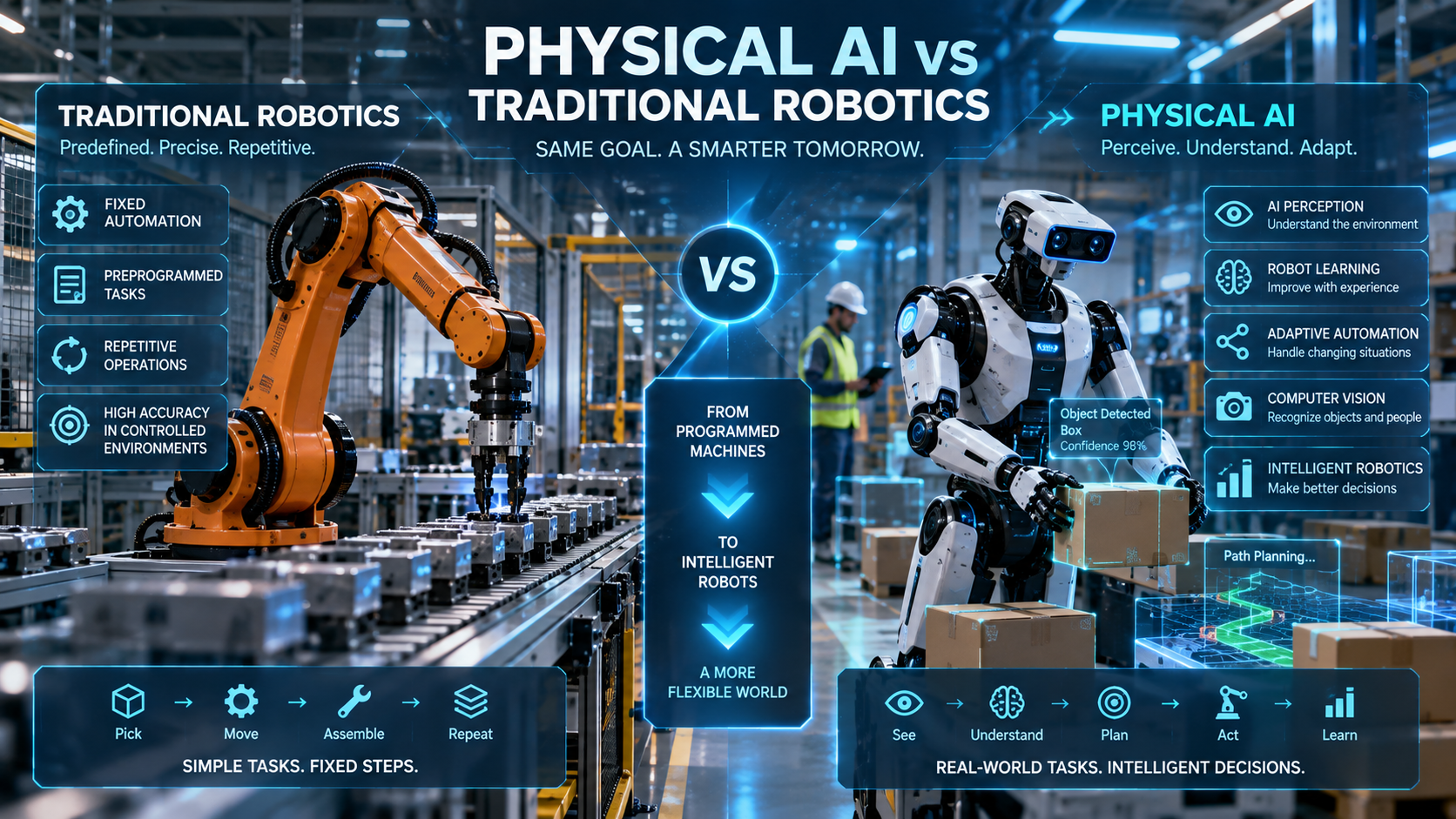
Robots have been used in factories, warehouses, hospitals, and other industries for many years. Traditional robots are very good at doing repetitive tasks quickly and accurately.
But robotics is changing. Artificial intelligence is now being combined with robots to help machines understand their surroundings, recognize objects, make decisions, and respond to changes.
This new approach is often called Physical AI.
So, what is the difference between Physical AI and traditional robotics? The simple answer is that traditional robots mainly follow programmed instructions, while Physical AI aims to make robots more aware, flexible, and capable of adapting to the real world.
What Is Traditional Robotics?
Traditional robotics is based mainly on predefined instructions.
For example, a robotic arm in a factory may be programmed to pick up a product, move it to another location, and place it there. It can repeat the same process thousands of times with high accuracy.
This works very well when the environment stays the same.
However, if the product moves to a different position or the task changes, the robot may need new programming or adjustments.
What Is Physical AI?
Physical AI brings artificial intelligence into physical machines.
Instead of only following fixed instructions, a Physical AI system can use cameras, sensors, AI models, and software to understand what is happening around the robot.
For example, instead of programming every movement, a worker could give a robot a higher-level instruction such as:
“Pick up the box and place it on the shelf.”
The system can then identify the box, understand where it is, plan a movement, and control the robot.
Physical AI is therefore focused on helping machines perceive, understand, decide, and act in the physical world.
What Is the Main Difference Between Physical AI and Traditional Robotics?
The biggest difference is adaptability.
Traditional robots are usually designed for specific tasks and controlled environments.
Physical AI aims to make robots more flexible so they can handle changes in their surroundings.
For example, a traditional robot may expect a product to always appear in the same location. An AI-powered robot could potentially use vision to find the product even when its position changes.
This does not mean that Physical AI can solve every robotics problem today. Many advanced capabilities are still developing.
How Does Traditional Robotics Work?
Traditional robotics usually follows a simple process:
Programming → Movement → Task → Repeat
Engineers define what the robot needs to do.
The robot then follows those instructions repeatedly.
For example:
- Move the robotic arm.
- Rotate the arm.
- Close the gripper.
- Pick up the object.
- Move to another position.
- Release the object.
This approach is highly useful when the task is predictable.
How Does Physical AI Work?
Physical AI adds another layer of intelligence.
A simplified process looks like this:
Sense → Understand → Decide → Act → Learn
The robot first collects information through sensors and cameras.
AI then processes this information and helps the robot understand the environment.
The system decides what action should be taken and the robot performs that action.
This approach can make automation more flexible, especially when the environment is not completely predictable.
Why Is Robot Vision Important?
One of the biggest changes in modern robotics is the improvement of computer vision.
Traditional robots may depend heavily on fixed positions and carefully controlled environments.
AI-powered robots can use cameras and other sensors to identify objects, people, obstacles, and changes in their surroundings.
For example, a warehouse robot could use vision to identify different packages instead of expecting every package to be positioned exactly the same way.
Modern Physical AI systems are increasingly combining perception with movement and manipulation.
Can Physical AI Help Robots Make Decisions?
Yes, decision-making is an important part of Physical AI.
A traditional robot might be told exactly what movement to make.
A Physical AI system can instead receive a goal and determine a sequence of actions that could achieve it.
For example:
Traditional Robotics:
“Move the arm 20 cm to the left.”
Physical AI:
“Pick up the red container.”
The second instruction is more general. The robot needs to understand the environment before deciding how to complete the task.
Can Robots Understand Human Language?
AI is also changing how people may interact with robots.
Instead of using complicated programming commands, future robots could understand more natural instructions.
For example:
“Move these boxes to the storage area.”
An AI system could interpret the instruction and convert it into a series of physical actions.
The International Federation of Robotics identifies natural-language and vision-based interaction as part of the broader AI-driven shift in robotics.
What Role Does Machine Learning Play?
Machine learning allows computers to learn patterns from data.
In robotics, this can help systems learn how to recognize objects, move around environments, or perform certain physical tasks.
For example, a robot can potentially learn how to pick up objects with different shapes rather than relying on one fixed movement.
This can make robots more flexible.
However, robots still require extensive training, testing, and safety controls before they can reliably perform difficult tasks in the real world.
What Is Robot Simulation?
Training a physical robot directly can be expensive and time-consuming.
Simulation provides a virtual environment where robots can practice tasks.
A developer can create a virtual factory or warehouse and allow a robot to practice different movements.
The robot can then be tested before being deployed in the real world.
Simulation is becoming an important part of Physical AI because it can help generate training experience and test robot behavior.
What Are World Models in Physical AI?
A world model is an AI system that attempts to understand how the physical environment works.
For a robot, this could involve understanding:
- Where objects are located.
- How objects can move.
- What may happen after an action.
- How people and objects interact.
- Which action could achieve a particular goal.
The long-term goal is to help robots understand not only what they see but also what could happen when they interact with the environment.
However, advanced physical reasoning remains a difficult research problem. BCG’s 2026 analysis distinguishes current perception and manipulation capabilities from more advanced reasoning that is still largely aspirational.
How Is Physical AI Changing Manufacturing?
Manufacturing has traditionally been one of the biggest users of robotics.
Traditional robotic arms are excellent at repetitive operations such as welding, painting, assembly, and material handling.
Physical AI could expand automation into tasks where products, objects, or production conditions change more frequently.
AI-powered robots could potentially identify different products, adjust their movements, inspect items, and respond to unexpected situations.
This could make factory automation more flexible.
How Is Physical AI Changing Warehouses?
Warehouses contain constantly changing objects and layouts.
Packages can have different shapes, sizes, and positions.
Traditional automation works well for predictable warehouse operations, but more flexible AI-powered robots could help with tasks such as picking, sorting, navigation, and handling different products.
Logistics and warehousing are among the areas currently highlighted for AI-powered robotics because their environments can be structured enough for practical deployment while still benefiting from greater flexibility.
Are Humanoid Robots Part of Physical AI?
Humanoid robots are one example of where Physical AI is being developed.
These robots have a human-like body with arms, legs, cameras, sensors, and other hardware.
The idea is that a human-shaped robot could operate in environments already designed for people.
For example, it could potentially use stairs, doors, shelves, tools, and workstations.
However, a humanoid body alone does not make a robot intelligent. The robot still needs advanced perception, movement, planning, safety, and AI capabilities.
Physical AI vs Traditional Robotics: Simple Comparison
| Traditional Robotics | Physical AI |
|---|---|
| Uses predefined instructions | Uses AI to interpret situations |
| Best for predictable tasks | Designed for more variable tasks |
| Often requires manual reprogramming | Aims for greater adaptability |
| Limited perception | Uses advanced vision and sensors |
| Fixed workflows | Can work toward higher-level goals |
| Repetitive automation | More flexible automation |
| Strong in controlled environments | Designed to handle more complex environments |
The two approaches are not necessarily competitors. In many factories, they can work together.
Does Physical AI Replace Traditional Robots?
Not necessarily.
Traditional robots are already highly effective for many industrial tasks.
If a factory needs a robot to perform the same movement thousands of times, a traditional robotic system can be extremely efficient.
Physical AI becomes more useful when the task requires greater flexibility, perception, or adaptation.
The future may therefore involve traditional automation and Physical AI working together.
What Are the Benefits of Physical AI?
More Flexible Robots
Physical AI can help robots deal with different objects and changing environments.
Better Object Recognition
AI-powered vision can help robots identify objects and understand their positions.
Less Fixed Programming
Higher-level instructions could reduce the need to manually define every movement.
Better Human-Robot Interaction
Natural language and visual inputs can make robot interaction easier.
More Automation Opportunities
Physical AI could make some tasks that were previously difficult to automate more practical.
What Are the Challenges of Physical AI?
Physical AI is still developing and has several challenges.
Safety
A mistake made by a physical robot can cause damage or injury. Safety systems are therefore extremely important.
Reliability
A robot must work correctly again and again, not just demonstrate a task successfully once.
Training Data
Robots need large amounts of useful physical-world data to improve their capabilities.
Cost
Advanced robots require hardware, sensors, computing power, software, and engineering.
Real-World Complexity
The physical world is unpredictable. Objects can move, people can appear unexpectedly, and environments can change.
Because of these challenges, current Physical AI systems should not be viewed as completely general-purpose robots. Industry research continues to distinguish between capabilities that are already deployable and more advanced capabilities that remain under development.
Will Physical AI Make Robots More Autonomous?
Physical AI is moving robotics toward greater autonomy.
Traditional automation generally tells the robot exactly what to do.
Physical AI aims to let robots understand goals, interpret their surroundings, and select appropriate actions within defined limits.
The International Federation of Robotics lists AI and autonomy among the major robotics trends for 2026.
However, greater autonomy does not mean that humans will disappear from the process. Human supervision, safety controls, maintenance, and system management remain important.
Why Is Physical AI Becoming Important in 2026?
AI is developing quickly, while robotics hardware is also becoming more capable.
Modern cameras, sensors, processors, simulation systems, machine-learning models, and robotic hardware can now work together more closely.
This is creating a new direction for robotics where software intelligence becomes an increasingly important part of physical machines.
The International Federation of Robotics identifies AI-powered autonomy, IT/OT convergence, humanoid testing, labor needs, and safety and cybersecurity as major robotics trends for 2026.
What Could the Future of Robotics Look Like?
The future of robotics may not be about replacing every traditional robot with an AI-powered machine.
Instead, different types of robots may be used for different jobs.
Traditional robots could continue handling highly repetitive tasks.
Physical AI robots could handle tasks that require perception and flexibility.
Humans could supervise systems, solve complex problems, and manage situations that robots cannot handle.
This combination could create more flexible and intelligent automation.
Physical AI vs Traditional Robotics: What Has Changed?
The biggest change is the move from fixed instructions to more intelligent and adaptive automation.
Traditional robotics focuses heavily on precision, repeatability, and predefined movements.
Physical AI adds technologies such as AI, computer vision, sensors, machine learning, simulation, and intelligent planning.
The goal is to help robots understand their surroundings and respond to changing situations.
Physical AI is not a complete replacement for traditional robotics. Instead, it represents a new direction where robots can potentially become more flexible, intelligent, and capable of working in less predictable environments.
Conclusion
Physical AI is changing the way we think about robots.
Traditional robots are excellent at repetitive and predictable tasks. Physical AI aims to give robots a better understanding of the physical world so they can perceive their surroundings, make decisions, and adapt to different situations.
The technology is still developing, and many advanced capabilities remain challenging.
But the direction is clear: robotics is moving from simple programmed machines toward systems that combine AI + sensors + vision + learning + physical action.
This could make the next generation of robots more flexible and useful across factories, warehouses, healthcare, agriculture, logistics, and other industries.
