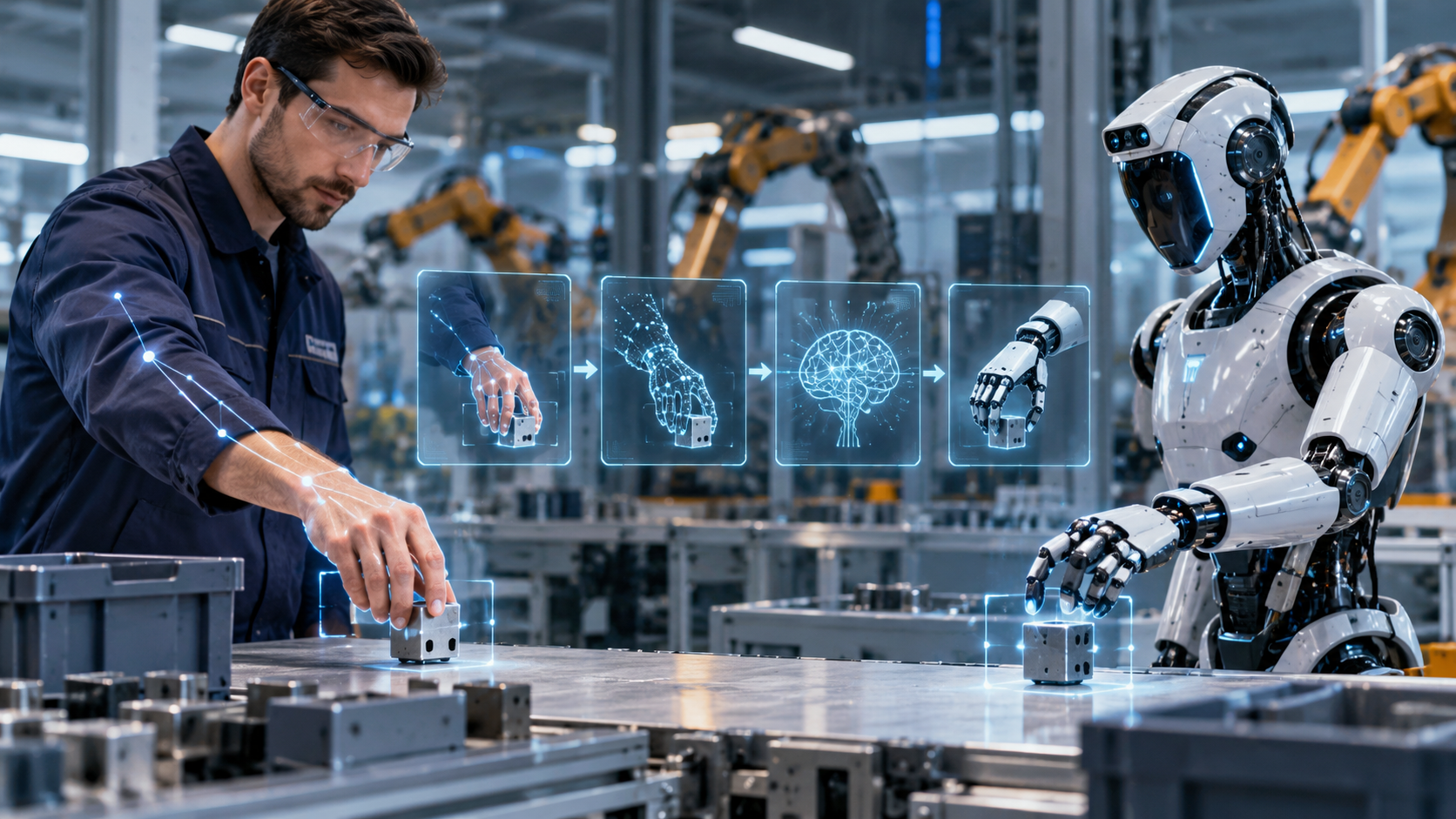
Robots are becoming smarter than ever. In the past, robots had to be programmed carefully to perform almost every task. Today, artificial intelligence is changing the way robots learn. Instead of programming every movement, researchers are developing robots that can learn by watching humans perform tasks.
This new approach could make robots easier to train, more flexible, and better suited for real-world environments such as factories, warehouses, hospitals, farms, and homes.
What Does It Mean When a Robot Learns by Watching Humans?
When we say a robot can learn by watching humans, it does not mean the robot simply watches a video and automatically becomes an expert.
The robot uses cameras, sensors, and artificial intelligence to observe what a person is doing. AI systems then analyze the person’s movements, the objects involved, and the steps required to complete the task.
For example, a person could demonstrate how to pick up an object and place it into a box. The robot can study that demonstration and learn how the task should be performed.
This is different from traditional robot programming because engineers do not necessarily need to define every individual movement manually.
How Do Robots Learn From Humans?
Several technologies work together to make this possible.
First, cameras and sensors help the robot understand its surroundings. The robot can identify objects, detect movement, and understand where things are located.
Next, artificial intelligence and machine learning help the robot identify patterns in the demonstration. The system can learn which actions are connected to specific results.
Another important technology is imitation learning. In simple terms, the robot tries to copy actions demonstrated by a human.
The robot can then use feedback to improve. If an action does not work correctly, AI systems can help the robot adjust its behavior and try again.
Traditional Robot Programming vs AI-Based Learning
Traditional industrial robots are usually programmed to follow specific instructions. This works very well when the environment and tasks remain predictable.
However, programming a robot for every new task can take time and require specialized knowledge.
AI-based robot learning offers a different approach. Instead of manually programming every movement, humans can demonstrate a task and allow the robot’s AI system to learn from that example.
This could make robot training faster and more flexible, especially when robots need to perform many different tasks.
What Is Imitation Learning in Robotics?
Imitation learning is one of the key ideas behind robots learning from humans.
The basic concept is simple: the robot observes how a human completes a task and tries to learn the same behavior.
Imagine teaching a robot to pick up a cup. A person demonstrates the action several times. The robot observes the movement, understands the position of the cup, and learns how the hand and arm move toward it.
With enough training, the robot can attempt the same task on its own.
The goal is not simply to copy one movement. The robot needs to learn the relationship between the environment, the object, the action, and the desired result.
The Role of Physical AI
This technology is closely connected to the growing field of Physical AI.
Traditional AI mainly works with digital information such as text, images, audio, and data. Physical AI focuses on AI systems that can understand and interact with the real world.
For robots, this means combining AI with cameras, sensors, motors, and other hardware.
A robot needs to see what is happening, understand the situation, make a decision, and physically perform an action.
In the future, this could allow robots to learn new physical skills in a way that is much closer to how humans learn.
Where Can These Robots Be Used?
Robots that learn from demonstrations could have applications across many industries.
Manufacturing
Factories could use robots to learn assembly, inspection, packaging, and material-handling tasks.
Instead of creating a completely new program for every small change, workers could potentially demonstrate the required process to the robot.
Warehouses
Warehouses contain thousands of different products and constantly changing tasks.
AI-powered robots could learn how to pick, move, sort, and package different items while adapting to changes in their environment.
Healthcare
Robots could potentially assist healthcare workers with repetitive physical activities, such as moving equipment or delivering supplies.
Because safety is extremely important in healthcare, these systems would require extensive testing and strict controls before being widely deployed.
Agriculture
Agricultural robots could learn tasks such as identifying crops, picking produce, and handling agricultural products.
The ability to adapt to different plants, environments, and conditions could be especially useful in modern farming.
Homes
In the long term, household robots could learn tasks by watching people.
For example, a person might demonstrate how to organize objects, clean a particular area, or use a household appliance.
This could make future home robots more useful because they would not need to be programmed separately for every household.
Why Is This Technology Important?
One of the biggest challenges in robotics is training robots for real-world situations.
A robot may perform perfectly in a controlled environment but struggle when something unexpected happens.
Humans are naturally good at adapting. If an object moves, changes shape, or is placed somewhere slightly differently, we can usually adjust without thinking about it.
Robots need AI systems that can develop similar flexibility.
Learning from human demonstrations could help robots understand a wider range of situations and become more adaptable.
Robots Still Have Many Challenges
Although the technology is promising, robots are still far from learning everything as easily as humans.
Robots need large amounts of high-quality training data. They also need powerful AI models and sensors that can accurately understand the physical world.
Safety is another major concern. A robot working around humans must understand its surroundings and respond safely when something unexpected happens.
Another challenge is generalization. A robot may learn how to perform a task in one environment but struggle when the same task is moved to a different location or involves a different object.
Researchers are working to make robots better at handling these changes.
Will Robots Replace Human Workers?
The rise of learning robots does not automatically mean that robots will replace humans.
In many industries, robots are more likely to work alongside people and handle repetitive, physically demanding, or dangerous tasks.
Humans can continue to focus on areas that require creativity, communication, judgment, and complex decision-making.
The future may therefore be less about humans versus robots and more about humans working together with intelligent robots.
What Could the Future of Robot Training Look Like?
Robot training could become much more natural in the coming years.
Instead of engineers spending weeks creating detailed instructions, a worker might demonstrate a task and allow the robot to learn from that demonstration.
Robots could also learn from videos, simulations, virtual environments, teleoperation, and their own experiences.
As AI models and robotic hardware continue to improve, robots could become capable of learning multiple skills and adapting them to new situations.
The Future: Teaching Robots Instead of Programming Them
The biggest change in robotics may be the shift from programming every action to teaching robots how to perform tasks.
A human could show a robot what needs to be done, while AI determines how to perform the task safely and efficiently.
This approach could make robots more flexible and easier to deploy across factories, warehouses, farms, hospitals, and eventually homes.
Robots that learn by watching humans are still an evolving technology, but they represent an important step toward a future where machines can understand, learn, and interact with the physical world more naturally.
