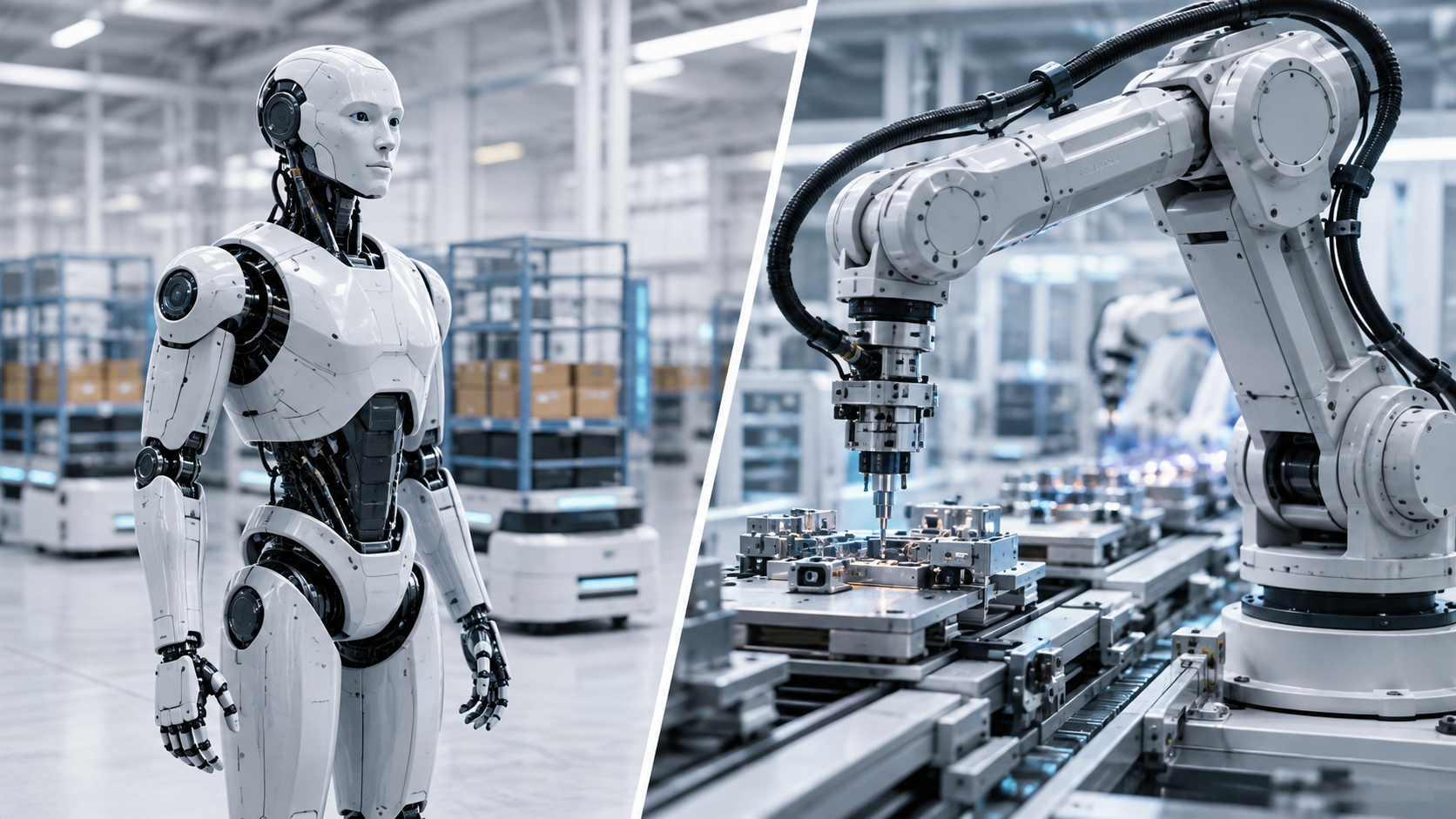
Robots are becoming an important part of modern industries. They are helping companies manufacture products, move materials, inspect machines, and complete repetitive tasks faster and more accurately. But robotics is now entering a new stage with the development of humanoid robots.
Humanoid robots are designed to look and move somewhat like humans, while industrial robots are usually built for one specific job. This raises an important question: Will humanoid robots replace traditional industrial robots, or will both technologies have a place in the future?
The answer is more complicated than simply choosing one. Humanoid and industrial robots are designed for different purposes, and each has its own advantages.
What Are Humanoid Robots?
Humanoid robots are machines designed with a human-like body structure. Many have two arms, two legs, a head, and sensors that help them understand their surroundings.
The main idea behind humanoid robots is flexibility. Because they are designed to move through spaces created for humans, they could potentially perform different tasks without requiring major changes to the workplace.
For example, a humanoid robot could potentially pick up objects, carry boxes, use tools, move between workstations, and perform simple physical tasks. Artificial intelligence can help these robots understand their environment and decide how to respond to different situations.
What Are Industrial Robots?
Industrial robots are specialized machines designed to perform specific tasks in factories and other industrial environments. They have been used in manufacturing for decades and are already highly reliable.
A common example is a robotic arm used in automobile manufacturing. It may repeatedly weld, paint, assemble, or move parts thousands of times with very high accuracy.
Industrial robots are usually designed around a particular task. This makes them extremely effective when the work is repetitive and the environment is predictable.
The Biggest Difference Between the Two
The biggest difference is flexibility versus specialization.
Humanoid robots are being developed to perform a wider variety of tasks. They may be useful in environments where conditions change frequently and where humans already work.
Industrial robots, on the other hand, are designed to perform specific jobs extremely well. They can be faster, more precise, and more efficient when they are working on a task they were specifically designed for.
In simple terms, think of a humanoid robot as a multi-purpose worker and an industrial robot as a specialist.
Why Are Humanoid Robots Getting So Much Attention?
Humanoid robots are receiving increasing attention because robotics is becoming closely connected with artificial intelligence.
Traditional robots generally follow predefined instructions. Modern AI-powered robots are being developed to understand images, objects, environments, and instructions more intelligently.
Technologies such as computer vision, machine learning, robot learning, and Physical AI could allow future robots to perform tasks that were previously difficult to automate.
This could make humanoid robots useful for jobs where traditional automation is difficult or too expensive to redesign.
Why Industrial Robots Are Still Important
The rise of humanoid robots does not mean industrial robots are becoming outdated.
Industrial robots are already very good at repetitive manufacturing tasks. They can work continuously, maintain consistent performance, and perform precise movements at high speed.
For example, if a factory needs to weld the same component thousands of times, a specialized welding robot can be an excellent solution. There may be no reason to use a humanoid robot for such a predictable task.
This is why industrial robots are likely to remain an important part of manufacturing for many years.
Where Humanoid Robots Could Be Better
Humanoid robots could become especially useful in environments that are difficult to automate using traditional machines.
Imagine a warehouse where workers need to pick up different products, carry packages, use tools, open doors, and move between different areas.
A specialized machine may be excellent at one of these jobs but not the others. A humanoid robot could potentially perform several different tasks using the same basic hardware.
This flexibility is one of the biggest reasons companies are exploring general-purpose humanoid robots.
Where Industrial Robots Have the Advantage
Industrial robots have a major advantage when the job is repetitive, predictable, and highly specialized.
They can be designed specifically for tasks such as welding, painting, packaging, assembly, and material handling.
Because the robot does not need to perform many different tasks, engineers can optimize it for speed, precision, and reliability.
For highly structured factories, this specialization can make industrial robots more practical and cost-effective than general-purpose humanoid robots.
Can Humanoid Robots Replace Industrial Robots?
It is unlikely that humanoid robots will completely replace industrial robots.
Instead, the two technologies are more likely to work alongside each other.
Industrial robots can continue handling highly repetitive production tasks, while humanoid robots could take on more flexible physical work.
For example, a factory might use robotic arms for welding and assembly while using humanoid robots for moving materials, handling different objects, or performing tasks that require more flexibility.
The future of robotics may therefore be about choosing the right robot for the right job.
Humanoid Robots and AI
Artificial intelligence could become one of the most important technologies behind humanoid robots.
AI can help robots recognize objects, understand their surroundings, interpret instructions, and make decisions based on changing conditions.
Instead of simply following a fixed sequence of movements, future robots could potentially understand what needs to be done and determine how to complete the task.
This combination of AI and robotics is often connected with the idea of Physical AI, where intelligent software can interact with and control physical machines.
The Role of Human-Robot Collaboration
The future of robotics will not necessarily be about robots replacing every human worker.
A more realistic future is one where humans and robots work together.
Humans can handle decision-making, creativity, communication, and unexpected situations, while robots can handle repetitive, physically demanding, or dangerous tasks.
Humanoid robots could become useful assistants in workplaces, while industrial robots continue operating behind the scenes in highly automated production systems.
Which Has the Bigger Future?
There is no single winner.
Industrial robots have a strong future because modern manufacturing depends on reliable and highly specialized automation. Their technology is mature, proven, and highly efficient for repetitive tasks.
Humanoid robots have a potentially larger long-term opportunity because they could bring automation to environments that were previously difficult to automate.
The important difference is that industrial robots are primarily about specialization, while humanoid robots are aiming for general-purpose flexibility.
The Future Could Include Both
The future of robotics is unlikely to be a competition where one type of robot completely replaces the other.
Instead, factories, warehouses, hospitals, construction sites, and other workplaces could use different robots for different purposes.
Industrial robots could handle precision manufacturing. Humanoid robots could perform flexible physical tasks. AI systems could coordinate operations, and humans could supervise and make important decisions.
Together, these technologies could create a new generation of intelligent automation.
Conclusion
Humanoid robots and industrial robots have different strengths. Industrial robots are excellent at repetitive, precise, and specialized work, while humanoid robots are being developed to handle a wider range of tasks in environments designed for people.
Humanoid robotics still has challenges to overcome, including cost, safety, reliability, battery life, and the ability to perform complex tasks consistently. However, advances in artificial intelligence and Physical AI could make these robots increasingly useful.
Rather than asking “Which robot will win?”, the better question may be “How will different types of robots work together?”
The future of automation will likely include both humanoid and industrial robots, each doing the jobs they are best suited for.
