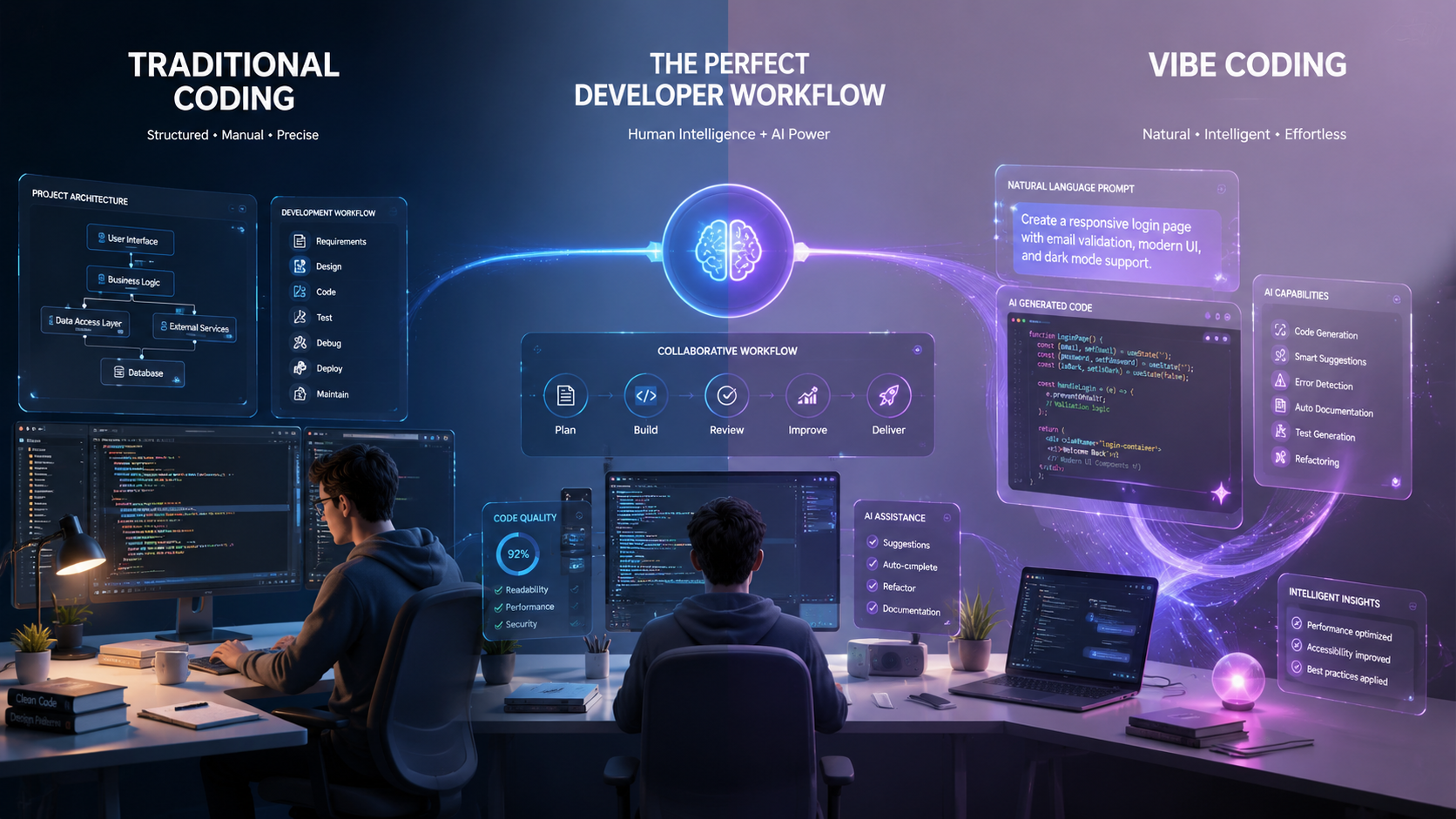
Software development is changing quickly. AI tools can now write code, create UI components, fix errors, generate tests, and even help developers build complete features from simple instructions.
This has led to a new approach called vibe coding.
Instead of writing every line of code manually, developers can describe what they want in normal language and let AI generate much of the implementation.
But does this mean traditional coding is becoming outdated?
Not exactly.
Vibe coding and traditional coding have different strengths. Understanding when to use each approach can help developers work faster without sacrificing code quality.
What Is Vibe Coding?
Vibe coding is a way of building software with the help of AI coding tools.
The basic idea is simple. Instead of manually writing everything, you explain your requirement to an AI tool and it generates code based on your instructions.
For example, a developer could write:
“Create a responsive login page using React and TypeScript with email validation and a password visibility button.”
An AI coding tool can generate the initial code for the page.
The developer can then review it, test it, and ask the AI to make changes.
This makes vibe coding useful when you want to turn an idea into a working prototype quickly.
How Does Vibe Coding Work?
Vibe coding usually starts with a simple description of what you want to build.
You give the AI a prompt explaining the feature, design, or functionality. The AI then generates code based on that description.
After that, the developer checks the result.
If something doesn’t work correctly, the developer can explain the problem to the AI and ask it to fix the issue.
This process can continue until the feature works as expected.
The important thing is that AI does not remove the need for developers. Developers still need to understand the code, test it, and make sure it fits the rest of the application.
What Is Traditional Coding?
Traditional coding is the approach developers have used for decades.
The developer understands the requirements, plans the solution, chooses the right technologies, writes the code, tests it, finds bugs, and maintains the application.
For example, when building a user authentication system, a developer may design the database structure, create API endpoints, implement authentication logic, handle errors, add security protections, and write tests.
The developer has direct control over how the system works.
Traditional coding can take more time, but it gives developers a strong understanding of the application and its architecture.
Vibe Coding vs Traditional Coding
The biggest difference is how the code is created.
With traditional coding, the developer writes most of the implementation manually.
With vibe coding, the developer explains what they want and uses AI to generate or modify the implementation.
Vibe coding can make development much faster, especially for repetitive tasks. Traditional coding gives developers more direct control over the code and architecture.
In real-world development, however, these approaches do not have to compete with each other.
Developers can use both.
Why Developers Are Using Vibe Coding
One of the biggest reasons developers are interested in vibe coding is speed.
AI can generate a basic component or feature in seconds. A task that might normally take a developer an hour can sometimes be completed much faster with AI assistance.
Vibe coding is also useful when experimenting with a new idea.
You can create a basic version of an application, test the idea, and make changes without spending too much time on the first version.
It can also reduce repetitive work.
Tasks such as creating basic forms, CRUD operations, API calls, test cases, and simple UI components can often be accelerated with AI.
Vibe Coding Makes Prototyping Easier
Imagine you have an idea for a new application.
Normally, you may need to spend several hours setting up the project and creating the basic features before you can see the result.
With AI coding tools, you can describe the application and quickly generate an initial version.
This makes it easier to test ideas.
If the idea works, you can continue improving it. If it doesn’t, you haven’t spent weeks building something that nobody needs.
The Problems With Vibe Coding
Vibe coding also has some important limitations.
AI-generated code is not automatically good code.
Sometimes the AI may generate code that works but is poorly structured. It may also introduce unnecessary dependencies, create inefficient logic, or misunderstand the original requirement.
This is why developers should not blindly accept everything AI generates.
The code still needs to be reviewed and tested.
AI Can Make Mistakes
AI coding tools are powerful, but they are not perfect.
An AI may misunderstand a requirement or generate code that works in one situation but fails in another.
For example, an AI-generated API might work correctly for normal input but fail when unexpected data is provided.
A developer needs to identify these problems before the code reaches production.
This is one of the main reasons programming knowledge is still important in the age of AI.
Security Still Matters
Security is another important concern when using AI-generated code.
AI may generate code that looks correct but does not follow the best security practices.
Authentication, authorization, database queries, file uploads, API endpoints, and user input all need careful review.
A developer should always check AI-generated code for possible security problems before using it in a real application.
Can Vibe Coding Replace Developers?
Vibe coding is not likely to completely replace software developers.
Instead, it is changing how developers work.
AI can write code, but developers still need to decide what the software should do and how it should be designed.
Developers also need to understand architecture, databases, security, performance, testing, and business requirements.
In simple words, AI can help build the software, but humans still need to guide the process.
The Developer’s Role Is Changing
In the past, developers spent a large amount of time writing code line by line.
With AI tools, some of that implementation work can be automated.
This means developers can spend more time thinking about architecture, solving difficult problems, reviewing code, understanding business requirements, and improving the overall product.
The skill is slowly shifting from simply writing code to knowing how to use technology and AI effectively.
When Vibe Coding Makes Sense
Vibe coding can be very useful for small projects and quick experiments.
It works well for prototypes, landing pages, UI experiments, personal projects, small scripts, documentation, basic components, and repetitive development tasks.
It is also useful when you want to learn how a particular technology works by experimenting with a working example.
However, the generated code should still be reviewed before it becomes part of a production application.
When Traditional Coding Is Better
Traditional coding becomes more important when the software is complex or security-sensitive.
For example, financial applications, healthcare systems, authentication systems, enterprise applications, and large distributed systems usually require careful architecture and testing.
In these situations, developers need strong control over the code.
AI can still help, but it should work as an assistant rather than blindly making important technical decisions.
The Best Approach Is a Combination
The real future may not be vibe coding vs traditional coding.
It may be a combination of both.
A developer can use AI to create the first version of a feature, then manually review the architecture, improve the code, add proper error handling, write tests, and check security.
This gives developers the speed of AI while keeping human control over important decisions.
For example:
Developer defines the requirement → AI creates the first version → Developer reviews the code → AI helps improve it → Developer tests everything → Feature goes to production
This approach can make development faster without removing engineering discipline.
What Developers Should Learn in the AI Era
AI makes programming easier, but it also makes fundamental knowledge more valuable.
Developers should still understand programming concepts, data structures, APIs, databases, security, system architecture, debugging, testing, and performance.
These skills help developers understand whether AI-generated code is actually correct.
Knowing how to write a good prompt is useful, but knowing how to review and improve the generated code is even more important.
The Future of Software Development
Vibe coding is likely to become another important tool in the modern software development process.
AI will continue to improve at generating code and helping developers complete larger tasks.
However, software still needs human decisions.
Someone needs to understand the business problem, choose the right architecture, protect user data, test the application, and make sure the final product works reliably.
The developers who learn how to combine AI tools with strong software engineering skills will have a major advantage.
Final Thoughts
Vibe coding is changing the way people build software.
It allows developers to describe ideas in simple language and get working code much faster. This can save time and make experimentation easier.
But faster development does not always mean better software.
AI-generated code still needs human review, testing, security checks, and proper architecture.
Traditional coding is not disappearing. Instead, it is becoming part of a larger development workflow where AI handles more of the repetitive work.
The future of software development is likely to be a combination of human creativity, programming knowledge, and AI assistance.
The most valuable skill may not be writing every line of code yourself. It may be knowing what to build, how to explain it to AI, and how to make sure the final software is actually good.
