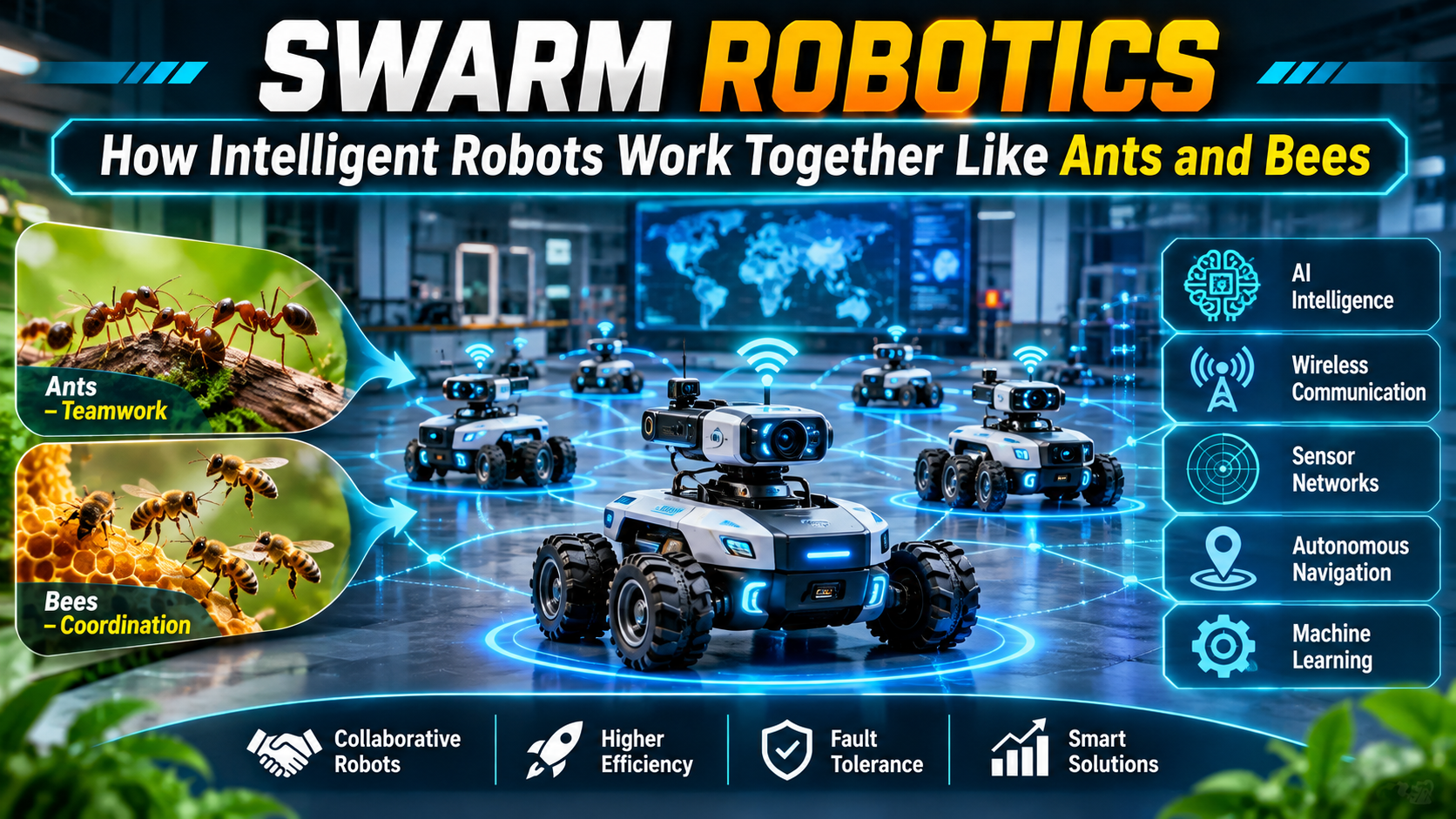
Robotics technology is becoming smarter with the help of Artificial Intelligence (AI) and automation. One interesting development is Swarm Robotics, where multiple small robots work together as a team to complete different tasks. This te
chnology is inspired by social insects such as ants, bees, and termites. Just as these insects work together to find food, build homes, and protect their colonies, swarm robots communicate and cooperate to achieve common goals. Instead of depending on one powerful robot, this technology uses a group of robots that work together.
1. What Is Swarm Robotics?
Swarm Robotics is a technology in which multiple robots work together to perform tasks as a coordinated group. Each robot has its own sensors, control system, and ability to interact with other robots. These robots follow simple rules and share information to complete larger and more complex activities. For example, a group of small robots can work together to explore an unknown area, move objects, or search for people during rescue operations.
2. How Does Swarm Robotics Work?
Swarm Robotics works through cooperation, communication, and coordination between multiple robots. Each robot performs its assigned activity while sharing useful information with nearby robots. They use sensors, cameras, wireless communication, and intelligent software to understand their surroundings. Based on the information they collect, the robots adjust their movements and activities. This allows the entire group to work together without always needing direct instructions from a human operator.
3. How Are Swarm Robots Inspired by Ants and Bees?
Swarm Robotics takes inspiration from the natural behaviour of social insects. Ants work together to find food and create paths that help other ants reach the same location. Similarly, bees communicate through movement and work together to maintain their colonies. Swarm robots use similar ideas of teamwork and shared information. Each robot follows simple instructions, but when many robots work together, they can perform complicated tasks more efficiently.
4. Important Technologies Used in Swarm Robotics
4.1 Artificial Intelligence (AI)
Artificial Intelligence helps robots process information, recognize patterns, and make decisions based on their surroundings. In swarm robotics, AI can help robots coordinate their activities, avoid obstacles, and choose suitable actions while working as a group.
4.2 Sensors and Cameras
Sensors and cameras help swarm robots understand their environment. They can detect nearby objects, identify obstacles, measure distances, and collect useful information. This allows robots to move safely and respond to changes around them.
4.3 Wireless Communication
Wireless communication allows robots to exchange information with other robots in the group. They can share details about their location, movements, and task progress. This communication helps maintain coordination and prevents robots from unnecessarily repeating the same work.
4.4 Autonomous Navigation
Autonomous navigation allows robots to move from one location to another with limited human control. Using sensors, cameras, and intelligent software, robots can identify obstacles and adjust their paths. This feature is useful when robots need to explore large or unfamiliar areas.
4.5 Machine Learning
Machine Learning helps robots improve their performance by learning from collected information and previous activities. It can help a swarm identify better ways to complete tasks, recognize environmental patterns, and improve coordination over time.
5. Real-World Applications of Swarm Robotics
5.1 Disaster Rescue Operations
Swarm robots can be used to explore dangerous areas after earthquakes, building collapses, and other disasters. Multiple small robots can search different locations at the same time and collect information about possible survivors. This can help rescue teams understand difficult environments while reducing the need to send people into unsafe areas.
5.2 Agriculture and Smart Farming
In agriculture, groups of small autonomous robots can help monitor crops, collect field information, identify weeds, and support other farming activities. Working together allows robots to cover larger farming areas and provide useful information to farmers.
5.3 Space Exploration
Swarm Robotics has potential applications in space exploration. Groups of small robots could explore different areas of a planet or moon, collect environmental information, and study difficult-to-reach locations. This approach may help scientists explore large areas more efficiently.
5.4 Warehouse and Industrial Automation
In warehouses and factories, multiple robots can work together to transport materials, move products, and support inventory management. They can coordinate their movements and share tasks to improve operational efficiency and reduce manual work.
5.5 Environmental Monitoring
Swarm robots can help monitor forests, oceans, rivers, and other natural environments. They can collect information about temperature, air quality, water conditions, and environmental changes. This information can support research and help scientists understand environmental problems.
6. Major Benefits of Swarm Robotics
Swarm Robotics offers several advantages compared to systems that depend on a single robot.
- Teamwork: Multiple robots can work together to complete common tasks.
- Scalability: More robots can be added when a task requires additional support.
- Flexibility: Robots can divide activities and adjust their work according to changing conditions.
- Faster Coverage: Multiple robots can explore different areas simultaneously.
- Fault Tolerance: If one robot stops working, the remaining robots may continue performing the task.
- Reduced Human Effort: Robots can handle certain repetitive or dangerous activities with less direct human involvement.
7. Challenges of Swarm Robotics
Although Swarm Robotics offers many benefits, it also has some challenges. Managing a large number of robots can be difficult because every robot needs to coordinate with others. Communication problems may affect teamwork, especially in areas with weak wireless signals. Battery life, maintenance costs, hardware failures, and limited computing power are other important concerns. Designing software that allows hundreds or thousands of robots to work together safely and efficiently is also a major technical challenge.
8. Future of Swarm Robotics
The future of Swarm Robotics is closely connected to developments in Artificial Intelligence, Machine Learning, sensors, and autonomous navigation. Future robot groups may become better at communicating, making decisions, and adapting to changing environments. Researchers are also exploring ways to develop smaller, more energy-efficient robots that can work together in large numbers. As the technology improves, swarm robotics could play an important role in smart factories, agriculture, environmental research, disaster rescue, and space exploration.
Conclusion
Swarm Robotics is an exciting development in modern automation and robotics. Inspired by the teamwork of ants and bees, this technology allows multiple intelligent robots to work together and complete tasks as a coordinated group. From disaster rescue and farming to industrial automation and space exploration, swarm robots have many potential applications. Although challenges such as communication, battery life, and coordination still exist, future developments in AI and robotics could make these systems more capable and useful.
Swarm Robotics shows how a group of small intelligent machines can achieve big results through teamwork, communication, and coordination.
