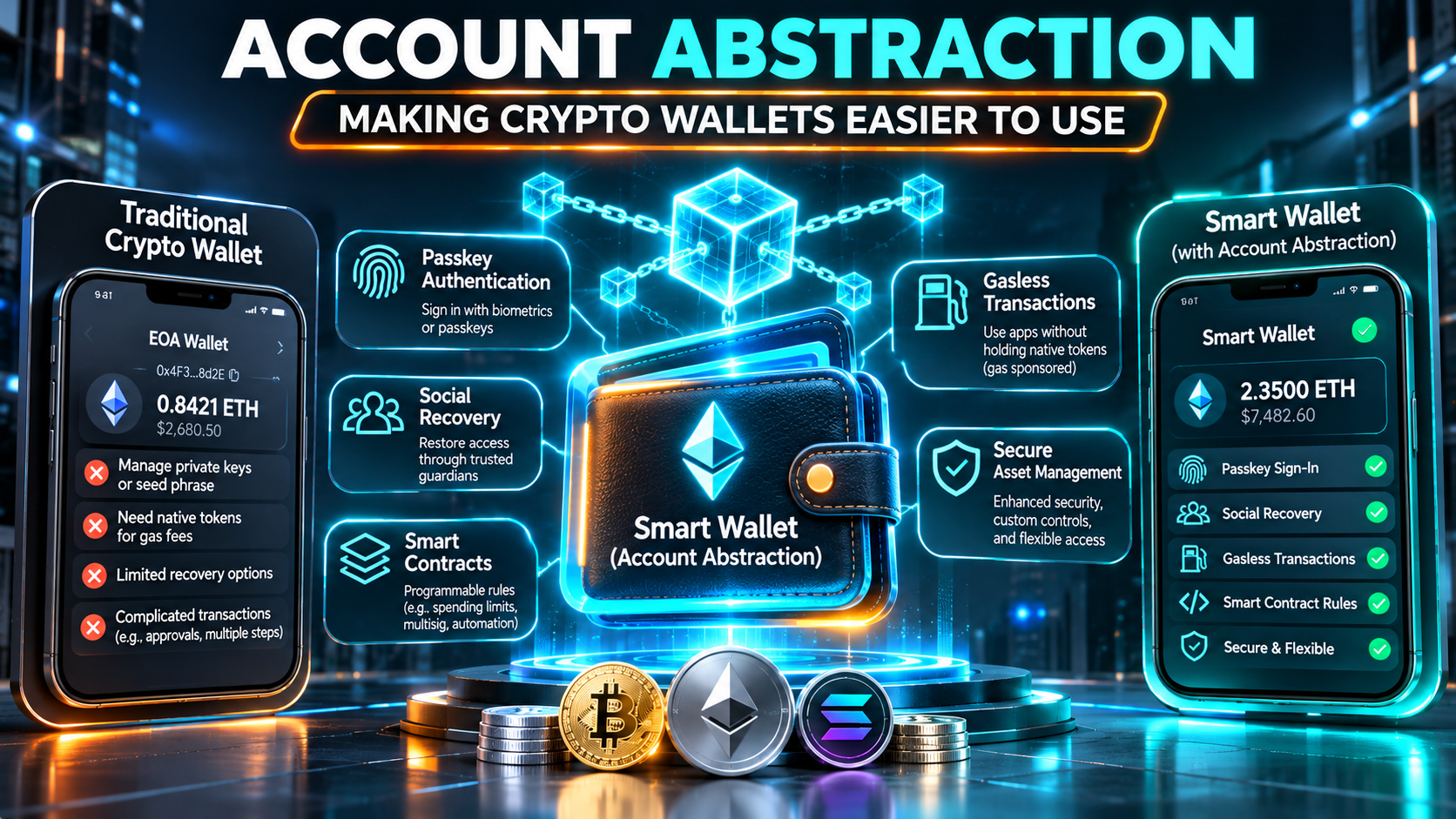
Cryptocurrency and blockchain technology have introduced new ways to manage digital assets, make payments, and interact with decentralised applications. However, despite their technological progress, crypto wallets can still be difficult for beginners to use.
Traditional wallets require users to manage private keys or recovery phrases, pay transaction fees using supported cryptocurrencies, and understand technical processes before performing blockchain transactions.
Losing access to a private key can also create serious problems because recovering a traditional self-custody wallet is often difficult or impossible.
To address these challenges, blockchain developers are introducing a technology known as Account Abstraction.
Account abstraction makes blockchain accounts more programmable by allowing users to customise how transactions are authorised and executed. It can enable features such as social recovery, transaction batching, gas sponsorship, spending limits, and alternative authentication methods.
This technology is helping developers build smarter cryptocurrency wallets and improve the overall Web3 user experience.
But what exactly is account abstraction, how does it work, and why is it important for the future of blockchain technology?
Let’s explore.
What Is Account Abstraction?
Account abstraction is a blockchain concept that makes accounts more flexible by allowing their transaction validation and execution logic to be customised.
In traditional Ethereum-style account systems, externally owned accounts (EOAs) use private keys to authorise transactions. Smart contracts follow programmable rules, but traditional smart contract accounts cannot independently initiate transactions in the same way as EOAs.
Account abstraction helps bridge this gap by enabling smart contract-based accounts to control how transactions are validated and executed.
This means developers can create wallets with customised security rules and user-friendly features.
For example, an account abstraction wallet could allow a user to:
- Sign in using supported biometric or passkey-based authentication.
- Recover wallet access through trusted guardians.
- Set daily transaction spending limits.
- Batch multiple transactions into one operation.
- Receive sponsored transaction fees.
- Require multiple approvals for high-value transfers.
Instead of relying entirely on a single private key and conventional transaction process, smart accounts can implement more flexible security and transaction rules.
What Is the Difference Between Traditional Wallets and Smart Wallets?
To understand account abstraction, it is important to understand the difference between traditional externally owned accounts and smart contract-based accounts.
1. Traditional Crypto Wallets
Traditional Ethereum wallets generally use externally owned accounts (EOAs).
An EOA is controlled by a cryptographic private key. The owner uses this key to sign transactions and prove that they have permission to access the account.
For example, when a user sends cryptocurrency to another wallet, the transaction is signed using the private key and submitted to the blockchain.
Traditional wallets offer direct control over digital assets, but their authentication and transaction processes are relatively limited.
Common characteristics include:
- Private-key-based transaction signing.
- Native cryptocurrency requirements for gas fees.
- Direct transaction submission.
- Limited built-in account recovery options.
- Fixed transaction authorisation mechanisms.
2. Smart Contract Wallets
A smart contract wallet is a blockchain account whose behaviour is controlled by programmable smart contract logic.
Instead of relying exclusively on a single private key, it can implement customised rules for transaction approval and execution.
For example, a smart wallet could require two authorised approvals before transferring a large amount of cryptocurrency.
It could also support social recovery, transaction limits, and sponsored transaction fees when connected to suitable infrastructure.
Account abstraction provides a framework for making these smart accounts easier to use and more widely supported.
How Does Account Abstraction Work?
Account abstraction changes how blockchain transactions are authorised, processed, and executed.
One of the most widely used approaches in the Ethereum ecosystem is ERC-4337.
ERC-4337 introduces a separate transaction-processing system that allows smart contract accounts to operate without requiring changes to Ethereum’s core transaction format.
It uses components such as UserOperations, Bundlers, an EntryPoint contract, and Paymasters.
Here is how the process works.
Step 1: User Creates a Smart Account
The user creates or configures a smart contract wallet.
The wallet can support customised authentication and transaction rules, depending on its implementation.
For example, a user may configure a wallet that supports passkey authentication and recovery through trusted guardians.
Step 2: User Initiates an Operation
When the user wants to send cryptocurrency or interact with a decentralised application, the wallet creates a UserOperation.
A UserOperation is a structured object that describes the requested account operation.
It contains information required for validation and execution, such as the intended action, account details, signature information, and relevant fee parameters.
Step 3: Bundler Receives the UserOperation
A Bundler collects UserOperations and prepares them for blockchain execution.
It checks whether the operations satisfy the required conditions and groups suitable operations into a bundle.
The Bundler then submits the bundle through the EntryPoint contract.
Step 4: EntryPoint Validates the Operation
The EntryPoint contract acts as the central execution mechanism in the ERC-4337 architecture.
It coordinates account validation and execution according to the relevant rules.
The smart account verifies whether the requested operation is authorised.
Step 5: Paymaster May Sponsor Gas Fees
A Paymaster is an optional smart contract component that can sponsor transaction fees or allow users to pay fees through supported alternative arrangements.
For example, a decentralised application could sponsor the gas fees for new users so they can perform their first blockchain transaction without holding the network’s native cryptocurrency.
Step 6: Transaction Is Executed
After validation and fee handling, the smart account executes the requested operation.
The result is recorded on the blockchain according to the network’s execution rules.
This process makes it possible to introduce more flexible wallet experiences without requiring users to understand every technical detail.
Key Components of Account Abstraction
Account abstraction relies on several technical components.
1. Smart Contract Accounts
Smart contract accounts contain programmable rules that determine how transactions are validated and executed.
These rules can support custom authentication, multiple approvals, spending restrictions, and recovery mechanisms.
2. UserOperations
UserOperations represent actions requested by smart account users in the ERC-4337 architecture.
They are different from ordinary Ethereum transactions because they are processed through the account abstraction infrastructure.
3. Bundlers
Bundlers collect UserOperations and submit them to the blockchain through the EntryPoint contract.
They help coordinate transaction processing and may receive compensation for their services.
4. EntryPoint Contract
The EntryPoint contract is a central component of ERC-4337.
It coordinates validation, execution, and relevant fee-handling processes for UserOperations.
5. Paymasters
Paymasters provide flexible gas payment mechanisms.
They can sponsor transaction fees or support alternative payment arrangements according to their implementation and policies.
6. Wallet Authentication and Recovery Logic
Smart accounts can implement different authentication methods and recovery procedures.
These may include multiple signatures, guardian-based recovery, time delays, and supported passkey-based authentication systems.
Important Features of Account Abstraction
Account abstraction introduces several capabilities that can improve the cryptocurrency wallet experience.
1. Social Recovery
Losing access to a crypto wallet can result in permanent loss of funds if the required recovery credentials are unavailable.
Social recovery allows users to configure trusted guardians who can help restore access under predefined conditions.
For example, a wallet owner could select trusted family members or separate devices as guardians.
If the owner loses access, the configured recovery process can be initiated using the required approvals.
This provides an alternative to relying entirely on a single recovery phrase.
However, social recovery must be configured carefully because compromised or colluding guardians can create security risks.
2. Gasless Transactions
Traditional blockchain transactions generally require users to pay network fees.
This can create problems for beginners who do not have the network’s native cryptocurrency in their wallets.
Account abstraction can support sponsored transactions through Paymasters.
For example, a Web3 gaming platform could sponsor transaction fees so users can interact with blockchain-based game features without purchasing native tokens first.
Gasless does not mean that network fees disappear. Someone still pays the underlying transaction cost.
3. Flexible Authentication
Traditional wallets commonly rely on private-key-based signing.
Smart accounts can support more flexible authentication systems, depending on their implementation.
These may include:
- Passkeys.
- Multiple signatures.
- Hardware security devices.
- Guardian-based approval.
- Biometric authentication through supported devices.
Biometric information should generally remain within the device’s authentication system rather than being stored directly on the blockchain.
4. Transaction Batching
In traditional wallet workflows, users may need to approve several separate transactions.
Account abstraction can allow multiple related actions to be grouped into one UserOperation.
For example, a decentralised application could combine token approval and a subsequent contract interaction into a single operation.
This can reduce the number of individual confirmation steps.
5. Spending Limits
Smart accounts can implement transaction limits to reduce the risk of unauthorised or accidental transfers.
For example, a user could configure a daily spending limit or require additional approval for high-value transactions.
These restrictions can be useful for personal wallets, business accounts, and treasury management systems.
6. Multi-Signature Security
Smart accounts can require approval from multiple authorised users before executing certain transactions.
For example, a business wallet could require approval from two out of three authorised administrators before transferring company funds.
This can improve control over organisational digital assets.
Account Abstraction vs Traditional Crypto Wallets
Account abstraction and traditional wallet systems provide different approaches to transaction management.
| Comparison | Traditional EOA Wallets | Account Abstraction Wallets |
|---|---|---|
| Account control | Private-key based | Programmable smart account logic |
| Authentication | Generally private-key signatures | Custom authentication rules |
| Gas payment | Usually native network token | May support sponsored or alternative payment methods |
| Recovery | Commonly recovery phrase or key backup | Can support social and customised recovery |
| Transaction batching | Generally requires separate transactions | Can support batched operations |
| Spending limits | Usually requires additional mechanisms | Can be built into smart account logic |
| Multi-signature | Requires additional wallet or contract functionality | Can be integrated into account validation rules |
| Flexibility | More limited transaction logic | Highly customisable |
| Infrastructure | Direct blockchain transaction submission | May use bundlers and other supporting infrastructure |
Account abstraction does not automatically make every smart account safer or cheaper. Its benefits depend on the wallet design, implementation, security, and network conditions.
Real-World Applications of Account Abstraction
Account abstraction can support several blockchain applications by simplifying how users interact with smart contracts.
1. Decentralised Finance (DeFi)
DeFi platforms often require users to perform several blockchain operations.
For example, users may need to approve tokens, deposit assets, exchange cryptocurrencies, or interact with lending protocols.
Account abstraction can simplify these processes through transaction batching, flexible authentication, and sponsored fees.
2. Web3 Gaming
Blockchain games often require users to interact with smart contracts for in-game purchases, asset transfers, and reward collection.
Gas fees and complicated wallet processes can create barriers for new players.
Account abstraction can support sponsored transactions and simplified wallet authentication, making blockchain games easier to access.
3. NFT Marketplaces
NFT marketplaces can use smart accounts to simplify digital asset purchases, transfers, and other blockchain interactions.
Transaction batching can reduce the number of individual confirmations required for certain operations.
4. Enterprise Blockchain Applications
Businesses can use smart accounts to implement approval workflows, transaction limits, and multi-user authorisation.
For example, an organisation could create a treasury wallet that requires approvals from multiple finance administrators before transferring digital assets.
5. Decentralised Applications
Web3 applications can integrate smart wallets to provide a smoother user experience.
Users may be able to sign in using supported authentication methods and interact with decentralised services without managing every technical aspect of blockchain transactions.
6. Digital Identity and Authentication
Smart accounts can support customised authentication and recovery mechanisms.
These capabilities may help developers create blockchain applications with familiar login experiences while maintaining programmable ownership and authorisation rules.
Benefits of Account Abstraction
Account abstraction provides several potential advantages for the blockchain ecosystem.
1. Better User Experience
Users can interact with blockchain applications through more familiar authentication and transaction workflows.
This can reduce the technical barriers associated with traditional crypto wallets.
2. Improved Account Recovery
Social recovery and customised recovery rules can provide alternatives to relying entirely on a single recovery phrase.
3. Flexible Gas Payments
Sponsored transactions can help new users interact with decentralised applications without first obtaining native network tokens.
4. Stronger Customisation
Developers can implement wallet rules based on application requirements, including transaction limits and multiple approvals.
5. Reduced Transaction Complexity
Transaction batching can combine related operations into fewer user interactions.
6. Better Enterprise Controls
Businesses can use programmable accounts to create more structured transaction approval and security workflows.
Challenges and Limitations of Account Abstraction
Despite its advantages, account abstraction also introduces technical and operational challenges.
1. Smart Contract Vulnerabilities
Smart accounts depend on programmable smart contract logic.
Bugs in authentication, validation, or execution mechanisms can create security vulnerabilities.
Smart contracts should undergo appropriate testing and security audits.
2. Increased System Complexity
Account abstraction introduces additional components such as Bundlers, Paymasters, and EntryPoint contracts.
Developers must understand how these components interact.
3. Infrastructure Dependency
Some account abstraction systems rely on external Bundlers, Paymasters, and supporting infrastructure.
Service availability and reliability can affect transaction processing.
4. Additional Costs
Smart account deployment, validation, and execution can introduce additional gas costs.
Gas sponsorship also transfers the cost to another party rather than eliminating it.
5. Recovery Security Risks
Social recovery can introduce risks if guardians are compromised, unavailable, or improperly configured.
Recovery procedures must balance convenience and security.
6. Ecosystem Compatibility
Different blockchain networks and wallet implementations may support different account abstraction standards and features.
Developers must consider compatibility when building applications.
ERC-4337 Explained: The Ethereum Account Abstraction Standard
ERC-4337 is one of the most important developments in Ethereum account abstraction.
It introduces an account abstraction system that operates without requiring changes to Ethereum’s core consensus protocol or transaction format.
Instead of sending ordinary transactions directly from externally owned accounts, users submit UserOperations to a separate processing system.
The system uses Bundlers, an EntryPoint contract, smart accounts, and optional Paymasters to validate and execute these operations.
ERC-4337 has helped developers build smart wallets with features such as sponsored transactions, flexible authentication, and transaction batching.
It is important to understand that ERC-4337 is one implementation of account abstraction, not the only possible approach.
Other Ethereum-related developments, including EIP-7702, provide additional mechanisms for improving account functionality.
Account Abstraction vs EIP-7702
Account abstraction is a broad concept, while ERC-4337 and EIP-7702 are different technical approaches within the Ethereum ecosystem.
EIP-7702 introduces a mechanism that allows an externally owned account to temporarily delegate its code execution to a designated implementation during a transaction.
This can enable programmable account-like behaviour without requiring users to migrate completely to a traditional smart contract wallet.
The approaches have different technical designs and use cases.
| Comparison | ERC-4337 | EIP-7702 |
|---|---|---|
| Main approach | Separate UserOperation processing system | EOA code delegation mechanism |
| Account type | Smart contract accounts | Existing EOAs with delegated code |
| Transaction processing | Uses Bundlers and EntryPoint | Uses Ethereum transaction infrastructure |
| Customisation | Programmable smart account logic | Delegated implementation provides programmable behaviour |
| Main purpose | Enable flexible smart account functionality | Extend the capabilities of existing EOAs |
These technologies can complement one another in the broader development of programmable blockchain accounts.
The Future of Account Abstraction
Account abstraction is an important development in making blockchain applications more accessible.
Several trends could influence its future.
1. Mainstream Crypto Wallet Adoption
More user-friendly wallet experiences could make cryptocurrency applications easier for people who are unfamiliar with blockchain technology.
2. Passkey-Based Wallet Authentication
Passkeys may help reduce dependence on traditional seed phrases and provide familiar authentication experiences.
3. AI-Powered Smart Wallets
AI systems could assist users with transaction explanations, risk analysis, spending insights, and wallet management.
However, sensitive transaction approvals should remain protected by secure authorisation mechanisms.
4. Better Cross-Chain Experiences
Smart account technologies may support more seamless interactions across blockchain networks through compatible infrastructure and application designs.
5. Growth of Web3 Applications
Gaming, DeFi, digital identity, NFT platforms, and enterprise blockchain systems could benefit from more flexible wallet functionality.
6. Improved Wallet Security
Future smart account designs may include more advanced recovery mechanisms, transaction monitoring, permission management, and configurable security policies.
Is Account Abstraction the Future of Crypto Wallets?
Account abstraction addresses several limitations of traditional blockchain wallets.
By introducing programmable smart accounts, it enables developers to build more flexible transaction systems with customised authentication, recovery, spending limits, and sponsored gas fees.
These capabilities could make blockchain applications easier to use and reduce some of the technical barriers preventing mainstream adoption.
However, smart account security, infrastructure reliability, deployment costs, and ecosystem compatibility remain important considerations.
Account abstraction is not simply about changing how wallets store digital assets. It is about changing how users interact with blockchain technology.
As Web3 applications continue to evolve, programmable accounts could become an important foundation for more accessible and user-friendly decentralised applications.
