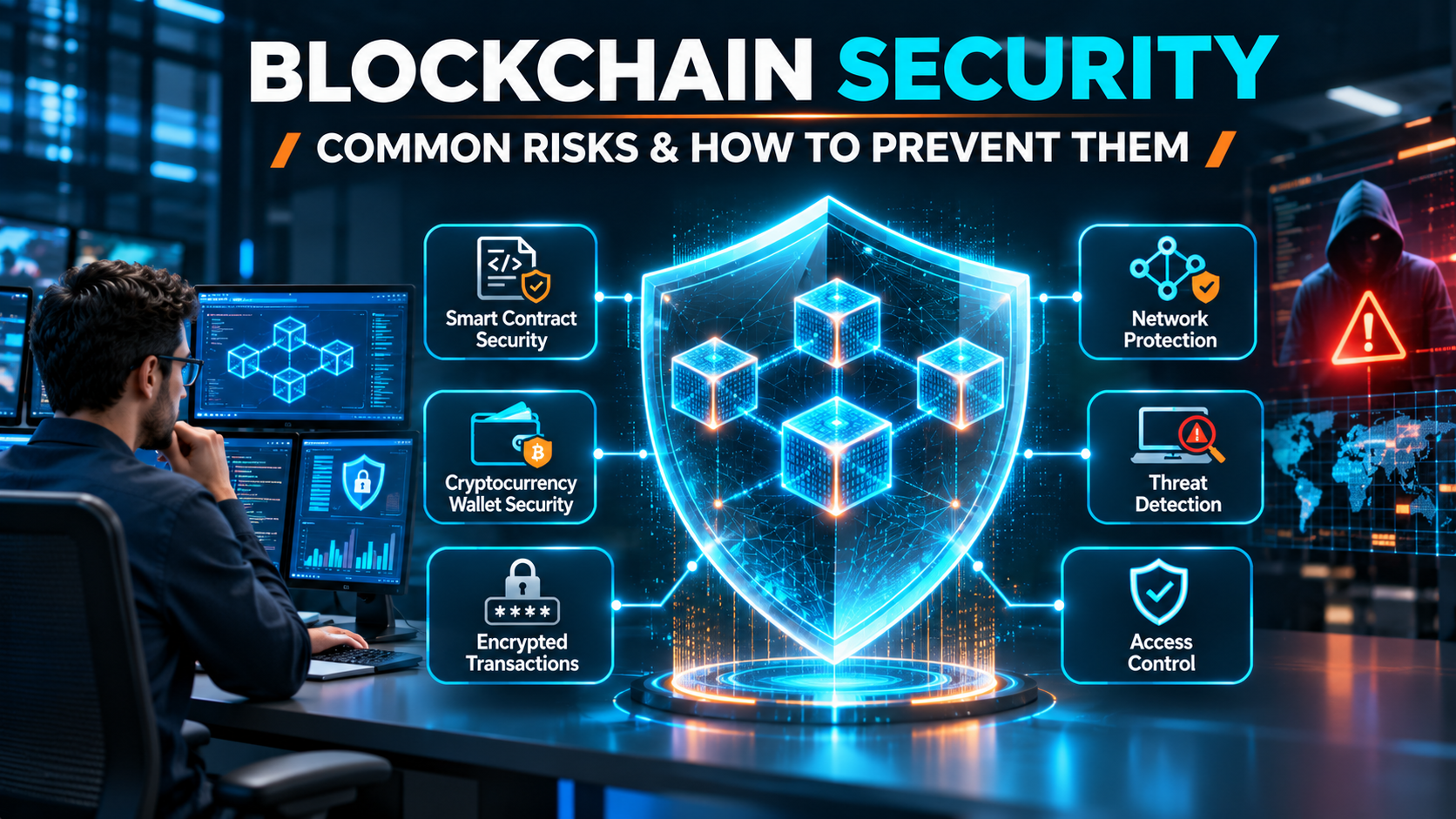
Blockchain technology is changing how people and businesses store information, transfer digital assets, and complete online transactions. It is used in cryptocurrencies, decentralized finance (DeFi), supply chain management, digital identity, and many other applications.
One of the main reasons businesses are interested in blockchain is its ability to maintain records across a distributed network. Instead of depending on one central database, blockchain networks use multiple computers, cryptographic techniques, and consensus mechanisms to validate and record transactions.
However, blockchain technology is not completely secure. Cybercriminals can target cryptocurrency wallets, smart contracts, blockchain applications, exchanges, and even the people using these systems.
For example, a blockchain network may have strong security, but a user can still lose cryptocurrency by sharing a private key with a fake website. Similarly, a smart contract may contain a coding error that allows an attacker to misuse its functionality.
This is why blockchain security is important for developers, businesses, investors, and everyday cryptocurrency users.
In this article, we will explore what blockchain security means, how it works, common security risks, and practical ways to protect blockchain systems and digital assets.
2. What Is Blockchain Security?
Blockchain security refers to the technologies, processes, and practices used to protect blockchain networks, transactions, smart contracts, applications, and digital assets from unauthorized access, fraud, manipulation, and cyberattacks.
It combines different security techniques to maintain the confidentiality, integrity, and availability of blockchain-based systems.
The main goal of blockchain security is to make sure that:
- Transactions are properly validated.
- Records cannot be changed without authorization or detection.
- Only authorized users can access protected resources.
- Digital assets are protected from theft.
- Smart contracts operate according to their intended rules.
- Blockchain applications remain reliable and available.
Blockchain security does not depend on a single technology. It involves cryptography, consensus mechanisms, access controls, secure software development, and continuous monitoring.
3. How Does Blockchain Security Work?
Blockchain networks use several security mechanisms to protect transaction data and maintain trust between participants.
3.1 Cryptography
Cryptography is one of the most important parts of blockchain security.
It uses mathematical techniques to protect information and verify transactions. Blockchain networks commonly use cryptographic hash functions and digital signatures.
A hash function converts input data into a fixed-length output called a hash. Even a small change in the original data produces a different hash.
For example, if someone tries to modify transaction information stored in a blockchain, the resulting hash will no longer match the expected value.
Digital signatures help verify that a transaction was authorized by the holder of the corresponding private key.
Together, these techniques help protect transaction integrity and verify ownership or authorization.
3.2 Decentralization
Traditional databases are often managed by a central organization or server. Blockchain networks can distribute transaction records across multiple participating computers called nodes.
This distributed structure reduces dependence on a single central point of control.
If one node becomes unavailable, other nodes may continue operating. However, decentralization does not automatically prevent every attack. Network design, node distribution, and consensus security still matter.
3.3 Consensus Mechanisms
Consensus mechanisms allow blockchain participants to agree on which transactions should be added to the blockchain.
Common consensus mechanisms include:
Proof of Work (PoW): Participants called miners compete to solve computational puzzles to add new blocks. Bitcoin is a well-known example.
Proof of Stake (PoS): Validators participate in transaction validation by committing cryptocurrency as a stake. Ethereum is a well-known example of a network using Proof of Stake.
Consensus mechanisms help prevent unauthorized transaction changes and maintain agreement across the network.
3.4 Immutable Transaction Records
Once transactions are confirmed and added to a blockchain, changing historical records is generally difficult.
Each block contains a reference to the previous block through its cryptographic hash. This creates a connected chain of records.
If someone modifies information in an earlier block, its hash changes, which affects the links to later blocks.
However, immutability should not be confused with absolute security. Certain network attacks, consensus failures, or implementation weaknesses can affect the reliability of blockchain records.
3.5 Public and Private Keys
Blockchain accounts commonly use cryptographic key pairs.
- Public Key: Used in cryptographic operations and, depending on the blockchain, helps derive or verify an account address.
- Private Key: A secret key used to authorize transactions or prove control over digital assets.
A private key must remain confidential. Anyone who gains control of the relevant private key may be able to control the associated digital assets.
Protecting private keys is therefore one of the most important parts of cryptocurrency security.
4. Common Blockchain Security Risks
Although blockchain networks use advanced security technologies, different types of attacks can still affect blockchain users and applications.
Understanding these risks is the first step toward preventing them.
4.1 51% Attack
A 51% attack occurs when an attacker gains control of more than half of the relevant mining power or consensus influence in certain blockchain networks.
This may allow the attacker to interfere with transaction ordering, reorganize recent blocks, or attempt double-spending.
For example, an attacker could attempt to spend cryptocurrency in one transaction and later reorganize the chain to reverse that transaction while keeping the original funds.
A successful attack does not automatically allow an attacker to steal every user’s cryptocurrency or create valid transactions belonging to other users.
How to Prevent It:
- Maintain a sufficiently decentralized network.
- Encourage broad participation among miners or validators.
- Monitor unusual changes in mining power or validator concentration.
- Wait for an appropriate number of confirmations before accepting high-value transactions.
- Use consensus mechanisms with suitable economic and security protections.
4.2 Smart Contract Vulnerabilities
Smart contracts are programs stored and executed on blockchain networks. They automatically perform actions when specified conditions are met.
However, errors in smart contract code can create security weaknesses.
Common vulnerabilities include:
- Reentrancy vulnerabilities.
- Incorrect access controls.
- Integer-related errors.
- Logic and validation mistakes.
- Unsafe external contract interactions.
For example, a vulnerable smart contract might allow an attacker to repeatedly trigger a withdrawal operation before the contract updates the user’s balance.
This type of issue can lead to significant financial losses.
How to Prevent It:
- Follow secure smart contract development practices.
- Conduct independent code audits.
- Use automated security testing tools.
- Add appropriate access controls.
- Test contracts with different input conditions.
- Use established libraries instead of unnecessary custom implementations.
- Consider formal verification for critical contract logic.
4.3 Phishing Attacks
Phishing is a common security threat in the cryptocurrency ecosystem.
Attackers create fake websites, emails, advertisements, or social media accounts that look similar to legitimate cryptocurrency platforms.
Their goal is to trick users into sharing private keys, wallet recovery phrases, login credentials, or approving malicious transactions.
For example, a fake wallet website may ask users to enter their recovery phrase to restore access. Once the attacker receives this information, they may gain control of the wallet.
How to Prevent It:
- Always verify website addresses before connecting a wallet.
- Never share private keys or recovery phrases.
- Avoid clicking suspicious links.
- Use official applications and verified websites.
- Enable additional account security where available.
- Carefully review wallet transaction requests before approving them.
4.4 Private Key Theft
Private keys provide authorization over blockchain assets. If an attacker obtains a private key, they may be able to transfer the associated assets without the owner’s permission.
Private keys can be exposed through malware, fake applications, insecure storage, compromised devices, or accidental sharing.
How to Prevent It:
- Store important private keys securely.
- Use reputable hardware wallets for suitable long-term storage.
- Never save private keys in public repositories or unprotected documents.
- Keep devices and wallet software updated.
- Use secure backups.
- Never share recovery phrases with anyone.
4.5 Sybil Attacks
A Sybil attack occurs when an attacker creates or controls multiple fake identities or nodes in a network.
The attacker attempts to gain influence by making it appear that many independent participants are supporting a particular action.
Depending on the network design, this can affect peer discovery, reputation systems, or other network operations.
How to Prevent It:
- Use strong identity or participation mechanisms where appropriate.
- Design consensus systems that make dishonest participation expensive or difficult.
- Monitor unusual node behavior.
- Apply reputation and validation mechanisms where suitable.
- Avoid depending only on the number of participating nodes as a measure of trust.
4.6 Double-Spending Attacks
Double-spending occurs when someone attempts to spend the same digital asset more than once.
Blockchain consensus mechanisms are designed to prevent this problem by validating transaction history and ensuring that conflicting transactions cannot both become valid in the accepted chain.
However, certain attacks can exploit weak confirmation policies, network delays, or insufficient consensus security.
How to Prevent It:
- Wait for sufficient transaction confirmations.
- Use reliable blockchain infrastructure.
- Apply risk-based confirmation requirements.
- Monitor suspicious transaction patterns.
- Avoid accepting high-value transactions based only on unconfirmed activity.
4.7 Exchange and Wallet Security Breaches
Cryptocurrency exchanges and wallet providers are attractive targets because they manage valuable digital assets and user information.
A security breach may result in unauthorized account access, stolen cryptocurrency, or exposed customer data.
It is important to understand that blockchain network security and exchange security are different things. A blockchain may operate correctly while a centralized exchange suffers a security breach.
How to Prevent It:
- Choose platforms with strong security practices.
- Enable multi-factor authentication.
- Use withdrawal allowlists where supported.
- Avoid keeping unnecessary funds on exchanges.
- Monitor account activity.
- Prefer secure custody arrangements for significant holdings.
4.8 Routing and Network-Level Attacks
Blockchain networks depend on communication between participating nodes.
Attackers may attempt to disrupt network communication through denial-of-service attacks, routing manipulation, or other infrastructure-level attacks.
Such attacks can affect transaction propagation, node availability, and network reliability.
How to Prevent It:
- Use reliable network infrastructure.
- Apply denial-of-service protection.
- Monitor node connectivity and performance.
- Maintain redundant infrastructure where appropriate.
- Keep node software updated.
- Follow secure network configuration practices.
4.9 Rug Pulls and Malicious Projects
A rug pull is a type of cryptocurrency or decentralized finance scam in which project operators withdraw liquidity, abandon the project, or misuse funds after attracting investors.
Some projects may also contain hidden smart contract functions that allow developers to restrict selling or misuse user funds.
How to Prevent It:
- Research the project team and its history.
- Review smart contract audit reports.
- Understand token distribution and liquidity arrangements.
- Be cautious of unrealistic profit promises.
- Check whether important contract permissions are controlled transparently.
- Never invest based only on social media promotions.
5. Best Practices for Improving Blockchain Security
Preventing blockchain attacks requires a combination of technical controls, responsible development, and user awareness.
The following practices can help organizations and individuals improve their security.
5.1 Use Secure Wallets
Choose reputable cryptocurrency wallets with appropriate security features.
Hardware wallets can help protect private keys by keeping them away from internet-connected devices during normal use.
Always purchase hardware wallets from trusted sources and follow the manufacturer’s security instructions.
5.2 Protect Private Keys and Recovery Phrases
Private keys and wallet recovery phrases should never be shared.
Store backups securely and avoid saving sensitive wallet information in unprotected cloud storage, emails, or public repositories.
For business environments, use secure key management systems and establish clear access policies.
5.3 Conduct Smart Contract Audits
Smart contract audits help identify weaknesses before contracts are deployed or used with significant funds.
Developers should combine manual code reviews, automated testing, security audits, and ongoing monitoring.
An audit can reduce risk, but it does not guarantee that a smart contract is completely secure.
5.4 Enable Multi-Factor Authentication
Multi-factor authentication (MFA) adds another layer of protection to cryptocurrency exchanges, administrative accounts, and blockchain-related services.
Where supported, authenticator applications or hardware security keys are generally preferable to relying only on SMS-based verification.
5.5 Keep Software Updated
Outdated wallet applications, blockchain nodes, operating systems, and smart contract dependencies may contain known vulnerabilities.
Regularly install security updates and monitor official announcements from software providers.
5.6 Use Secure Development Practices
Blockchain developers should follow secure coding standards throughout the development process.
Important practices include:
- Input validation.
- Access control checks.
- Secure API integration.
- Dependency management.
- Automated security testing.
- Error handling.
- Logging and monitoring.
- Regular code reviews.
Security should be included from the beginning of development rather than added only after deployment.
5.7 Monitor Blockchain Transactions
Continuous monitoring can help detect unusual activity, suspicious transactions, and unexpected contract behavior.
Organizations can use blockchain analytics tools, security monitoring systems, and automated alerts to investigate potential threats.
5.8 Follow Risk-Based Access Control
Not every employee or application needs access to every blockchain resource.
Businesses should follow the principle of least privilege, giving each user or service only the permissions necessary to perform its responsibilities.
For important operations, use multiple approvals and clearly documented authorization procedures.
6. Blockchain Security Tools and Technologies
Several tools and technologies can help developers and organizations identify vulnerabilities and improve blockchain security.
6.1 Smart Contract Security Analysis Tools
These tools analyze smart contract code to identify possible vulnerabilities.
Examples include:
- Slither: A static analysis framework for Solidity smart contracts.
- Mythril: A security analysis tool for Ethereum Virtual Machine (EVM) bytecode.
- Echidna: A property-based smart contract fuzzing tool.
These tools can help developers detect potential security problems during development.
6.2 Blockchain Monitoring Tools
Blockchain monitoring and analytics platforms help users examine transaction activity, investigate suspicious addresses, and understand on-chain behavior.
They can be useful for security teams, compliance departments, and blockchain investigators.
6.3 Hardware Wallets
Hardware wallets are physical devices designed to protect private keys and authorize transactions securely.
They can reduce exposure to malware on everyday computers, provided users follow proper device and recovery-phrase security practices.
6.4 Multi-Signature Wallets
Multi-signature wallets require more than one authorized signature before certain transactions can be completed.
For example, a business wallet could require approval from two out of three authorized administrators before transferring company funds.
This reduces dependence on a single private key or individual.
6.5 Zero-Knowledge Proofs
Zero-knowledge proofs are cryptographic techniques that allow one party to prove that a statement is true without revealing all the underlying information.
They can support privacy-focused blockchain applications while still allowing verification.
However, their implementation must be designed and tested carefully to avoid introducing additional security weaknesses.
7. Blockchain Security in Business Applications
Blockchain is being explored across different industries. Each application has its own security requirements.
7.1 Banking and Financial Services
Financial organizations can use blockchain for digital asset management, transaction settlement, and other financial applications.
Security is especially important because these systems may process valuable transactions and sensitive financial information.
Organizations need strong identity verification, access controls, transaction monitoring, and secure custody systems.
7.2 Supply Chain Management
Blockchain can help organizations maintain shared records of product movement, ownership, and transaction history.
For example, a manufacturing company may use blockchain to record when raw materials are received, inspected, processed, and delivered.
Security controls help protect these records from unauthorized modification.
However, blockchain cannot independently guarantee that information entered into the system is physically accurate. Businesses still need reliable inspection and verification processes.
7.3 Healthcare
Blockchain applications can support certain healthcare record-sharing and verification processes.
Security requirements include patient privacy, authorization, data protection, and compliance with applicable healthcare regulations.
Sensitive medical information should not be placed directly on a public blockchain without careful consideration of privacy, legal, and technical requirements.
7.4 Digital Identity
Blockchain-based digital identity systems can help users manage and verify certain identity-related information.
Security is essential to prevent identity theft, unauthorized access, and misuse of personal information.
Strong authentication and privacy-preserving verification methods are important for these applications.
8. Blockchain Security vs Traditional Database Security
Blockchain and traditional databases use different approaches to store, manage, and protect information.
| Feature | Blockchain Security | Traditional Database Security |
|---|---|---|
| Data storage | Distributed across network participants, depending on the blockchain | Usually managed by a centralized database system |
| Data integrity | Cryptographic hashes and consensus mechanisms | Access controls, transaction logs, constraints, and integrity checks |
| Access control | Can be public, permissioned, or restricted depending on the network | Managed through database permissions and application controls |
| Transaction validation | Uses blockchain-specific consensus and validation rules | Managed by database transaction mechanisms and application logic |
| Data modification | Historical records are generally difficult to alter | Authorized users may update or delete records |
| Performance | Depends on network architecture and consensus design | Often optimized for high-speed data operations |
| Main security concerns | Consensus attacks, smart contract vulnerabilities, key theft | Unauthorized access, SQL injection, misconfiguration, and data breaches |
Which is more secure?
Neither technology is automatically more secure in every situation.
Blockchain can be useful when multiple parties need a shared record without relying entirely on one central administrator. Traditional databases may be more suitable when an organization needs high-performance data management and centralized control.
The right choice depends on the application, security requirements, data sensitivity, and business objectives.
9. Future of Blockchain Security
As blockchain adoption grows, security requirements will continue to evolve.
Several developments are likely to influence blockchain security in the coming years.
9.1 AI-Powered Threat Detection
Artificial intelligence can help security teams analyze transaction patterns, detect unusual activity, and identify potential threats.
AI-powered monitoring systems may help organizations investigate suspicious behavior faster.
However, AI-generated alerts need validation because automated systems can produce false positives and miss certain attacks.
9.2 Post-Quantum Cryptography
Quantum computing may eventually affect some cryptographic systems currently used across digital infrastructure.
Post-quantum cryptography focuses on developing cryptographic algorithms designed to resist attacks from sufficiently powerful quantum computers.
Blockchain developers and infrastructure providers are researching how cryptographic systems may need to evolve over time.
9.3 More Secure Smart Contracts
Smart contract security is becoming an important part of blockchain development.
Future development practices are likely to place greater emphasis on formal verification, automated testing, secure libraries, and continuous security monitoring.
9.4 Improved Blockchain Interoperability Security
As different blockchain networks connect and exchange assets or information, cross-chain security becomes increasingly important.
Bridges and interoperability protocols can introduce additional risks if their validation mechanisms, smart contracts, or infrastructure are compromised.
9.5 Stronger Regulatory and Compliance Requirements
Businesses using blockchain for financial and commercial applications need to consider applicable laws, data protection requirements, and security standards.
Clearer governance and compliance processes can help organizations manage risks as blockchain adoption increases.
