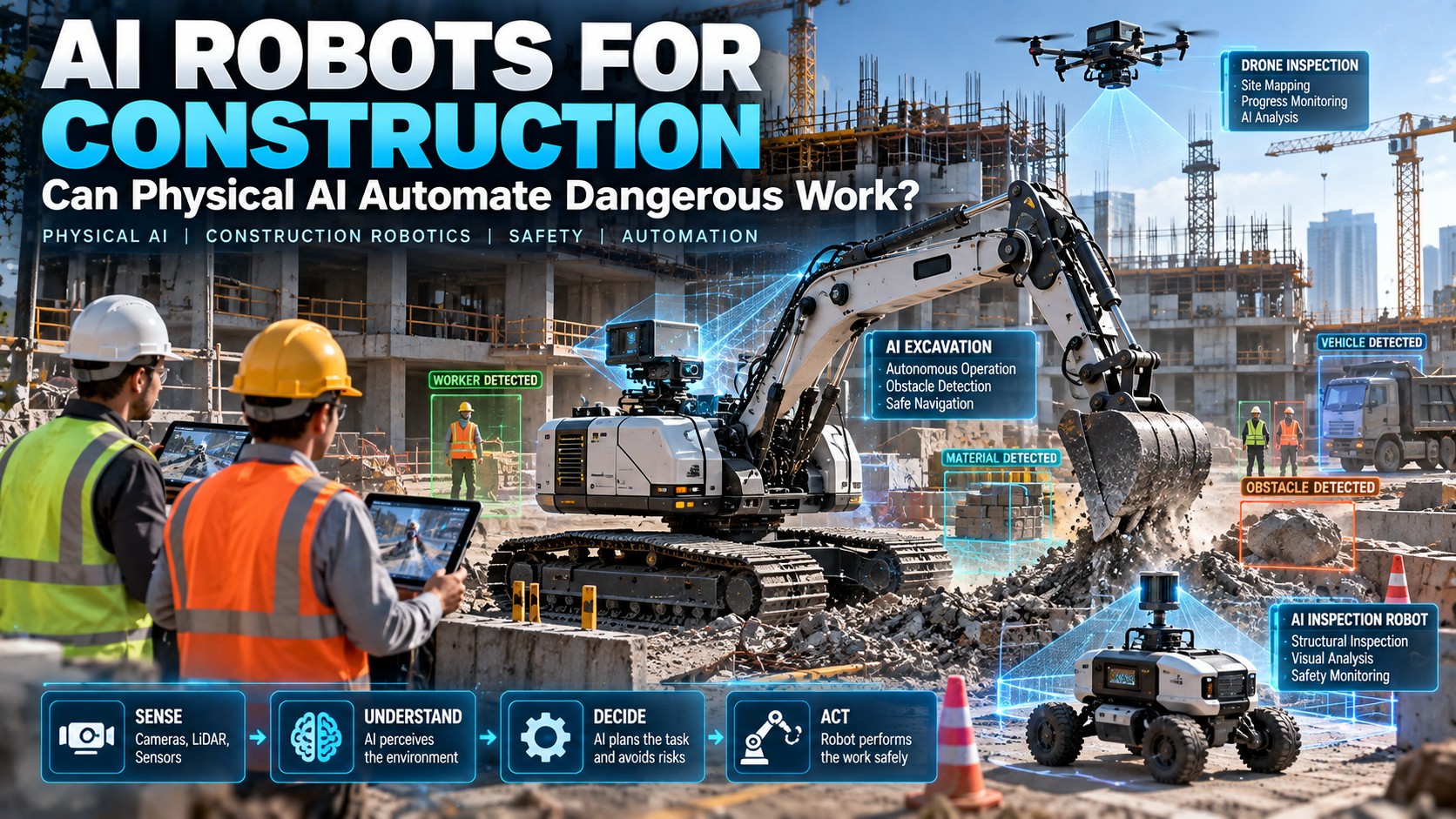
Construction is one of the most physically demanding industries in the world. Workers often deal with heavy materials, large machines, dust, noise, heights and changing work environments. Some construction tasks are also dangerous and repetitive.
Now, Artificial Intelligence (AI), robotics and sensors are coming together to create a new technology called Physical AI. Unlike traditional AI that mainly works with digital information, Physical AI allows machines to understand and interact with the physical world.
This raises an important question: Can AI robots automate some of the dangerous work on construction sites?
The answer is becoming increasingly interesting. Robots are already being developed and tested for tasks such as excavation, inspection, drilling, demolition, material handling and other construction activities. However, fully autonomous construction is still challenging because real construction sites are unpredictable and constantly changing.
What Is Physical AI?
Physical AI is AI that works with the physical world.
Traditional AI can understand text, images, videos and data. Physical AI goes one step further by connecting AI models with robots, cameras, sensors, machines and other physical systems.
A Physical AI robot can collect information about its surroundings, understand what is happening and decide what action to take.
For example, a construction robot could use cameras and other sensors to detect a wall, recognize a pile of materials, identify an obstacle and decide how to move around it.
The basic process can be explained simply:
Sense → Understand → Decide → Act
This ability is what makes Physical AI particularly interesting for construction.
Why Does Construction Need AI Robots?
Construction sites contain many tasks that require physical effort.
Workers may need to lift heavy materials, perform repetitive movements, operate large equipment or work in areas where mistakes can result in serious injuries.
Robots could potentially take over some of these repetitive or dangerous tasks.
For example, robots can be used or researched for activities such as:
- Excavation
- Drilling
- Demolition
- Material handling
- Inspection
- Bricklaying
- Site mapping
- Construction layout
- Heavy equipment operation
Construction robotics research specifically focuses on areas such as earthmoving, drilling, masonry, installation, navigation and safe interaction between robots and workers.
The goal is not simply to replace workers. One important goal is to reduce human exposure to dangerous work.
How Can AI Robots Perform Dangerous Work?
AI robots can be useful when a construction task is too dangerous, repetitive or physically demanding for a person.
Imagine a demolition project involving an unstable structure.
Instead of sending a worker directly into a dangerous area, a robot could potentially perform part of the demolition while the worker operates or supervises the system from a safer location.
Similarly, autonomous or semi-autonomous construction machines can potentially assist with excavation and other heavy-equipment tasks.
Research in 2026 has also demonstrated Physical AI approaches for small-scale robotic excavation, showing how robots can learn physical construction tasks from demonstrations.
AI Robots for Excavation
Excavation is an important area for construction automation.
Traditional excavation requires skilled operators to control heavy machines such as excavators and bulldozers.
With AI and sensors, machines can potentially understand their environment and perform certain excavation operations with less direct human control.
An AI-powered excavator could use sensors to understand:
- Where the machine is located
- Where excavation should happen
- Where obstacles are located
- How the terrain is changing
- Where materials need to be moved
This could make excavation more automated while allowing human workers to focus on supervision and higher-level decisions.
AI Robots for Demolition
Demolition is another area where robots can provide safety benefits.
Buildings and structures can sometimes become unstable during demolition. Working close to such structures can expose workers to falling materials, dust and other hazards.
Demolition robots can perform certain tasks while keeping operators farther away from the immediate danger zone.
Research on construction robotics includes demolition robots as one of the important applications of automation in the industry.
However, robots still need to operate within carefully defined safety limits.
AI Robots for Construction Inspection
Robots can also help inspect buildings and construction sites.
A robot equipped with cameras and sensors can move through areas and collect information.
AI can then analyze this information to identify possible problems or differences from the expected construction plan.
For example, robots could help with:
- Progress monitoring
- Visual inspection
- Site mapping
- Detecting construction changes
- Identifying potential hazards
- Comparing actual construction with digital plans
This can reduce the amount of manual inspection required and create more useful digital records of a project.
How Do Physical AI Robots Understand a Construction Site?
One of the biggest differences between a traditional machine and a Physical AI robot is its ability to understand its surroundings.
A robot can use several types of sensors, including:
- Cameras
- Depth cameras
- LiDAR
- GPS
- Motion sensors
- Proximity sensors
- Force sensors
These sensors provide information about the environment.
AI models can process this information and create an understanding of the robot’s surroundings.
For example, the robot may determine:
“There is a worker in front of me.”
“The planned path is blocked.”
“The ground ahead is uneven.”
“I need to slow down before moving.”
This combination of perception, planning and physical movement is one of the main research challenges in construction robotics.
Can AI Robots Work Alongside Construction Workers?
Yes, human-robot collaboration is an important part of the future of construction robotics.
Construction sites are not empty environments. Robots may have to work around workers, engineers, supervisors, vehicles and other machines.
Therefore, a robot must understand where people are and adjust its behavior accordingly.
For example, a robot may need to:
- Stop when a person enters a dangerous area
- Slow down when approaching a worker
- Change its route when an obstacle appears
- Maintain a safe distance
- Allow a human operator to take control
Safety systems can include monitored stops, speed and separation monitoring, force limiting and human control mechanisms. However, these systems are more difficult to implement on construction sites than in controlled factory environments.
Why Are Construction Sites Difficult for Robots?
A factory usually has a controlled environment.
Construction sites are completely different.
The environment can change every day.
A robot may encounter:
- Uneven ground
- Dust
- Rain
- Changing structures
- Moving vehicles
- Construction materials
- Temporary obstacles
- Workers moving in different directions
- Poor lighting
This makes construction one of the more difficult environments for autonomous robots.
IEEE’s construction robotics research community identifies changing and unstructured environments as a major challenge for robot perception, navigation, planning and safe human-robot interaction.
What Are the Benefits of AI Robots in Construction?
AI robots could provide several potential benefits to the construction industry.
Better Worker Safety
Robots can potentially perform some dangerous tasks instead of humans, reducing human exposure to hazardous environments.
Less Physical Strain
Heavy lifting and repetitive physical work can place significant strain on workers. Robots can potentially handle some of these activities.
Higher Productivity
Machines can perform repetitive operations consistently and can potentially work for longer periods than humans.
Better Accuracy
Robotic systems can perform certain repetitive tasks with consistent positioning and movement.
Better Site Data
Robots equipped with cameras and sensors can continuously collect information about construction progress and site conditions.
Automation of Repetitive Tasks
Tasks that follow predictable patterns are often good candidates for automation.
Research on AI-driven construction machinery reports potential productivity and safety benefits, while also emphasizing that results depend heavily on the operating environment and the maturity of the technology.
What Are the Challenges of AI Construction Robots?
AI robots are not a perfect solution.
Several challenges still need to be solved before robots can safely perform a wide range of construction tasks.
Unpredictable Environments
Construction sites constantly change, making it difficult for robots to understand every possible situation.
Safety
A robot mistake can become a physical safety problem.
The robot must correctly understand people, objects and its surroundings before taking action.
High Cost
Advanced robots require expensive sensors, computing systems, software and maintenance.
Reliability
Construction companies need machines that can work reliably in real-world conditions, not just during controlled demonstrations.
Integration
Robots must work with existing construction equipment, software, workflows and human workers.
Training
Workers may need new skills to operate, supervise and maintain robotic systems.
Cybersecurity
Connected robots can also introduce cybersecurity risks. If an attacker manipulates a robot’s perception or control system, the consequences can become physical rather than purely digital. Recent discussions of Physical AI safety highlight this emerging connection between cybersecurity and physical safety.
Is Physical AI Ready for Construction?
Physical AI is making progress, but it is important not to confuse demonstrations with complete automation.
Current research and industry development are moving toward robots that can perform specific construction tasks. However, construction robotics is still limited by issues such as perception, reliability, safety, workflow integration and validation.
This means the near-term future is more likely to involve task-specific robots than one robot that can independently build an entire building.
Can AI Agents Control Construction Robots?
A particularly interesting future development is the combination of AI agents and Physical AI.
An AI agent could receive a high-level instruction such as:
“Inspect this section of the building.”
The system could then:
- Understand the request
- Plan the task
- Send instructions to a robot
- Navigate to the required location
- Collect images and sensor data
- Analyze the results
- Create a report
- Ask a human for approval when necessary
This could create a new type of construction workflow where AI handles planning and coordination while robots perform physical tasks.
Will AI Robots Replace Construction Workers?
It is too early to say that robots will replace construction workers.
A more realistic possibility is human-robot collaboration.
Humans can handle:
- Planning
- Judgment
- Complex decisions
- Unexpected situations
- Supervision
- Communication
Robots can handle:
- Repetitive tasks
- Heavy physical work
- Data collection
- Certain dangerous activities
- Precise repeated movements
The future could therefore look less like “robots versus workers” and more like:
Human + AI + Robot
This approach can allow people to remain responsible for important decisions while robots handle selected physical tasks.
What Will the Future of Construction Robotics Look Like?
Future construction sites could contain many different types of intelligent machines.
For example:
AI Excavators could assist with earthmoving.
Inspection Robots could scan buildings and identify potential problems.
Demolition Robots could work in dangerous areas.
Material Robots could move supplies around a site.
Layout Robots could transfer digital construction plans into physical locations.
AI Agents could coordinate different machines and workflows.
Instead of one robot doing everything, construction could eventually use a network of specialized robots working together.
Research into robotized construction is already exploring how BIM data, robot execution systems and multi-robot coordination can be connected into a broader digital workflow.
Conclusion: Can Physical AI Automate Dangerous Construction Work?
Physical AI could make construction robots much more capable than traditional automated machines.
By combining AI, cameras, sensors, robotics and autonomous decision-making, machines can potentially understand their surroundings and perform selected construction tasks.
The biggest opportunity may be dangerous and repetitive work such as excavation, demolition, inspection, material handling and other physically demanding activities.
But construction is not a controlled factory. Every site is different, and safety, reliability, cost and human-robot collaboration remain major challenges.
So the future of construction may not be about completely replacing people with robots.
Instead, it could be about using AI robots to perform the dangerous work while humans remain in control of the decisions that matter most.
