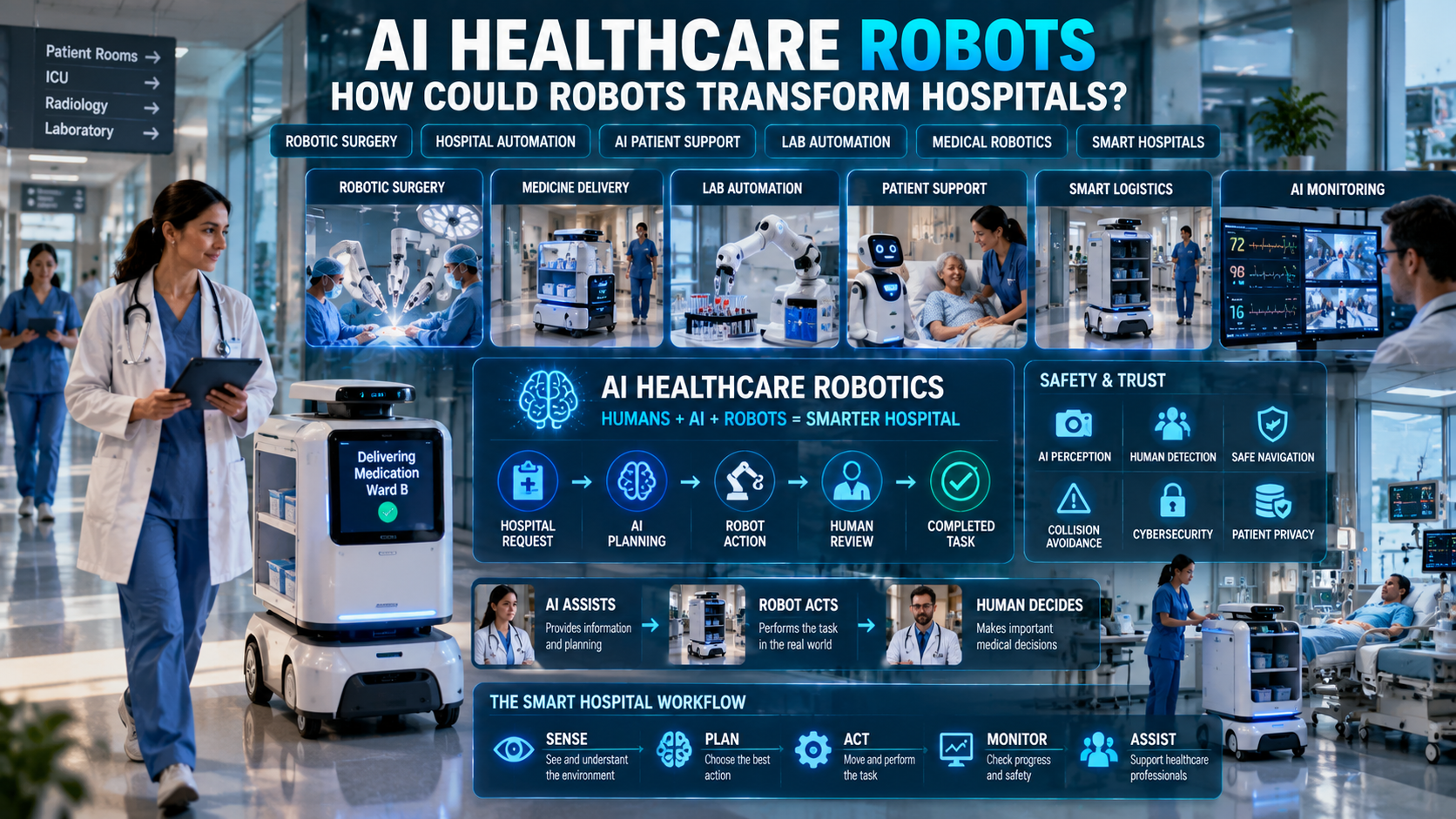
Robots are becoming an important part of modern healthcare. Hospitals are already exploring robots for tasks such as delivering medicines, moving medical equipment, processing laboratory samples, assisting surgeons and supporting patient care.
Artificial intelligence is making these robots more useful. Instead of following only fixed instructions, AI-powered robots can use cameras, sensors and software to understand their surroundings and respond to different situations.
But this does not necessarily mean robots will replace doctors and nurses. The bigger opportunity is human and robot collaboration, where robots handle repetitive or physically demanding work while healthcare professionals focus on patients and important medical decisions.
What Are AI Healthcare Robots?
AI healthcare robots are machines that combine robotics, artificial intelligence, sensors, cameras and software to perform tasks in hospitals and other healthcare environments.
Some robots can move independently through hospital corridors, while others are designed specifically for surgery, rehabilitation, laboratory work or patient assistance.
For example, a hospital robot could receive a request to deliver medical supplies to another department, find a safe route, avoid people and obstacles, and report when the delivery is complete.
This makes AI healthcare robots different from simple automated machines because they can use information from their surroundings to make decisions.
Why Are Hospitals Using Robots?
Hospitals have many repetitive tasks that require time and physical effort.
Healthcare workers may spend part of their day transporting medicines, collecting equipment, moving samples or completing other routine activities. Robots can potentially automate some of this work.
For example:
Hospital Request → Robot Receives Task → Robot Navigates → Item Delivered → Task Completed
This could give doctors, nurses and other healthcare workers more time to focus on patient care.
How Can Robots Help Nurses?
Nurses spend a large amount of time caring for patients, but they also have to complete many physical and repetitive tasks.
Healthcare robots could help with activities such as:
- Delivering medicines
- Moving medical equipment
- Transporting supplies
- Carrying linens
- Moving laboratory samples
- Transporting waste
- Supporting routine monitoring
The goal is not to replace nurses. Instead, robots can handle suitable repetitive tasks while nurses focus on patients.
This is one of the most practical uses of hospital robotics.
What Are Autonomous Hospital Robots?
Autonomous hospital robots are machines that can move around a hospital with limited direct human control.
They can use technologies such as:
Cameras + LiDAR + Sensors + Maps + AI Navigation
to understand where they are and identify obstacles.
For example, a delivery robot may need to travel through a busy corridor. It has to recognize people, wheelchairs, beds and other objects and adjust its route.
AI-powered navigation can help the robot decide how to move safely from one location to another.
How Does AI Make Hospital Robots Smarter?
Traditional robots usually follow predefined instructions.
AI can make robots more adaptable.
An AI-powered robot can use sensor information to understand its surroundings, identify objects, recognize changes and choose an appropriate action.
A simple AI robotics process looks like:
SENSE → UNDERSTAND → PLAN → ACT → CHECK
This is closely related to Physical AI, where artificial intelligence is connected to machines that can interact with the physical world.
How Are Robots Used in Surgery?
Robotic surgery is one of the most well-known applications of robotics in healthcare.
However, robotic surgery does not usually mean that a robot independently performs an operation.
In many current systems, a trained surgeon controls robotic instruments through a computer-assisted system.
The basic process is:
SURGEON → ROBOTIC SYSTEM → SURGICAL INSTRUMENTS
Robotic systems can help surgeons perform minimally invasive procedures and control instruments with high precision.
The robot acts as an advanced surgical tool, while the surgeon remains responsible for the procedure.
Could AI Make Surgical Robots More Intelligent?
AI could potentially make surgical systems more useful by helping surgeons understand information during an operation.
Possible applications include:
- Identifying anatomy
- Surgical navigation
- Detecting potential risks
- Supporting surgical planning
- Monitoring procedures
- Assessing surgical performance
- Providing decision support
However, fully autonomous surgery is still a much more difficult challenge.
A more realistic near-term approach is:
AI Assists → Surgeon Reviews → Surgeon Decides → Robot Executes
This keeps humans involved in important medical decisions.
Can Robots Help Hospital Laboratories?
Laboratories contain many repetitive processes that can potentially be automated.
Robots can help with tasks such as:
Sample Handling → Testing → Sorting → Analysis → Result Processing
For example, laboratory automation can help move samples between different stages of testing.
This can improve consistency and reduce the amount of repetitive manual work.
Laboratory professionals can then spend more time on complex testing, interpretation and quality control.
Can Robots Deliver Medicines Inside Hospitals?
Yes, medicine and supply delivery is one of the practical applications of hospital robotics.
Imagine that a pharmacy needs to send medication to a particular hospital department.
Instead of a staff member physically transporting it, an autonomous mobile robot could potentially receive the task and travel to the destination.
The workflow could be:
Pharmacy → Robot → Hospital Corridor → Ward → Delivery
The robot can use sensors and navigation technology to avoid obstacles and move through the hospital.
Can Robots Monitor Patients?
Researchers are also exploring robots that can support routine patient monitoring.
Depending on the robot’s design, it could help collect information, communicate with patients or connect patients with healthcare professionals.
The important point is that the robot does not necessarily need to make the medical decision itself.
A safer workflow can be:
Robot Collects Information → AI Processes Information → Healthcare Professional Reviews It
This approach keeps medical professionals involved when decisions are important.
Could Robots Help Older Patients?
Robotics could also become useful in elderly care and rehabilitation.
Assistive robots may eventually help with:
- Mobility support
- Medication reminders
- Communication
- Fetching objects
- Exercise assistance
- Routine monitoring
- Emergency alerts
However, healthcare is not only about physical tasks.
Older patients may also need emotional support, communication and human companionship.
Robots can assist with certain activities, but human caregivers remain extremely important.
Can AI Robots Reduce Hospital Workloads?
AI robots could reduce workloads by taking care of repetitive and physically demanding tasks.
For example:
Robot: Delivers medical supplies.
Nurse: Uses the supplies to care for the patient.
Robot: Moves laboratory samples.
Technician: Performs and reviews the test.
Robot: Assists with precise surgical movements.
Surgeon: Controls the procedure and makes medical decisions.
This is known as human-robot collaboration.
The idea is not humans versus robots. It is humans working with robots.
Can Healthcare Robots Work Safely Around Patients?
Safety is one of the biggest challenges for healthcare robotics.
Hospitals are busy environments where people, equipment and machines are constantly moving.
A healthcare robot may encounter:
- Patients
- Doctors
- Nurses
- Visitors
- Wheelchairs
- Hospital beds
- Medical equipment
- Other robots
Therefore, robots need technologies such as:
Human Detection
Obstacle Detection
Collision Avoidance
Safe Navigation
Speed Control
Emergency Stop
Reliable Sensors
A robot working around patients must be designed with safety as a major priority.
What About Patient Privacy?
Healthcare robots may interact with sensitive information.
Depending on their purpose, they could use cameras, microphones, medical information or hospital systems.
This creates important privacy questions:
- What information does the robot collect?
- Where is the information stored?
- Who can access it?
- Is the information encrypted?
- How long is it retained?
- Can the information be deleted?
Healthcare robotics therefore needs strong data protection and privacy controls.
Can Healthcare Robots Be Hacked?
Cybersecurity is another important concern.
Connected healthcare robots may communicate with hospital networks, software systems and cloud platforms.
A simplified system could look like:
Robot → Hospital Network → Software → AI System → Hospital Data
If one part of this system is poorly protected, it could create security risks.
Hospitals need strong authentication, encrypted communication, software updates, access controls and security monitoring to protect connected robotic systems.
For healthcare robots, cybersecurity is closely connected to patient safety.
Will AI Robots Replace Doctors and Nurses?
It is unlikely that robots will simply replace doctors and nurses across healthcare.
Medical work requires:
- Human judgment
- Communication
- Empathy
- Complex decision-making
- Ethical reasoning
- Responsibility
- Patient relationships
Robots are better suited to tasks that are repetitive, physically demanding, highly structured or require precise movements.
A more realistic future is:
Doctors + Nurses + AI + Robots
working together.
What Are the Biggest Challenges?
Healthcare robotics still faces several challenges.
High Cost
Advanced robots can be expensive to purchase, install and maintain.
Safety
Robots must operate safely around patients and medical staff.
Cybersecurity
Connected robots need strong protection against unauthorized access.
Privacy
Medical and patient data must be handled carefully.
Training
Hospital staff need to understand how to operate and work with robotic systems.
Integration
Robots need to work with existing hospital software and equipment.
Reliability
A hospital robot must work consistently because failures can affect important operations.
Regulation
Medical robots and AI systems may need to meet strict regulatory requirements before being widely deployed.
What Could the Hospital of the Future Look Like?
The future hospital may use many different types of robots instead of one robot trying to do everything.
For example:
Logistics Robots → Move supplies
Laboratory Robots → Process samples
Surgical Robots → Assist surgeons
Patient-Care Robots → Support routine tasks
Rehabilitation Robots → Assist physical therapy
Cleaning Robots → Automate selected cleaning tasks
These systems could work alongside AI software, IoT sensors, medical devices and hospital information systems.
The result could be a more connected and automated healthcare environment.
What Role Will Physical AI Play in Healthcare Robotics?
Physical AI could become particularly important because healthcare robots operate in the real world.
A chatbot can provide information through a screen, but a hospital robot needs to understand physical surroundings.
It needs to know:
Where am I?
What is around me?
Is a person nearby?
What should I do next?
Is it safe to move?
Did I complete the task correctly?
Physical AI combines perception, reasoning and physical action to help robots interact with real-world environments.
Could Robots Make Hospitals More Efficient?
Potentially, yes.
Robots could reduce time spent on repetitive transportation, improve automation in laboratories and support precision-based medical procedures.
But efficiency should not be the only goal.
A successful healthcare robot should also be:
Safe + Reliable + Secure + Useful + Affordable + Easy to Manage
Technology is valuable only when it actually improves healthcare operations or patient care.
What Will AI Healthcare Robots Look Like in the Future?
The future may not look like a hospital filled with humanoid robots.
Instead, hospitals may use many specialized robots, each designed for a particular purpose.
One robot might deliver medicines.
Another could transport samples.
Another could assist a surgeon.
Another could support rehabilitation.
Another could help with hospital logistics.
This specialized approach could be more practical than creating one robot that tries to perform every hospital task.
AI Healthcare Robots: How Could Robots Transform Hospitals?
AI healthcare robots could transform hospitals by taking over suitable repetitive tasks, assisting medical professionals and improving automation.
Their biggest contribution may not be replacing humans. It may be giving healthcare workers more time to focus on the parts of their jobs that require human expertise.
From autonomous delivery robots to surgical assistance and laboratory automation, robotics could gradually become part of everyday hospital operations.
Conclusion: Are Robots the Future of Hospitals?
AI healthcare robots are changing how we think about hospital automation.
Robots can potentially transport supplies, assist surgeons, automate laboratory processes, support patients and reduce repetitive workloads.
But healthcare is a high-stakes environment. Robots need to be safe, reliable, secure and properly supervised.
The future is therefore more likely to be about humans and robots working together rather than robots replacing healthcare professionals.
The hospital of the future may combine:
AI + Robotics + IoT + Medical Devices + Human Expertise
The real question is not whether robots will replace doctors and nurses.
